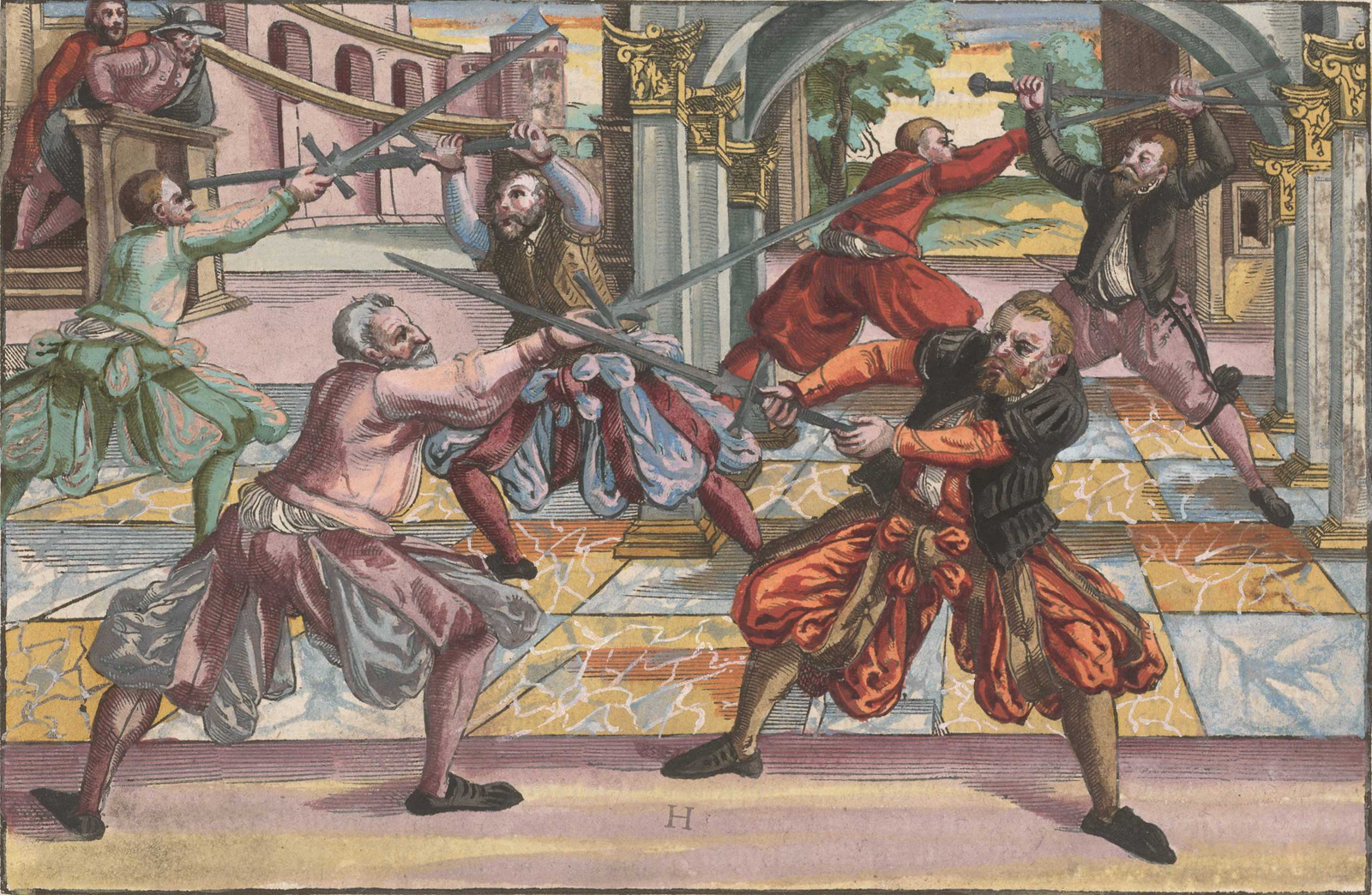
[1] The third part of the Sword [Section], in which the following didactic poem is explained with many nice and swift techniques, with which a fencer who loves the art can usefully read and train themselves in the same.
1570 Edition · fol. Ⅰ.44v.1
[Ⅰ.44v.1] Das dritte theil vom Schwerdt, in welchem der folgende Zedel mit vil schönen und geschwinden stucken erklert wirt, welchen dan ein kunst liebender Fechter mit nutz lesen und sich darinnen üben kan.
Take note: if you want to learn skillful fencing You should listen diligently to the Recitation. A fencer should hold themselves to high standards: Not be a braggart, gambler, or drunk; [They should] also not blaspheme nor swear, And not be ashamed to learn. [They should be] God-fearing, modest, and also calm, Especially on the day on which they will fence. [They should] be moderate, honor their elders And women. Listen further: You should strive at all times for All virtues, honor, and virile strength. So that you can serve [The] emperor, king, princes, and lords with honor, And also be useful to the fatherland And not be a disgrace to the noble art [of fencing]. Also take diligent note of the word Indes, also Weak and Strong, The Before and the After Learn feeling to check for soft and hard Step with the strike whether it is close or far. Keep the division [of the opponent] well in mind Also guard yourself against great wrath. Observe the guards and the cuts So that the counters are obvious to you. High, Wrath, Middle, and Low: From them execute all of your marvelous [techniques]: Squinter, Hairline, Crooked, and Crosswise And many more techniques according to your desire. Ensure that you are the first at the field. Before they [can] adopt a stance, attack them. Pay attention to Indes; understand me correctly: Hit them, before they position themselves in a stance. Whatever stance appears good to you. Hit them in the After with bold courage. Guide your cuts powerfully from your body; Direct your work at the four openings. If you cut a Crooked Cut, lift quickly. With crossed hands, throw the point on their hands. Let the circle touch on the right, Hold your hands high if you want to mislead them. When you cut a Crooked Cut at their strong, Take note: turn through, overrun with this. You should contemplate misleading with the pommel You will annoy them with Tagging contacts, flicks. Step well with the Crooked [cut] if you want to counteract, Crossing over will injure [the opponent]. [Cut a] Crooked Cut at the flat if you want to strengthen yourself. You should take diligent note of how to weaken them. As soon as it touches above and glances off, Pull up to the opening if you want to enrage them. Also, if you want to shoot through correctly, Cut Crooked, Short, [or] change through on their ricasso. Take note: if they want to confuse you with a Crooked Cut, Remain correctly on the sword and execute the War, With twists, slices, and whatever else. Do not let yourself fly too far astray. Also flick with the Weak at the right. Flick twice and guard yourself with the ricasso, And twist strongly around your opponent’s ricasso. Shove off Indesly and strike swiftly. You should carry out the Squinter Cut wisely. You can also double it by twisting. You should also consider the Crosswise Cut as worthy, Your skill with the sword becomes compete with it. The Crosswise Cut can counteract Everything that comes from the Day. Execute the Crosswise Cut strongly in the attack; Also take note of reversals and misses in addition to it. Be quick to the Plow and Ox, Threaten them fast with cuts at contrary ends. Take note of which type of Crosswise Cut is executed with a leap; You also miss with it; it touches according to your desire. You should doubly execute the Misser, Likewise double the step and slice. From the sword to the body, reverse Twice with it or slice into the weapon. Pursuit is exceptionally good; Protect yourself with slicing, twisting. In the case of a second [slice] or in the middle [of a technique] Let it fly away. Begin with this. Execute hits towards all four ends; Learn pulling if you want to play them false. Bring the slice off and catapult [to your fencing] as well. Rebuff hard and hostile [actions] with the slice. Do not rely too much on the Crown, Otherwise you will receive injury and insult from it. Strike powerfully through with Longpoint; This holds off all hard and hostile actions. See that you counter all cuts and techniques correctly If you want to avenge yourself for your part. You should use the hangings deliberately If you want to wrestle; do not grab at the wrong time. If you also want to know the core [knowledge] of the Masters, Learn to step correctly in all sequences. If you don’t counteract too often, you will be much freer; Joachim Meyer warns you against doing that.
MErck wiltu künstlich Fechten lehrn,
Solt du mit fleiß den Zedel hörn,
Ein Fechter sol sich halten fein,
Kein Rümer, spiler, sauffer sein,
Auch nit Gottslestern noch Schweren,
Unnd sich nit schemen zu lehren,
Gottsfürchtig, Züchtig, darzu still,
Sonderlich den tag er Fechten will,
Sey messig, erzeig den Alten ehr,
Unnd dem Weibs bild, auch weiter hör,
Aller tugendt ehr und manlichheit,
Der solt dich fleissen alle zeit,
Auff das du dienen könst mit ehren,
Keyser, König, Fürsten und Herren,
Auch nützlich seyest dem Vatterlandt,
Und nicht der Edlen kunst ein schandt,
Indes, das wort, auch Schwech und Sterck,
Das Vor und Nach auch fleissig merck,
Brieff Weich und Hert, das fühlen lern,
Trit mit streich, es sey nach oder fern, [Ⅰ.44v.3] Die theilung halt in guter hut,
Vor grossem zorn auch dich behut,
Der Huten und der Hauw nim war,
Das ihr Bruch dir sey offenbar,
Ober, Zorn, Mittel, auch Under,
Aus den treib all deine wunder,
Als Schieler, Scheidler, Krump, und Zwer,
Unnd was mehr stuck nach deim beger,
Schauw das der erst seyst auff dem Blan,
Ehe sich dein Mann legt, greiff ihn an,
Indes nim war, versteh mich recht,
Ihn triff, ehe er sein Leger schlecht,
Es kom dir für was Leger güt,
Im Nach ihn triffst aus freyem muth,
Dein Häuw führ gewaltig von deim leib,
Zu den vier Blöß dein arbeit threib,
So du Krumphauwst, fahr auff behend,
Geschrenckt den ort wirff auff sein hend,
Den Zürckel laß zur Rechten rühren,
Halt dein hend hoch, wilt ihn verführen, [Ⅰ.45r.1] Wann du ihm hauwest Krump zur sterck,
Durchwendt, Uberlauff damit merck,
Des knopffs verführen solt gedenken,
Mit Zeckrur, Schnellen werft ihn krencken,
Mit krump trit wol, wilt du versetzen,
Das uberschrenken thut ihn letzen,
Krump zun flechen wilt dich stercken,
Wiet ihn schwechst, solt fleissig mercken,
Als baldts rührt und glützet Oben,
Zuck ab zur Blöß, wilt ihn betoben,
Auch so du Recht durchiessen wilt,
Krump, Kurtz, durchwechßle an sein schilt,
Merck so er dich mit Krump wolt irren,
Bleib am Schwerdt, recht den krieg thu füren,
Mit Winden, Schneiden, und was mehr,
Mit verfliegen laß dich nit zu ferr,
Auch schnell die schwech zum Rechten dar,
Zwifach schnellen, mit Schilt dich bewar,
Und deins Mans Schilt mit sterck verwindt,
Indes stoß ab, und schlag geschwindt,
Den Schielhauw soltu weißlich machen,
Mit Winden kanst ihn auch zwifachen,
Die Zwürch solt du auch halten werdt,
Damit gantz wirt dein kunst im Schwerdt,
Dann alles was er ficht vom tag,
Solchs dir die Zwürch versetzen mag, [Ⅰ.45r.2] Im angriff treib die Zwürch mit sterck,
Verführen, Fehlen, auch mit merck,
Zum Pflug und Ochssen sey behendt,
Ihm trauw die Zwürch bald wider endt,
Merck was für Zwürch mit sprung wirt gfürt[!],
Auch fehlest mit, noch wünschen rürht,
Doppel solt den Fehler machen,
Deßgleichen Trit und Schnit zwifachen,
Vom Schwerdt zum Leib, damit verkehr,
Zweymal oder Schnit in die Wehr,
Nachreisen ist außbindig gut,
Mit Schneiden, Winden dich behut,
Bey zweymal, oder darinnen,
Verfliegen laß, damit begüne,
Und zu all vier enden treib die treffen,
Die zucken lern, wilt du sie effen,
Abschneiden, Schlaudern, bring auch mit,
Die herten gfehrt[!] weiß ab mit Schnit,
Verlaß dich nit zuvil auf die Kron,
Du bringst sonst von ihr spot und hon,
Den Langen ort durchstreich mit gewalt,
Damit all harte gfert[!] auff halt,
Sich thu all Hauw und stuck recht brechen,
Ob du dich an deim part wilt rechen.
Die hengen thu weißlichen bringen,
Greiff nit zur unzeit wiltu Ringen, [Ⅰ.45v.1] Wilt du auch wissen der Meyster kern.
Zu allen stucken recht tretten lern,
Versetzest nit vil, ist desta freyer,
Darvor verwarndt dich Jochim Meyer.
Dear Reader to whom I have granted my didactic fencing poem which, based on the Authorities, I have composed, improved, and correctly organized: I also wanted to explain it to some extent, using many beautiful and clever sequences and examples (so that many can gain more use from it) and to provide a small introduction in order to understand it. Because it is so rich in techniques and all types of cleverness, the longer you ponder this introduction, the more techniques you can gain from it. The fact that rhymes without an explanation are not very useful is clear from other preceding fencing treatises. And you should know that the first part of these rhymes has been explained sufficiently in my previously-taught fencing; therefore, I will take the initiative with this one:
NAch dem ich guthertziger Leser bewilliget, disen meinen Fecht zedel welchen ich auß rechtem grunde der Alten
zusamen gesetzt, gebessert und in ein rechte ordnung gebracht, hab ich den (damit meniglich dester mehr nutz
darauß haben möcht) durch vil schöner geschwinder stuck unnd Exempel auch etwas zu erkleren, unnd
denn zu verstehn ein kleine anleitung geben wöllen, dann sie dermassen reich von stucken, und aller hand geschwindigkeit,
also das wo du sie nach solcher anleitung erwigest, ihe lenger ihe mehr stuck hierauß erlernen wirst können, dann das
die Reimen ohn auslegung nicht vil nutzen, ist offenbar an andern außgangenen Fechtbüchlein, und solt aber wissen
das der erste theil solcher Reimen in meinem bisher gelehrten Fechten gnugsam erklärt, derwegen an disem meinen
anhab nemen, also.
Ⅰ.45v.2
15.3linked passage
15.4
[4] Ensure that you are the first at the field; Before they [can] adopt a stance, attack them.
That is, when you want to fence with an opponent then ensure that you are the first at the location so that you can position yourself in your prepared sequence in good time. Then, you should hold them up with cuts and steps to such an extent that they do not have the time or space to position themselves in a stance or to execute sequences according to their desire. And you should thus overwhelm them quickly with clandestine steps before they perceive them. You can gather how this is brought to pass sufficiently from the following couplets.
1570 Edition · fol. Ⅰ.45v.3
[Ⅰ.45v.3] Shauw das der erst seist auff dem Blan, Ehe er sich Legert greiff ihn an.
Das ist, wann du mit einem Fechten wilt, so schauw das du der erst bey ihm seyest auff dem blatz, damit du
dich in dein fürgenomene stuck beyzeyt schicken mögest, als dann soltu mit Häuwen und in triten dermassen anhalten,
das er nit zeit oder blatz möge haben sich in ein Leger oder stuck zuschicken nach seinem gefallen, unnd solt ihn
also ehe und denn ers gewar wirt mit verborgenen tritten ubereilen, wie du denn solches in nachfolgenden Reimen,
wie es zuwegen zubringen gnugsam kanst abnemen.
Ⅰ.45v.3
15.4linked passage
15.5
[5] Pay attention to Indes, understand me correctly: Hit them before they position themselves in a stance.
You should understand this in this way: when you are in the Onset, pay attention and when they act as if they want to position themselves into a stance, then do not let them move there in peace, but always thrust continuously through in front of them. Pay attention and observe, and in that moment in which they want [to position themselves in] their stance, attack straight at the closest opening. Act as if you wanted to cut strongly, but let it miss or fly past and attack another opening. As soon as you are halfway there with your blade (or have arrived on their sword) then don’t rest, but instead cut a Crosswise Cut, or strike around, or rip out, or slice, or twist, or execute whatever work seems to come most properly to hand for you.
1570 Edition · fol. Ⅰ.45v.4
[Ⅰ.45v.4] In des hab acht, versteh mich recht, Ihn Triff ehe er sein Legert schlecht.
Solches solt du also verstehn, wenn du im zufechten bist, so hab acht wann er sich stelt als wöll er sich Legern, [Ⅰ.46r.1] so laß ihn nit Rühen oder dazu komen, sondern ficht immer furt vor im durch, in dem er aber seines Legers wil acht
und war nemen, so greiff ahn, stracks der nechsten Blös zu, und stelle dich als ob du starck hauwen wöllest, laß aber
fehl gahn, oder verfliegen, und greiff zu einer andern Blöß an, als bald du dann mit deiner klingen zum halben
theil darinen, oder an sein Schwerdt komen bist, so feyre nit, sonder Zwirch oder schlag umb, oder reiss aus, oder
Schneid, oder Windt, oder threib was für arbeit dir mögen am füglichsten zu handen komen.
Ⅰ.45v.4Ⅰ.46r.1
15.5linked passage
15.6
[6] No stance should appear so good to you; Hit them in the After with bold courage
One could ask here how this is to be understood since there are so many good stances, and now and again many sequences have been shown and taught from the same. Regarding this, you should take note that there are many good stances and that beautiful and good sequences can be fenced from some stances, as some have been shown to you and contained herein.
From these rhymes, however, you are taught that it is always better to avoid completely assuming a stance because your counterpart can easily steal [information] from the stances about what kind of sequences you have in mind to fence, which cannot be predicted from the cuts.
In addition, you should learn from this how you should hit a fencer or come at an opening (when an opponent stands before you in a stance), and you should also understand everything that can be brought to fruition in the After.
When your counterfencer stands in a stance, cut opposite [that stance] to the other opening. As soon as they move from their stance (to counteract your cut), when it just barely touches (or it is better if it doesn’t touch at all), pull around your head and hit in at the part or quarter which they have abandoned in order to oppose you. However, so that this is even easier [to understand], I will set you an example.
Namely, as soon as you take note in the Onset that they have positioned themselves in the Wrath Guard: cut through from your left toward their right in front of them. Ensure that you are not too close to them. In the cut through, let your sword shoot around in the air as if you wanted to thrust from right Ox. Before you have completely indicated that and acted this out with body language: step hurriedly and cut from below at their left while keeping your hands high. In this way, you force them [to act]: they either must counteract you out from their stance, or they must cut in simultaneously with a step backward.
If they cut, then take note: as soon as the swords touch together, pull around your head and cut at their right ear with the short edge. Execute this in one sweeping motion and with crossed hands (as this Figure [G] indicates). In this attack or fencing, which is quite an ambitious technique, you should observe the step in particular, and allow your body to move well after the cuts.
When you threaten to strike at one point, you can mislead them quite well. Therefore, you must secretly steal the ground from them in this attack and in the Onset, act as if you were going to step close and narrow. Then, before they perceive it, step broadly to attack.
Or, in contrast, allow yourself to be noticed at the Beginning with large steps so that your counterpart also pays attention to that and will want to oppose you fast, and to seriously arrive before you. Then, restrain your steps and act with moderation until they make useless movements for no reason.
In that moment in which you perceive your advantage—as soon as you observe your advantage—then you will be next to them with fast, broad steps.
1570 Edition · fol. Ⅰ.46r.2
[Ⅰ.46r.2] Für dich kein Leger kompt so gut, Im Nach ihn triffst aus freyem muth.
Hie möchte einer fragen wie solches zuverstehn, dieweil sovil guter Leger seindt, unnd auch hin unnd wider vil
stuck aus denselbigen angezeigt und gelehrt worden, hierauff solt du mercken ob schon vil guter Leger seind, und auch
schöne und gute stuck aus etlichen Legern gefochten werden können, wie ihr denn etlich auch hierin angezeigt und begriffen,
so lehrest du doch aus disen Reimen, das allweg besser sey es Leger sich einer gar nit, sintemal aus den Legern
leichtlich dein gegenmann kan abnehmen, was für stuck du zufechten im sinn habest, welches aber aus den häuwen
nit mag also vermerckt werden, uber das lernestu hieraus wie du (wenn einer vor dir in einem Leger stehet)
ihn treffen oder zur Blös komen solt, welches alles durch das Nach mag zuwegen bracht werden, das versteh also,
Wenn dein gegenfechter in einem Leger stehet, so Hauw gegen uber zur andern Blös, als bald er (dein hauw zuversetzen)
aus seinem Leger gehet, so zuck ehe es recht rührt (oder welches besser gar nit rührt) umb den Kopff, und
schlag eben zu disem theil oder quatier hinein, von welchem er dir zubegegnen abgangen, aber auff das solches noch
desto leichter sey, will ich dir des ein Exempel setzen, Nemlich so bald du im zufechten merckest das er sich in die Zornhut
legert, so Hauw von deiner Lincken gegen deiner Rechten vor im durch, doch das du im nit so nach seiest, im
durchhauwen aber laß dein Schwerdt in der lufft umbschiessen, sam du aus dem rechten Ochssen stechen wöllest,
ehe du aber solches recht zeigest, und mit geberden dich dazu schickest, so trit in eil, und Hauw von Unden zu seiner
Lincken ein, das deine hend hoch bleiben, damit zwingestu in das er dir eintweder auß seinem Leger versetzen, oder
mit einem abtrit zugleich einhauwen muß, hauwet er denn, so merck als bald die Schwerdter zusamen rühren, so
zuck umb den Kopff, und Hauw in einem schwung mit geschrenckten henden die kurtz schneid zu seinem rechten ohr [Ⅰ.47r.1] ein, wie diese Figur außseiset, in disem angreiffen oder Fechten, welches gar ein lustig stuck ist, soltu der trit gar
wol warnemen, und den leib den häuwen nach wol mit gehn lassen, wann du in einem ort trauwest zuschlagen,
denn dardurch kanstu ein gar bald verführen, must derowegen in solchem angreiffen ihm das erdtrich abstehlen, und
im zugang dich stellen als trettest du nahe und enge trit, ehe erß denn gewar wirt, so trittest du weit zum angreiffen,
hergegen laß dich anfencklichen mit grossen tritten mercken, so es denn dein widerpart acht nimpt, und will
dir mit ernst begegnen in eil dir vor zukommen, so verhalt als denn dein trit und thu gemach, biß er sich vergebens
verzabelt, in dem nimstu deines vortheils war, so bald du dein vorthel ersihest, so bistu in eil mit weiten triten bei im.
Ⅰ.46r.2Ⅰ.47r.1
15.6linked passage
15.7
[7] Guide your cuts powerfully from your body; Direct your work at the four openings.
In these rhymes, you are taught how you should guide your cuts to all four ends powerfully and long—that is, freely flying at all four openings along with the body, which you should move fully with the cuts (as mentioned above).
1570 Edition · fol. Ⅰ.47r.2
[Ⅰ.47r.2] Die Häuw führ gewaltig von dem leib, Zu den vier Blös dein arbeit threib.
In disen Reimen wirt gelehrt wie du deine Häuw gewaltig unnd lang, zu allen vier enden das ist zu allen vier
Blössen frey fliegent, sampt dem Leib welchen du wol mit wie oben gemelt nehmen, führen solt.
Ⅰ.47r.2
15.7linked passage
15.8
[8] If you cut a Crooked Cut, lift quickly; With crossed hands, throw the point on their hands.
The crooked cuts are fenced in many ways because all cuts that are cut with crossed or crossing hands are called “crooked cuts”. Therefore, a Squinter is numbered among the crooked cuts. This applies regardless of whether they occur with the half or whole edge whenever you hold your hands crossed.
1570 Edition · fol. Ⅰ.47r.3
[Ⅰ.47r.3] So du Krumphauwst far auff behendt, Geschrenckt, den ort wirff auff die hendt.
Die Krumphäuw werden auff mancherley art gefochten, denn alle Häuw so mit geschrenckten oder gekreutzigten
henden gehauwen, werden Krumphäuw genent, daher denn auch der eine Schieler zun Krumphäuwen gezelt
wirt, es gilt auch gleich sie geschehen mit halber oder gantzer schneid, wann du die hend kreutzweiß fürest.
Ⅰ.47r.3
15.8linked passage
15.9
[9] Firstly, take note: when a fencer cuts from their right and from above, straight at your head, step with your right foot well out of their strike to their left so that you evade their strike in one leap to their left. Cut with crossed hands from your right toward their cut. You thus arrive with your sword blade between their head and sword on their half edge, which faces toward them. In that moment in which it touches, step again with your right foot toward their left side and counteract with your blade or displace your blade from their blade to their arm (between their head and sword). Press their arm downward in one jerk with your hands still crossed. During this, you will certainly find an opening at which you can cut according to opportunity, and you should not delay as soon as you see the opening.
Furthermore, when you approach your counterpart in the Onset, be observant, and in that moment in which they lift their arms to strike, cross your hands in the air and throw the point (that is, the Weak or outermost part of your blade) on their hands or arm. Take note that this should take place (as mentioned) in that moment in which they lift their arms to strike. And before they have completed that, you should be back on their blade with a Crosswise Cut because these sequences should move swiftly and fluidly.
1570 Edition · fol. Ⅰ.47r.4
[Ⅰ.47r.4] Erstlichen aber merck wann dir einer von seiner Rechten von Oben stracks zum Kopff hauwet, so trit mit dem
Rechten fuß, wol auß seinem streich auff sein Lincke, das du seinen streich in einem sprung auff seine lincke seiten
erwischest, und Hauw mit geschrenckten henden von deiner Rechten gegen seinem Hauw, so komstu mit deiner
Schwerdts klingen zwischen sein Haupt und Schwerdt auff sein halbe schneid, die dann gegen ihm stehet, in
dem es rührt, so trit fürbaß mit deinem Rechten gegen seiner Lincken seiten umb unnd versetz, oder transferier
mit deiner klingen von seiner klingen, zwischen seinem Kopff und Schwerdt auff sein Arm, truck also mit geschrenckten
henden in einem ruck sein Arm undersich, under disen wirstu gewißlich ein Blöß finden zu welcher du hauwen[Ⅰ.47v.1] magst nach gelegenheit, und solt dich hiemit so bald du die Blöß ersehen nicht lang saumen. Ferner wann du im
zufechten zu deinem widerpart kommest, so schauw in dem er seine Arm auffzeucht zum streich, so verschrenck dieweil
deine hend in der lufft, und wirff ihm den ort das ist die schwech oder eussertheil deiner klingen auff sein hende
oder Arm, diß aber merck wie bemelt, sol geschehen in dem er zum streich auffzeucht, und ehe er damit fertig soltu
ihm mit einer Zwirch schon wider an seiner klingen sein, denn solche stuck sollen fliegend und geschwindt zugehen.
Ⅰ.47r.4Ⅰ.47v.1
15.9linked passage
15.10
[10] Let the circle touch on the right; Keep your hands high if you want to mislead them.
[The] circle also arises from the crooked cuts and is a particularly good technique for misleading (better than others) because it does not drop down meaninglessly, vainly, or without touching like other misleading techniques (dropping down, flying away, and the like) because if one uses it correctly, the circle hits very hard with the half edge as it moves forward.
Perform this technique like this: when you stand in front of an opponent in a bind (after you have come under their sword with the attack) and you hold your sword up high over your head, then as soon as they allow you space and don’t bind onto your sword, but instead also hold their sword with the point upward, cross your hands in the air and cut with the short edge (with your hands thus crossed) from above down at their right ear so that, regardless of whether your blade hits it or not, it moves around in a circle next to their right arm. Keep your hands high over your head during this.
As soon as they swipe after the circle: step with your left foot well out toward their right side. Cut with the long edge behind their blade and over their right arm at their head. Along with the step, move your body (including your head) well outward to their left side out from their strike.
1570 Edition · fol. Ⅰ.47v.2
[Ⅰ.47v.2] Den Zürckel laß zur Rechten rührn, Bhalt hoch dein hendt, wilt ihn verführn.
Zürckel kompt auch auß den Krumphäuwen, unnd ist ein sonderlich gut stuck zum verführen für andern, dann
es nit lehr oder vergebens und ungerührt (wie ander verführende stuck, als da ist Ablauffen Verfliegen und dergleichen
ablaufft) sonder so man in recht macht, trifft der Zürckel mit der halben schneid im fürlauff sehr hart. Diß stuck
aber treib also, wenn du (nach dem du mit dem ahngriff under sein Schwerdt komen) vor einem im bund stehest, und
dein Schwerdt in der höhe ob dem Haupt führest, so bald er dir blatz lasset und dir nit nach deim Schwerdt bindt,
sonder füret sein Schwerdt mit dem ort auch hoch, so verschrenck dein hendt in der lufft, und Hauwe mit kurtzer
schneid also geschrenckt von Oben nider zu seinem rechten Ohr, das demnach dein klinge sie treff oder nit, ne ben
seinem rechten arm füruber in einem zirckel herumb lauff, und behalt in dessen gleichwol die hend hoch uber deinem
Haupt, so bald er dem Zirckel nachwischt, so trit mit deinem Lincken fuß wol auff sein rechte seiten auß, und Hauw
mit Langerschneid hinder seiner klingen uber sein Rechten arm zum Kopff, nim den leib sampt dem trit wol auß,
auff dein Lincke seiten, mit deim Haupt auß seinem streich.
When you stand in front of an opponent in the same work (as mentioned previously), pay attention: whenever you have the opportunity, step with your left foot out toward your left side. Simultaneously with the step, cut a circle past their right, however, such that when [the cut] passes by on their right, it grazes or hits. Simultaneously with the circle, step through with your right foot between yourself and them to their right side. During this step through, cut a Crosswise Cut from your right toward their left in front at their face (as you can see in the upper tenants in the Figure designated with K). Jump Indesly well out to their right and cut with the Weak at their sword.
WAnn du wie vor bemelt in gleicher arbeit vor dem Mann stehest, so hab acht wenn dir die gelegenheit wirt, so
trit mit deinem Lincken fuß auff dein lincke seiten beseitz auß, und Hauw zugleich mit dem trit ein Zirckel zu seinem
Rechten füruber, doch das es im füruber lauffen zur Rechten anschürff und treffe, und trit zugleich in solchem
Zirckel mit deinem rechten fuß zwischen dir und ihm auff sein Rechte seiten durch, unnd im durchtreten Hauw ein
Zwirchhaw von deiner Rechten gegen seiner Lincken vornen zum gesicht, wie du an den obern bossen in diser Figur so
mit dem K. verzeichnet sehen kanst, in des spring wol auß auff sein Rechte, und Haw im lang nach zu seim Kopff.
Ⅰ.47v.3
15.11linked passage
15.12
[12] Step well with the Crooked [Cut] if you want to counteract; Crossing over will injure [the opponent].
This should be understood in this way: when you cut in with a Crooked Cut, step well out of their strike simultaneously with your cut (so that you withdraw your head out of their strike behind your blade).
Secondly, when you have bound onto their sword with a Crooked Cut (if you have an opportunity to do this), you should quickly cross over. Subsequently, snap around or twist a flick at their head, or rip out, or let it overrun, or the like.
1570 Edition · fol. Ⅰ.48v.1
[Ⅰ.48v.1] Mit Krump trit wol wiltu versetzen, Das uberschrencken thut ihn letzen.
Solches soll also verstanden werden, wenn du Krump mit einhauwest, so trit zugleich mit dem Hauw wol
auß seinem streich, das du dein Kopff hinder deiner klingen auß seinem streich entziehest. Zum andern wenn du
also mit einem Krumphauw an sein Schwerdt gebunden hast, das du behend (wo du gelegenheit darzu haben
magst) uberschrenckest, folgends umbschnappest, oder die schnellen nach seinem Kopff windest, oder ausreissest,
oder lassest uberlauffen und dergleichen.
Take note in the Onset and pay attention when your counterpart rises up in front of you: step and cut from your left with the short edge and crossed hands at or over their right arm. However, step well toward them in this Crooked Cut. Reverse your sword and rip downward and out to your right side. If they work above with their arms, so that you cannot force them downward: move your pommel from the inside between both their arms. Release your left hand from the hilt and grab your sword blade. Rip upward (as is shown in the Figure with the O).
MErck im zufechten hab acht, wenn dein widerpart für dir auffgehet, so trit unnd Hauw von deiner Lincken
mit kurtzer schneid und geschrenckten henden zu oder uber den Rechten arm, aber in disem Krumphauw trit
wol zu ihm, verkehr dein Schwerdt, unnd reiss undersich auß, auff dein Rechte seiten, arbeitet er ubersich mit
den Armen also das du ihn nit undersich zwingen magst, so fahr mit dem knopff von inwendig zwischen sein beide
Arm, laß dein Lincke hand vom Hefft, greiff damit dein Schwerdts klingen und reiss ubersich auß wie die Figur
mit dem O. anzeiget.
Release your left hand, so that they rip outward in vain. Follow their rip upward Indesly with a slice at their arm. Do not allow them to come to any other work, nor allow them to be free [of you]. When you have observed your advantage, let fly at the closest opening.
laß die Linckhand ledig also das er vergeblich außreißt, in des fahr seinem
ubersich rucken nach, mit dem Schnit auff sein Arm, und laß ihn ferner zu keiner arbeit kommen noch ledig werden,
du habst dann deinen vortheil ersehen, demnach so laß zur nechsten Blöß fliegen.
Ⅰ.48v.3
15.14linked passage
15.15
[15] Cut Crooked at the flat if you want to strengthen yourself; You should take diligent note of how to weaken them.
This is a teaching about how you should weaken your opponent’s in-coming strike. You should execute it like this: in the Onset, pay attention when your counterfencer cuts at you from their right, step well out of their strike and cut with crossed hands and the long edge on the Strong of their blade in the flat. You weaken them with this so that they can scarcely recover to another [strike]. Before they recover, you can be at their head with turns or flicks.
1570 Edition · fol. Ⅰ.48v.4
[Ⅰ.48v.4] Krump zun flechen wilt dich stercken, Wie du ihn schwechst solt fleissig mercken.
Solchs ist ein lehr wie du dem Mann sein herkommenden streich schwechen solt, diß soltu aber also treiben,
im zufechten hab acht wann dein gegenfechter dir von seiner Rechten zuhauwet, so trit wol auß seinem streich, und
Hauw mit geschrenckten henden und Langer schneid auff die sterck seiner klingen in die flech, damit schwechest du [Ⅰ.49v.1] ihn also, das er sich kaum zu einem andern erholen mag, denn ehe er sich erholet kanstu ihm mit verwenden oder
schnellen, auff seinem Kopff sein.
If you take note that a fencer will oppose you with a Crooked Cut on your in-coming strike to weaken you: quickly change through under their blade and work at the side from which they originated their Crooked Cut.
1570 Edition · fol. Ⅰ.49v.2
[Ⅰ.49v.2] Den Bruch aber soltu hierin also machen,
Merckestu das dir einer mit einem
Krumphauw begegnet, auff dein herkomenden streich dich zuschwechen, so Wechsel behend vdner seiner klingen
durch, und arbeit ihm zu der seiten, von welcher er den Krumphauw her bracht hat.
Ⅰ.49v.2
15.16linked passage
15.17
[17] As soon as it touches above and glances off, Pull up to the opening if you want to enrage them.
These verses are quite necessary to note because they seriously remind you to pay attention to the openings as they occur. It is certain here that if you pursue the matter correctly, as often as it touches above or as often as two strikes glance together above, you can rush to a lower opening. You will not lack in this; however, in order that you can understand it better, take note of this through the following example and sequence.
1570 Edition · fol. Ⅰ.49v.3
[Ⅰ.49v.3] Als bald es rührt und glützt oben, Zuck ab zur Blöß wilt ihn betoben.
Dise vers seiud[!] sehr notwendig zumercken, sintemal sie dich ernstlich acht zuhaben vermahnen auff die fürfallende
Blöß, dann hie ist gewiß wann du der sachen recht nachgehest, das du so offt es rührt oder zwen streich oben
zusamen glützen, du unden ein Blöß ereilen kanst, solches wirt dir nit fehlen, diß aber damit du es desto baß verstehn
könnest, so merck solchs durch diese nachfolgende exempel und stuck also.
Ⅰ.49v.3
15.17linked passage
15.18
[18] Thus, in the Onset, as soon as you trust that you can reach your opponent: step and cut a powerful High Cut at them from your right. In that moment in which it glances off, strike quickly around back at their left ear. During this, step with your left foot behind your right. You thus hit twice equally [with them] or you complete two strikes on one side before they complete one.
1570 Edition · fol. Ⅰ.49v.4
[Ⅰ.49v.4] Im zufechten als bald du dir trauwest den Mann zuerlangen, so trit und Hauw mit ihm von deiner Rechten
ein gewaltigen Oberhauw hinein, in dem es glützt so schlag behend umb wider zu seinem Lincken ohr, unnd trit
under des mit deinem Lincken fuß hinder dein Rechten, so triffst du gleich zweymal, oder volbringest zwen streich
auff einer seiten ehe denn er einen.
Ⅰ.49v.4
15.18linked passage
15.19
[19] Likewise, if an opponent cuts at you from above (as before): cut from your left and from below toward their strike so that you catch their High Cut high in the air on your sword with crossed hands. As soon as it glances off, cut with the front short point, that is with crossed hands, away from their sword in a circle at their right ear. This should occur quite speedily so that, in that moment in which the blades touch together, [you] also simultaneously strike down from above with the half edge.
1570 Edition · fol. Ⅰ.49v.5
[Ⅰ.49v.5] Deßgleichen Hauwet einer von Oben wie vor auff dich, so Hauw von deiner Lincken von Unden gegen seinem
streich, das du sein Oberhauw hoch in der lufft mit geschrenckten henden auff dein Schwerdt fangest, als
bald es glützt, so Hauw mit dem vordern kurtzen ort, also mit geschrenckten henden von seinem Schwerdt, in einem
Zürckel zu seinem rechten Ohr, diß aber soll geschwindt schier zugleich geschehen, also das in dem die klingen
zusamen rühren, auch gleich mit die halb schneid von Oben nider treffen.
Ⅰ.49v.5
15.19linked passage
15.20
[20] Furthermore: act in the Onset with body language as if you wanted to cut from above. As soon as you observe that they will swipe upward to counter your cut, twist your High Cut into a Low Cut before it actually touches above. This is a true Misser, and you will hit their left ear before they perceive it.
1570 Edition · fol. Ⅰ.49v.6
[Ⅰ.49v.6] Ferner stell dich im zugang mit geberden sam du von Oben wöllest Hauwen, so bald du aber vermerckest das
er dem Hauw ubersich entgegen wischet, so verwindt dein Oberhauw in ein Underhaw, ehe denn es oben recht
rühret, welches ein rechter fehler ist, und triffest ihm also das Linck ohr ehe ers gewahr wirt.
Ⅰ.49v.6
15.20linked passage
15.21
[21] Finally, if your counterpart cuts from below: drop onto it with your long edge. In that moment in which it glances off, strike quickly at the closest opening in a sweeping motion or strike around away from their sword with the flat in a twisting flick at the closest opening.
1570 Edition · fol. Ⅰ.49v.7
[Ⅰ.49v.7] Ferner stell dich im zugang mit geberden sam du von Oben wöllest Hauwen, so bald du aber vermerckest das
er dem Hauw ubersich entgegen wischet, so verwindt dein Oberhauw in ein Underhaw, ehe denn es oben recht
rühret, welches ein rechter fehler ist, und triffest ihm also das Linck ohr ehe ers gewahr wirt.
Ⅰ.49v.7
15.21linked passage
15.22
[22] When you cut a Crooked Cut at their strong, Take note: turn through, overrun with this.
When you cut a Crooked Cut at an opponent and they resist strongly so that you cannot achieve anything with crossed [hands] or other work from above: turn through below with the pommel. Reach for the other side with the same [pommel] from outside and over their blade or arm. Rip downward. In this [downward] rip, hit them on the head with the long edge. Or reach with the pommel between their two hands (as can be seen in the Figure [O] printed previously, in the two tenants on the left side).
1570 Edition · fol. Ⅰ.50r.1
[Ⅰ.50r.1] Wann du ihm Hauwest Krump zur sterck, Durchwendt, Uberlauff damit merck.
Wann du einem ein Krumphauw zuhauwest, und er hart widerhalt, also das du ihn mit uberschrencken oder
anderer arbeit Oben nichts haben magst, so wend mit dem knopff unden durch, und greiff mit demselben im auff
der andern seiten aussen uber sein klingen oder Arm, unnd reiss undersich, schlag ihn mit Langer schneid im riss
auff sein Kopff, oder greiff mit dem knopff zwischen sein beide hend, wie in der Figur hievor getruckt an den zwen
bossen gegen der Lincken hand zu sehen.
If an opponent cuts a Low Cut at you, cut with the long edge from above on top of the strong of their blade so that your hands are crossed or so that you cut a Crooked Cut. In that moment in which it glances off, shove the blade directly in front of you, twisting your short edge in a flick around at their face or at their head (during this shove).
If they rise up to defend against your flick: rise up also, pull around your head and strike at their lower opening.
Hauwet einer ein Underhauw auff dich, so Hauw mit
Langer schneid, das du dein hendt krum oder kreutzweiß habest, oben auff die sterck seiner klingen, in dem es dan
glützt so schieb die kling gerichts für dir hin, unnd im fürtscheiben so winde die kurtze schneid in einem schnall umb
zu seinem gesicht oder auff sein Kopff, fehret er auff und wehrt dir dein schnall, so fahr auch auff, unnd zuck umb
dein Kopff, und schlag ihm zu seiner undern Blöß.
Ⅰ.50r.2
15.23linked passage
15.24
[24] You should contemplate misleading with the pommel; You will annoy them with Tagging contacts, flicks.
That is to say, when you cut a Crooked Cut at their right and they resist or counteract high: twist through below with the pommel and (with body language) act as if you wanted to grip past with the pommel (as taught previously). Before or when they notice that: flick back in with the short edge at whichever side you originally cut the Crooked Cut at.
1570 Edition · fol. Ⅰ.50r.3
[Ⅰ.50r.3] Des Knopffs verführens solt gedencken, Mit Zeckrur, Schnellen würst ihn krenken.
Ist sovil, wenn du in einem Krumphauw einhauwest zu seiner Rechte, und er widerhelt oder versetzt hoch, so
windt mit dem knopff unden durch, und stelle dich mit geberden als wolstu wie vor gelehrt, mit dem knopff ubergreiffen,
ehe und denn er sich solches versicht, so Schnell ihm die kurtze schneide daselbst wider hinein, zu welcher
seiten du erst den Krumphauw gethon hast.
Ⅰ.50r.3
15.24linked passage
15.25
[25] Item, in the Onset, attack your counterpart strongly with a powerful Middle Cut across at the left ear. Quickly pull your pommel around your head and threaten them with it (as if you wanted to thrust at the other side with the pommel). In that moment in which they swipe at you to interrupt the thrust: flick with the short edge back at their left ear. Step with your left foot back behind your right during the flick. Cut away from them.
1570 Edition · fol. Ⅰ.50r.4
[Ⅰ.50r.4] Item greiff im zufechten dein gegenmann mit einem gewaltigen uberzwerch Mittelhauw, starck zum Lincken
ohr an, zuck behend dein knopff umb dein Kopff, und trauw ihm damit, als ob du ihm mit dem Knopff zur andern
seiten stossen wolß[!], und in dem er dir hie entgegen wischt den stoß zuversetzen, so schnell ihn mit der kurtzen
schneid wider zu seinem Lincken ohr, und im schnall trit mit deinem Lincken fuß zu ruck hinder dein Rechten, und
Hauwe dich von ihm.
Ⅰ.50r.4
15.25linked passage
15.26
[26] Also, if you want to shoot through correctly, Cut Crooked, Short, [or] change through on their ricasso.
This is truly a small Master Sequence. When you are in the Onset, position yourself in right Wrath. As soon as they bring their sword [up] into the air: cut a free High Cut at them but do not complete it. Instead, cross your hands in the air (so that your right moves over the left), and cunningly cut a Crooked Cut through their cut with the short edge. Step out Indesly with a doubled step to their right. Cut with the long edge at their right ear or use a change through to arrive on their ricasso toward their right. Work with twisting, slices, and whatever kind of work you can.
1570 Edition · fol. Ⅰ.50v.1
[Ⅰ.50v.1] Auch so du recht durchschiessen wilt,
Krump, Kurtz, Durchwechsel an sein Schilt.
Diß ist ein recht artig Meister stücklein, wenn du im zufechten bist so schick dich in rechten Zorn, als bald er sein
Schwerdt in die lufft bringt, so Hauw ein freyen Oberhauw zu ihm, volführe den aber nit, sonder verschrenck
in der lufft deine hend, das die Rechte hand uber die Lincke kom, und Hauw also mit kurtzer schneid Krump gegen
seinem Hauw listiglich durch, in dessen trit wol mit einem zwifachen trit auff sein Rechte aus, unnd Hauw mit
Langer schneid zu seinem Rechten ohr, oder kom mit dem durchwechseln an sein Schilt gegen seiner Rechten, alda arbeit mit Winden, Schneiden und was dir fur arbeit werden mag.
Pay attention in the Onset: as soon as your counterfencer lifts their sword to strike, cut a Crooked Cut quickly and cunningly through during this (as mentioned above) so that you arrive on their right and on their ricasso from outside. When it just touches, swiftly twist the short edge inward at their head. Yank your pommel well upward in this twist so that the short edge drives even deeper.
If they lift to counteract this: let your blade snap back around so that your right hand moves back over the left. Flick back under their right ear during this snap around, stepping well out to their right with your left foot during this. Then cut a Crosswise Cut deeply at their left ear with a step back. Twist your short edge on their sword back out from below and at their left ear. Afterwards, cut away from them. Everything should be completed quickly using twisting.
HAb im zufechten acht, so bald dein gegenfechter sein Schwerdt zum streich auffziehet, so Hauw dieweil behend
und listig vor ihm Krump durch (wie oben gemelt) damit du zu seiner Rechten aussen an seinen Schilt
komest, und als geschwindt es nur rührt so winde ihm die kurtze schneid einwerts zum Kopff, unnd ruck in solchem
winden dein knopff wol ubersich, das die kurtze schneid dest dieffer kom, fehrt er dann auff zu versetzen, so laß dein
kling wider umbschnappen das dein Rechte hand wider uber die Lincke kome, und schnell ihm also im umbschnappen
wider unden zu seinem Rechten ohr hinein, in solchem aber trit mit dem Lincken fuß wol auß auff sein Rechte,
Zwirch dann bald wider mit einem abtrit zu seinem Lincken ohr dieff, unnd wind an seinem Schwerdt dein kurtze
schneid wider unden heraus, zu seinem Lincken ohr, demnach Hauwe dich von im, und solches alles soll durch das
winden behendiglich volbracht werden.
Ⅰ.50v.2
15.27linked passage
15.28
[28] Take note: if they want to confuse you with a Crooked Cut, Remain correctly on the sword and execute the War With twists, slices, and whatever else. Do not let yourself fly too far astray.
With these lines, you learn how you should behave against an opponent who binds on your sword with a Crooked Cut. Two techniques will be mentioned here that are of service—namely, remaining and the War—which function like this: if a fencer binds on your sword with a Crooked Cut, don’t pull away quickly. Instead, remain on the sword to feel what kind of work will be necessary here. So that when they move away, you pursue, or if they remain, you twist.
Twists, slices, reversals, and outward rips are called the War, because one [fencer] always counters the other [fencer’s] sequences this way, and one counter follows from another because if they defend against one [counter] then they cause or assist you in the second [counter]. Therefore, both [fencers] War around the Before.
You should also pay attention when a fencer wants to fence at you with Crooked Cuts, so that you do not fly astray and let them move from one opening to the next. As soon as you move away from their Crooked Cut, you are completely exposed to them if they have a little knowledge about how to send in [their sword] during this.
1570 Edition · fol. Ⅰ.50v.3
[Ⅰ.50v.3] Merck so er dich mit Krump wolt irren,
Am Schwerdt recht bleib, den krieg thu führen,
Mit Winden, Schnieden und was mehr,
Mit verfliegen laß dich nit zu ferr.
[Ⅰ.51r.1] Auß disen versen lernestu wie sich zuverhalten sey, gegen dem der dir krump an dein Schwerdt bindt, es werden
aber hie zu zwey stuck dienstlich vermeldet, nemlich das Bleiben und der Krieg, welches sich also halt, Wenn dir
einer krump an dein Schwerdt bindet, so zuck nit bald ab, sonder bleib an seinem Schwerdt, zu fülen was dir für
arbeit hie nötig sein werde, als wenn er abgieng das du Nachreisest, oder so er bleibt du windest, dann Winden
Schneiden, Verkeren, Außreissen heist hie der krieg, dardurch immer einer dem andern sein stuck bricht, unnd
ein Bruch aus dem andern volget, dann wehret er dir eines so verursacht er dich oder hilfft dir zum andern, und
kriegen also beide umb das Vor, auch soltu mercken wenn dir einer mit Krumphäuwen zuficht, das du gar nit verfliegen
lassest von einer Blöß zur andern, dann als bald du vom Krumphauw abgehest, so bistu ihm gantz bloß,
wo er sich ein wenig weiß darein zuschicken.
Ⅰ.50v.3Ⅰ.51r.1
15.28linked passage
15.29
[29] Now, take note of a good sequence arising from this: if an opponent cuts a Crooked Cut from their right at you, set their cut away and upward using the long edge. In that moment in which it glances off: remain on their blade with the bind, twisting your pommel Indesly and upward toward your left, and twisting the blade downward toward their left, [which twists] the short edge at their left ear. This should occur simultaneously and in one step so that you hit with certainty.
If they were skilled enough that they could also turn the Crooked Cut into Longpoint: twist the short edge to flick at their head from inside. Afterwards, twist the pommel quickly back from underneath and down to your left side. Reach with the pommel over their blade or arm and rip it outward. Or, if you have completed that, take in hand another sequence that you view to be most proper here.
1570 Edition · fol. Ⅰ.51r.2
[Ⅰ.51r.2] Hieraus merck nun ein gut stuck, Hauwet einer von seiner Rechten ein Krumphauw auff dich so setz ihm den
Hauw mit Langer schneid ubersich ab von dir, in dem es glützt, so bleib mit dem Bandt an seiner klingen, winde
in des dein knopff ubersich gegen deiner Lincken, unnd die kling undersich gegen seiner Lincken, die kurtze Schneid
an sein Linck ohr, Diß aber alles soll zugleich in einem trit zugehn, so triffestu gewiß, ob er aber so gescheid wer
und auch den Krumphauw in das Langort verwenden würdt, so winde in einem schnall die kurtze schneid einwerts
zu seinem Kopff, winde demnach behend mit dem knopff wider unden durch auff dein Lincke seiten, greiff also mit
dem knopff uber sein kling oder arm unnd reiss aus, oder so dir das gewendt, so nim andere stuck so du hie am tüglichen
ersihest für die hand.
Ⅰ.51r.2
15.29linked passage
15.30
[30] Flick with the Weak fast at the right; Flick twice and guard yourself with the ricasso.
Take note: in the Onset, move into the right Change [Guard]. From there, strike up through their face so that your sword runs around over your head in a round. Step with your left [foot] well to their right and strike across at their ear with the outward flat, from your left toward your right. Move your head well out of the way with that (as mentioned previously). In that moment in which it glances off, thrust your pommel quickly through under your right arm and flick with the inward flat in a flick (from below and back up) at their right ear. In this twist, remain hard on their ricasso with your sword, and simultaneously push hard away from you.
If they resist: then let your sword move slightly outward and pull around your head. Strike a strong Glancing Cut with the outward flat at their left with your palm upward (so that your pommel rises well upward—this [allows] the cut to go deeper). Twist the pommel back through under your arm and flick from inside and behind their blade at their head. Remain on their ricasso constantly and hard and twist hastily back outward. You then stand back in the Glancing Cut (as previously). Work whatever you want further according to the four openings.
1570 Edition · fol. Ⅰ.51r.3
[Ⅰ.51r.3] Bald schnell die schwech zur Rechten dar,
Zwifach schnellen, mit Schilt dich bewar.
Merck kom im zufechten in rechten Wechsel, von dannen streich auff durch sein gesicht, das dein Schwerdt
uber dein Haupt umblauff in einder Rinde, trit mit deinem Lincken wol auff sein Rechte, und schlag mit der außwendigen
flech von deiner Lincken gegen seiner Rechten, uberzwerch zum ohr, nim den Kopff wol mit, wie hievor
gemelt, aber in dem es glützt, so stoß behend dein knopff under dein Rechten arm durch, und schnell ihm also mit [Ⅰ.51v.1] inwendiger flech in einem schnall, von unden auff wider zu seinem rechten Ohr, in solchem winden bleib hart an
seim Schilt mit deinem Schwerdt, und truck zugleich hart von dir, helt er wider, so laß dein Schwerdt leiß auß,
und zuck umb den Kopff, schlag also mit außwendiger flech zu seinem Lincken, ein starcken Glützhauw uber dein
hand, das dein knopff wol ubersich gang, so gehet der Hauw dester dieffer, windt mit dem knopff wider under
deinem Arm durch, und schnell von inwendig hinder seiner klingen zum Kopff, bleib alwegen hart an seinem schilt
unnd windt in eyl wider herauß, so stehestu wider im Glützhauw wie vor, arbeit weiter waß du wilt, nach den vier Blössen.
Ⅰ.51r.3Ⅰ.51v.1
15.30linked passage
15.31
[31] Item, if a fencer cuts a High Cut at you from their right: cut a High Cut toward theirs and simultaneously with them as well. In that moment in which it glances off, thrust your pommel hastily through under your arm and flick back inward at their head. Before that actually touches, pull both of your arms (which are crossed) upward and toward your left and rip upward and around on their blade. Flick back with the outward or reversed flat at their left ear from below, as just [completed] above.
This double flick should occur quickly, and because it is an especially quick sequence, I have presented it to you in detail because it is sure [to hit] when you bind from one side on their sword, remain hard thereon, and twist thus inward and outward in a double flick at one side (at the upper and lower part of their head).
If they swiftly counteract the flick, you have an opening on the other side that you can touch with a circle, or you can flick around in one motion.
In my opinion, you can take good note of and learn twisting from this.
1570 Edition · fol. Ⅰ.51v.2
[Ⅰ.51v.2] Item Hauwet einer ein Oberhauw auff dich von seiner Rechten, so Hauw auch ein Oberhauw, gegen seinem
zugleich mit ihm hinein, in dem es glütz, so stoß in eil dein knopff under deinem arm durch, und schnell also
wider einwerts zum Kopff, ehe das recht rühret zuck deine beid Arm also geschrenckt ubersich gegen deiner Lincken,
und reiss an seiner klingen ubersich umb, schnell also wider mit außwendiger oder letzer flech zu seinem Lincken
ohr von Unden, wie nechst hie oben, Diß zwifach schnellen soll behendt zugohn, und weil es ein sonderlich
behendt stuck ist, hab ich dirs also eigentlichen dargeben, dann gewiß ist, wann du von einer seiten ihm an sein
Schwerdt bindest, und bleibest hart daran, windest ihm also hinein unnd außwerts in einem schnall, auff einer
seiten Doppel zu dem Obern und Underen theil seines Haupts, so hastu auff der andern seiten, wann er die schnellen
versetzt, ein Blöß welche du rühren magst mit einem Zirckel, oder umbschnall in einem flug, hierauß kanstu
meins erachtens die winden wol mercken und lehren.
Ⅰ.51v.2
15.31linked passage
15.32
[32] Also, twist strongly around their ricasso; Shove off Indesly and strike swiftly.
That is, if an opponent wants to defend themselves from the double flicks and counteracts you, catch their ricasso with yours (as the small portrait on the right in the Figure designated with I, who has caught the arms of the other [fencer]). Yet do so in such a manner that you don’t release your left hand from the hilt. Jerk their sword outward and away from you to the side in one thrust. Let the short edge snap around Indesly [to strike] deeply at their other opposite opening.
1570 Edition · fol. Ⅰ.51v.3
[Ⅰ.51v.3] Auch ihenes Schilt mit sterck verwindt,
In des abstoß und schlag geschwindt.
Das ist, wann dir einer das doppel Schnellen wehren wolt, und setzet dir ab, so fasse mit deinem schilt den seinen,
gleich wie das kleiner Bild zur Rechten in der Figur so mit dem I. verzeichnet, dem andern die Arm gefaßt hat,
doch auff solche weiß das du die Linck hand nit vom hefft lassest, unnd ruck ihm das Schwerdt in einem
stoß von dir beseitz auß, laß in des die kurtz schneide umbschnappen, dieff zu seiner andern Blöß gegen uber.
If a powerful and coarse fencer cuts at you so that you cannot approach them with such finely detailed work, cut the first simultaneously with them. Take note at that point: in that moment in which they pull their arms back toward themselves, move your horizontal blade onto both their arms from below. During this run underneath, release your left hand from the pommel and grab your blade in the middle (as the smaller tenants show on the left side in the previous Figure N). Rip both their arms outward to the side with your ricasso and cross-guard, releasing your left hand in the thrust or rip. Cut quickly afterwards, either short or long.
Therefore, take note: when an opponent arrives before you who attacks crudely from above, observe how you can counteract one strike or two until you perceive the opportunity to strike most optimally. When they have lifted, move quickly under their arms and step well under them so that they strike their own arms onto your blade.
HAuwet einer gewaltig Püffel auff dich, also das du ihme mit solcher subteilen arbeit nit zukommen kanst, so Hauw
den ersten zugleich mit ihm ein, und merck eben, in dem er sein Arm wider zu sich zeucht, so fahr ihm mit uberzwercher
klingen an sein beide Arm von Unden, und im underfahren, laß dein Lincke hand vom knopff unnd begreiff
dein kling in der mitte, wie die kleiner bossen in der Figur N. hievor getruckt zur Lincken handt anzeigen,
reiß ihm sein beide Arm mit deinem Schilt und kreutz beiseits auß, und im stoß oder riss laß dein Lincke hand ab,
Hauw behendt nach es sey kurtz oder lang, Derhalben merck, wann du also ein dach büffler für dich bekommest,
so schauw wie du ihme ein streich zwen versetzt, biß du die gelegenheit ersihest, das er im besten aufffahren ist zum
streich, so underfahre ihme behendt sein Arm, und trit wol under ihn, so schlegt er sich selbst, mit den Armen in
dein klinge.
Ⅰ.52v.1
15.33linked passage
15.34
[34] You should carry out the Squinter Cut wisely; You can also double it by twisting.
There are three types of Squinters: namely, two Squinter Cuts—one from the right, the other from the left (which is not dissimilar to the Crooked Cut with crossed hands, as is mentioned above in relation to the crooked cuts)—and the third is a Squinter with the face, in that I look at a point as if I wanted to strike there (including all of the body language), then I don’t do that but instead strike anywhere else.
1570 Edition · fol. Ⅰ.52v.2
[Ⅰ.52v.2] Den Schielhauw soltu weißlich machen, Mit winden kanst ihn auch zwifachen.
Der Schieler seind dreyerley, nemlich zwen Schielhäuw, einer von der Rechten, den andern von deiner Lincken,
welcher mit geschrenckten Henden, dem Krumphauw nit unehnlich, wie oben bey den Krumphäuwen gemelt.
Der dritt ist ein Schieler mit dem gesicht, als do ich an ein ort sihe, mit sampt den geberden, sam ich
dahin schlagen wolt, ich thüe es aber nicht sonder schlag anderswo hinein.
Ⅰ.52v.2
15.34linked passage
15.35
[35] You have been taught about these Squinter Cuts previously in the first part [of the Sword Section], and because they were additionally mentioned here and there in the sequences, it is unnecessary to treat them further here. Therefore, I will only say something about various counters and the like that arise from them.
1570 Edition · fol. Ⅰ.52v.3
[Ⅰ.52v.3] Von disen schielhäuwen bistu bißher im ersten theil gelehrt, und zu dem diewel hin und wider in stucken davon
gemelt wirt, ist unnöthig insonders weiter dvon zu handlen, will derhalben allein von etlich Bruchen und dergleichen
so hierauß genomen werden etwas sagen,
Take note: as often as a fencer carries out a Squinter Cut against your long cuts, they expose their right side. Therefore, don’t allow them to arrive on your sword; instead, change through below and (after this move through) cut long at their right from your left.
Merck als offt dir einer ein Schielhauw, gegen deinem langen Hauw herfüret, so blösset er sein Rechte seiten,
derhalben so laß ihn nit an dein Schwerdt kommen, sonder Wechsel unden durch, unnd Hauwe ihm zu seiner
Rechten dem durchfahren nach von deiner Lincken lang hinein.
Item, if an opponent changes through under your Squinter Cut to your right side, remain steady with the point directly in front of their face and turn the long edge toward their blade. Let your pommel move through Indesly under your right arm and step with your left foot well out to their right side. Then they will have changed through in vain because you will arrive at their head using the other Squinter Cut and crossed hands. Let that run down immediately next to their right in a circle and Crosswise Cut at their left ear.
ITem Wechselt dir einer under deinem Schielhauw durch, zu deiner Rechten seiten, so bleib gleichwol mit
dem ort gerichts vor seinem gesicht, und wende die Lange schneide gegen seiner klingen, laß in des dein knopff
under dein Rechten arm durchgehen, und trit mit dem Lincken fuß wol auff sein Rechte seiten, so hat er vergebens
durchgewechselt, dann du kommest ihm mit dem andern Schielhauw und geschrenckten henden auff den Kopff, laß
als bald durch den Zirckel neben seinem Rechten ablauffen, und Zwirch zu seinem Lincken ohr.
Take note: when a fencer approaches you in the guard of the Plow, feel free to attack them with the Squinter Cut. As soon as they rise upward, work at their lower openings and furthermore at all four ends.
MErck wann dir einer fürkompt in der Hut des Pfluges, so greiff in frölich an mit dem Schielhauw, so bald er
aufffehrt, so arbeit ihm zu den undern Blössen, und fürter zu allen vier enden.
Item, if an opponent stands before you in Longpoint, present yourself with body language as if you wanted to cut a long High Cut at their left ear. Don’t do that, but instead turn in the air and cut a strong Squinter Cut on top of their sword. In that moment in which it glances off, shove the point forward at their face. They must counter this. In that moment in which they rise upward, pull your sword in one sweeping movement around your head and cut across at their right ear with crossed hands and the short edge (I call this the second Squinter). Let your left hand move well upward and under your right arm—this moves the short edge deeper. Pull back around your head and rip their blade out with the flat across from your right toward their left (so that your sword flies back over your head) and let the short edge shoot in deeply at their left ear. Immediately cut two Low Cuts at their right and left. Cut away Indesly.
ITem stehet einer vor dir in das Langort, so stelle dich mit geberden sam du ein langen Oberhauw woltest zu seinem
Lincken ohr Hauwen, thu es nit, sonder verwende in der lufft, unnd Hauwe ein starcken Schielhauw
auff sein Schwerdt, in dem es glützt, so schieb den ort für dir hin zu seinem gesicht, das muß er versetzen, in dem
er ubersich fehrt, so zucke dein Schwerdt in einem fluge umb dein Kopff, Hauwe mit gekreutzigten henden, die kurtz
schneid uberzwerch zu seinem Rechten ohr, disen nenne ich den andern Schieler, laß die Linck hand wol under deinem
rechten Arm ubersich gehen, so gehet die kurtz schneide dieff, zuck wider umb dein Kopff, unnd reiß ihm sein kling
von deiner Rechten uberzwerch gegen seiner Lincken, mit der flech auß, das dein Schwerdt ober deinem Haupt
widerumb fleuget, und laß ihm die kurtz schneide dieff einschiessen zu seinem Lincken ohr, als bald Hauw zwen Underhäuw
zu seiner Rechten und Lincken, in des Hauwe dich wegk.
Item, if a fencer arrives before you and they like to bind on you long from above, or they like to execute their first strike long from the Day, then when you approach them, strike through before them (upward and toward your left) so that your sword’s blade shoots around over your head toward your left in the Plummet. Threaten them as if you wanted to strike toward their left. They will doubtlessly be ready for this and cut towards that. Therefore, let your sword snap back around Indesly over your head with the right hand over the left and (simultaneously with their strike) strike in with the short edge at their right ear (as taught above). If you do this correctly and step well in addition, you will certainly hit.
If they counteract and rise upward (as they must rise up if they want to counteract), immediately pull around your head and cut with the long edge, across and from below, at their left forearm (close under their pommel at the bone). You will certainly hit one of these two openings: either the right ear or the forearm. Pull your hilt back upward and around your head and cut a strong Long Cut at their left and at their head. In this third strike, step well around to their left side with both feet in a double step. This allows the cut to proceed well.
This is a good, serious sequence, if you want to fight in your opponent’s space (bring it home to them).
ITem kompt dir einer fur, der gern von Oben lang auff dich bindet, oder seinen ersten streich lang von Tag
auff dich führet, wann du dann nahte zu ihm kompst, so streich vor ihm durch, ubersich auff gegen deiner Lincken,
das dein Schwerdt kling im sturtz uber deinem Haupt umbschiesse, gegen seiner Lincken, trauwe ihm als
woltestu also gegen seiner Lincken schlagen, so wirt er ohn zweiffel fertig sein und herhauwen, derhalben so laß in
des dein Schwerdt ober deinem Haupt wider umbschnappen, die recht handt uber die Linck, unnd schlag also mit
kurtzer schneid zugleich mit seinem streich hinein zu seinem Rechten ohr, wie oben gelehret, machstu das recht unnd
tritst wol darzu, so triffstu gewis, versetzet ers aber und fehrt auff, wie er dann so erß versetzen will aufffahren muß
als bald zucke umb dein Kopff, unnd Hauwe ihme mit Langer schneide von Unden uberzwerch zu seiner lincken
Spindel, nahet under seinem knopff hinein zum knochel, under disen zweien Blössen wirt dir eine werden, einweder
das rechte ohr oder die Spindel, zuck dein gefeß wider ubersich umb dein Kopff, und Hauwe ein starcken Langen
hauw zu seiner Lincken zu seinem Kopff, in disem dritten streich trit wol mit deinen beiden füssen in einem zwifachen
trit, umb sein Lincke seiten, so gehet der Hauw wol an, das ist ein gut ernst stuck, so du einen daheim suchen wilt.
When you are just approaching them in the Onset: present yourself as if you want to carry out a long, strong High Cut. In that moment in which they rise up to oppose you: turn the short edge in the air from your right toward their left and pull your pommel upward. Strike over their arm or hands with the short edge. Step well to their left side and let [your sword] move around and past in a circle. Afterwards, cut long at their closest opening or fence at them from the Low Cuts.
IM zufechten wann du schier bey ihn kommest, so stell dich sam du ein langen starcken Oberhauw thun wöllest,
in dem er aufffehrt dir zu begegnen, so verwende in der lufft die kurtze schneide von deiner Rechten gegen seiner
Lincken, und rucke dein knopff ubersich, schlag ihn mit der kurtzen schneid uber sein Arm oder hendt, trit wol auff
sein lincke seiten, laß also in einem Zürckel füruber umblauffen, unnd Hauwe lang nach zur nechsten Blöß, ober
ficht auß den Underhäuwen zu ihm.
Item, in the approach, cut a Squinter Cut from your right on top of their sword against their cut. In that moment in which it glances off, turn your sword on their blade and slide on their blade out toward your left side. Also step with your right foot farther toward their left. Let your blade move around your head and cut the second Squinter Cut (also from your right) deeply in from above and behind their blade. [Cut] the one like the other, quickly one after the other, twice at their left, with a doubled step. This is a swift sequence against slow fencers who hold their arms too far out from themselves.
ITem im antrit, so Hauwe gegen seinem hauw ein Schilhauw auff sein Schwerdt, von deiner Rechten, in
dem es glützt, so verkehr dein Schwerdt an seiner kling, und ritsch also auff seiner kling gegen deiner lincken seiten
auß, trit mit deinem Rechten fürbas nach auch gegen seiner Lincken, laß dein kling umb den Kopff fahren, und
Hauwe den andern Schielhauw auch von deiner Rechten, dieff oben hinein hinder seiner klingen einen wie den andern
behendt auff einander, hinein mit einem zwifachen trit, zwyfach zu seiner Lincken, das ist ein geschwindt
stuck auff die langsamen Fechter, die doch die Arm weit von sich führen.
Ⅰ.54r.1
15.42linked passage
15.43
[43] Or, once you have completed the first Squinter and want to also carry out the second: push your pommel quickly through under your right arm (while you are guiding your sword through the air). Cut the second with crossed hands (also at their left, as previously) and pull your head well toward your right.
1570 Edition · fol. Ⅰ.54r.2
[Ⅰ.54r.2] Oder so du den ersten Schielhauw volbracht, und also den andern auch herführen wilt, so schieb dein knopff in
eil (dieweil du dein Schwerdt in der lufft fürest) under deinem rechten Arm durch, unnd Hauwe den andern mit
geschrenckten henden auch zu seiner Lincken gleich wie vor, und nim dein Kopff wol gegen deiner Rechten.
Ⅰ.54r.2
15.43linked passage
15.44
[44] The third Squinter is misleading using your face
In the Onset, strike up into the guard of the Day. As soon as you can reach them, immediately turn the short edge toward them while in the air. Use your face to act as if you wanted to cut a Squinter Cut at their left. Don’t do it, but instead let the Squinter run past next to their left as a deliberate miss and work at their right. Or flick your eye[lids] at their right and strike quickly back in at their left, using your entire body. It is lovely and fast work which is not easy to describe, but [can be] shown with a living body.
1570 Edition · fol. Ⅰ.54r.3
[Ⅰ.54r.3] Der drit Schieler ist ein verführung mit dem gesicht.
IM zufechten kom im auff streichen in die Hut des Tags, so bald du ihn erlangen kanst, als bald wendt die kurtz
schneid noch also in der lufft gegen ihm, stell dich mit deinem gesicht sam du mit dem Schielhauw zu seiner
Lincken wolltest einhauwen, thu es nit, sonder laß den Schieler fehl neben seiner Lincken füruber lauffen, unnd
arbeite ihm zu seiner Rechten, oder wincke ihm zu der Rechten, und schlag behendt wider zu seiner Lincken hinein,
nim den leib wol mit, es ist schöne unnd geschwinde arbeit, die sich nicht lest schreiben als mit lebendigem leib erzeigen.
In that moment in which you just barely approach them: wing your elbows out in front of them so that you arrive into the Unicorn with crossed hands. During this elbow movement, lift your left foot somewhat upward (following the change in weight that you achieve by raising the crossed hands high and coming through the Unicorn). You thus stand as if you wanted to shoot through. As soon as they extend their sword out, cut down with crossed hands and the short edge from above and toward their right, up to the outermost point of their sword blade. Before it touches, turn your short edge around and strike a Squinter Cut. That is, with the short edge from your right at their left ear, arm, or face, with a step forward of your right foot toward their left. You thus hit them (like the large portrait teaches on the left side in Figure G). When it hits, let your blade run out a bit to the side and away from their left and simultaneously thrust your pommel through under your right arm. Cross your hands so that your half edge snaps back around in front of them toward their left and over their head or arm. Rip their sword outward with crossed hands (from your right toward your left) or cross [your sword] over both of their arms. If they resist so that you can’t rip out or cross over, let your pommel pass through underneath and [use it to] grip over their right arm. Use wrestling against them.
1570 Edition · fol. Ⅰ.54r.4
[Ⅰ.54r.4] Merck ein geschwindt stuck auß dem Schieler.
IN dem du schier zu ihm kommest, so flügele vor ihm auff, das du mit geschrenckten henden in das Einhorn
kommest, im aufflügeln erhebe dein lincken Füß etwas ubersich, dem gewicht nach, das du mit geschrenckten
henden hoch durch das Einhorn kommest, so stehest du als woltestu durch schiessen, als bald er sein Schwerdt auß [Ⅰ.54v.1] streckt, so Hauwe also mit geschrenckten henden, und kurtzer schneide von Oben nider gegen seiner Rechten, biß
an das eussertheil seiner Schwerdts klingen, und ehe es rührt, wende dein kurtz schneid umb, und schlag mit dem
Schielhauw, das ist mit kurtzer schneid von deiner Rechten zu seinem lincken ohr, Arm oder gesicht, mit einem
zutrit deines rechten Füses gegen seiner Lincken, so triffestu wie dich das grösser Bild gegen der Lincken handt in
der Figur G. lehrt, und im treffen laß dein kling von seiner Lincken, ein wenig beiseits außlauffen, und stoß gleich
auch mit dein Knopff under deinem rechten Arm durch, verschrencke also dein hendt, das dein halb schneide vor
ihm wider umb schnap, gegen seiner Lincken uber sein Kopff oder Arm, reiß also mit geschrenckten henden von
deiner Rechten gegen deiner Lincken sein Schwerdt auß, oder schrenck ihm uber sein beide Arm, helt er wider das
du nicht außreissen noch uberschrencken kanst, so laß unden durchlauffen mit dem knopff, und greiff ihm uber sein
rechten Arm, threib die ringen gegen ihm.
The change through is appropriate against those who fence using the Squinters or Crooked Cuts. Take note like this: if they don’t extend their hands far in front of them in their cuts, but instead keep them close by in their fencing, this is one that you can happily [use the] change through at a distance.
DUrchwechseln gehört auff die, so also mit Schieler oder Krumphäuwen fechten, das merck also, streckt er sein
hende nicht lang von ihm in seinen Häuwen, sonder behalt die im Fechten nahe bey sich, dem magstu frölich durchwechseln in der weite.
Ⅰ.54v.2
15.46linked passage
15.47
[47] Item, if they fence out of the twisting, reversing, Crooked Cut, Squinter Cuts, or any other type of technique in which they shorten their strikes, or they can’t fence long in front of themselves (as occurs using those techniques), then before they complete their technique to the halfway point, you should change through against them to the other side (which they expose due to this shortening [of the strike]). By doing this, you force them to counteract and they must let the Before pass to you.
1570 Edition · fol. Ⅰ.54v.3
[Ⅰ.54v.3] Item ficht er auß dem Winden, Verkehren, Krumphäuw, Schielhäuwen, oder
was der stuck mehr seindt, damit er sein streich verkürtzet, oder nicht lang von sich kan Fechten, wie es dann in solchen
stucken geschicht, denen soltu auch durchwechseln (ehe dann sie ihre stuck zum halben endt bringen) zur andern
seiten, welche er mit solchen verkürtzen Blöst, damit zwingestu ihn zuversetzen, unnd das er dir das Vor lassen muß.
Ⅰ.54v.3
15.47linked passage
15.48
[48] Item, if a fencer already fences wide and long in of themselves with the long edge, but more at your sword than at your body, then you should change through at their closest opening and let them completely miss with their cuts.
Therefore, be diligent in what you fence at (whether with the long or short edge) so that you properly cut at the opening (that is, at their body). And even though it isn’t always possible that you can cut close to the body, you should drop in after their sword at the opening as soon as they change through.
Take note of this rule in all cuts, so that when you touch or contact their blade with the strong of your sword in the bind, immediately and simultaneously and in that moment in which it glances off, you should simultaneously cut in with the Weak of your blade (that is, with the outer part) at their body or closest opening so that your sword simultaneously hits their blade and body. Or, as soon as your Strong touches their sword (while [the swords] still mutually glance together) you should turn the Weak to the next opening and snap and twist with flicks.
1570 Edition · fol. Ⅰ.54v.4
[Ⅰ.54v.4] Item ob schon einer weit und lang von sich ficht, mit Langer schneid, aber doch mehr zu deinem Schwerdt
dann leib, dem soltu aber durchwechseln, zur nechsten Blöß, und ihn mit seinen Häuwen verfallen lassen, Derhalben
so fleiß dich was du fichtest, es sey mit langer oder kurtzer schneid, das du ihme fürnemlich zur Blöß, das
ist zum leibe Hauwest, und ob es schon nicht alwegen kan sein, das du ihme den nechsten zum leibe hauwen magst,
so soltu doch so bald er durchwechselt seinem Schwerdt nach zur Blös einfallen, auch merck dise Regel in allen häuwen,
so du mit der sterck deines Schwerdts sein kling rührest oder empfahest im band, als bald und gleich mit, in
dem es noch glitzt, soltu zugleich auch mit der schwech deiner klingen, das ist mit dem eussern theil zum Leib oder[Ⅰ.55r.1] nechsten Blös inhauwen, das also dein Schwerdt sein kling unnd leib zugleich trifft, oder so bald dein sterck sein
Schwerdt rühret, so soltu noch also im zusamen glützen, die schwech zur nechsten Blöß wenden, mit Schnellen,
schnappen und winden.
Ⅰ.54v.4Ⅰ.55r.1
15.48linked passage
15.49
[49] Furthermore, keep this instruction [in mind] if you want to fence these techniques against those who know how to change through against you (namely, while you guide your sword in the air to a Squinter Cut or Crooked Cut).
1570 Edition · fol. Ⅰ.55r.2
[Ⅰ.55r.2] Ferner hald dich auch diser lehr, Wann du solche stuck Fechten wilt gegen denen er dir durchwechseln kann, als
nemlich dieweil du dein Schwerdt in der lufft führest, zu einem Schielhauw oder Krumphauw.
Ⅰ.55r.2
15.49linked passage
15.50
[50] Item, [when you use] crossed hands, missing, and the like: as soon as you perceive that they want to change through, drop out of such work into the long slice (that is, into Longpoint at the opening that they will offer to you during the change through) because as often as they change through, they expose themselves. In that moment in which you rip through at the opening, guard against their sword with your long edge (so that you turn the Strong toward them) wherever they want to arrive next, and simultaneously remain at their opening with the short edge. As soon as you have touched, do not tarry any longer, but instead let it fly quickly away from one opening to another.
1570 Edition · fol. Ⅰ.55r.3
[Ⅰ.55r.3] Item zum verschrencken,
verfellen, und was dergleichen ist, so bald du gewar wirst das er durchwechseln will, so verfall auß
solcher arbeit in den langen schnit, das ist in das Langort der Blösse zu, die er dir geben wirt im durchwechseln,
dann so offt er durchwechselt blöst er sich, unnd in dem du ihme zur Blöß durchreissest, so wardt mit der Langen
schneide seines schwerdts, wo es dir zu nahe kommen wolt, das du mit der sterck gegen ihme wendest, und gleichwol
mit der kurtzen schneide auff seiner Blöse bleibest, als bald du gerühret hast, so verharr nicht lenger, sondern
laß behendt abfliegen von einer Blöß zur andern.
Ⅰ.55r.3
15.50linked passage
15.51
[51] You should also consider the Crosswise Cut as worthy; Your skill with the sword becomes compete with it.
The Crosswise Cut is also one of the proper Master Techniques with the sword. You should know that if the Crosswise Cut did not exist (as it is currently used at the present time), only half of fencing would be possible. [This would be] especially true when you are inside and under your opponent’s sword, as you cannot fence through the Cross with long cuts. Even though I have written a lot about the Crosswise Cuts previously—enough that if one can fence, they could gain sufficient understanding from there—yet, because much depends on the Crosswise Cut (as stated), I have undertaken to write more, both for great masters and even more for students. Therefore, I will not merely repeat the Crosswise Cut, but instead I will write more fully about it to teach those who love this art.
1570 Edition · fol. Ⅰ.55r.4
[Ⅰ.55r.4] Die Zwirch soltu auch halten werdt,
Damit gantz wirt dein kunst im Schwerdt.
Die Zwürch ist auch der fürnemen Meisterstuck eins im Schwerdt, dann du solt wissen, wann die Zwirch nit
wehre wie jetziger zeit im brauch ist, wehre es umb das halb Fechten geschehen, sonderlich wann du under des mannes
Schwerdt darinen bist, da du nicht mehr mit langen häuwen durch kreutz Fechten kanst, ob ich schon foenen
auch von den Zwirchen geschriben, sovil das wo einer Fechten kan, gnugsamen verstand daraus fassen köndte,
aber dieweil vil an der Zwirch (wie gesagt) gelegen, zu den ich auch grossen Meistern, sonder vil mehr den
tehrnenden[!] zuschreiben mir fürgenomen, Derhalben ich die Zwirch hie nicht allein wider holen, sonder auch weitläuffiger
davon schreiben, zur lehr denen die solche kunst lieben.
Ⅰ.55r.4
15.51linked passage
15.52
[52] Pay attention in the Onset as to whether your opponent wants to attack you from the Day (that is, from above). Strike up from the right Change [Guard] toward your opponent’s face. In that moment in which they want to strike or cut: let your blade move next to your left and around your head (so that your flat faces upward and your thumb is under on the ricasso, or the ricasso lies on your thumb). Step with your right foot well around their left side toward them. Simultaneously with this step, cut from your right side toward their left ear with the half edge, so that your hilt (including your thumb below) stands high over your head to counteract. [This is] so that, wherever they strike, you receive their strike on the strong of your blade. Simultaneously with this, you will hit their left ear with the Crosswise Cut with the outer short edge from below. As soon as the swords touch together or glance off, strike deeply and obliquely at their right ear with the long Crosswise Cut (so that your thumb remains underneath).
1570 Edition · fol. Ⅰ.55r.5
[Ⅰ.55r.5] Im zufechten hab acht, ob der Man auff dich von Tag, das ist von Oben angreiffen wil, so streich von dem
rechten Wechsel auff, gegen des Mans gesicht, in dem er schlagen oder Hauwen will, so laß dein kling neben deiner
Linken umb den Kopff fahren, das dein flech ubersich stehe, und dein Daumen undersich auff deinem schilt,
oder der schilt auff deinem Daumen lige, trit mit dem Rechten fuß wol umb sein Lincke seiten zu ihm, gleich mit[Ⅰ.55v.1] dem trit, Hauwe mit halber schneide von deiner Rechten seiten, gegen seinem Lincken ohr, das dein gehiltz sampt
dem Daumen unden hoch uber dem Haupt stehe zur versatzung, also das wo er schlüge, du ihm sein streich auff
die stercke deines Schwerdts empfangest, unnd zugleich mit der eussern kurtzen schneid zwerch von unden zu seinem
Lincken ohr treffest, so bald die Schwerdter zusamen rühren oder glitzen, so schlag mit der langen Zwirch,
das dein Daumen unden bleib, ubereck zu seinem rechten ohr dieff.
Ⅰ.55r.5Ⅰ.55v.1
15.52linked passage
15.53
[53] Secondly, take note: when you simultaneously cut in or bind on with a Crosswise Strike, immediately seek the opening (above and below) on the same side by reversing and snapping around, or [with] Crosswise Cuts, crossing over, pursuit, slicing, crushing hands, and ripping outward. As soon as an opponent cuts at your from above, counteract with the Crosswise Cut. In that moment in which the swords glance off or touch together: reverse, cross over, seek the opening, and fence whatever work you can first execute that has been mentioned here.
Therefore, Liechtenauer states correctly in his enigmatic verses:
The Crosswise Cut takes away that which comes from above. Item, Crosswise Cut with the strong, take note of your work with it.
That is: counteract all strikes from the Day with the Crosswise Cut, or as I have set it here in my [own] rhyming lines:
1570 Edition · fol. Ⅰ.55v.2
[Ⅰ.55v.2] Zum andern merck, wann du mit einem Zwirchschlag zugleich mit ime einhauwest oder anbindest, so bald such
Oben und Unden auff derselben seiten die Blöß, mit verkeren und wider umbschnappen, oder Zwirchen Uberschrencken,
Nachreisen, Schneiden, Hendtrucken, Außreissen, dann als bald dir einer von Oben zuhauwet,
so versetz ihm mit der Zwirch, in dem die Schwerdter zusamen glitzen oder rühren, so verkehr schrenck ubersich die
Blöß, unnd ficht was dir für arbeit hie neben gemelt zu erst werden mag, Darumb spricht Lichtenawer recht in
seinen verborgenen Reimen, Zwirch benimbt, Was von oben kümpt. Item Zwirch mit der sterck, Dein arbeit
damit merck. Das ist alle dach streich versetz mit Zwirch, oder wie ich sie hie meinen Reimen gesetzet.
Ⅰ.55v.2
15.53linked passage
15.54
[54] The Crosswise Cut can counteract Everything that comes from the Day. Execute the Crosswise Cut strongly in the attack Also take note of reversals and misses in addition to it.
If an opponent cuts at you from the Day, cut a Crosswise Cut strongly against their strike. You force them [to act] with this so that they must drop more deeply downward with their cut. In that moment in which it glances off, thrust your pommel through and under your right arm, reverse, and press downward. Let the blade immediately snap back around with the short edge into their face, but such that you remain with the edge on their arms in the reverse and snap around.
1570 Edition · fol. Ⅰ.55v.3
[Ⅰ.55v.3] Dann alles was da kompt von tag, Die Zwirch solches versetzen mag. Im angriff treib die Zwirch mit sterck, Verkehren, fehlen auch mit merck.
Hauwet einer auff dich von Tag, so Zwirch gegen seinem streich mit sterck, damit zwingestu ihn das er dester
dieffer mit seinen Hauw zu thal fallen muß, in dem es glitzt so stoß dein knopff under deinem rechten Arm durch,
verkehr also und truck undersich, laß die kling als bald wider umbschnappen, die kurtz schneide in sein gesicht, doch das du im verkeren und umbschnappen mit dem Schnit auff sein Armen bleibest.
Ⅰ.55v.3
15.54linked passage
15.55
[55] This sequence proceeds well when you execute it with speed.
If they evade you [by moving] their arms upward too quickly, let your blade move around your head so that the long edge arrives in front and across on their arms through a Low Cut (as the small scene indicates on the left side in Figure [N]; however, don’t release your left hand from your hilt, but instead thrust them away from you with crossed hands).
1570 Edition · fol. Ⅰ.55v.4
[Ⅰ.55v.4] Diß stuck gehet wol an wann du es in einer geschwinde machest, wischet er dir aber mit den Armen zubehendt
ubersich, so laß dein klingen umbfahren umb dein Kopff, das dein Lange schneid, vornen an sein Arm kome uberzwerch
durch einen Underhauw, wie das kleiner Bild in der Figur I. zur lincken hand außweist, aber laß die lincke
hand nit vom Hefft, sonder stoß ihn von dir mit geschrenkten henden.
Ⅰ.55v.4
15.55linked passage
15.56
[56] Be quick to the Plow and Ox, Threaten them fast with cuts at contrary ends.
The rhyming lines are also quite clear in themselves (like the others as well). Namely, that you should quickly cut a Crosswise Cut at the Ox and Plow (that is, at the lower and upper openings), to the left and right, cross-wise and obliquely, to all four quarters as with other cuts (as has been taught previously and extensively in the section on the four openings).
1570 Edition · fol. Ⅰ.56v.1
[Ⅰ.56v.1] Zum Pflug und Ochssen bist behendt,
Ihm trauw den Hauw bald wider endt.
Der Reimen ist an im selber auch gar dentlich[!], wie auch die andern, Nemlich das du zu dem Ochssen unnd
Pflug, das ist zur undern und obern Blöß, zu Linck und Recht, behendiglich kreutzweiß und ubereck Zwirchen solt,
zu allen vier theilen, wie mit andern Hauwen, so in den vier Blössen hievor weitleuffiger gelehrt.
Ⅰ.56v.1
15.56linked passage
15.57
[57] Take note of which type of Crosswise Cut is executed with a leap; You also miss with it, as it touches according to your desire.
Take note in the Onset if you want to cut a Crosswise Cut at the upper left opening: leap well toward the same, and also let the pommel move well upward. This allows the Crosswise Cut to move deeply at the head, especially if you can misrepresent the body language—that is, leap unexpectedly and simultaneously with the Crosswise Cut, so that they don’t observe the leap until it has occurred and the Crosswise Cut has hit.
If they perceive it and defend or counteract the same: step swiftly toward their right side with the left foot and, with your body bent forward, cut a Crosswise Cut from your left to their lower right opening. You will certainly hit this if they have counteracted the first Crosswise Cut.
1570 Edition · fol. Ⅰ.56v.2
[Ⅰ.56v.2] Merck was für Zwürch mit springen wirdt geführt,
Auch fehlest mit, nach wüntschen rührt.
Merck im zufechten, wann du zur Lincken obern Blöß zwirchen wilt, so spring zu solcher wol auff, unnd laß
auch den knopff wol ubersich gehen, so gehet die Zwirch dieff zum Kopff, sonderlich wann du die geberdt also verstellen
kanst, auch gleich unversehens mit der Zwirch daher gesprungen bist, das er des sprungs nicht wahr nimpt
biß er geschehen, und die Zwirch getroffen hat, ersicht erß aber und wehret oder versetzet solches, so trit eilents mit
dem Lincken fuß gegen seiner Rechten seiten, unnd Zwürche ihm von deiner Lincken, mit gesenktem leib zu seiner
Rechten undern Blöß, die hastu (wo er die erste Zwirch versetzt hat) gewiß.
Ⅰ.56v.2
15.57linked passage
15.58
[58] Item, if you leap and strike high and deeply with the Crosswise Cut (or another type of flat [cut] at the opponent), don’t let it hit but instead let it drop down as a deliberate miss next to the left. Strike at another opening hurriedly with the Crosswise Cut, then you will hit according to your desire because before they think to counteract the Crosswise Cut, you have hit them at another location—as long as you execute this with your whole body (that is, that you use the body language for this technique).
1570 Edition · fol. Ⅰ.56v.3
[Ⅰ.56v.3] Item wann du also dem Mann in einem sprung hoch und dieff zuschlechst, mit der Zwirch oder sonst einer flech,
und last es aber nicht treffen, sonder neben seiner Lincken fehl lauffen, schlechst also in eil mit der Zwirch einer andern
Blöß, so triffest du nach wunsch, dann ehe er sich besinnet die Zwirch zuversetzen, so hastu anderstwo[!] getroffen,
wo du anders solches mit gantzen leib führest, das ist die geberdt zu solchem stuck recht brauchest.
Ⅰ.56v.3
15.58linked passage
15.59
[59] You should doubly execute the Misser; Likewise, double the step and slice.
The Misser is a good technique against fencers who like to counteract (like the previous techniques from the Crosswise Cut). When you cut at an opening, and you take note that they [will] counteract the cut in response, then let the cut run past as a deliberate miss and strike at another opening. Double misses are a skillful technique and require a well-practiced fencer. However, I will place here and describe some techniques as double and single, from which you can well learn all kinds of Missers.
1570 Edition · fol. Ⅰ.56v.4
[Ⅰ.56v.4] Doppel solt du den Fehler machen,
Desgleichen Trit und Schnit zwifachen.
Der Fehler ist ein gut stuck gegen den Fechtern die gern versetzen, wie auch die vorige stuck auß der Zwirch, als
wann du einer Blöß zuhauwest, und merckest das er dem Hauwe nach, versetzen, so laß du den Hauw fehl fürüber [Ⅰ.57r.1] lauffen, und schlechst einer andern Blöß zu, Doppel fehlen ist ein kunstreich stuck, und gehöret ein geübter Fechter
darzu, aber ich will dir etliche stuck doppel und einfach hieher setzen unnd beschreiben, darauß du allerley fehler
wol lernen kanst.
Ⅰ.56v.4Ⅰ.57r.1
15.59linked passage
15.60
[60] Position yourself in the Onset into the Wrath Guard on the right. As soon as they lift their sword into the air, cut through from your right and around your head (with the long edge and extended arms) at their right side to deliberately miss, so that your Crosswise Cut flies powerfully around in the air toward their left ear. Don’t let it touch, but instead pull back around your head and cut with the long edge, so that the flat sweeps in powerfully at their right ear. Now reverse, snap around, and let it fly, and carry out whatever work you can.
1570 Edition · fol. Ⅰ.57r.2
[Ⅰ.57r.2] Im zufechten schick dich in die Zornhut zur Rechten, als bald er sein Schwerdt in die lufft bringt, so Hauwe
von deiner Rechten umb dein Kopff, mit Langer schneid und außgestreckten Armen, zu seiner Rechten seiten fehl
durch, also das die Zwirch gewaltig in der lufft wider umbfleugt gegen seinem Lincken ohr, laß aber nit rühren,
sonder zuck wider umb den Kopff, und Hauwe mit Langer schneide das sich die flech dapffer einschwing zu seinem
Rechten ohr, jetz verkehr, schnap umb laß verfliegen, und was dir für arbeit werden mag.
Ⅰ.57r.2
15.60linked passage
15.61
[61] Item, in the Onset, cut a long High Cut at their upper left opening. When you have scarcely touched their blade above in the air, change your High Cut into a Crosswise Cut and strike with the Crosswise Cut from below at their left ear or arms. These are the correct fencing techniques from which many sequences are fenced.
1570 Edition · fol. Ⅰ.57r.3
[Ⅰ.57r.3] Item im zufechten hauw ein langen Oberhauw, zu seiner Lincken obern Blöß, wann du mit dem Hauw oben in der lufft schier an sein klingen rührest, so verwandle den Oberhauw in ein Zwirch, und schlag ihn mit der
zwirch von Unden zu dem Lincken ohr, oder Armen, Dises seind die rechten Fecht stuck, darauß vil feiner stuck
gefochten werden.
In the Onset, cut a lofty High Cut and when your blade barely touches on their blade, immediately change the High Cut into a Crosswise Cut. Simultaneously with the Crosswise Cut, step through with your right foot between you and them and out to the side toward their right side. During this same step, cut a Crosswise Cut at their muzzle such that the point is between their arms (as you can see in the small upper scene in the subsequently printed Figure [K]). Immediately let it snap around again and strike with the short edge and crossed hands back around at their right ear, or cut with the long edge in response. Regardless, leap well out to their right to the side with this strike.
IM zufechten Hauwe einen hohen Oberhauw, und wann dein kling schier an sein klinge rühret, als bald verwandle
den Ober hauw in ein Zwirch, und gleich mit der Zwirch trit mit deinem Rechten fuß zwischen dir und
ihm beiseits durch, auff sein Rechte seiten, und Hauw ihn under des durch solche Zwirch den ort zwischen seinen
Armen zum Maul, wie du solches an den kleinern obern Bilder in hienach getruckter Figur sehen kanst, als bald
laß wider umbschnappen, und schlag ihn mit kurtzer schneide und gekreutzigten henden wider umb zu seinem Rechten
ohr, oder hauwe mit Langer schneide nach, doch spring mit solchem streich wol auff sein Rechte, beiseits auß.
Item, in the Onset, before you actually arrive before them, cut through next to your right so that your weapon shoots over into the Plummet. Step forward toward them with your right foot. Let your sword move around your head and pull a High Strike from the Day into the air. However, cross your hands and threaten to hit them with the short edge.
If they swipe in response and want to counteract: turn your hands back around and change the curved edge into a Crosswise Cut. Don’t let the Crosswise Cut touch either, but instead let it run forward in a deliberate miss. Strike the second at their right side; that is doubly missed.
These two Missers are completed together in the air in one sweeping motion as you twist around their blade. However, you can break off in the middle into a counterposture whenever you want, or you can turn into [a counterposture] if they were to reach you (such that you could not get to them with your sequences). However, when you have forced them to counteract you, then the double Misser is very good, and it goes very fast.
ITem im zufechten ehe du recht zu ihm kompst, so Hauwe neben deiner Rechten durch, das dein Wehr uberschiesse
im sturtz, trit fürbaß mit dem rechten Fuß zu ihm, laß dein Schwerdt umb den Kopff fahren, und zuck ein [Ⅰ.58r.1] hohen streich von dach in der lufft, aber verschrenck deine hend, trauwe ihm mit der kurtzen schneiden zu schlagen,
wischt er ihm nach und wil versetzen, so wendt dein hendt wider umb, unnd verwandle die Krumpschneide in ein
Zwirch, laß die zwirch auch nicht rühren, sonder füruber lauffen fehl, und schlag zur andern seiner Rechten seiten,
das ist doppel gefehlt, dise zwen fehler werden gleich in der lufft sam du windest umb sein klingen in einem
flug volbracht, doch kanstu abbrechen darinnen wann du wilt zur versatzung oder in ein verwenden, so er dich
erreichen würde, das du mit deinem stuck nit zu ihm kommen möchst, wann du ihn aber darzu getrungen hast, das
er dir versetzen muß, so ist der doppel fehler sehr gut, unnd gehet gar geschwindt zu.
Ⅰ.57r.5Ⅰ.58r.1
15.63linked passage
15.64
[64] Item, this is also called a double miss because one allows it to drop down doubly (or twice) in order to mislead their opponent.
1570 Edition · fol. Ⅰ.58r.2
[Ⅰ.58r.2] Item das heist auch doppelfehl wann einer doppel oder zweymal ablauffen lest, den Mann zuverführen.
In the Onset, bring a High Strike from your right high into the air. Before it touches, turn the short edge toward them as if you wanted to cut a Squinter Cut. However, don’t let the short edge touch either, but instead let it also run quickly down as a deliberate miss and swing your Weak at their right ear with crossed arms. Let that fly quickly upward again and attack them with your sword at the closest opening (or on their sword). From there, [attack] at their body and on top of their arms.
IM zufechten bring ein hohen streich von deiner Rechten und in der lufft, noch ehe dann es rühret, so verwende
die kurtz schneide gegen ihm, sam du den Schielhauw wöllest hauwen, laß aber die kurtz schneide auch nicht
rühren, sonder laß ihn einer behendt auch fehl lauffen, und schwinge ihm dein schwech zu seinem Rechten ohr, mit
gekreutzigten Armen, laß behendt widerumb abfliegen, und fall ihme mit dem Schnit zur nechsten Blöß, oder
an sein Schwerdt, von dannen zum leib und auff die Arm.
Take note: when you bind with a fencer from above or cut in simultaneously with them, observe whether they want to strike around with the Crosswise Cut. In that moment in which they strike around: strike your Crosswise Cut before [theirs] and under their blade at their neck (as the large portrait shows on the left side of Figure L).
MErck wann du mit einem von Oben bindest, oder gleich mit ihm einhauwest, so sihe ob er mit der Zwirch wöl
umbschlagen, in dem er umbschlegt, so kome vor mit der zwirch under seiner klingen an sein halß, wie das
grösser Bild in der Figur L. zur Lincken hand anzeiget.
Ⅰ.58r.4
15.66linked passage
15.67
[67] Item, if they cut a Crosswise Cut from below so that you cannot come underneath [their blade], catch their Crosswise Cut on your ricasso by pushing forward. Thrust your pommel above your right arm and well away from you, turning the long edge over their blade (up from below and from outside) toward their head (as the larger portrait indicates on the right side in Figure N).
1570 Edition · fol. Ⅰ.58r.5
[Ⅰ.58r.5] Item zwircht er von Unden, das du darunder nicht kommen kanst, so fange sein Zwirch mit fürschieben, an
dein Schilt, und stoß dein knopff oberhalb deinem rechten Arm wol von dir, unnd wendt ihm die Lange schneid
aussen uber seiner kling von Unden auff zum Kopff, wie das grösser Bild in der Figur N. zur rechten hand außweiset.
Much importance is placed on steps. Therefore, observe that you give each strike its [corresponding] step, because if you cut at their opening and don’t step with your foot from the side from which you have cut, your cut will be useless. When you are only threatening to cut but not completely cutting, you should also not fully step but instead use body language to act as if you had stepped. Practice will teach you this better.
Execute a double step like this: when you are stepping with your right [foot] to their left but your technique requires that you must step even farther around, then step quickly with your left following your right (either behind your right, outside, or past it). Scarcely after you have set your left down, you can step forward with the right.
To double the slice, observe the following sequence. If an opponent cuts at you from their right, cut also from your right toward their strike, yet with the short edge and crossed hands. In that moment in which the swords touch, step in a doubled step with the right foot (quickly and farther around toward them on their left) and drop away from their sword with the long edge onto their arm. Now cross your hands over.
If they rise up and will not suffer your slice: follow them with a slice from below into their arms. Thrust them away from you with your crossguard and ricasso before they recover. Cut in response. That is the correct, classic slice, and is the purview of a master.
AM treten ist vil gelegen, darumb schauw das du einem jeden streich sein trit gebest, dann wan du ihme zur blöß
Hauwest, und tritst nicht mit dem fuß, von welcher seiten du gehauwen hast, so ist der Hauw kein nutz, wan
du aber den Hauw nicht gantz sonder nur trauwest zuhauwen, so darffestu auch nicht gantz treten, sondern mit geberden
nur stellen, sam du trettest, doch wirt dich solches die übung besser lehren, Zwifach trit mach also, wan du
mit deinen Rechten zu seiner Lincken treten bist, erfordert dann dein stuck das du noch ferner herumb treten must,
so trit mit dem Lincken fuß dem Rechten nach, hinder dein Rechten hinauß oder füruber, ehe du dan den
Lincken noch kaum setzest, kanst du mit dem Rechten fürt treten, den Schnit zwifachen, merck diß nachvolgendt
stuck, Hauwet einer auff dich von seiner Rechten, so Hauwe auch von deiner Rechten gegen seinem streich, doch
mit kurtzer schneide und gekreutzigten Henden, in dem die Schwerdter rühren, so trit in einem zwifachen trit mit
dem rechten fuß behendiglich ferner umb sein Lincke zu ihm, und fall mit Langer schneid vom Schwerdt ab, auff
sein Arm, jetz schrenck uber, fehrt er ubersich und wil den Schnit nit leiden, so folge ihm nach mit dem underschnit
in seine Arm, stoß ihn also mit deinem kreutz und schilt von dir ehe er sich erholt, Hauw nach. Das ist der recht
alt Schnit, und gehört ein Meister darzu,
Ⅰ.59r.1
15.68linked passage
15.69
[69] Item, when you have sliced an opponent on the arms from above, you can pull the sharp edge through their muzzle.
1570 Edition · fol. Ⅰ.59r.2
[Ⅰ.59r.2] Item wann du einem auff die Arm geschnitten hast von Oben, so
magst ihm die schneide durchs Maul ziehen.
Ⅰ.59r.2
15.69linked passage
15.70
[70] From the sword to the body, reverse Twice with it, or slice into the weapon.
This is the correct gloss about the previous rhymes which say: twist twice or slice into the weapon. Understand it like this: when you slice from the sword onto their arm, you should reverse immediately. If they escape upward: you should twist your pommel back out from under your arm, which reverses your sword again.
Slice into the weapon means: if the double reverse has missed, you should pursue twice [while] remaining with the slice on their arms. If they defend against that: drop on their blade with the slice and ensure that you don’t let them move away out of your advantage, but instead always pursue [them].
1570 Edition · fol. Ⅰ.59r.3
[Ⅰ.59r.3] Vom Schwerdt zum Leib, damit verkehr, Zweimal, oder Schneid in die Wehr.
Das ist die recht Glosse uber den vorigen Reimen, das aber sagt wind zweymal oder schneid in die Wehr, verstandt
also, wann du vom Schwerdt auff sein Arm schneidest, soltu als bald verkehren, entwischt er dir dann ubersich,
so soltu dein knopff, under deinem Arm wider herfür winden, so kehrt sich dein Schwerdt widerumb, In die Wehr
Schneiden ist, wann dir das zweymal verkehren gefehlt, solt du zwifach nachreisen, mit dem Schnit auff den Armen
bleiben, wehrt er das, so fall seiner kling zu mit dem Schnit, unnd schauw das du ihn ohn dein vortheil nit
abkommen lassest, sondern reiss alwegen nach.
Ⅰ.59r.3
15.70linked passage
15.71
[71] Pursuit is exceptionally good; Protect yourself with slicing, twisting.
Pursuit is varied and diverse and should be executed with great caution against those fencers who fence around themselves with long cuts without any skill.
Execute it like this. When you approach them in the Onset with your left foot forward and you hold your sword in the Day, if they cut long at your head from above, do not counteract them, but instead observe how you can slip through with your head and sword under their blade toward the other side while it is still in the air flying toward you (so that their cut doesn’t touch [you]).
Let them miss in this way: in that moment in which they are still dropping with their sword and cutting downward toward the ground, cut quickly and cunningly at their head from above while you step through (as mentioned above) before they recover or lift back upward.
If they lift upward so quickly that they counteract you: remain hard on their sword and feel whether they push strongly further upward. [If that is the case], let your blade escape quickly and easily upward. Step and strike a Crosswise Cut around at their right.
1570 Edition · fol. Ⅰ.59v.1
[Ⅰ.59v.1] Nachreisen ist außbindig gut, Mit Schneiden, Winden dich behut.
Nachreisen ist vil und mancherley, und gehöret zu treiben mit grosser fürsichtigkeit, gegen den Fechtern die da
ohn alle kunst mit langen häuwen umb sich Fechten, die treib also, wann du im zufechten zu ihm kompst, mit dem
Lincken fuß vor, und dein Schwerdt im Tag heltest, Hauwet er auff dich von Oben lang zu deinem Kopff, so
versetze ihm nicht, sondern schauw wie du ihm entfallest mit dem Kopff und Schwerdt, under seiner klingen dieweil
die noch in der lufft herfleuget, durch, gegen der andern seiten, das er der keins rühret, laß ihn also verfehlen,
in dem er mit seinem Schwerdt und Hauw noch undersich fellet gegen der erden, so Hauwe im listiglich unnd behend
in gemeltem durchtreten von Oben hinein zum Kopff vnd das ehe er sich erholet oder wider ubersich kompt,
fehrt er aber so behend ubersich, also das er dir versetzet, so bleib hart auff seinem Schwerdt, unnd füle eben, ob er
starck ferner ubersich tringt, so laß dein Scwerdt behend ubersich doch leiß außgehen, trit unnd schlag mit der
Zwirch umb zu seiner Rechten.
Ⅰ.59v.1
15.71linked passage
15.72
[72] Item, if a fencer binds onto you from their right: pay attention to when they strike around. In response, follow them with a slice on their arm at their right. Or, if you stand in the guard and they drop their sword onto yours before you lift up, remain below on their sword and lift upward. Feel Indesly whether they want to carry out a cut or twist from the counterposture. Do not let them move away from your sword, but instead follow them and work Indesly at the closest opening.
Also take note about what pursuit is: when an opponent lifts too high upward so that you pursue them from below with cuts or slices (in that moment in which they pull up to strike). The same [holds] if they move astray or too far out to the sides: pursue their weapon to the opening from above.
However, pay attention in all pursuit; if they evade you: turn your long edge toward their weapon.
Also consider the slice, because you can use it to force them out of their work.
1570 Edition · fol. Ⅰ.59v.2
[Ⅰ.59v.2] Item bindt einer auff dich von seiner Rechten, so hab acht wann er umbschlegt, so folge ihm mit dem Schnit
nach auff sein Arm zu seiner Rechten, Oder stehest du in der Hut, und er fellet dir auff dein Schwerdt mit dem
seinen ehe du auffkommest, so bleib also unden an seinem Schwerdt, und heb ubersich, füle in dessen ob er dir
dann auß der verzatzung ein Hauwe oder Winden machen wölle, so laß ihn von deinem Schwerdt nicht kommen,
sonder volge ihme daran nach, unnd arbeite in des zur nechsten Blöß, auch merck das Nachreisen ist, wann
einer zu hoch ubersich fehret, das du ihme unden in dem er auffzeucht zum streich Nachreisest, es sey mit Hauwen
oder Schneiden, desgleichen verfehrt er sich auch zu weit auff die seiten, so reiß ihme auch seiner Wehr nach zur
Blöß von Oben, in allem Nachreisen aber so hab acht wo er dir entgienge, das du die Lange schneide gegen seinem
Wehr wendest, und nim des Schnits wol war, dann damit kanstu ihn zwingen auß aller seiner arbeit.
Ⅰ.59v.2
15.72linked passage
15.73
[73] In the case of a second [slice] or in the middle [of a technique], Let it fly away. Begin with this.
That is, you should pay attention so that when you have set upon them with the slice, you do not immediately release them, but instead follow them once or twice with the slice in order to hinder them from their work and sequences in this way. When they least expect it, you should slyly and unobtrusively let your sword slip away to another of the closest openings before they become aware of this. This is a true Master Technique; thus, it is a Beginning.
1570 Edition · fol. Ⅰ.59v.3
[Ⅰ.59v.3] Bey zweimalen oder darinnen, Verfliegen laß, damit begüne.
[Ⅰ.60r.1] Das ist du solt acht haben, Wann du ihm mit dem Schnit auffgesessen bist, das du ihn nit gleich ledig solt lassen,
sondern ein mal oder zwey mit dem Schnit nachvolgen, unnd ihn damit an seiner arbeit und stuck verhindern,
wann er sich dann am wenigsten versihet soltu listig ihme unmercklich ehe er es gleich gewahr wirt, mit
dem Schwerdt entfliegen, einer andern der nechsten Blöß zu, ist ein recht Meisterstucklein, damit begine das ist.
Ⅰ.59v.3Ⅰ.60r.1
15.73linked passage
15.74
[74] Execute hits towards all four ends; Learn pulling if you want to play them false.
You must be well taught in the four openings if you want to fight with some certainty because then you can fence whatever cuts and sequences you want, as well as you want. However, if you do not know how to break off in each quarter, to transform the intended technique and change it into another, more suitable work (depending on the person who fences against you and counters your sequences), it may occur that you intend [to use] a sequence at one opening but they move against this such that you might have another, closer opening. Yet this opportunity will escape you if you continue to fence your intended sequence without taking note of other opportunities of chance. Therefore, be diligent so that you can quickly conceive of and can fence at all four openings in a free-flying manner, because you only have three ways to cut and to strike (that is, with the long and short edges and with the flat), from which all fencing is composed together in harmony with the four parts of the opponent, from which all other techniques of opportunity arise (that is, pulling, doubling, dropping down, which have been sufficiently dealt with previously).
1570 Edition · fol. Ⅰ.60r.2
[Ⅰ.60r.2] Zu allen vier enden treib die treffen, Die zucken lern, wiltu sie effen.
Der vier Blössenen mustu wol bericht sein, wilt du anderst etwas gewisses Fechten, dann du fichtest für häw
und stuck so gut sie wöllen, wann du nicht in einem jeden quatier weist ab zubrechen, unnd die fürgenommene
stuck zu mutieren, in andere füglichere arbeit verwandelen, ihe nach dem er gegen dir ficht, unnd deinen stucken
begegnet, dann es kan geschehen das du ein stuck dir fürnimbst, einer Blöß zu, und aber er sich so gegen die schickt
das du ein andere nehere Blöß haben kanst, welche gelegenheit dir entgienge, so du dein fürgenommen stuck also
ohne auffmerckens anderer zufelliger gelegenheit zufechtest, darumb fleiß dich das du bald bedacht seyest, zu allen
vier Blössen frey fliegent zufechten, Dieweil du der arten nur dreyerley hast zuhauwen und zuschlagen, als mit
Langer und kurtzer schneide, unnd mit der flech, von welchen alles Fechten zusamen Componiret, nach den vier
theilen das Manns gerichtet, auß welchen sich dann all andere zufellige stuck als Zucken, Doplieren, Ablauffen, geben, davon hievor gnugsam gehandlet.
Ⅰ.60r.2
15.74linked passage
15.75
[75] Bring the slice off and catapult [to your fencing] as well; Rebuff hard and hostile [actions] with the slice.
As you now allow your sequences to run to all four openings (as taught previously), you should also simultaneously pay attention to their movements (that is, to their sequences) so that you stop them and slice them off according to opportunity. Therefore, hinder them and slice off their sequences long until you observe your opportunity for other work. The two hostile actions are the strikes from both sides. When you slice them off, ensure that you do not overlook any opportunity and also do not slice too far away from their body (so that they don’t move through).
1570 Edition · fol. Ⅰ.60r.3
[Ⅰ.60r.3] Abschneiden, Schlaudern, bring auch mit, Die herten gefehrt weiß ab mit Schnit.
Wann du nun also deine stuck zu all vier Blössenen lauffen last, wie hievor gelehret, so hab gleich auch mit achtung
auff seinem lauff, das ist auff sein stuck, also das du ihme die nach gelegenheit steckest unnd abschneidest, darumb
so hindere unnd schneide ihm sein stuck also lang ab, biß du dein gelegenheit ersihest zur andern arbeit, Die [Ⅰ.60v.1] zwey gefert seind die streich von beiden seiten, wann du sie abschneidest, so schauw das du kein gelegenheit versehest,
unnd schneid auch nicht zu weit von seinem leib, das er dir nicht durchgang.
Ⅰ.60r.3Ⅰ.60v.1
15.75linked passage
15.76
[76] Pay attention to the catapult. As soon as they expose one side, rush up from below with the flat to their ears. Slice quickly back down at the opening. (With regard to more information on the catapult, see the first part in the chapter about Handwork.)
1570 Edition · fol. Ⅰ.60v.2
[Ⅰ.60v.2] Des Schlauderns aber nim war, so bald er eine seiten bloß gibt, so rausch von Unden auff mit der flech an seine
ohren, schneid behend wider nider zur Blöß, vom Schlaudern besihe ferner das erste theil im Capitel von der
Handarbeit.
Ⅰ.60v.2
15.76linked passage
15.77
[77] Do not rely too much on the Crown, Otherwise you will receive injury and insult from it.
Take note: when you counteract with your crossguard horizontal, high over your head, that is called the Crown.
When you take note that your opponent wants to run under your High Cut with the Crown, do not let your High Cut touch at all, but instead pull the cut so that they lift upward in vain. Cut a Middle Cut across with the long edge at their arms or forearm (if you want to lame them). Therefore, as often as you take note that your opponent likes to rise up high to counteract, present yourself with body language as if you wanted to cut high. Do not do it, but instead strike quickly around at a lower opening with a Crosswise Cut, the flat, or the long edge.
In summary: whoever wants to use the Crown against you, execute a Misser against them.
1570 Edition · fol. Ⅰ.60v.3
[Ⅰ.60v.3] Verlaß dich nicht zuvil auff d[er] Kron, Du hast sonst von ihr schad und hon.
Merck wann du mit uberzwerchen kreutz hoch uber deinem Haupt versetzest, das heist die Kron, wann du merckest
das dir einer dein Oberhauw underlauffen will mit der Kron, so laß deinen Oberhauw nit gar rühren, sonder
verzuck in dem Hauw, auff das er vergebens aufffehrt, und Hauwe mit Langer schneide, ein uberzwerchen
Mittelhauw, zu seinen Armen oder Spindel, so du in lehmen wilt, Derhalben als offt du merckest das einer gern
hoch aufffehret zuversetzen, so stelle dich mit geberden sam du hoch wöltest Hauwen, thus aber nicht, sondern schlag
behendt umb zur undern Blöß, mit der Zwirch, flech oder langer schneide, Summa wer dir krönen will dem mach ein Fehler.
Ⅰ.60v.3
15.77linked passage
15.78
[78] Strike powerfully through with Longpoint; This holds off all hard and hostile actions.
Stand with your left foot forward and strike through your opponent’s face from your right (so that the half edge leads)—once or four times—quickly, one after the other. As soon as you drive them upward, attack from below, either with a Crosswise Cut or the long edge.
Take note, when you thus strike up toward them, observe: when they cut at you from your right and from above, turn your long edge toward their blade while striking upward and catch their cut in the air at the Strong of your sword (so that your blade extends somewhat horizontally, with your point upward and out toward their left). Step quickly with your left foot to their left and thrust your pommel Indesly through under your right arm. Strike using the short edge by sliding down the back of their blade to the pommel (as the tenant teaches you on the left side of the Figure designated with B). Simultaneously step with your right foot well toward their left. Quickly jerk the pommel back out from under so that you stand with your sword in the Crosswise Cut or in Hanging Point.
1570 Edition · fol. Ⅰ.60v.4
[Ⅰ.60v.4] Den Langen ort durchstreich mit gewalt, Damit all harte gefehrt auff halt.
Standt mit dem Lincken fuß vor, unnd streich von deiner Rechten dem Mann durch sein gesicht, das die halb
schneide vorgehet, ein mal oder vier behendt auff ein ander, so bald du ihn aufftreibest, so greiff ihn unden zu an,
es sey mit Zwirch oder Langer schneid, und merck wann du also gegen ihm auffstreichest, so nim war, wan er von
deiner Rechten auff dich Hauwet von Oben, so wend im auffstreichen dein Lange schneide gegen seiner klingen,
und fang seinen Hauw in der lufft, in die sterck deines Schwerds, das dein kling etwas uberzwerch stande, dein
ort gegen seiner Lincken ubersich auß, trit bald mit dem Lincken fuß zu seiner Lincken, und stoß dein knopff in des [Ⅰ.61r.1] under dein Rechten arm durch, schlag ihn mit der kurtzen schneide mit abrützten hinder seiner klingen zum Kopff,
wie dich der boß zur Linckenhand in der Figur mit dem B. verzeichnet lehrt, trit gleich mit deinem Rechten fuß
wol gegen seiner Lincken, rucke den knopff behend wider herfür, das du mit deinem Schwerdt in der Zwirch standest,
oder im hengeten ort.
Ⅰ.60v.4Ⅰ.61r.1
15.78linked passage
15.79
[79] Item: strike upward in front of them and let your sword fly around above next to your left. Step and cut powerfully from below and from your right at their arm. If they counteract, twist through below with your hilt and use your pommel to catch over their arm from outside. Release the hilt with your left hand and grab your blade with it [your left hand] to assist your right. Strike with the long edge at their head (as the tenants show you on the right side in Figure O).
1570 Edition · fol. Ⅰ.61r.2
[Ⅰ.61r.2] Item streich vor ihm auff, und laß dein Schwerdt oben umbfliegen neben deiner Lincken, trit und Hauw von
deiner Rechten, von unden gewaltig zu seinem Arm, versetzt er, so wind unden durch mit deinem hefft, und greiff
mit deinem Knopff aussen uber seinen Rechten arm, laß dein lincke hand von dem Hefft, begreiff damit dein kling
zu hilff der Rechten, schlag ihn mit Langer schneid auff sein Kopff, wie dich solches die bossen in der Figur O. zur
Rechten hand anzeigen.
Ⅰ.61r.2
15.79linked passage
15.80
[80] You should let the Obscured Cut rebound; Throw the Crosswise Cut around, be diligent about the flick.
Strike the Longpoint into their face. Step and pull your sword around your head and strike with the inside flat through the middle line (from your right at their left ear). Move your head with you and quickly twist back on their sword and around the outside flat at their left.
1570 Edition · fol. Ⅰ.61r.3
[Ⅰ.61r.3] Den Blendthauw soltu lassen bröllen, Umbwirff die Zwirch, fleiß dich des schnellen.
Streich den Langen ort in sein gesicht, trit und zucke dein Schwerdt umb den Kopff, und schlag mit inwendiger
flech von deiner Rechten, zu seinem Lincken ohr, durch die mittel Lini, nim den Kopff wol mit, und windt
behendt an seinem Schwerdt wider umb die außwendige flech, auch zu seinem Lincken.
Ⅰ.61r.3
15.80linked passage
15.81
[81] You should use the hangings deliberately If you want to wrestle; do not grab at the wrong time.
This is when you have both run in toward one another. You should make certain of the attack when you want to wrestle with the other, because with one grab you can jeopardize yourself (if you miss), and you will scarcely be able to rescue yourself from this without injury.
1570 Edition · fol. Ⅰ.61r.4
[Ⅰ.61r.4] Die hengen soltu weißlich bringen, Greiff nicht zu unzeit wiltu Ringen.
Das ist so ihr beid einander eingelauffen seind, solt du dich des angreiffens gewiß machen, wann du anders ringen
wilt, dann mit einem griff (so du fehlst) kanst du dich in gefahr geben, von welcher du dich ohn schaden kaum
retten kanst.
Ⅰ.61r.4
15.81linked passage
15.82
[82] About this grappling and wrestling: take note of these following examples, of which the first originates from the High Cut.
In the Onset, hold your sword with the blade extended in front of you so that the front end faces out toward their face. As soon as you can reach them, let your blade drop downward from their face toward your left. Pull your sword around your head with the blade hanging. Cut a high and powerful strike toward their left ear with a leap forward. As soon as the cut hits, immediately pull your blade back upward and remain with your hands high over your head. However, let the blade drop downward next to your left side into a Low Cut toward their right arm. During this, bend downward swiftly with your upper body and release your left hand from the hilt. Grab the middle of your sword’s blade with that hand and quickly lift it up from below onto both of their arms (while they are high with their arms to counteract the first strike). When you have thus captured their arms between your two hands with the long edge of your sword: twist powerfully with the front end over both their arms from outside.
If they are too strong and force you upward: remain with your blade equally hard on their arms and twist your pommel through below. Use the [pommel] to catch over their left arm from outside and rip powerfully downward and outward. In that moment in which you rip outward and downward and toward yourself with your pommel: use your left hand to set your front end over their left arm and inside of their right [arm] at their face.
If they want to work further with the sword: catch their right arm with the front part of your blade as well. Rip downward and hit them in the face with your pommel.
1570 Edition · fol. Ⅰ.61r.5
[Ⅰ.61r.5] Von disem Greiffen und Ringen, merck dise folgende exempel, under welchen das erste auß dem Oberhauw genomen.
IM zufechten, führe dein Schwerdt mit außgestreckter klingen vor dir her, das der vorder ort gegen seinem gesicht
auß standt, als bald du ihn also erlangen kanst, so laß dein klingen von seinem gesicht gegen deiner Lin= [Ⅰ.61v.1] cken undersich sincken, zuck hiemit dein Schwerdt mit hangender klingen umb deinen Kopff, und Hauwe in einem
zusprung, ein hohen und gewaltigen streich gegen seinem Lincken ohr, so bald der hauw getroffen, als bald
zucke dein Klingen gerad ubersich ab, und bleib also mit den henden hoch uber deinem Kopff, die klingen aber lasse
hiemit neben deiner Lincken seiten undersich sincken, zu einem Underhauw gegen seinem Rechten Arm, underdeß
sencke dich mit dem obern leib eilents undersich, und lasse dieweil deine lincke Hand vorm hefft ab, und ergreiffe
mit derselbigen dein Schwerdts klingen in der mitte, fahr ihm also von unden auff, behendiglich (dieweil er mit
seinem Armen dem ersten streich zu versetzen hoch ist) an seine beide Arm, wann du ihm nun also seine Arm zwischen
dein beide hend, mit der Langen schneide deines Schwerdts auffgefangen hast, so winde mit gewaldt mit dem vordern ort aussen uber seine beyde Arm, ist er zu starck, und tringet ubersich, so bleibe gleichwol mit deiner
klingen hart an seinen Armen, und wind mit dem Knopff unden durch, greiffe mit demselbigen außwendig uber
seinen Lincken Arm, und reiß mit gewalt undersich auß, in dem du also mit deinem Knopff undersich zu dir außreissest,
so setze ihm dein vordern ort mit der Lincken hand uber seinen Lincken arm, innerhalb seinem Rechten in
sein gesicht, will er aber mit seinem Schwerdt weiter arbeiten, so ergreiffe ihm sein Rechte auch mit dem vordern
theil deiner klingen, und reisse undersich, und schlag ihn mit deinem Knopff in sein angesicht.
When you perceive that your opponent wants to twist over both your arms from outside with their blade, release your left hand from the pommel and grip your sword’s blade in the middle with [your left hand]. During this same time, move the pommel between both their arms and use the [pommel] to catch over their right arm from the inside. Rip towards you with the pommel and use the blade to push away from you. Thus, you take their sword. In this way, one counter always follows from the other.
WAnn du gewahr wirst, das dir einer mit seiner klingen aussen uber deine beide Arm winden will, so lasse dein
Lincke hand von dem Knopff, und ergreiffe damit dein Schwerdts klingen in der mitte, fahre dieselbige weil
mit deinem Knopff zwischen seine beide Arm, unnd greiffe mit demselbigen, von inwendig uber seinen Rechten
Arm, reiß also mit dem Knopff zu dir, unnd mit der klingen truck von dir, so nimstu ihm sein Schwerdt, Also
folget immer ein Bruch auff den andern.
In the Onset, hold your sword with extended arms (extended long and in front of yourself). Take diligent note of the opportunity and when you observe it, once again, cut powerfully (with your sword pulled around) from above toward their left ear. In that moment in which the cut hits, lift both arms up and thrust your pommel through under your right arm during this same time. Swiftly release your left hand from the hilt and grab back on your sword’s pommel with the same [left hand] over your right arm. Thrust behind their sword toward their face.
Or, if you have a short[ened] sword, thrust in from above (between both their arms) and set the front end on their chest. Step back with your right foot and shove them away from you with the front end. Let your sword move back Indesly and cut completely through from your right (across at their left ear) with a step backward of your left foot. Cut the last from your left through their right to withdraw.
Or, when you have thrust in at an opponent from above between their arms, release your left hand from the pommel and reach with the [hand] underneath their right arm to grab your blade. Turn [your blade] upward in front of their face and toward their left, and rip downward with your pommel or with your right hand. Thus, you take their sword.
IM zufechten führe dein Schwerdt mit außgestreckten Armen, außgestreckt und lang vor dir her, unnd merck
fleissig auff die gelegenheit, wann du die ersehen, so Hauwe abermals mit herumb gezucktem Schwerdt, ge= [Ⅰ.62r.1] waltig von Oben gegen seinem Lincken ohr, in dem der Hauwe trifft, so fahr auff mit beiden Armen, unnd stoß
dieselbige weil deinen Knopff under deinem Rechten Arm durch, lasse hiemit dein Lincke hand eilents vom heffte,
und greiffe mit derselbigen oberhalb deinem Rechten Arm wider an dein Schwerdts knopff, Stich ihm also hinder
seinem Schwerdt gegen seinem gesicht, oder so du ein kurtz Schwerdt hast, so Stich ihm von Oben zwischen
seinen beiden Armen hinein, und setze ihm den vordern ort an seine Brust, und trit mit dem Rechten fuß zuruck,
stoß ihn also mit dem vorderen ort von dir, laß in dessen dein Schwerdt wider verfahren, und Hauwe von deiner
Rechten uberzwerch zu seinem Lincken ohr, mit einem abtrit deines Lincken fusses, gantz durch, den letsten Hauwe
zum abzug von deiner Lincken durch sein Rechte, Oder wann du einem also zwischen seinen Armen, von Oben
hinein gestochen hast, so lasse dein Lincke hand vom Knopff, unnd ergreiffe mit derselbigen dein klingen, underhalb
seinem Rechten Arm, wende mit derselbigen ubersich, vor seinem gesicht gegen seiner Lincken, und mit dem
Knopff oder mit Rechter hand reisse undersich, so nimstu ihm sein Schwerdt.
Ⅰ.61v.3Ⅰ.62r.1
15.84linked passage
15.85
[85] Although you can learn many counters from the preceding sequences through deliberation, it is also useful that I set one here as well.
1570 Edition · fol. Ⅰ.62r.2
[Ⅰ.62r.2] Ob du wol mit nach gedencken, vil Bruch aus den vorgehenden stucken erlehrnen kanst, so hieher dienstlich,
will ich dir doch auch einen setzen also.
Ⅰ.62r.2
15.85linked passage
15.86
[86] If an opponent moves high with their hilt or both hands against you (as taught), move high with the Crown as well, so that they cannot set their point on you. Also, approach them even closer. Release your right hand from your hilt, reverse it, and reach between both their arms for their hilt. Jerk toward your right side with your reversed hand. Thus, you take their sword.
1570 Edition · fol. Ⅰ.62r.3
[Ⅰ.62r.3] Fehrt dir einer mit seinem hefft oder beiden henden, also wie gelehrt hoch auff, so fahre mit der Kron auch hoch
auff, also das er mit dem ort nicht ansetzen kan, komme hiemit auch noch neher zu ihm, und lasse die Rechte hand
von deinem hefft, verkehr dieselbige, unnd greiff damit zwischen seinen beiden Armen in sein hefft, ruck also mit
verkehrter hand auff dein Rechte seiten, so nimstu ihm sein Schwerdt.
Ⅰ.62r.3
15.86linked passage
15.87
[87] In the Onset, strike upward from your right through their face (strongly and powerfully) with your extended sword. Immediately step and cut across from above with the long edge (from your right toward their neck) with a step forward of your right foot. As soon as the same hits, cut the second from your left toward their right (also across from below). In that moment in which you execute this Low Cut, release your left hand from your hilt and grab your blade in the middle. Twist the front part of your blade over their right arm and at their face.
If they raise their arms and want to counteract: remain high with your right hand, (including the crossguard) and change downward with your left hand (including the front end), down from above and around next to their right arm. Move the front point in between both their arms and catch over their right arm and from the inside with the [front end]. Shove away from you with the pommel and rip toward yourself with the blade. Thus, you take their sword again.
1570 Edition · fol. Ⅰ.62r.4
[Ⅰ.62r.4] IM zufechten so streiche mit außgestrecktem Schwerdt, von deiner Rechten starck und gewaltig ubersich, durch
sein gesicht, als dann trit unnd Hauwe mit Langer schneide, von deiner Rechten, von uberzwerch ubersich,
mit einem zutrit deines Rechten fusses gegen seinem Hals, als bald derselbige getroffen, so Hauwe den andern von deiner Lincken gegen seiner Rechten, auch uberzwerch von Unden, aber in dem du disen Underhauw herführest,
so lasse dein Lincke hand ab vom hefft, und ergreiff damit abermals dein klingen in der mitte, und winde
ihm mit dem vordern theil deiner klingen, oberhalb seinem Rechten arm zum gesicht, fehrt er aber mit seinen Armen
auff, und wil versetzen, so bleibe mit der Rechten hand sampt dem kreutz hoch, und wechsele mit der Lincken
hand sampt dem vordern ort von Oben herab, neben seinem Rechten Arm herumb, unnd führe dasselbige vorder[Ⅰ.62v.1] ort zwischen seinen beyden Armen hinein, und greiffe mit demselbigen, von inwendig uber seinen Rechten arm,
truck also mit dem Knopff von dir, und mit der klingen reisse zu dir, so nimstu ihm abermals das Schwerdt.
Take note: in that moment in which the Low Cut toward your right hits and you have counteracted the same, release your right hand from the sword and reach for their sword’s pommel (over their left arm from outside). Rip it toward you and onto your right side. Thus, you take their sword.
MErck in dem der Underhauw gegen deiner Rechten antrifft, unnd du den selbigen versetzt hast, so lasse dein
Rechte hand vom Schwerdt, und greiffe mit derselbigen aussen uber seinem Lincken arm, in sein Schwerds
Knopff, Reiß den zu dir, auff dein Rechte seiten, so nimstu ihm sein Schwerdt.
When you perceive in your opponent that they want to rush you with a High Strike and run in [at you] with this, raise your hilt with your hands open and facing upward and catch their cut on your hilt (as this is illustrated by the upper tenants on the left side in Figure O). As soon as the cut hits your hilt: move your crossguard from above between both their arms and step backward. Rip downward with the crossguard toward yourself and out. Use this pull to cut at their head.
WAnn du an einem gewahr wirst, das er dich mit einem hohen streich ubereylen, unnd hiemit einlauffen will,
so fahre mit deinem hefft und offenen henden ubersich, fange ihm also seinem hauw in dein hefft, wie dir solches
mit den obern bossen in der Figur O. zur Lincken fürgemohlet ist, als bald der hauw auff dein hefft trifft, so
fahre mit dem kreutz von Oben zwischen seine beide Arm, trit hiemit zu ruck, und Reiß mit dem kreutz undersich zu
dir auß, Hauwe ihn mit solchem zug auff den Kopff.
When a fencer has run under you with their sword so that both of you have approached quite closely, throw your sword away behind you. Bend down quickly in front of them and grab both of their legs with both hands. Pull towards you so that they fall on their back (regarding this, see the upper and smaller tenants on the left side in Figure D).
WAnn dich einer mit seinem Schwerdt underlauffen hat, also das ihr gar nahet zusamen komen, so wirff dein
Schwerdt hindersich von dir, auch bucke dich eylents vor im undersich, und ergreiff im mit beyden henden beide
bein, zuck an dich, so fellet er an rucken, davon besihe die obern unnd kleinern bossen, zur lincken Hand in der Figur D.
Ⅰ.62v.4
15.90linked passage
15.91
[91] Or, if you both have approached too closely and they hold their sword above their head so that their blade hangs down a little bit behind them, release your right hand from your sword and move the same over their left arm from the outside. Grab their right hand close to the joint. In that moment in which you grab them by the hand, simultaneously step with your right foot behind their left. Pull your right hand backwards, upwards, and away from you and shove with your left hand (including the sword) in front on their chest. You will drop them onto their back over your extended leg.
1570 Edition · fol. Ⅰ.62v.5
[Ⅰ.62v.5] ODer so ihr beyde so nahet zusamen komen seind, und er führet sein Schwerdt ober dem Kopff, also das sein
klingen ein wenig hinder ihm abhangt, so lasse dein Rechte hand vom Schwerdt, unnd fahr mit derselbigen
aussen uber seinen Lincken Arm, und ergreiff damit sein Rechte hand bey dem glid, zugleich in dem du ihm sein
hand ergreiffest, so trit mit deinem Rechten fuß hinder seinen Lincken, zeuch ihn also mit der Rechten hand uberruck
von dir, und stoß ihn mit der Lincken hand sampt dem Schwerdt, für die Brust, so fellest du in uber dein für
gesetzt bein an seinen rucken.
Ⅰ.62v.5
15.91linked passage
15.92
[92] When both of you approach closely together, step with your left foot between their two legs. Release your left hand from your sword and turn your back a little. During this, reach through with your left hand (released from the sword) under both their arms, and with your right hand (including the sword—or throw it away from you) over their left arm from the outside, so that you grab your left hand again with your right above both of their arms. Squeeze both of their arms together toward your left shoulder. In the meantime, step forward with your left foot in front of both of their feet. Swing yourself toward your right side, bending yourself forward and downward in that swing, to throw them down in front of you.
1570 Edition · fol. Ⅰ.63r.1
[Ⅰ.63r.1] WAnn ihr also nahet zusamen komen, so trit ihm mit deinem Lincken fuß zwischen seine beide bein, laß hiemit
dein Lincke hand vom Schwerdt, unnd wende ihm ein wenig den rucken, greiff under des mit deiner, vom
Schwerdt abgelassener Lincker hand, under seinen beiden Armen durch, und aussen uber seinen Lincken arm, mit
der Rechten hand aber, sampt dem Schwerdt (oder wirffe dasselbige von dir) greiffe aussen uber seinen Rechten
arm, also das du mit deiner Rechten hand dein Lincke oberhalb seinen beiden Armen wider ergreiffest, trucke ihm
also beide Arm zusamen, auff dein Lincke achsel, hie zwischen trit auch mit dem Lincken fuß vornen für seine beide
fuß, schwinge dich hiemit auff dein Rechte seyten, und in dem schwung bucke dich fürsich undersich, und wirff in
fur dir nider.
Or, in that moment in which both of you have approached closely together by running in so that you must grapple, step with your right foot between their two legs. Release your left hand from the sword and reach through with your right hand (including the sword) under their right arm, from outside and around their body. With the left hand, reach through to their right thigh from the inside (the lower the better), and ensure that you have stepped well through between their two legs with your right foot so that you can assist the throw with the same by blocking and jerking outward. Lift them in one sweeping motion and throw them behind you onto their head.
ODer in dem ihr durch einlauffen so nahet zusamen komen seind, also das es zu rung gerahten muß, so trit mit
dem Rechten fuß zwischen sein beide bein, laß die Lincke hand vom Schwerdt, unnd greyffe mit den Rechten
hand sampt dem Schwerdt under seinen rechten Arm durch, aussen umb seinen leib, und mit der Lincken hand
ergreyffe ihm von inwendig durch, seinen rechten Schenckel, ihe niderer ihe besser, und schauwe das du mit deinem
Rechten fuß zwischen sein beyde bein wol durchgetretten seyest, auff das du mit demselbigen mit widersperren
unnd außrucken, dem wurff zu hilff komen könnest, erhebe ihn also in einem schwung, unnd wirff ihn hinder dir
auff seinen Kopff.
If an opponent runs under your sword with a Crosswise Cut, take note: in that moment in which they cut the Crosswise Cut toward your left, counteract this Crosswise Cut with a hanging blade and reach through with your left hand (which you should release form the sword) under your blade and theirs and over their right arm from outside. Attack their throat with the same reversed left hand. During this [movement of your left hand], step with your left foot behind their right. Throw them on their back once again.
UNderlaufft dir einer mit der Zwirch dein Schwerdt, so merck in dem er dir gegen deiner Lincken herzwircht, so
versetze ihm solche Zwirch mit hangender klingen, und greiff mit der Lincken hand (die du dann vom Schwerdt
ablassen solt) under deiner und seiner k[l]ingen durch, außwendig uber seinen rechten Arm, fall ihm also mit derselben
verkehrten Lincken hand an die gurgel, auch trit under des mit dem lincken fuß hinder seinen Rechten, wirff
ihn abermals an seinen rucken.
Ⅰ.63r.3
15.94linked passage
15.95
[95] In order that you have a foundation for wrestling and grappling, I will explain and present the hangings and twistings somewhat broadly: the fighting sequences for the short sword originate and flow from these techniques. The hangings are properly used in the work in two ways. Namely, they are first used to catch the cuts, to let the same slide off on top of the flat of the blade, and to fence in response. Or to use this [blade] hanging in front of an opponent to go under their sword and to twist in under it. These are generally brought into use and completed from the Plow or from one of the Low Cuts. Secondly, they are used to hang inward or over, which are originated from the High Cut and from the Ox. The two types of hangings are understood like this:
1570 Edition · fol. Ⅰ.63r.4
[Ⅰ.63r.4] Damit du aber den Ringen und Greiffen ein grund habest, so will ich dir die Hengen und Winden erlicher masen
dar thun und erkleren, auß welchen dann die Kampffstuck im kurtzen Schwerdt herfliessen und erwachsen, und
werden die Hengen zu zweyerley fürnemen ins werck gericht, gebraucht, Nemlich zum ersten werden sie gebraucht[Ⅰ.63v.1] die häuw damit auffzufangen, und dieselbige auff der flachen klingen abrischtzen lassen und nachfechten, oder mit
solchem verhengen dem Man under sein Schwerdt gehn, und darunder einwinden, und dise werden den mehrertheil
auß dem Pflug, oder von den Underhäuwen zu wegen bracht und vollendet. Zum andern so werden sie auch gebraucht
zum, ein, oder uberhengen, welche dann auß dem Oberhauw und von dem Ochsen hergebracht werden,
welche beyderley Hengen verstand also.
Ⅰ.63r.4Ⅰ.63v.1
15.95linked passage
15.96
[96] How you should twist inward and outward out of the Low Hangings
In the Onset, approach with your right foot forward. Strike upward toward their sword with arms extended such that the half edge faces upward and precedes [the sword] in this strike upward. Afterwards, when your front end arrives equal [in height] to the belt (namely, of your opponent) in this upward strike, and while they are striking in: thrust your sword’s pommel swiftly through and under your right arm, and lift upward towards their left with hands crossed so that your blade hangs a little toward their right side.
During this rise upward, ensure that the flat of your blade rests on your thumb. Catch their cut on your horizontally extending flat blade, so that both swords touch together at their Strong in this upward catch and movement underneath, and that your head is covered and well defended under your sword. Immediately when their cut touches on your blade, jerk your pommel back out from under your right arm toward your left side, using this to turn your half edge inward behind their blade and across over their head. In this twisting inward, remain with your sword hard on theirs (so that you can feel when they will want to move away). You should also withdraw your head well away from their blade toward your left side during this twisting inward.
If, however, you perceive Indesly that they will want to rush down from above (because you have somewhat exposed yourself with this twist inward), step with your left foot quickly out toward their right side, thrust your pommel back through under your right arm, lift with both arms, and turn the half edge back outward at their right ear. In this way, you can twist inward and outward on the one side (with the blade under their sword) and you can reach over with the pommel on the other side.
Thus, when you have caught their sword in the previous way through hanging in front, in that moment in which the swords still touch together, step quickly with your right foot toward their left side and reach in with the pommel from outside and from above (over their right arm) and rip out toward yourself.
Or, after you have twisted inwardly and outwardly and they have raised their arms up high, twist the pommel inwardly between both their arms and reach with the same [pommel] from inside and over their right arm. rip it outward and toward your left. If you want, you can release your left hand from the hilt and grab the middle of your blade with the same [hand]. Afterwards, as you pull with your right hand toward your left side and toward yourself, shove away from you with your left hand toward their left. You can also shove under and counteract with a hanging blade from all stances, and thus twist inwardly and outwardly on their sword from both sides (as has been taught).
1570 Edition · fol. Ⅰ.63v.2
[Ⅰ.63v.2] Wie du auß dem Underhengen ein und auß winden solt.
IM zufechten so kome mit deinem Lincken fuß vor, und streiche mit außgestreckten Armen ubersich, gegen seinem
Schwerdt, also das in solchem ubersich streichen die halb schneid Oben stand, und vorgange, demnach
wann dein vorder ort, in solchem ubersich streichen seinem (nemlich deines gegenmans) gürdel gleich kompt, und
er dieweil eben herschlecht, so stosse eylents deinen Schwerdts knopff under deinem Rechten arm durch, und fare
also mit gekreutzigten henden ubersich, gegen seiner Lincken, also das damit dein klingen ein wenig gegen seiner
Rechten seiten hang, und schauwe das in solchem aufffahren, dein flache klingen auff dein Daumen zu ligen komme,
fang also seinen hauw auff deine uberzwerche stehende flache klingen auff, also das in solchem auffangen und
undergehn, beyde Schwerdter in die stercke zusamen rühren, unnd dein Kopff under deinem Schwerdt bedeckt
und wol bewart sey, so bald nun also sein hauw auff deine klingen rühret, so rucke deinen knopff wider under deinen
rechten Arm, gegen deiner Lincken seiten herfür, und wende hiemit dein halbe schneide einwart hinder seiner
klingen, uberzwerch uber seinen Kopff, in solchem einwinden aber, bleib mit deinem Schwerdt hart an dem seinen,
auff das du fühlen könnest, wann er abgehn wölle, auch soltu deinen Kopff mit solchem einwinden wol aus
von seiner klingen, gegen deiner Lincken seiten entzichen, wirstu aber in dessen gewahr, das er (dieweil du dich
mit solchem einwinden etwas blössest) von Oben nider derselbigen zu eylen wölle, so trit mit deinem Lincken fuß
behend gegen seiner Rechten seiten auß, unnd stosse deinen knopff wider under deinem Rechten arm durch, unnd
fahr mit beiden Armen auff, wende ihm also die halbe schneide wider außwerts an sein Recht ohr, auff dise weiß
kanstu auff der einen seiten mit der klingen under seinem Schwerdt, ein und außwerts Winden, auff der andern
seiten aber, magstu mit dem Knopff ubergreiffen, Also, wann du ihm auff vorige weiß sein Schwerdt mit verhengen
auffgefangen hast, so trit behendt in dem die Schwerdter noch zusamen rühren, mit dem rechten Fuß ge= [Ⅰ.64r.1] gen seiner Lincken seiten, und greiff mit dem Knopff, außwendig Oben uber seinem Rechten arm hinein, unnd
reisse zu dir auß. Oder nach dem du ihm ein und außwerts gewunden hast, unnd er mit den Armen hoch auff gefahren
ist, so wind ihm mit dem Knopff inwendig zwischen seinen beyden Armen hinein, und greiff also mit demselbigen
von inwendig uber seinen Rechten arm, und reisse gegen deiner Lincken auß, wiltu so magstu dein Lincke
hand vom hefft ablassen, und mit derselbigen in die mitte deiner klingen greiffen, demnach wie du mit der Rechten
hand gegen deiner Lincken seiten zu dir zeuchst, also trucke mit deiner Lincken hand, gegen seiner Lincken von
dir, Auch magstu ihm auß allen Legern mit hangender klingen underschieben und versetzen, und also wie gelehrt,
an seinem Schwerdt ein und außwahrts Winden, und das zu beiden seiten.
Ⅰ.63v.2Ⅰ.64r.1
15.96linked passage
15.97
[97] How you should direct the Inward Hangings and twist from above in the work
In the Onset: execute a powerful cut from above toward their left ear. In that moment in which your cut touches or glances off their sword, thrust your sword’s pommel through under your right arm again and hang the blade inward (with crossed arms) well behind their blade and at their head.
Or, after you have twisted inward from above, hang your blade well over both their arms and rip out toward your left with your sword. In this twist inward, as soon as you feel that they want to rush down at your opening from above: yank your sword’s pommel back out once again, lift the same [pommel] back high upward, and hang the half edge back inward at their head from the outside.
If they defend themselves against this: twist quickly through and underneath with the pommel, and inward over their right arm from outside. Rip out downward toward yourself again. Or reach inward and between their arms. Catch one of the same from inside with your pommel and rip it toward you again.
1570 Edition · fol. Ⅰ.64r.2
[Ⅰ.64r.2] Wie du die einhengen und winden von Oben in das werck richten solt.
IM zufechten führe einen gewaltigen hauw von Oben gegen seinem Lincken ohr, unnd in dem dein hauw an
sein Schwerdt rühret oder glützt, so stosse deinen Schwerdts Knopff abermals under deinem Rechten Arm
durch, und henge ihm die klingen also mit gekreutzigten Armen, wol hinder seiner klingen hinein zum Kopf, oder
nach dem du ihm also von Oben eingewunden hast, so henge ihm dein klingen wol uber seine beyde Arm, unnd
reisse also mit deinem Schwerdt, gegen deiner Lincken seiten auß, so bald du aber in solchem hinein winden fühlest,
das er deiner Blösse von Oben nider zu eilen will, so rucke deinen Schwerdts knopff abermals wider herfür,
und fahr mit demselbigen wider hoch ubersich auff, und henge ihm die halbe schneid wider außwerths hinein zum
Kopff, wehrt er dir solches, so winde behend mit deinem knopff unden durch, und außwendig uber seinen rechten
Arm hinein, reisse also abermals undersich zu dir auß, oder greiffe im auch inwendig zwischen seinen Armen hinein,
fasse ihm derselbigen einen von inwendig mit deinem knopf, und reiß zu dir abermals auß.
Ⅰ.64r.2
15.97linked passage
15.98
[98] Item, when you guide a High Cut in on top of your counterfencer and they counteract you with a Crosswise Cut, then take note: as soon as your cut touches on their blade, thrust your sword’s pommel high upward (regardless of whether it is under your right arm or not) and hang the blade over theirs in at their head. You can remain hard on their blade and twist inwardly and outwardly (according to opportunity). If they defend against these twists and rise up, twist your pommel around their arm (in that moment in which they lift up). You can thus twist powerfully inward and outward (from all sides) when you have bound on to them.
Finally, you should also always consider three things every time you want to twist inward, namely: the first is the cut; secondly, the twist inward in and of itself with which you should hit; thirdly, the slice (because you must expose yourself with the twist). Therefore, you should remain with your sword hard on theirs, depending on if they want to pursue or move away (while you are twisting). You pursue them with the slice and remain on their sword and guide it outward and deflect it with the slice. Or if they move away, you attack from inside at the closest opening with the above-mentioned slice.
1570 Edition · fol. Ⅰ.64r.3
[Ⅰ.64r.3] Item wan du einen Oberhauw auff deinen gegenfechter hinein fürest, und er versetzt dir solchen mit der Zwirch,
so merck als bald dein hauw auff seine klingen rührt, so stosse deinen Schwerdts knopf (es sei under deinem Rechten
arm oder nit) hoch ubersich, und hencke im dein klingen uber die seine hinein zum Kopff, magst also hart auff seiner
klingen bleiben, und hinein und außwerts winden, nach gelegenheit. Wehrt er dir solche winden und fehrt auff, so[Ⅰ.64v.1] winde (in dem er auffert) aber mit dem knopf umb seine Arm, also kanstu im von allen seiten wie du ihm angebunden
hast, mit gewalt aus und einwerts winden, letstlich soltu auch alwegen so offt du einwinden wilt, drei ding betrachten,
Nemlich zum ersten den haw, Zum andern das einwinden an im selbs, mit welchem du treffen solt, Zum dritten den
schnit, dan dieweil du dich mit dem winden blössen must, so soltu mit dem Schwerdt hart an dem seinen bleiben, uff das
wan er (dieweil du windest) nachfolgen oder abgen wil, du im mit dem schnit nachfolgest, und an seinem Schwerdt
bleibest, und ime dasselbige mit dem schnit außführest und abwendest, oder (dieweil er abgeht) mit gedachtem schnitt
der nechsten Blöß zu einfallest.
In the Onset, position yourself with your sword in the left Change [Guard] and take note. In that moment in which they cut in toward you from above, step with your left foot toward their right (or well out to the side on your left). Simultaneously with this step outward, cut upward toward their in-flying cut with the long edge (such that you thrust your sword’s pommel through under your right arm in this upward cut and you catch their strike at the Strong on your long edge with crossed hands high in the air). In that moment in which the swords now touch together and glance off, jerk your sword’s pommel back out and downward from under your right arm so that, due to this outward rip, the front part of your blade moves back out behind their sword and sweeps inward over their right arm and slantwise through their face. In that moment in which you twist the Low Cut back out (through a High Cut and toward their face)—precisely during this time—step with the left foot further out toward your left side and back behind you (as you have an illustration of the same in the larger scene on the right side in Figure H). Cut through their face in this step back. When you have quickly executed and completed this Low Cut, including the step out and twist outward in one cutting motion, then it will succeed certainly and well.
Many other lovely sequences are derived and brought to completion from this Twisting Cut.
IM zufechten schicke dich mit deinem Schwerdt in den Lincken Wechsel, und merck (in dem er von Oben gegen
dir herhauwet, so trit mit deinem Lincken fuß gegen seiner Rechten, oder auff dein Lincke wol zur seiten
auß, zugleich mit solchem außtretten Hauwe mit Langer schneide ubersich, gegen seinem herfliegenden hauw, also
das du in solchem ubersich hauwen, deinen Schwerdts knopf under deinem rechten Arm durch gestossen, und
seinen streich also mit kreutzigeten henden hoch in der lufft, auff deine Lange schneide in die sterck, auff gefangen
habest, in dem nun also die Schwerder zusamen rühren und glützen, so rucke deinen Schwerdts knopf neidlichen
under deinem rechten arm wider herfür, damit sich das forter theil deiner klingen, durch solches herauß rucken,
hinder seinem Schwerdt, uberhalb seinem Rechten arm hinein, und schlims durch sein gesicht wider herauß schwinge,
in dem du aber den Underhauw also durch einen Oberhauw gegen seinem gesicht wider herauß windest, eben
dieselbigew[!] weil, trit auch mit dem Lincken fuß ferner gegen der Lincken seiten auß zuruck hindersich, wie du dessen
in der Figur H. an dem grossern Bild zur rechten Hand ein anzeigung hast, Hauwe ihn also im abtretten durch
sein gesicht, wann nun dieser Underhauw sampt dem außtrit, unnd herauß winden in einem huy behendiglichen
gemacht und volbracht wirt, so geht es dir gewiß und wol an, auß disem Windhauw werden auch vil andere und
schöne stuck genomen und zuwegen bracht.
_1570_page109.jpg)
_1570_page110.jpg)
_1570_page111.jpg)
_1570_page112.jpg)
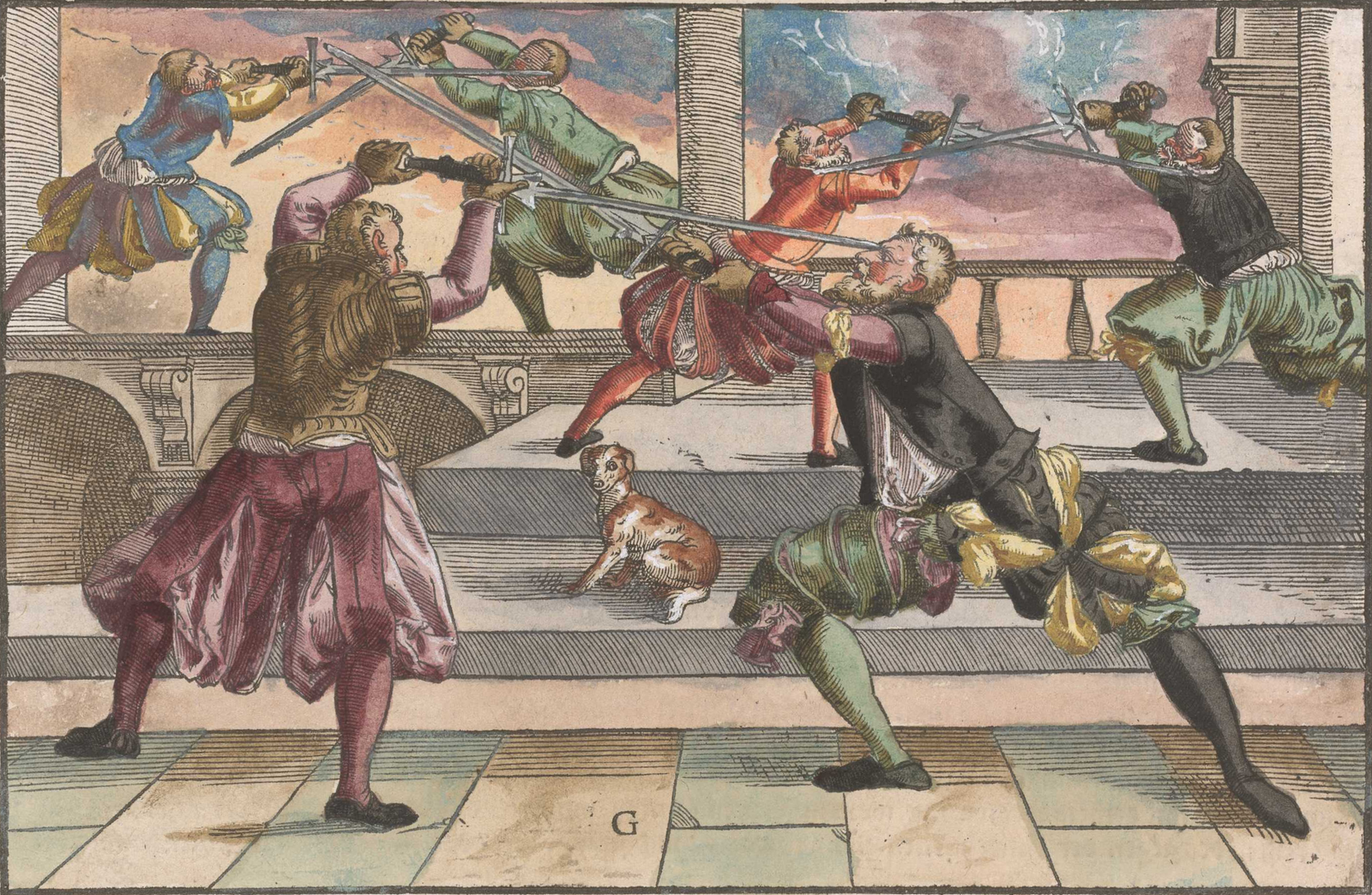
_1570_page114.jpg)
_1570_page115.jpg)
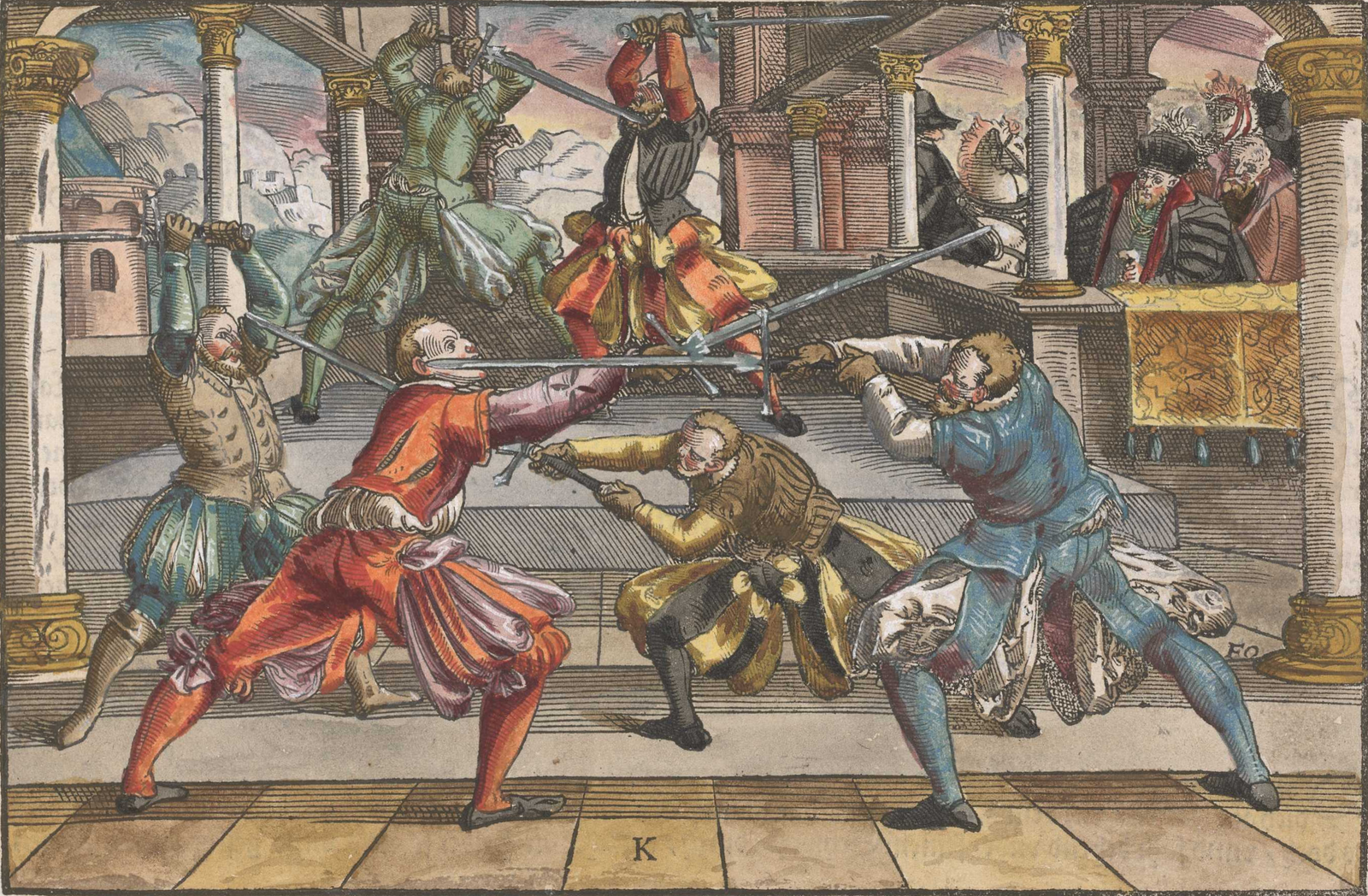
_1570_page117.jpg)
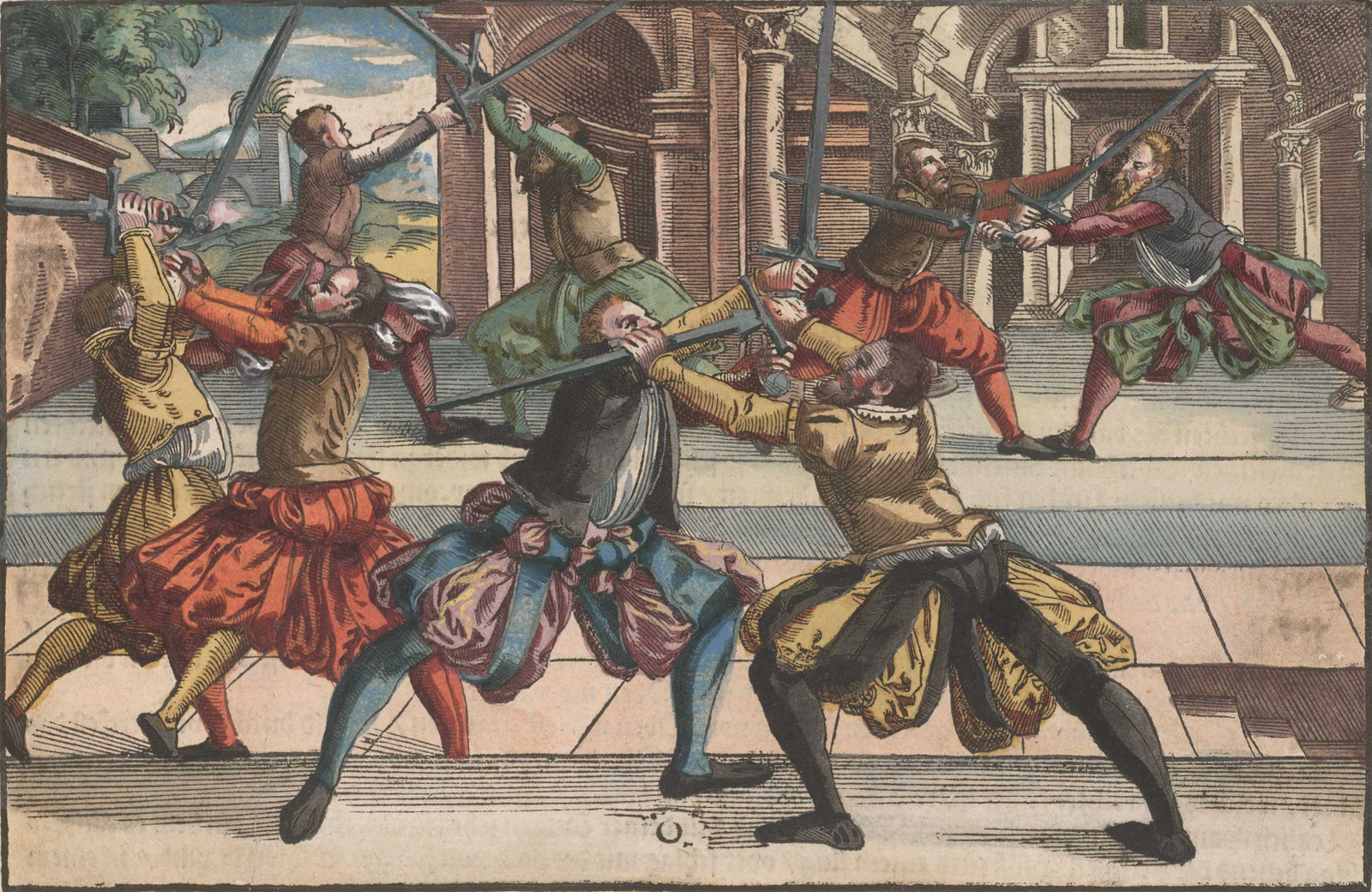
_1570_page119.jpg)
_1570_page120.jpg)
_1570_page121.jpg)
_1570_page122.jpg)
_1570_page123.jpg)
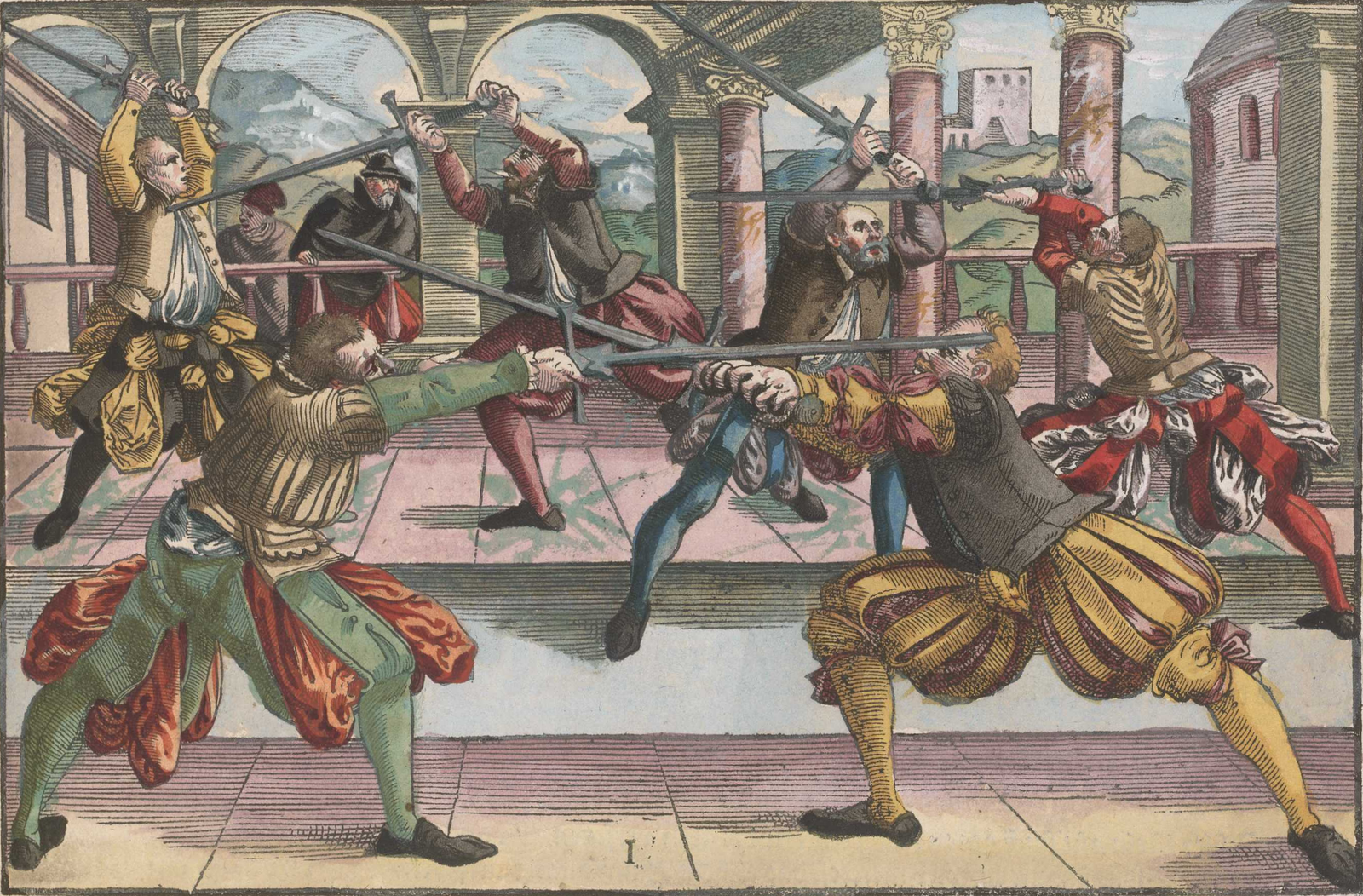
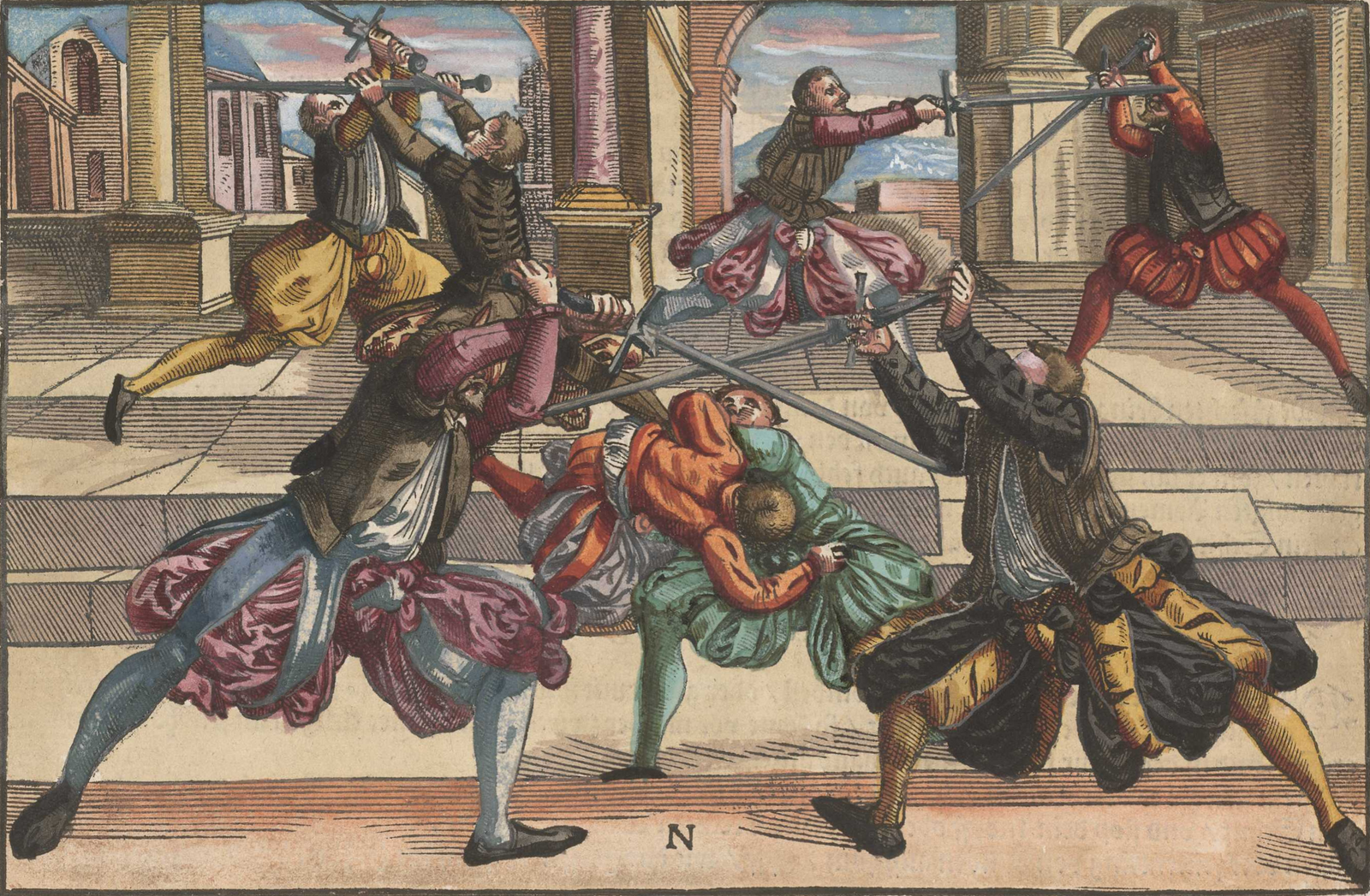
_1570_page125.jpg)
_1570_page126.jpg)
_1570_page127.jpg)
_1570_page128.jpg)
_1570_page129.jpg)
_1570_page130.jpg)
_1570_page131.jpg)
_1570_page133.jpg)
_1570_page134.jpg)
_1570_page136.jpg)
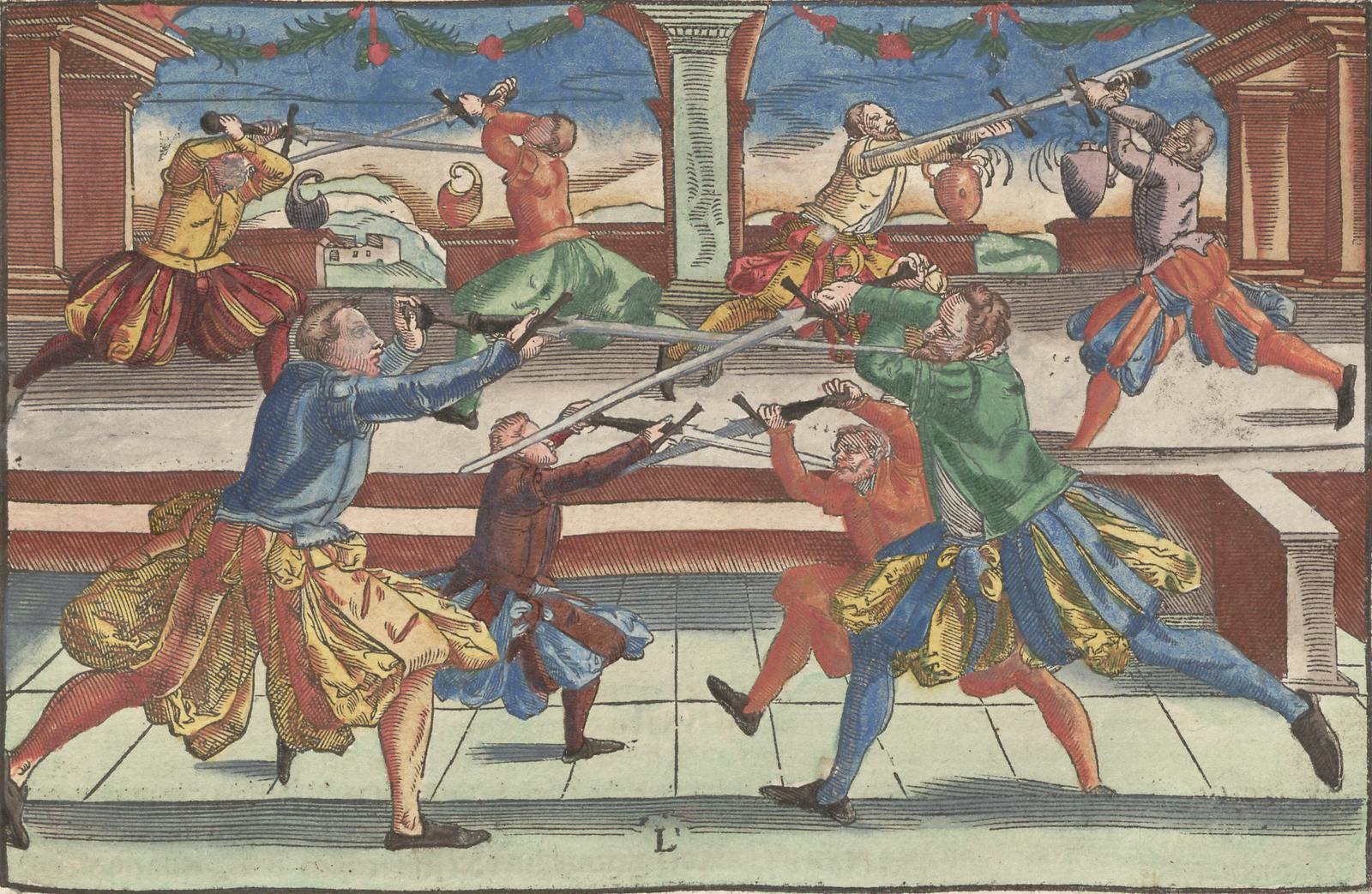
_1570_page138.jpg)
_1570_page139.jpg)
_1570_page140.jpg)
_1570_page141.jpg)
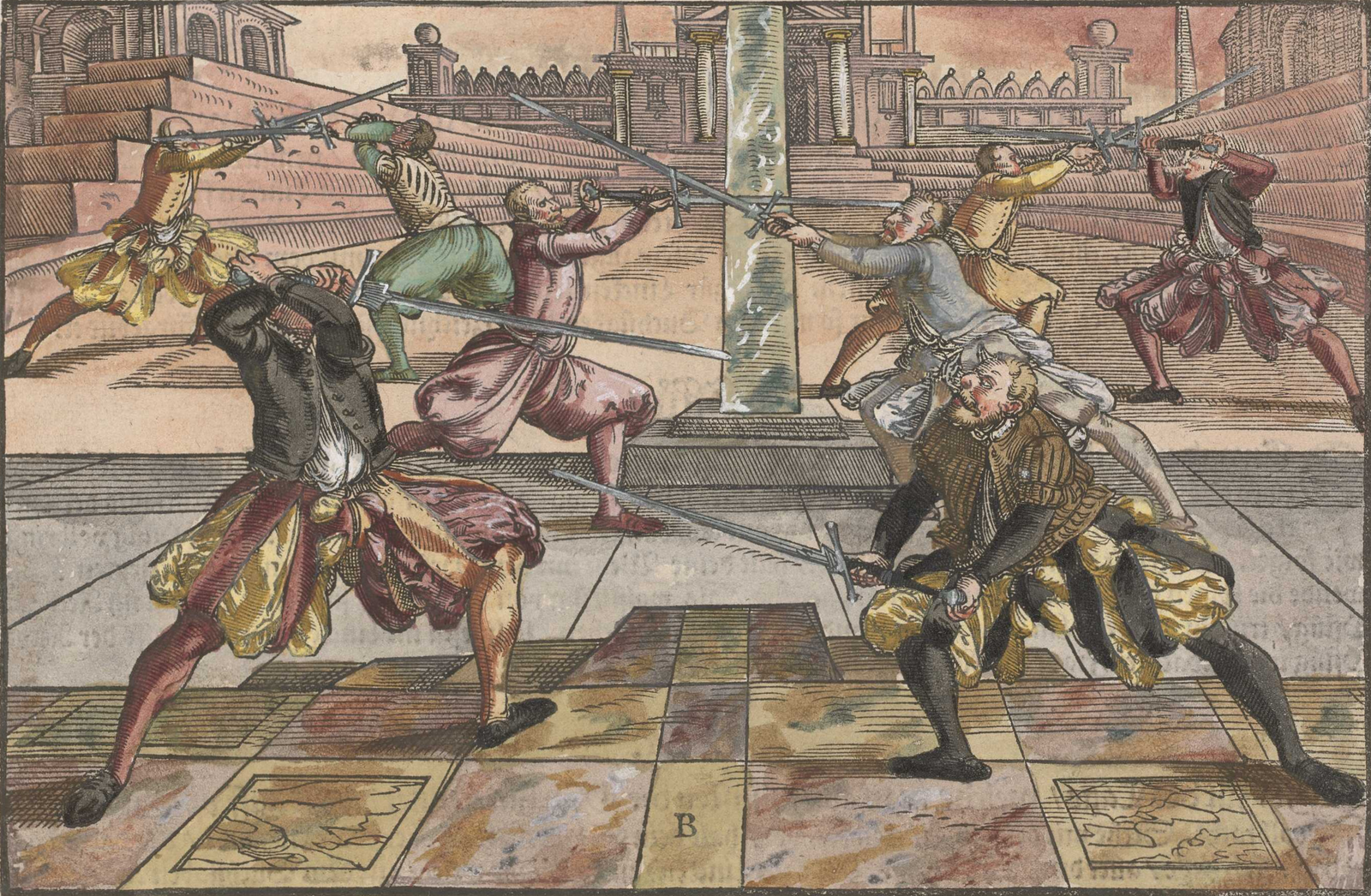
_1570_page142.jpg)
_1570_page143.jpg)
_1570_page144.jpg)
_1570_page145.jpg)
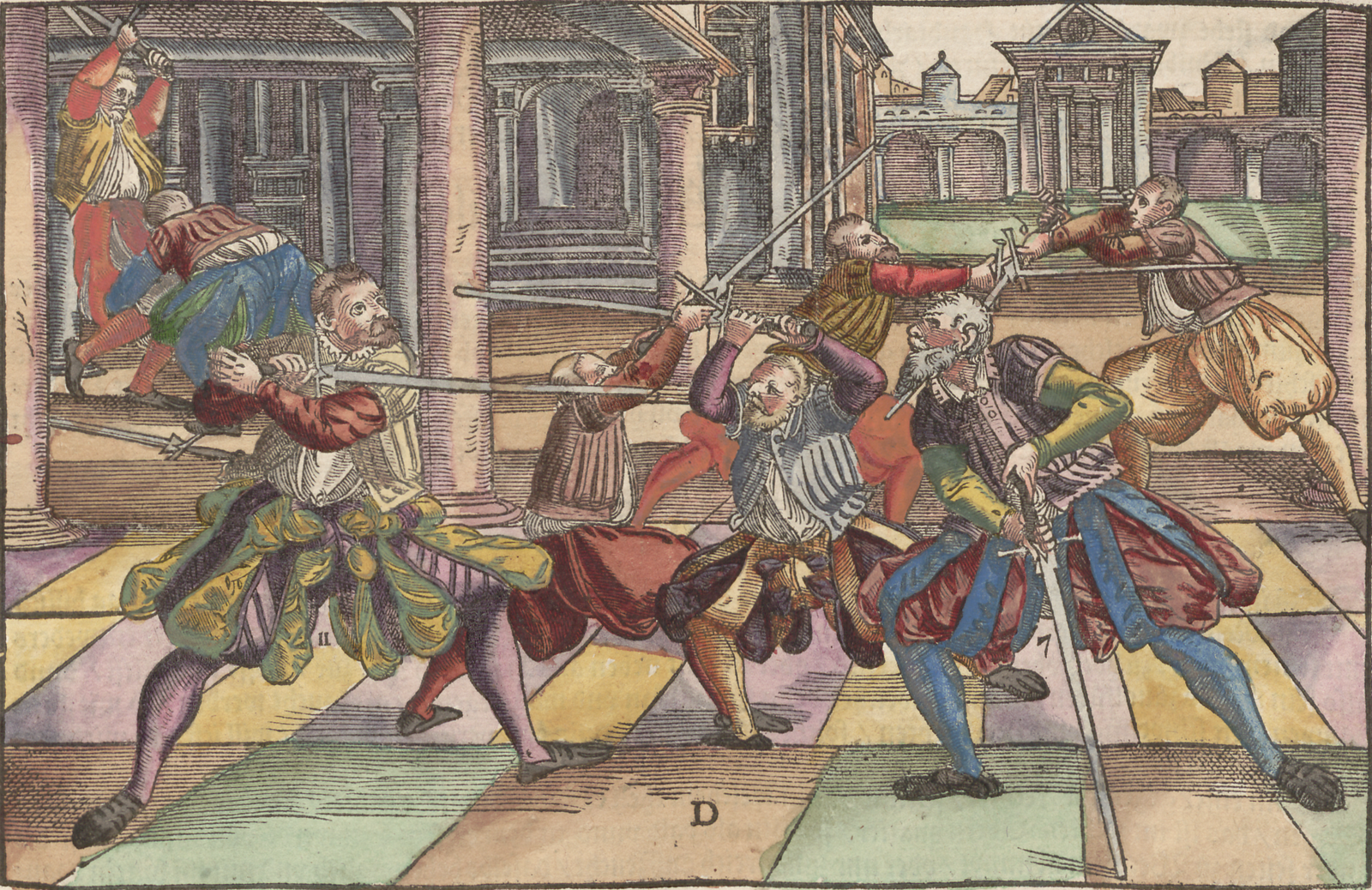
_1570_page146.jpg)
_1570_page147.jpg)
_1570_page148.jpg)
_1570_page149.jpg)