Because, dear reader, all components that support sword fencing have been explained previously to such an extent that any serious person who assesses such things (in addition to diligent practice) will have sufficient instruction for understanding all subsequent sequences, I now want to describe, using one stance after the other, how one should hold oneself therein and how one should fence with another from each.
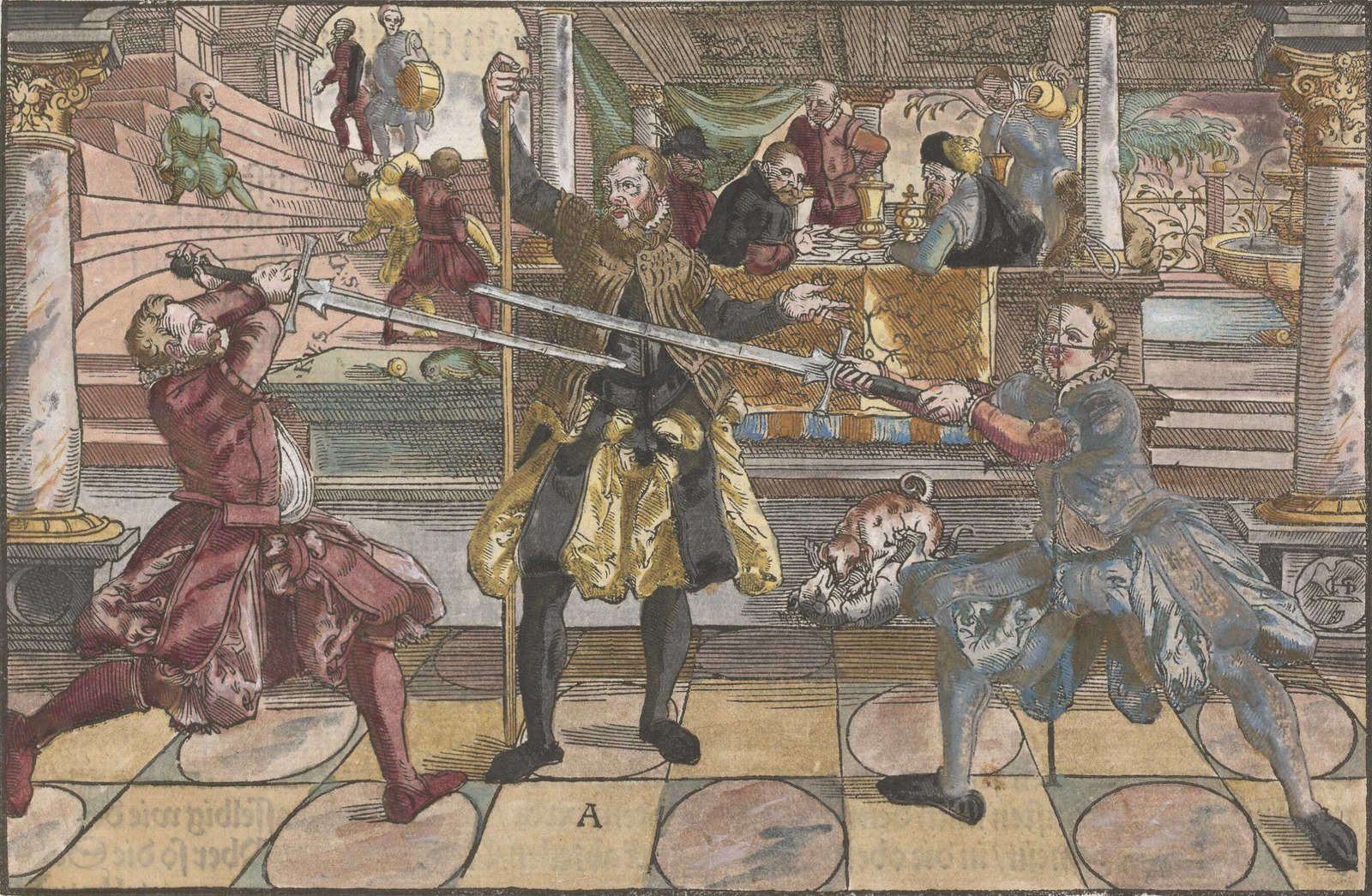
Prior to this, and because all of your cuts and techniques should be directed at or toward the four parts of the opponent, you must also be attentive to the same four previously-mentioned parts. At the beginning of fencing from the stances, it is therefore necessary that I actually describe these parts, which I want to present and set down using the following example. And firstly:
1570 Edition · fol. Ⅰ.27v.1
[Ⅰ.27v.1] Wie man nach den vier Blössen fechten sol.
Cap. 10.
DIeweil nun bißher günstiger Leser, alle zum Schwerdt Fechten dienstlich stuck meines erachtens
dermassen erklert, also das ein jeglicher dem ernst sein wirt, solches neben fleissiger
übung zu erwegen, gnugsame anleitung alle nach gesetzte stuck zuverstehn haben wirt, derhalben
wil ich nun ferner ein Leger nach dem andern, wie man sich darinnen verhalten und aus deren einem
jeden Fechten sol, anzeigen, Zuvor aber dieweil alle deine Häuw und stuck, auff oder gegen
die vier theil des Manns gericht werden sollen, hergegen du auch derselbigen von gemelten vier
theilen gewertig sein must, ist derhalben nötig zum eingang des Fechtens auß den Legern, das ich
von disem stuck eigentlichen bericht, welches ich durch folgende Exempel dargeben und setzen
wil, und erstlich:
Ⅰ.27v.1
13.1linked passage
13.2
[2] In the Onset, when you approach within one Klafter of your opponent, strike up from your right in front of them through their face—once, twice, three times—so that in the third strike upwards in front of them (when you have your left foot in front) you arrive in Longpoint. From there, let the front part of your blade drop downward toward your left and, in that moment in which your blade has just dropped downward, pull your hilt upward while this is happening, step and cut the first from your right side toward their left ear. As soon as this strike has hit, quickly pull back in one sweeping motion and cut the second obliquely from below and toward their right arm. With regards to this cut, retain your crossguard high over your head. Simultaneously with this Low Cut, step with your left foot slightly toward their right outward to the side toward them. As soon as this has also hit, you should quickly pull your sword back upward and toward your right, and cut from your right at their left lower opening. Before that has correctly touched or hit, pull back around your head again and cut the fourth slantwise toward their right ear. From there, cut a Crosswise Cut around and withdraw. These first four cuts should be completed quickly and swiftly, from one opening to the other, including all of their steps.
1570 Edition · fol. Ⅰ.27v.2
[Ⅰ.27v.2] Im zufechten wann du kloffters nehe zum Mann kommest, so streiche von deiner Rechten vor
ihm auff, durch sein gesicht ein mal zwey drey, also das du im driten auffstreichen vor im (doch
das du mit deinem Linkcen fuß vor bleibest) in das Lang ort kommest, von dannen laß das vordertheil
deiner klingen gegen deiner Lincken ablauffen, unnd in dem dein klingen eben im undersich
sincken ist, so ziehe under des dein hefft übersich, trit und hauwe den ersten von deiner Rechten
gegen seinem Lincken ohr, als bald solcher Hauw antroffen, so bald zuck in einem flug wider
ab, und Hauwe den andern von Unden uberecke gegen seinem Rechten arm, zu solchem hauw
aber bleib mit deinem kreutz hoch uber deinem Kopff, und trit mit deinem Lincken fuß zugleich
mit solchem Underhauw, ein wenig gegen seiner Rechten zur seiten aus zu ihm, und so diser
auch antroffen, soltu behendt dein Schwerdt wider ubersich rucken gegen deiner Rechten,
und also von deiner Rechten zu seiner Lincken undern Blösse Hauwen, ehe das recht gerürt oder[Ⅰ.28r.1] getroffen so zuck wider ab umb dein Kopff, und Hauwe den vierten schlims gegen seinem Rechten
ohr, von dannen Zwirch umb unnd zieh ab, Dise ersten vier Häuw sollen behend unnd geschwint
von einer Blöß zur andern sampt ihren tritten volbracht werden.
Ⅰ.27v.2Ⅰ.28r.1
13.2linked passage
13.3
[3] Additionally, your sword or swordblade can hit and touch in three ways when forming the cuts properly: firstly with the long edge thereof (as was just taught), then with the short edge, and finally with the flat. Therefore, it will also be necessary that you can nimbly guide the short edge to all four openings (just as well as previously with the long edge), then also finally to hit with the flat (just as was mentioned here previously with the half edge), flying freely from one opening to the next—namely, with the inward flat to the right and with the outward (which is the reversed or inverted flat) to their left.
1570 Edition · fol. Ⅰ.28r.2
[Ⅰ.28r.2] Dieweil aber das Schwerdt oder dein schwerdts klingen, im herführen zum hauwen fürnemlich
auff dreyerley weiß antreffen und rühren mag, als erstlich mit Langer davon jetzt gelert,
demnoch mit kurtzer, und letzlichen mit der flech, Derhalben wil auch von nöten sein, das du
die kurtze schneide eben als wol wie zu voren die Lange, behendiglich zu allen vier Blössenen führen
könnest, demnoch auch zum letzsten mit der flech, gleichwol als wie jetz gemelt mit halber
schneide, frey fliegendt von einer Blöß zur andern (nemlich mit der inwendigen flech zur Rechten,
und mit der auswendigen das ist letzer oder ebichter flech zu seiner lincken) schlagen.
Ⅰ.28r.2
13.3linked passage
13.4
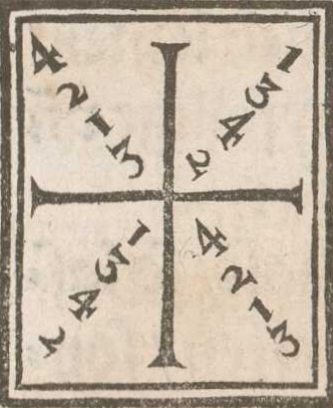
[4] In order that you become more practiced in the same, you should always change around with the first strike. Thus, if one time you have cut your first strike at the upper left opening and the second to their lower right opening, then continue as taught above, (as the outermost numbers in this small illustration indicate here). You should afterwards cut the first at their lower left, the second at their upper right, and continue as the second number shows you in the small image mentioned previously. Afterwards, cut the first at their lower right, the second at their upper left, and continue as the third numbers indicate. Finally, you cut your first toward their right, and continue as the inner number indicates.
And learn all of that first with the long edge as mentioned, then with the half edge, and finally direct yourself in the work with the flat. When you can do this well, then the second part follows: namely, that you know to protect the four openings from these cuts as taught, and either hold them off with your swordblade or you rebuff them from you with counter cuts (which is better). These are the two principal parts in fencing and the origin of all, from which all other aspects flow.
Furthermore, a chance aspect follows as the third, which is actually called the practical application. The practical application is this: that you can now guide your cuts well from the stances to all parts of the opponent, which is the first principal part in fighting and must be brought into the work in the Before. If your counterfencer is equally and quickly finished with the second principal part—the counteraction to remove or to hold up your cut in the After so that you cannot reach your intended goal with these cuts—then the third aspect, which is called the practical application, comes into play. This is the cunning knowledge and teaches you how—when you perceive your strike as being unsuccessful or unproductive at one point—you quickly and immediately pull back from that point before this strike hits or you allow it to pass over as an intentional miss, and then guide it to another opening. If they also want to counteract that, then pull the same back and then let fly vigorously from one opening to the other, as long and as many as needed until you can overwhelm and hit.
In order that this may be better recalled and understood by those learning, I will provide and set forth a few good examples of the same which, in my opinion, easily and clearly teach this. From this, the benevolent reader can receive sufficient report to understand all types of favorable and demonstrated techniques (as discussed previously in the Middle work) like this:
1570 Edition · fol. Ⅰ.28r.3
[Ⅰ.28r.3] Damit du aber solches dester geübter werdest, so soltu mit dem ersten hauw alwegen umbwechseln,
Also wann du einmal deinen ersten hauw zur Lincken obern Blöß, unnd den andern zu seiner
Rechten undern Blöß, unnd also fürtan wie oben gelehrt, wie solches die ausserste ziffer in
disem hiebey getrucktem Figürlein anzeigen) gehauwen hast, so soltu demnoch auch
den ersten gegen seiner Lincken undern, den andern gegen seiner Rechten obern, und
dann fürter wie die ander zal im gedachten Figürlein lehrt, darnach so Hauwe den
ersten zu seiner Rechten unden, den andern zu seiner Lincken oben, und also fürter
wie dich die drit zal weist, zum letzten Hauwe deinen ersten gegen seiner Rechten,
und fürter wie solches die inere zal außweisset, unnd das alles lerne erstlich wie gemelt
mit langer dann mit halber schneid, und letzlich mit der fleche in das werck richten, wanndu nun
solches wol kanst, so folget nu ferner das ander stuck, nemlich das du solche vier Blösse wissest vor solchen
gelerten häuwen zu bewaren, und eintwederst die mit deiner schwerts klingen auffhaltest oder[Ⅰ.28v.1] welches besser mit gegen häuwen von dir abweisest, dises seind also die zwey Hauptstuck im Fechten,
daraus alle ander stuck herfliessen und ist das Original, Ferner folget nun für das drit ein zufellig
stuck welches eigentlich zu reden die Practick heißt und ist, welche Practick ist dise, wann du nun deine
Häuw aus den Legern wol zu allen theilen des Mans führen kanst, welches das erste stuck im fechten
so im Vor ins werck bracht werden muß, und aber dein gegenfechter ist gleich, und behend
auch fertig mit dem andern stuck der versatzung, dir deine häuw im Nach abzuschaffen oder auff
halten, damit du dein fürgenommen ziel mit solchen Häuwen nicht erreichen kanst, Derwegen
kompt nun das dritte stuck das ist die Practick genant, welches ist der list, und lehrt dich wie du
dein Häuw wo du gewahr wirst, das solche an einem ort vergeblich oder unfruchtbar seind, bald
unnd behendig von dannen ehe dann solcher Hauw antrifft wider abzuckest, oder fehl füruber
gehn lassest, und den einer andern Blöß zuführest, wil er daselbst auch versetzen, so zuck daselbst
auch ab, und laß also verfliegen von einer Blös zur andern, so lang unnd vil biß du eine ereilen
kanst zu treffen, Damit aber solches vom lernenden desterbas gemerckt und verstanden mag werden,
wil ich demselbigen zu gut etliche exempel so meines erachtens einfeltig unnd deutlich lehren,
dargegen und setzen, aus welchen der guthertzig Leser gnugsamen bericht, allerley beyfellige und
verführte stuck, so hievor in mitler arbeit erzelt, dieselbigen zuverstehn nehmen kan, also:
Ⅰ.28r.3Ⅰ.28v.1
13.4linked passage
13.5
[5] When you have struck upward into the Onset (as taught previously) and have recovered to strike, let the first and the second hit hard (as above), but do not let the third hit. Instead, quickly pull that one back in one sweeping motion before it hits, so that you can hit with the fourth faster and earlier.
1570 Edition · fol. Ⅰ.28v.2
[Ⅰ.28v.2] Wann du im zufechten wie vor gelert auffgestrichen, und dich zum streich erholet hast, so lasse
den ersten und den andern hart antreffen wie oben, den dritten aber lasse nicht antreffen, sonder
verzuck den behend ehe dann solcher trifft wider ab in eim flug zu ruck, auff das du den vierten
dester geschwinder und eher antreffen könnest.
Ⅰ.28v.2
13.5linked passage
13.6
[6] Item, if the first hits, quickly pull the second and the third back in one fast sweeping motion, and let the fourth hit. Likewise, threaten with the first and the second up to the opening and pull the same back, and guide another in to the second closest opening. When you use pulling [of cuts], you can and should attack with the first, but changing or cycling through (as taught previously with regard to the numbers), namely that you now pull this one back and then the other, and you allow [your] strikes to miss. While doing this, you have the same concerns and pay the same attention as if they were to attack you at any opening so that you would soon be on their sword with a bind from this outward pulling. The dropping down and missing and the like now flow from these pulled cuts.
That is, when you guide a cut at these above-mentioned parts of the opponent, and in that moment in which you perceive that they would counteract such a strike: don’t pull back immediately, but instead—depending on whether they do not perceive your observation—allow [the strike] to drop down past on this same side as a complete miss. Cut quickly at another opening before they correctly conceive of what you have planned. Example:
1570 Edition · fol. Ⅰ.28v.3
[Ⅰ.28v.3] Item triffe den ersten, unnd verzucke den andern und den dritten in einem geschwinden flug,[Ⅰ.29r.1] unnd lasse den vierten treffen, eben desgleichen trauwe den ersten unnd den andern biß an die
Blösse, und verzucke doch solches wider ab, und führe den der andern nechsten Blösse eine zu, in
diser verzuckung kanstu, und solt sie auch mit dem ersten angreiffen, aller ding wie hievor in der ziffer
gelehrt abwechseln, nemlich das du jetz an diser dann an einer andern abzuckest unnd verfehlen
lassest, und under des gleichwol fürsorg und auffmerckens habest, wo er dir irgendt zur
Blöß würde einfallen, das du im bald von solchem verzucken mit dem Bandt an seinem schwert
seyest, aus disem verzucken fleußt nun weiter das Ablauffen und Fehlen unnd dergleichen, Also
wann du ein hauw diser obgedachten theilen des Mans eine zuführest, und aber in dem du gewahr
würst, das er solchen Hauw versetzen, so zuckest du gleichwol nicht wider ab, sonder (auf
das er deines vermerckens nicht gewahr werde) so lasse neben der selben seiten vollen fehl füruber
ablauffen, unnd Hauwe ihm behende zu einer andern Blöß, ehe dann ers recht (was du
führest) innen wirt, Exempel:
Ⅰ.28v.3Ⅰ.29r.1
13.6linked passage
13.7
[7] When you have recovered to strike using the upward strikes (as taught above): step and cut in from your right, high and toward their left ear. As soon as they swipe at that, let your blade drop quickly downward next to their left with the half edge, and use this to jerk your pommel and hilt upward. Cut quickly with the short edge at their right ear so that your hands cross in this cut.
1570 Edition · fol. Ⅰ.29r.2
[Ⅰ.29r.2] So du dich durch das auffstreychen zum streich erholet hast, wie Oben gelehret, so trit unnd
Hauwe von deiner Rechten hoch herein gegen seinem Lincken ohr, als bald er dem nach wischt
so lasse behend dein klingen mit der halben schneide neben seiner Lincken undersich sincken, unnd
ruck damit dein Knopff und Hefft ubersich, und Hauwe ihm behend mit kurtzer schneide zu seinem
Rechten ohr, also das dein hend in solchem hauw kreutzweiß kommen.
Ⅰ.29r.2
13.7linked passage
13.8
[8] Item: let the first [strike] at their left ear hit hard. Let the second run quickly past as an intentional miss on their right (as above). Strike deeply at their left ear. You can also—if you have cut in hard with the first—let it drop down quickly on both sides afterwards and still attack the closest opening (if it is open). You can do all of this obliquely and cross-wise (as taught previously) and can also direct [the strikes] singly and doubly on opposite sides in the work, according to your desire and opportunity.
Furthermore, also learn to quickly guide your entire blade in the work, firstly with the long edge, then also with the half edge, and also with the flat toward their sides at the upper and lower openings, together in one complete sweeping motion, as follows.
1570 Edition · fol. Ⅰ.29r.3
[Ⅰ.29r.3] Item las den ersten gegen seinem Lincken ohr hart antreffen, den andern lasse behend auff
vorige weiß neben seinem Rechten fehl füruber lauffen, unnd triffe dieff zu seinem Lincken ohr,
also magstu auch (wo du den ersten mit im hart eingehauwen hast) behend darauff, auff beiden
seiten ablauffen lassen, und demnoch zu der nechsten Blöß so die offen ist einfallen, dises alles so
bisher gelehrt kanstu uberecke und kreutzweiß, auch gegeneinander einfach unnd doppel, in das[Ⅰ.29v.1] werck richten, nach deinem gefallen und gelegenheit, weiter so lehre auch dein klingen in voller
arbeit, erstlich mit Langer dann auch mit halber schneid, oder auch mit der flech, gegen seiner seiten
zur obern und undern Blösse, in vollem flng[!] behendiglichen zusamen führen, also.
Ⅰ.29r.3Ⅰ.29v.1
13.8linked passage
13.9
[9] In the first attack, cut a High Cut long at their left ear. In that moment in which it glances off, pull both hands upward so that your pommel is shoved through under your right arm while moving upward and cut quickly with the long edge from below also at their left. Step Indesly toward them with your left foot behind your right and lift your hilt over your head in these cuts. Conversely to this: first cut a Low Cut at their lower opening with the long edge with a step forward of your right foot. Pull quickly back upward to your right and cut the second from above, also at their left, with a step backwards of your left foot behind your right toward them like before, so that you stand protected behind your blade.
1570 Edition · fol. Ⅰ.29v.2
[Ⅰ.29v.2] Im ersten angriff Hauw ein Langen Oberhauw zu seinem Lincken ohr, in dem es glützt, so
zuck beide hend ubersich, das dein Knopff under deinem Rechten arm im ubersich fahren durch
gestossen werdt, unnd Hauwe behend mit Langer schneiden von Unden auch zu seiner Lincken,
trit in des mit deinem Lincken fus hinder deinen Rechten zu ihm, und komm mit deinem Hefft
in solchem hauwen hoch uber deinem Haupt, Herwiderumb so hauwe den ersten einen Underhauw,
mit einem zutrit deines rechten Fuß, zu seiner undern Blös mit Langer schneid, zuck behendt
neben deiner Rechten wider ubersich, unnd Hauwe den andern von Oben auch zu seiner
Lincken mit einem abtrit deines lincken Fus, hinder deinem Rechten zu ihm wie vor, auff das
du hinder deiner kling verdeckt standest.
Ⅰ.29v.2
13.9linked passage
13.10
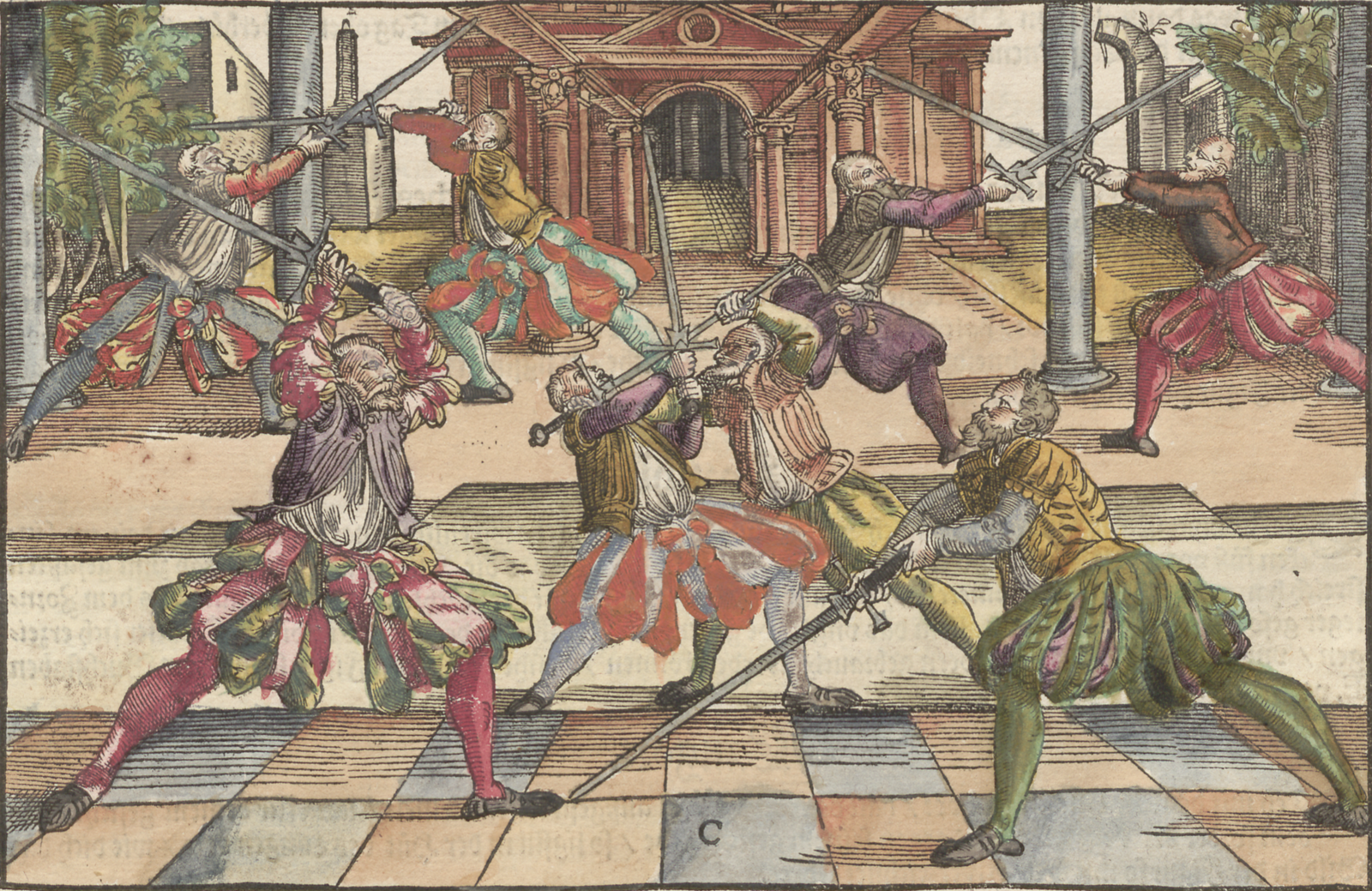
[10] Item: pull a High Strike from the right at their left with the half edge, crossing your hands in the air to hit at their left ear with the half edge (as you can see in the two upper portraits on the left in the Figure designated with C). Pull your crossed hands back upward and hit again with a Crosswise Cut from below at their left ear. Or also conversely: cut the Crosswise Cut from below at their left with a step forward. Pull quickly upward next to your right and thrust your pommel through under your right arm during this pull upward. Flick back at their left with crossed hands from high on your right. In this way, you will hit with the flat below and above on one side; this works on both sides. And take note: when you hit at the lower right opening, whether with the flat, long, or short, your hands will cross. However, when you hit at their upper right opening, your hands do not always cross. Take note of this in the following example:
1570 Edition · fol. Ⅰ.29v.3
[Ⅰ.29v.3] Item zuck mit halber schneid von dem Rechten ein hohen streich zu seiner Lincken, aber in der
lufft verschrenck dein hend, und schlag mit halber schneide zu seinem lincken ohr, wie du solches
an den zweyen obern Bilder zur Lincken in der Figur so mit dem C. verzeichnet sehen kanst, zuck
deine hende also kreutzweiß wider ubersich, unnd schlag mit einer Zwirch wider von Unden zu
seinem lincken Ohr, also auch herwiderumb Hauw die Zwirch von Unden zu seiner Lincken mit
einem zutrit, zuck behendt neben deiner Rechten ubersich, unnd stoß in solchem auffzucken dein
Knopff under dein rechten Arm durch, und schnell also mit geschrenckten henden wider von deiner
Rechten Oben hinein zu seiner Lincken, auff dise weise schlag es auch mit der flech Unden und Oben auff einer seiten zusamen, das gehet zu beiden seiten, und merck wann du zur Rechten undern
Blöß schlechst, es sey flech, lang oder kurtz, so kommen dein hend kreutzweiß, aber wann du[Ⅰ.30r.1] zu seiner Rechten obern Blösse schlechst, so kommen deine hende nicht alwegen kreutzweiß, hievon
merck auff folgend Exempel.
Ⅰ.29v.3Ⅰ.30r.1
13.10linked passage
13.11
[11] In the Onset, shoot through in front of them and strike from your left at their right ear with the half edge without crossed hands (instead, your pommel projects out toward your left). Pull quickly back upward toward your right and cross your hands in the air. Hit them with crossed hands at their lower right opening from your left. In that moment in which all of this [occurs], ensure that you have stepped out twice to their right with your head well behind your blade.
You can also hit with the flat and long edge from below and above toward their right (as I just taught you previously) so that you should threaten and wrench the cuts from one opening to the other. That is, you should pull and threaten here at one side and at the lower and upper opening in parallel.
Namely, when you guide a cut at the upper opening, and you take note that they are not cutting, but instead are moving to counter your sword, don’t allow your cut to hit. Instead guide your blade to the lower opening. If they come under the cut, continue to move with your cut against the Strong of their blade.
The twistings on the sword arise from this work, namely: when you have bound on their sword from your right toward their left, remain strongly on their blade. Thrust your pommel unexpectedly through under your right arm yet continue to remain on their sword. Jerk your pommel back out and twist the short edge at their head from outside. Thus, you have found three options for the edges and flat (and this on both sides): namely, the outward and inward long edge; Item, outward and inward short edge; likewise inward and outward flat.
1570 Edition · fol. Ⅰ.30r.2
[Ⅰ.30r.2] Also im zutritt schieß vor ihm durch, und schlag mit halber schneid, von deiner Lincken zu seinem
rechten ohr nicht mit geschrenckten henden, sonder das dein Knopff gegen deiner Lincken
aus steht, zuck behend wider ubersich gegen deiner Rechten, und verschrenck dein hende in der
lufft, schlag ihm mit gekreutzigten henden zu seiner undern rechten Blöß, von deiner Lincken,
in dem allem schaw das du mit dem Kopff wol hinder deiner kling, mit zwifachen tritten gegen
seiner Rechten außtreten bist, also kanstu auch mit flech und Langer schneid, von unden unnd
oben, neben seiner Rechten zusamen schlagen, wie ich dich nur vor gelert hab, das du die häw
von einer Blöß zur andern verzucken und trauwen solt, also soltu hie auff einer seiten, auch die
undern und obern Blöß zusamen trauwen und verzucken, Nemlich wann du ihm also ein haw
zur obern Blösse führest, und merckest das er nicht hauwet, sonder deinem Schwerdt entgegen
fehrt, das du als dann dein hauw nicht antreffen lassest, sonder dein klingen der undern Blöß
zuführest, wo er aber under des hauwen wirt, so fahr mit deinem Hauw fürt doch gegen der
sterck seiner klingen, Aus dieser arbeit erwachsen die winden am Schwerdt, nemlich wann du
ihm an sein Schwerdt hast angebunden, von deiner Rechten gegen seiner Lincken, so bleib hart
an seiner klingen, stoß dein Knopff ime unversehens under dein rechten Arm durch, bleib also
ferner an seinem Schwerdt, und ruck als dann dein Knopff wider herfür, und windt ihm die
kurtz schneiden außwendig zum Kopff, also findestu auch dreyerley schneid und flech, Nemlich
außwendige und inwendige Lange schneide. Item außwendige und inwendige kurtze schneide,
deßgleichen inwendig und auswendige flech, und das auff beiden seiten.
Ⅰ.30r.2
13.11linked passage
13.12
[12] You now understand that the third aspect in fencing (as mentioned above) is nothing other than a correct practical application of the two first principal parts in fencing, through which practical application you are taught how—that is, in the first principal part—you allow the stances and cuts to transform, drop downward, change through, fly away, and miss, according to chance opportunity, in order to steal such cuts from the one who would counteract and remove [them].
Likewise, in the second principal part of the counteraction, the practical application teaches you how you suddenly withdraw your counteraction back from them, pursue them, slice them, press them, etc., executing these around their cuts such that they end ineffectually, or at least that they cannot complete them nor end them at their intended target. And that is the sum total of all practical applications: namely and firstly, that you attack your counterfencer in a virile way with cuts through the stances to their disadvantage and without injury [to yourself], using whatever cunning knowledge and quick execution as can occur. After you have then attacked them, you drive them farther away with Handwork that is simultaneous or gains the upper hand, so that you subsequently either safely withdraw at your pleasure as the third aspect or, if they have to yield to you, that you follow them carefully. The extent of these types of practical application and the variety of ways in which the two are used in naming and in fencing were described in greater detail previously in the chapter about Handwork (as you will find). Therefore, I will continue on to describe fencing from the stances.
1570 Edition · fol. Ⅰ.30r.3
[Ⅰ.30r.3] Also verstehstu nun das das dritte stuck im Fechten davon oben gemelt nichts anders ist, dann[Ⅰ.30v.1] ein rechte Practick, der zwey ersten Hauptstuck im Fechten, durch welche Practick gelehrt wirt,
wie du solche nach zufelliger gelegenheit, nemlich im ersten Hauptstuck die Leger unnd Häuw
verwandlen, ablauffen durchwechseln verfliegen unnd fehlen lasset, damit dem versetzer unnd
abtrager solche Häuw entführet werden, desgleichen im andern Hauptstuck des versetzens, lert
dich die Practick wie du im deine versatzung entzuckest, ihm nachreisest, schnidest, truckest &c. Damit
du ihn auch umb seine häuw das er die vergebens, oder auff das wenigest zu seinem fürgenomen
ziel nicht volführe noch ende. Und ist das die summa aller Practick, nemlich das du erstlich
deinen gegenfechter durch die Leger, mit dem hauwen manliche unnd ohn schaden, zu seinem
nachtheil, mit was listigkeit unnd behender verführung das geschehen kan, angreiffest, unnd
nach dem du ihn als dann angriffen, ihne ferner mit obligender oder gleicher handtarbeit ihn also
trengest, auff das du demnach zum dritten sicher nach deinem gefallen eintweders abziehest,
oder wo er dir weichen müste, du ihm fürsichtig nach folgest, wie ferner aber solche Practick
sich erstrecke und auff wie vilerley arth dieselbigen beide in den namen und im Fechten gebraucht
werden, findestu hievor im Capitel von der handtarbeit weitleuffiger beschriben, will derwegen
nun fürter das Fechten aus den Legern zu beschreiben fürt fahren.
_1570_page75.jpg)
_1570_page76.jpg)
_1570_page77.jpg)
_1570_page78.jpg)
_1570_page79.jpg)
_1570_page80.jpg)
_1570_page81.jpg)