One now advances to the art and boundless knightly exercise itself, namely the cuts, which are truly a principal part of fencing (as such was mentioned at the beginning): how many of them there are, what each one is, and how it is formed and should be completed.
It is necessary to state something here at the outset, merely as a reminder to the friendly reader: as there is a large difference between fencing with the sword in our times and how it was used by our ancestors and the ancients, I will describe at this point only that which is currently customary, and as much as belongs to the sword and the cuts. However, I want to discuss much that is relevant to the older usage separately in its proper place, as they fenced with both sharp cuts and thrusts.
NUn kompt das man zu der kunst und freien Ritterlichen übung selbst schreite, nemlich zu den
Häwen, welche das eine rechte Hauptstuck im Fechten (wie solches anfangs gemeldet) seind,
wie viel deren, was ein jeder sey, wie er gemacht und volbracht sol werden, ist nöttig hie etwas
zusagen, wil allein hie den freundlichen Leser zu vorderst erinnert haben, Dieweil zwischen dem
Schwerdt Fechten zu unsern zeiten, wie bey unsern vornfahren und uralten im gebrauch gewesen,
ein grosser underscheid, das ich an diesem ort nur was jetzund gebrächlich unnd so viel
zum Schwerdt gehörig von häuwen erzelen, so vil der alten gebrauch aber belangt, wie sie beide
mit Hauwen unnd stechen scharpff gefochten, wil ich in seinem gewissen unnd sondern ort
anzeigen.
Ⅰ.10v.1
7.1linked passage
7.2
[2] There are two different types of cuts which are now relevant to the sword, the straight and inverted cuts. I name “the straight cuts” those which are cut against an opponent with the long edge and extended arms, of which there are four: High, Wrath, Middle, and Low Cut. All others originate from these, and there is nothing that can be conceived of or invented in the world that cannot properly be understood as belonging to one of them. They are also deservedly called the Main or Principal Cuts.
1570 Edition · fol. Ⅰ.10v.2
[Ⅰ.10v.2] Der Häuw aber so viel das Schwerdt jetzt belangt, sind zweierley underschiedne art, als gerade
und verkerte Häuw, die Gerade nenne ich so mit Langer schneid und außgestreckten Armen
gegen dem Man gehauwen werden, deren sein vier Ober, Zorn, Mittel, Underhauw, auß
disen dieweil die anderen alle herkommen, und keiner auff der welt so seltzam erdacht noch erfunden
kan werden, der nit under deren einem füglich möchte begriffen werden, seind sie auch, unnd billich, die Haupt oder Principal Häuw geheissen.
Ⅰ.10v.2
7.2linked passage
7.3
[3] The inverted cuts are those in which the fencer inverts the hands with the sword in the cut, so that the fencer does not hit their opponent with the full or long edge but instead with the half edge, flat, or with a corner, as this occurs using the Glancing, Short, Crown, Squinter, Crooked, Crosswise, Rebound, Obscured, Twisting, Wrist, Plummet, and Change Cut.
1570 Edition · fol. Ⅰ.10v.3
[Ⅰ.10v.3] Die Verkerte Häuw seind die, wan man in den Häuwen die handt mit dem Schwerdt verkert
also das man nicht mit voller oder Langerschneid, sonder etwa mit halber schneid, flech, oder
einer ecken den Man trifft, als da geschicht mit dem Glitz, Kurtz, Kron, Schiel, Krump, Zwerch,
Brell, Blend, Windt, Knichel, Sturtz, Wechselhauw.
Ⅰ.10v.3
7.3linked passage
7.4
[4] Because these originate from the four cuts mentioned above, they are called Derivative Cuts.
1570 Edition · fol. Ⅰ.11r.1
[Ⅰ.11r.1] Dise dieweil sie auß den vier oberzelten Häuwen herkommen seind, werden sie darauß wachsende
Häuw genant.
Ⅰ.11r.1
7.4linked passage
7.5
[5] Five cuts, which originate from and are selected from these two types, are called the Master Cuts, not because whoever can complete these correctly is quickly named a master of this art, but instead because from them originate all correct, skilled techniques which would well befit a master to know. And whoever can correctly fence and use them is considered a skilled fencer, because all Master Sequences are concealed within them and fencers cannot do without them. These are the Wrath, Crooked, Crosswise, Squinter, and Hairline Cut.
1570 Edition · fol. Ⅰ.11r.2
[Ⅰ.11r.2] Nun auß disen beiden komen und werden außgelesen fünff, so die Meisterhäuw genandt werden,
nit das wer dieselben wie Recht volbringen kan, als bald ein Meister diser kunst zunennen,
sondern das aus denselben alle rechte künstliche stuck die einem Meister wol gezimmen zuwissen her
gehn, und der sie recht Fechten und brauchen kan, für einen kunstreichen Fechter zuhalten, sintemal
alle Meisterstuck in denselben verborgen, und man derer mit nichten kan entberen. Die seind
der Zorn, Krump, Zwerch, Schieler, und Scheitelhauw.
Ⅰ.11r.2
7.5linked passage
7.6
[6] I now want to show in an orderly, sequential way how they all should be formed, and I will discuss the straight cuts first, among which the first is the High Cut.
1570 Edition · fol. Ⅰ.11r.3
[Ⅰ.11r.3] Dise alle wie sie gemacht sollen werden, will ich ordenlich nach einander anzeigen, und erstlich
von den Geraden Häuwen sagen, under welchen der erst der Oberhauw.
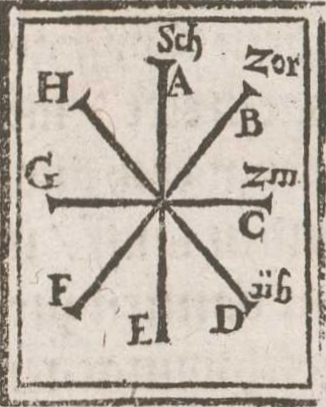
The Wrath Cut is an oblique cut from your right shoulder toward your counterpart’s left ear, or through their face and chest (obliquely, as shown by the two lines which cross through the upright line and cross each other). This is the strongest of all, because within it lies all the force and virility of the fencer who is fighting and fencing against their enemy. For this reason, it was also called the Fighting Cut or the Father Strike by the ancients. (You will find more later about imaginary lines, etc.)
DEr Zornhauw ist ein Schlimmer Hauw von deiner Rechten Achsel, gegen deines widerparts Lincken ohrs, oder
durch sein gesicht und Brust, Schlims durch wie die zwo Linien, so durch die auffrecht Linien kreutzweiß uber
einander sich schrencken anzeigen. Diß ist der sterckest under allen andern, als darinen alle krafft unnd manligkeit
des Mans gegen seinem feindt im Kempffen unnd Fechten gelegen, darumb er auch von den Alten Streithauw
oder Vatterstreich genant und geheissen wirt. Von gedachten Lini findestu hernach, etc.
The Middle or Crossing Cut can be formed in almost all ways like the Wrath Cut, except for this difference: that is, while the Wrath Cut is completed obliquely, this one is completed across, as can be seen in the crossing line (designated with the two letters G and C). You will subsequently find these lines in the Dusack [Section].
DEr Mittel oder zwerchhauw kan fast aller ding wie der Zornhauw gemacht werden, allein ist diß der underscheidt,
das wie der Zornhauw schlims uber ort, also diser aber uberzwerch volbracht wirdt, wie zusehen an
der uberzwerch Linien mit beiden Buchstaben G. und C. verzeichnet, solche Linie findestu hernach im Dusacken.
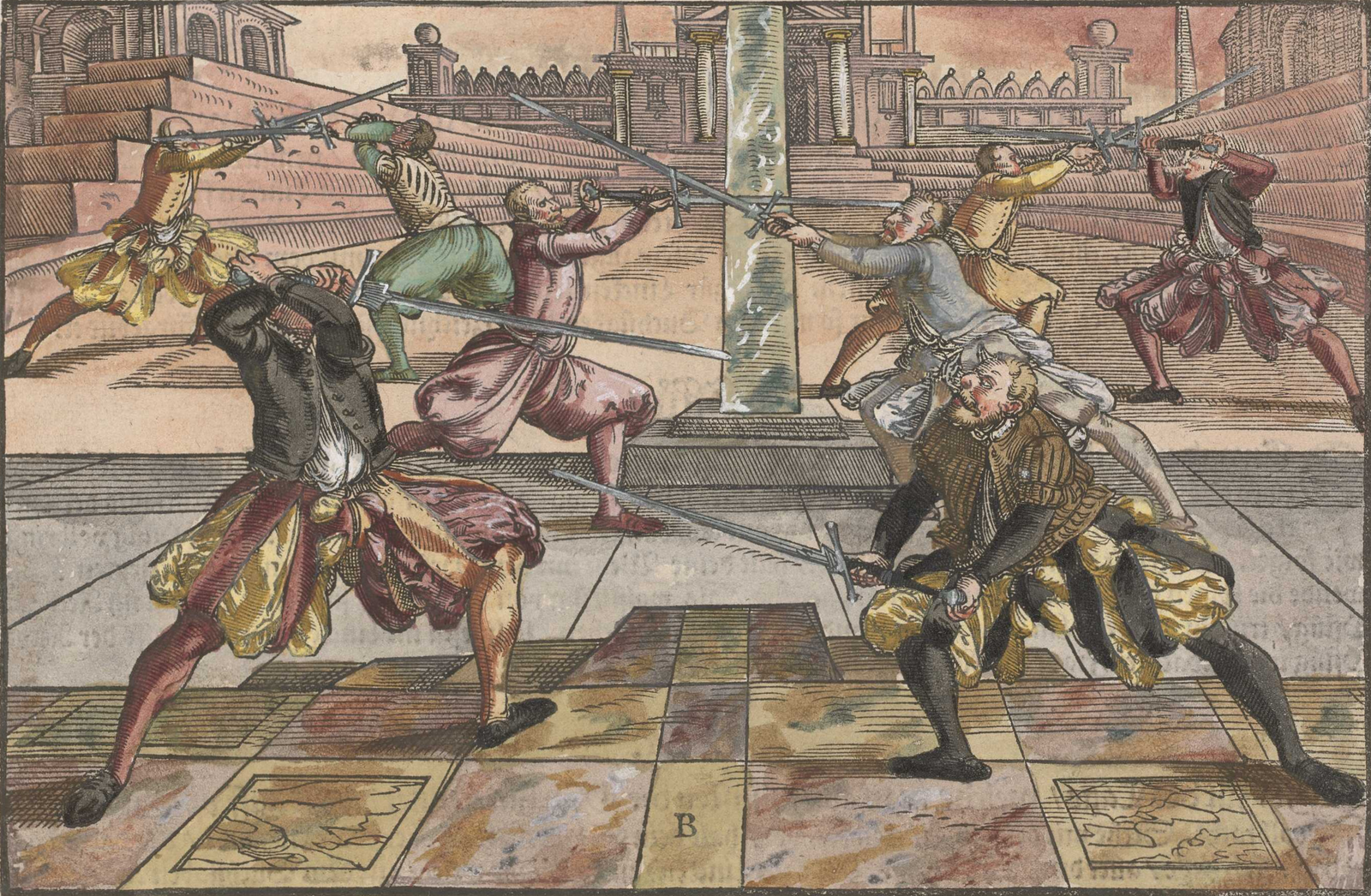
You form this one like this: use cuts so that you move into the right Ox (which was discussed in the immediately-preceding chapter), and as soon as you can reach the counterfencer, step and cut across (upward from below) at their left arm, so that you arrive with the cross-guard high over your head. Thus, you have completed it. Regarding this, observe the small tenants on the [right] side in the Figure with the B.
DIsen machstu also, Verhauw dich das du in Rechten Ochsen kommest (davon im nechst vorgehenden Capitel
gesagt ist) und als bald du deinen gegenfechter erlangen kanst, so trit und Hauw von Unden uberzwerch
nach seinem Lincken Arm, das du mit dem kreutz hoch uber deinem Haupt kommest, so hastu in volbracht. Davon
besihe die kleinen bossen in der Figur mit dem B. gegen der Lincken handt.
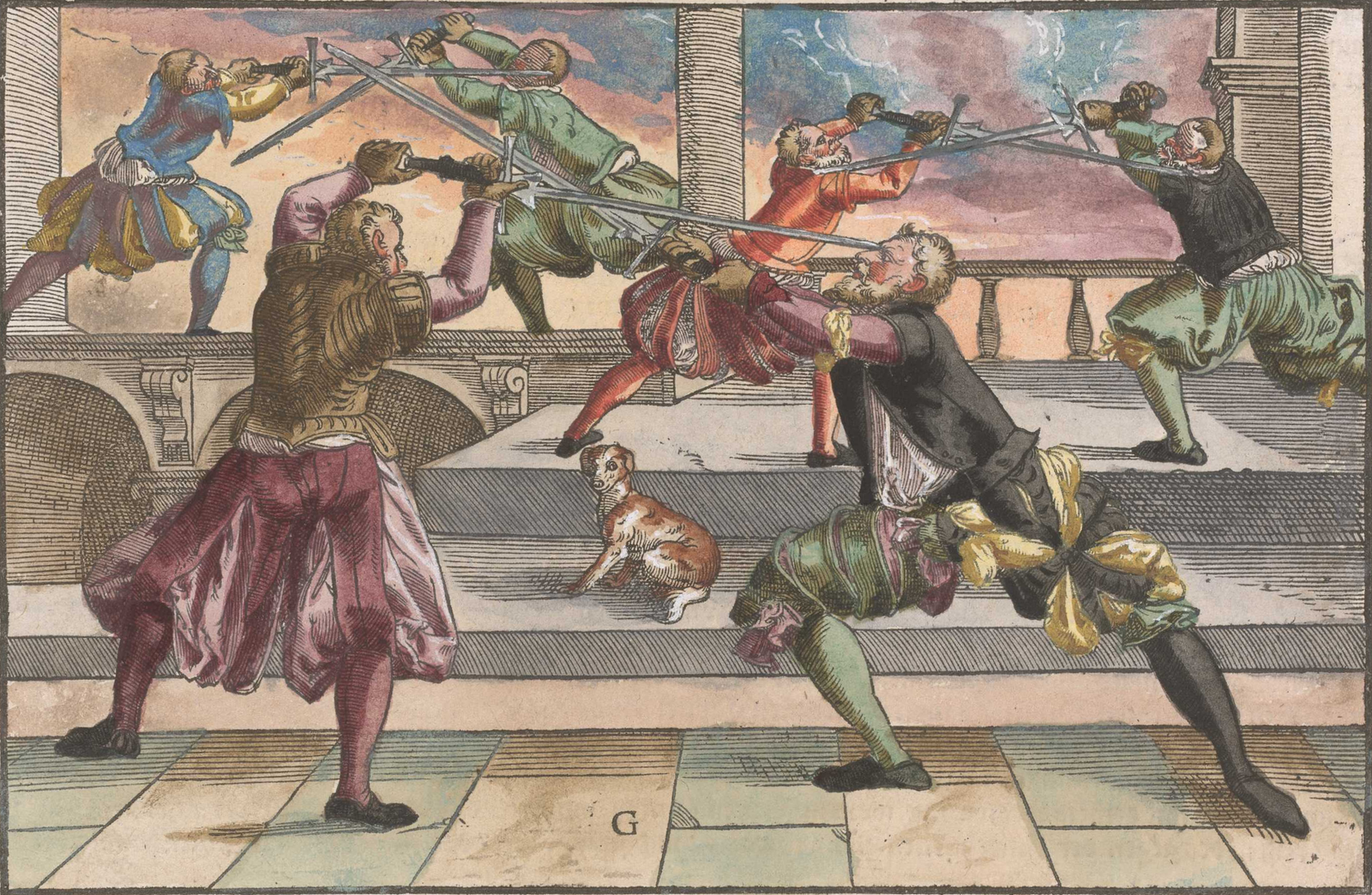
Squinter Cut is also a High Cut, but it is so named because it is cut together with a small skewed bit, and is formed like this: position yourself into the Guard of the Day or Wrath (regarding this, see the third chapter) with your left foot forward. If an opponent cuts at you, then cut to counter; however, in the strike, turn your short edge against their strike and hit equally with them (with inverted hands). Step with your right foot well to their left side and move your head quickly with [the cut]. Thus, you have executed it correctly, and you stand like the larger scene on the left side in the next Figure indicated with G.
SChielhauw ist auch ein Oberhauw, aber darumb also genant das er gleich mit einer kleinen Schiele gehawen,
wirt also gemacht, stell dich in die Hut des Tags oder Zorns (davon im dritten Capitel) mit dem Lincken fuß
vor, wirt auff dich gehauwen, so Hauwe hingegen, doch im streich verwende dein kurtze schneid gegen seinem
streich, unnd Schlag mit ebichter hand zugleich mit ihme hinein, trit mit deinem Rechten Fuß wol auff seine
Lincke seiten, und nimm den Kopff geschwindt mit, so hastu ihm recht gethan, und stehest wie das grosser Bild in nechst gedachter Figur mit dem G. gegen der lincken anzeiget.
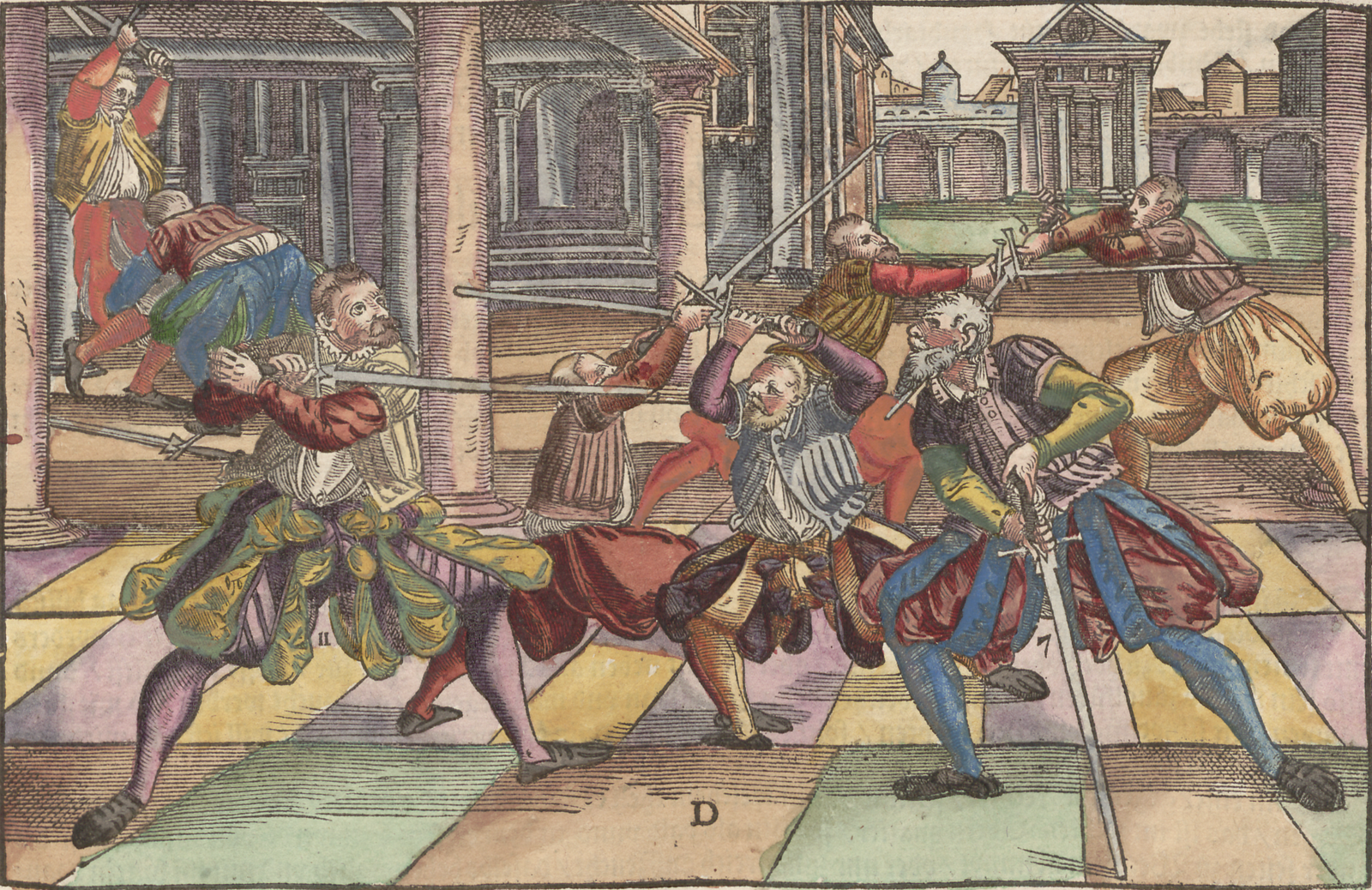
This cut is completed like this: stand in the Wrath Guard with the left foot forward. If your opponent cuts at you, then step with your right foot well toward their left side and out of their strike. Cut with the long edge and crossed hands counter to their cut or between their head and blade, across at their hands, and let the blade shoot well past their arms (such as can be seen in the upper tenants on the right in the Figure with the D).
DIser Hauw wirt also volbracht, stehe in der Zornhut mit dem Lincken fuß vor, Hauwet dein gegen Man auff
dich, so trit mit deinem Rechten fuß wol auß seinem streich gegen seiner Lincken seiten, Hauwe mit Langerschneid
unnd geschrenckten henden seinem hauw entgegen, oder zwischen seinen Kopff und Klingen, uberzwerch
auff seine hendt, und laß die Kling wol uber seinen Arm uberschiessen, wie solches in der Figuren mit dem D. an
obern bossen zur rechten Hand zusehen.
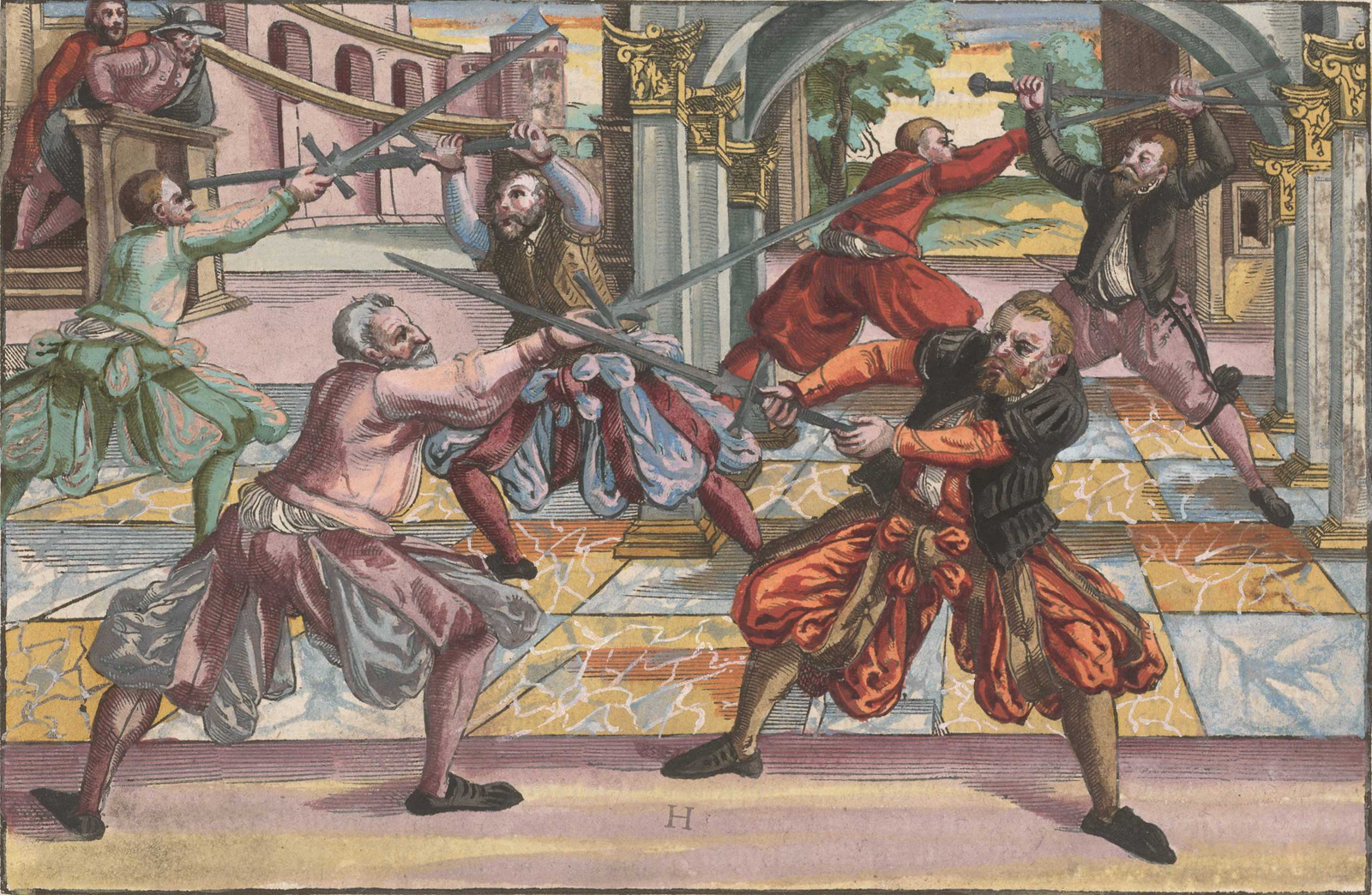
Comport yourself like this for the Crosswise Cut: in the Onset, position yourself in the Wrath Guard to the right (regarding this, see the previous chapter). Place your left foot forward and hold your sword at your right shoulder (as if you wanted to execute a Wrath Cut). If your opponent then cuts at you from the Day or from above, then simultaneously cut with the half edge across from below toward their cut. Maintain your crossguard high over your head, so that your head is blocked, and step well to their left side simultaneously with the cut. Thus you counteract [their cut] and you hit the weapons with one another (like the two tenants on the left side indicate in the Figure with the H).
How you would complete this Crosswise Cut on the left: you should direct yourself in the work toward their right side, with the exception that you should hit at their right with the long edge.
ZU der Zwerch schick dich also, stell dich im zufechten in die Zornhut zur Rechten (davon in vorgedachten Capitel)
das ist, setz deinen Lincken fuß vor, halt dein Schwerdt an deine Rechte Achsel, als ob du ein Zornhauw
thun woltest, Hauwet dann dein gegen Man auff dich von dach oder Oben, so Hauwe zugleich mit halber schneid,
von Unden uberzwerch gegen seinem hauw, behalt dein kreutz hoch ob deinem Haupt, damit dein Kopff versetzet
sey, und mit dem hauw zugleich trit wol auff seine Lincke seiten, so versetzestu und triffest mit einander wie die
zwen bossen in der Figur mit dem H. gegen der Lincken anzeigen. Wie du dise Zwerch zur Lincken volbracht, also
soltu sie auch gegen seiner Rechten in das werck richten, allein das du gegen seiner Rechten mit Langer schneide
antreffen solt.
This is a secret move through and is executed like this: when your opponent cuts at you from above, position yourself as if you wanted to bind on their sword with a Crooked Cut (that is, with the short edge). Pass under it instead and quickly move through under their sword. Strike with the short edge and crossed arms over their right arm and at their head. Thus, you have caught their sword with the long edge, and completed the Short Cut. At the end of the same, you stand like the small tenant on the right side of the upper left scene indicate (which Figure is designated with the letter B).
DIser ist ein heimlicher durchgang, und wirt also gemacht, wann man von Oben zu dir einhauwet, so stelle
dich als woltestu mit dem Krumphauw, das ist mit halber schneide auff sein Schwerdt anbinden, underlaß
es doch, unnd fahr behend under seinem Schwerdt durch, schlahe mit halber schneid unnd geschrenckten Armen [Ⅰ.13r.1] uber seinen Rechten arm zum Kopff, so hast sein Schwerdt mit Langer schneid auffgefangen, unnd den Kurtzhauw
volbracht, und stehest nach ende desselbigen, wie an den obern kleinern bossen zur Lincken, das Bilde gegen
der Rechten handt außweisset, welche Figur ist mit dem Buchstaben B. verzeichnet.
The Glancing Cut is completed in this way: if a fencer cuts toward you from above, then hit with reversed or inverted hands against their strike at the upper left opening. Allow your sword blade to glance off with the inverted flat down their blade so that the short edge hits the head in the sweeping motion over the hands.
DEr Glützhauw wirdt dermassen volbracht, hauwet einer von Oben gegen dir zu, so schlag mit letzer oder
ebichier handt gegen seinem streich, der Lincken obern Blöß zu, laß deinen Schwerdts klinge an seiner klingen
mit ebichter fleche abritschen, das die kurtze schneidt im schwung uber die handt den Kopff treffe.
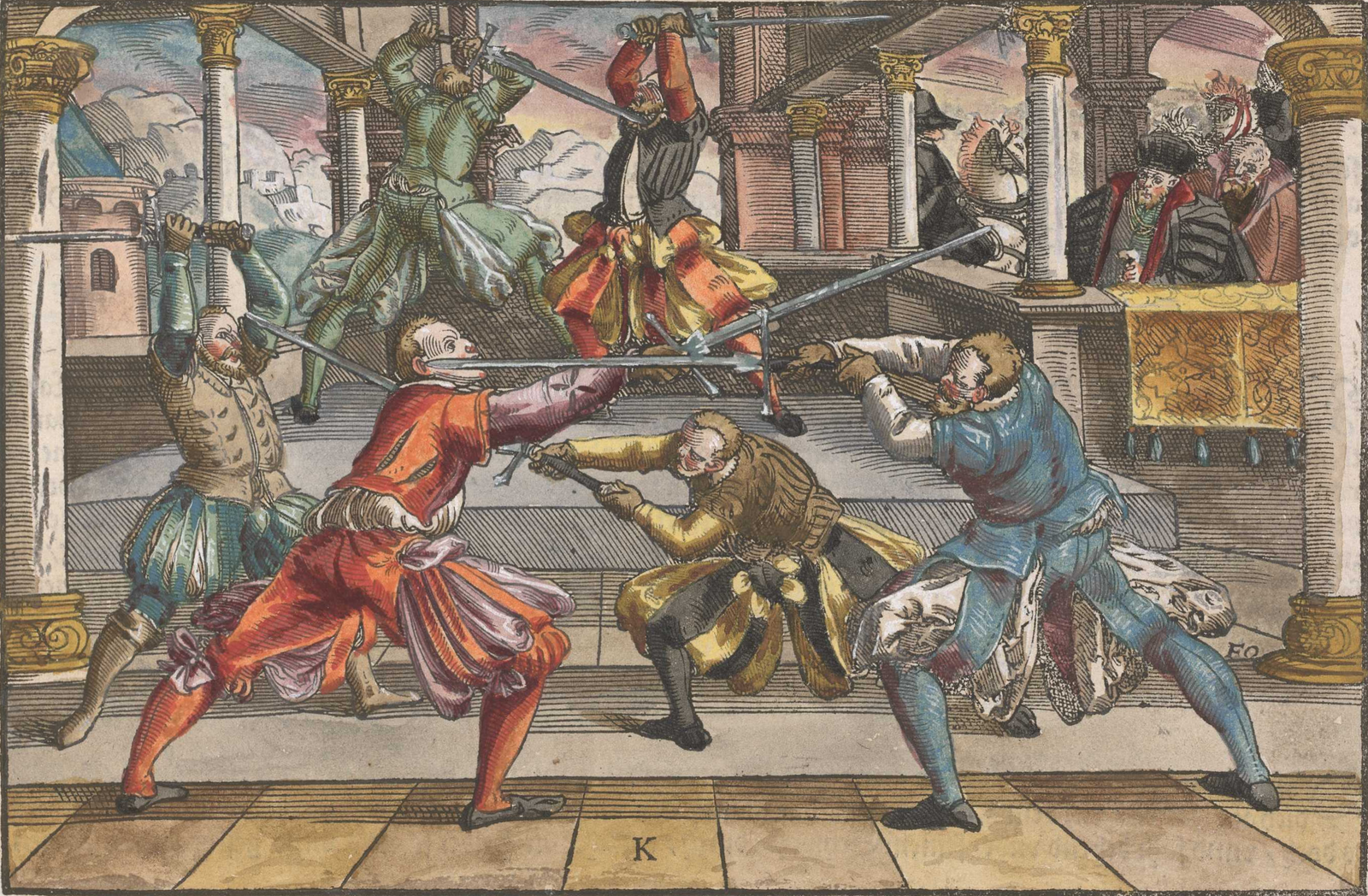
This one has two forms: the first is called the single, the second the double. The single is executed like this: if your counterpart cuts at you from above, then oppose their strike with a Crosswise Cut. As soon as it glances off, pull your sword around your head and hit at their ear from your left with the outward, inverted flat—but [do it] so that the sword rebounds back again (as the large scene shows on the right side in Figure K). Pull the rebounded sweeping movement back around your head, cut with the Crosswise Cut at the left, then it is complete.
DIser ist zweyerley: Einer der Einfach, der ander der Doppel genandt. Der Einfache wirt also gemacht, Hauwet
dein gegentheil auff dich von Oben her, so begegne seinem streich mit einer Zwerch, als bald es dan glitzt
so zuck das Schwerdt umb deinen Kopff, unnd schlag von deiner Lincken mit außwendiger letzer flech, zu seinem
Ohr, aller ding wie das grosser Bild zur Rechten hand in der Figur K. außweißt, das das Schwerdt widerumb zu
ruck abprelt, zuck es also im abpreleten schwung wider umb deinen Kopff, Hauw mit der zwerch zur Lincken, so
ist er volbracht.
Ⅰ.13r.3
7.16linked passage
7.17
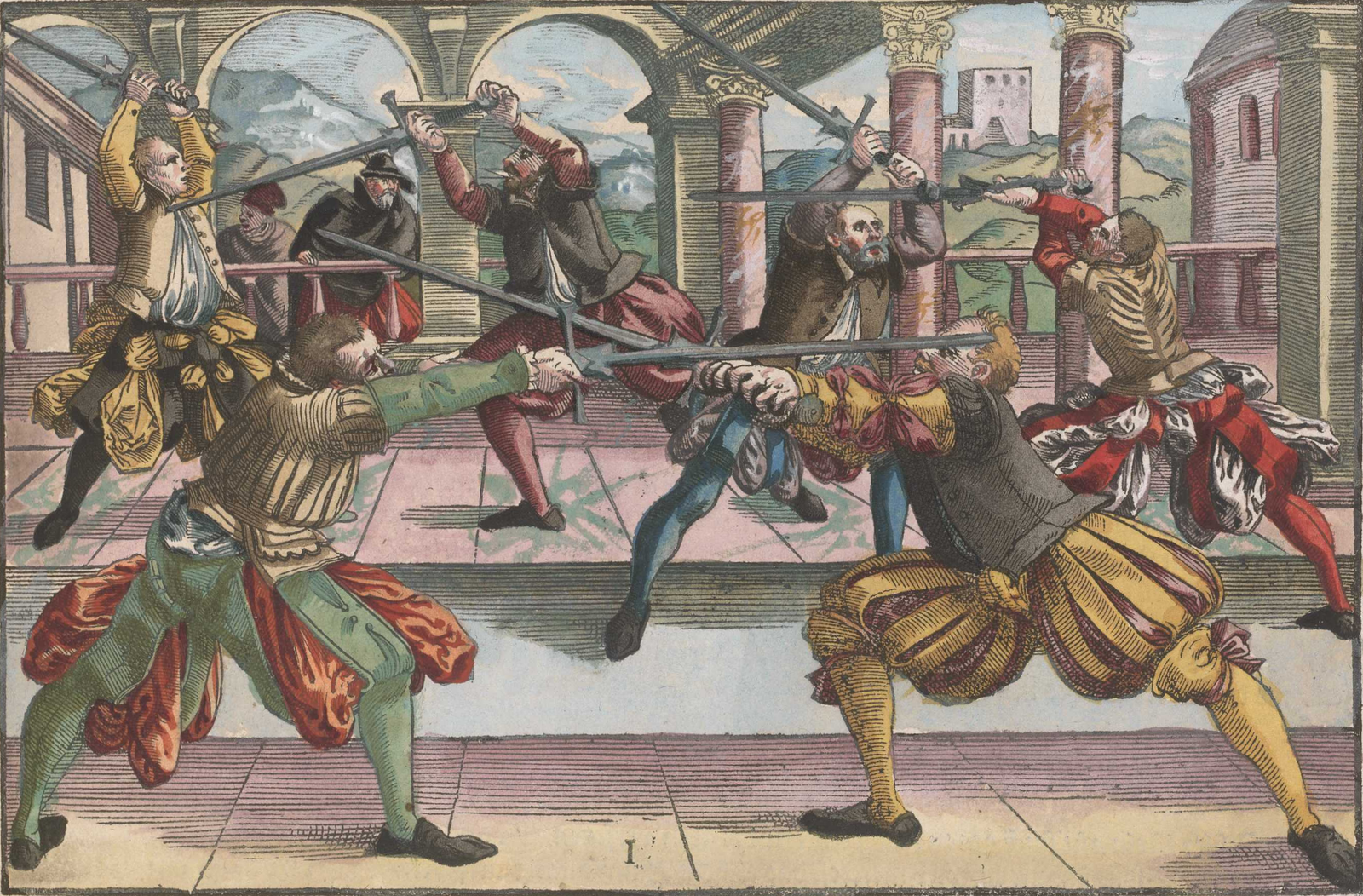
[17] Execute the double like this: as soon as your counterpart brings their sword into the air to work in the Onset, position yourself in the right Ox (regarding this, see the immediately-preceding chapter), pull the sword around your head and cut strongly at their blade from your right with the inward flat (so that in the hit, your pommel touches [you] low on the forearm bone), as can be seen in the larger portrait on the left in the Figure designated as I. In the strike, step with your right foot well around their left and as soon as it glances off or touches, jerk it upward and Indesly rip it outward and toward the left side. Quickly strike back around at the same opening from the outside and with inverted hands (namely, with the reversed or inverted flat). If it strongly rebounds around in another rebounding hit, then you have executed it correctly.
1570 Edition · fol. Ⅰ.13r.4
[Ⅰ.13r.4] Den Doppeln mach also, als bald im zufechten dein widerpart sein Schwerdt in die lufft bringt zur arbeit, so
stell dich in den Rechten Ochsen (davon im nechsten Capitel) zucke das Schwerdt umb dein Haubt, unnd Hauw
mit inwendiger flech von deiner Rechten starck wider seine klinge, das dir dein Knopff im schlag unden an die
spindel rühre, wie solchs an dem grossern Bild in der Figur I. verzeichnet, gegen der Lincken handt zusehen, im
streich aber trit mit deinem rechten fuß wol umb seinen Lincke, und so bald es glützt oder rühret, so ruck es ubersich,
reiß in des gegen der Lincken seiten gleich mit auß, und schlage behend außwendig mit ebichter handt wider[Ⅰ.14r.1] umb zu der selben Blöß hinein, nemlich mit letzer oder ebichter fleche, als wann es sich in einem widerprell also
herte umbprelt, so hastu !hn[!] recht gemacht.
Bind to your opponent on their sword from your right. In the bind, twist through below toward their left side using the hilt or grip. If your counterpart now wants to swipe to follow this twisting, then quickly flick the Weak (that is, the front end) from your right toward their left at their head with crossed hands. Quickly twist back through, or rip out toward your left side with the half edge. Thus, you have completed the Obscured Cut. This Obscured Cut is executed in many ways; more about this in later sequences.
BIndt dem Mann von deiner Rechten an sein Schwerdt, windt im Bandt mit dem gehültz oder Hefft unden
dnrch[!] gegen seiner Lincken seiten, wann nun dein widerpart dem winden will nachwischen, so schnell geschwindt
von deiner Rechten gegen seiner Lincken mit geschrenckten henden, die schweche zu seinem Kopff, das
ist der vorder ort, windt behendt wider durch, oder reiß auff deiner Lincken seiten mit halber schneiden auß, so
hastu den Blendthauw volbracht, dieser Blendthauw wirdt auff vil wege gemacht. Daruon in Stucken weiter.
The Twisting Cut is carried out in the following configuration: if your counterpart cuts at you from above, cut at their sword from below, from your left with crossed hands (so that your pommel peeks out from under your right arm). As soon as it glances off, immediately step out with your left foot away from them (well on your left side). Pull your sword’s pommel back up into a circle toward your left side, so that your long edge touches their head in a sweeping movement over their right arm (and behind their blade) or [you] hit over their right arm. (Regarding this, view the large portrait on the right in the following Figure designated with the H.) And, following this, immediately let your sword fly out next to your side and quickly cut back counter to this through the cross. This is how it is executed.
DEr Windthauw wirt volgender gestalt gemacht, Hauwet dein gegenpart auff dich von Oben, so Hauwe
von Unden mit gekreuzten henden, von deiner Lincken an sein Schwerdt, also das dein Knopff under deinem
rechten Arm außsehe, unnd so bald es glützt, so bald trit mit dem Lincken fuß von ihme aus, wol auff dein
Lincke seiten, zeuch dein Schwerdts knopff wider ab in ein runde, gegen deiner Lincken seiten herfür, das deine Langeschneid
uber seinem Rechten Arm hinder seine klingen seinen Kopff im schwang rühret, oder uber seinen rechten
Arm treffe, davon besihe das grosser Bild in gedachter Figur mit dem H. gezeichnet zur Rechten, und das demnach
zugleich dein Schwerdt neben deiner seiten ausfliehe, unnd Hauw behendt durch das kreutz wider dargegen,
so ist er gemacht.
This is conducted like this: when you stand in Plow (or otherwise fence up through a stance from below—this was discussed in the preceding chapter) and your counterpart cuts at you from above, then lift the crossguard horizontally, catch their strike in the air on your ricasso or crossguard, and, as soon as it glances off, quickly thrust the pommel upward and hit them behind their blade on the head using the half edge. Thus, you have completed the Crown Cut correctly.
DIser helt sich also, wann du im Pflug stehest, oder sonsten durch ein Leger (von welchem im vorgehenden Capitel
gesagt ist) von Unden auff zufechtest, unnd dein widerpart von Oben auff dich Hauwet, so fahre mit
uberzwerchem kreutz ubersich, fang ihme seinen streich in der lufft auff dein schilt oder kreutzstang, und als bald es
glitschet, stoß den Knopff behendt ubersich, und schlag ihn mit der halben schneiden hinder seiner klingen auff den Kopff, so hastu den Kronhauw recht volbracht.
This one is named after the body part towards which it is directed. Complete it like this: after the first attack, when you have arrived under your counterfencer’s sword with both hands high over your head and they hold their head between both arms, cut with the Crosswise Cut under their sword pommel, upward at their wrists or at the joint between their hand and arm. If they hold their hands too high, then cut from below upward at the knot [of bone] by the elbow (using the abovementioned Crosswise Cut). This is how it is carried out.
DIeser hat den Namen von dem Gliedt, nach welchem er gerichtet wirdt, den vollend also, wann dumit de[i]nen
henden hoch uber den Kopff nach dem ersten angriff, deinem gegenfechter under sein Schwerdt kommen
bist, und seinen Kopff also zwischen beiden Armen heltet, so Hauw mit den Zwirchhäuwen under seines Schwerts
Knopff, ubersich nach seinen Kniecheln, oder zu den gelencken zwischen seiner Hand und Arm, helt er die hendt
gar zu hoch, so Hauw mit obgemelten Zwirchhäuwen von Unden auff nach dem knöpfflein bey den Elenbogen,
so ist er gemacht.
Attention should be granted to the fact that there is a small difference between the [Plummet Cut] and the [Hairline Cut]. Although this cut is a High Cut, it is named the Plummet Cut because, in the cut through, it always Plummets headlong from above so that the point moves toward the counterpart’s face in Ox. It is mostly used in the approach or in the Onset.
OB wol diser Hauw ein Oberhauw ist, unnd dafür geachtet das zwischen disem und jenem ein geringer underscheidt
sey, wirdt doch diser darumb der Sturtzhauw genant, das er im durchhauwen alweg oben ubersturtzt,
das die spitz dem widerpart gegen seinem gesicht kompt in Ochsen, und wirt den mehrertheil im gang oder zufechten
gebraucht.
The Change Cut is nothing more than changing, with cuts, from one side to the other, from above to below and back again, in front of your opponent in order to mislead them.
DEr Wechselhauw ist nichts anders, dann vor dem Manne mit den häuwen von einer seiten zur andern, von
Oben zum Undern und hinwider abwechseln, ihn damit irre zumachen.
A flick or a tagging contact is almost a concept, one in which the cuts are not cut but instead are flicked. They are completed in the middle of the work or when the work is complete, whenever you have a suitable opportunity. Namely, you allow the weapon to snap from above, from both sides, or from below at your counterpart with the flat or outermost part of the blade, or you flick over or under their blade in a fluid motion.
SChneller oder Zeckrur ist fast ein ding, welche eigentlich nit häuw seindt die gehauwen, sonder geschnelt werden,
die werden volbracht in mitten oder voller arbeit, wann einer fug hat, so du nemlich von Oben oder
auff beiden seiten, oder von Unden gegen deinem gegenpart mit der flech oder eussern theil der klingen, das wehr
last Schnappen oder in einem schwung oben oder under seiner klingen hinein schnellest.
Ⅰ.14v.4
7.24linked passage
7.25
[25] This is a brief summary of the actual description of the cuts, as they usually occur in sword fencing. Though the same are described here with such strikes, steps, and cuts that they can only be easily used on one side and manner, yet they can be fenced on both sides, so I wanted to remind the gracious reader about this here. That is: with the same configuration, each of the preceding cuts, as is established and is executed from one side, can also be completed from the other neatly and suitably. I have then only skipped this in good faith because the extensive repetition and repeated description of the same is excessive.
1570 Edition · fol. Ⅰ.14v.5
[Ⅰ.14v.5] Diß ist kurtzlich die eigentlich beschreibung der Häuw, wie sie im Fechten des Schwerdts üblich, Dieweil[Ⅰ.15r.1] aber dieselb mit den streichen, treten unnd Häuwen nur wie sie auff eine seiten unnd art einfach gebraucht werden
mögen, alhier beschrieben, und aber sie auff beiden seiten können gefochten werden, hab ich den gutherzigen Leser
dessen alhier erinnern wöllen, das gleicher gestalt ein jeder aus den vorgehenden Häuwen wie er gesetzt, unnd
von einer seiten gemacht, also auch von der andern artig und füglich kan volbracht werden, darumb dann ich der
selben weitleuffige widerholung unnd ernewerte beschreibung, als uberflüssig gutwillig ubergangen.
Ⅰ.14v.5Ⅰ.15r.1
7.25linked passage
7.26
[26] Because there may be questions about many of the cuts and their usage—why they occur, when everything is sufficiently understood in the four Main Cuts as well as the Squinter (in which the other inverted cuts are contained)—I wanted to admonish the kind reader of this art that such cuts (as described previously) are all apprehended in the five Master Cuts since they originate from the same. However, they were actually invented as another division of the art, and named with their different names, by those learned in this art for more diligent and useful examination so that the art, which is hidden and wrapped in another, can be more readily and more easily understood, grasped, and considered in different ways.
1570 Edition · fol. Ⅰ.15r.2
[Ⅰ.15r.2] Weil aber umb vile der Häuw und ihrer verenderung möchte gefragt werden, warumb solches beschehe, so doch
alles gnugsam in den vier Haupthäuwen sampt dem Schielhauw, mit welchem die andere verkehrte häuw begriffen
unnd verstanden werden, wil ich den liebhabenden Leser dieser kunst ermanet haben, das solche bißher erzelte
zuhäuw wol all in den fünff Meisterhäuwen begriffen, als die aus denselbigen herwachsen, jedoch eigentlich von
den erfahrnen diser kunst, zu mehrer fleissiger unnd nutzlicher ersüchung, unnd von einander theilung der kunst
darumb erfunden, unnd mit ihren underschiedlichen namen benamset, damit die kunst die also in einander gewickelt
verborgen, desto ehe und leichter begriffen, gefast und underschiedlich behalten werden köndt.
_1570_page41.jpg)
_1570_page42.jpg)
_1570_page43.jpg)
_1570_page45.jpg)
_1570_page46.jpg)
_1570_page48.jpg)
_1570_page49.jpg)
_1570_page50.jpg)