This stance is not dissimilar from the Plummet [Cut] and is one of the best stances from which all kinds of techniques can be fenced using all of the cuts that are appropriate for attacking in the Before.
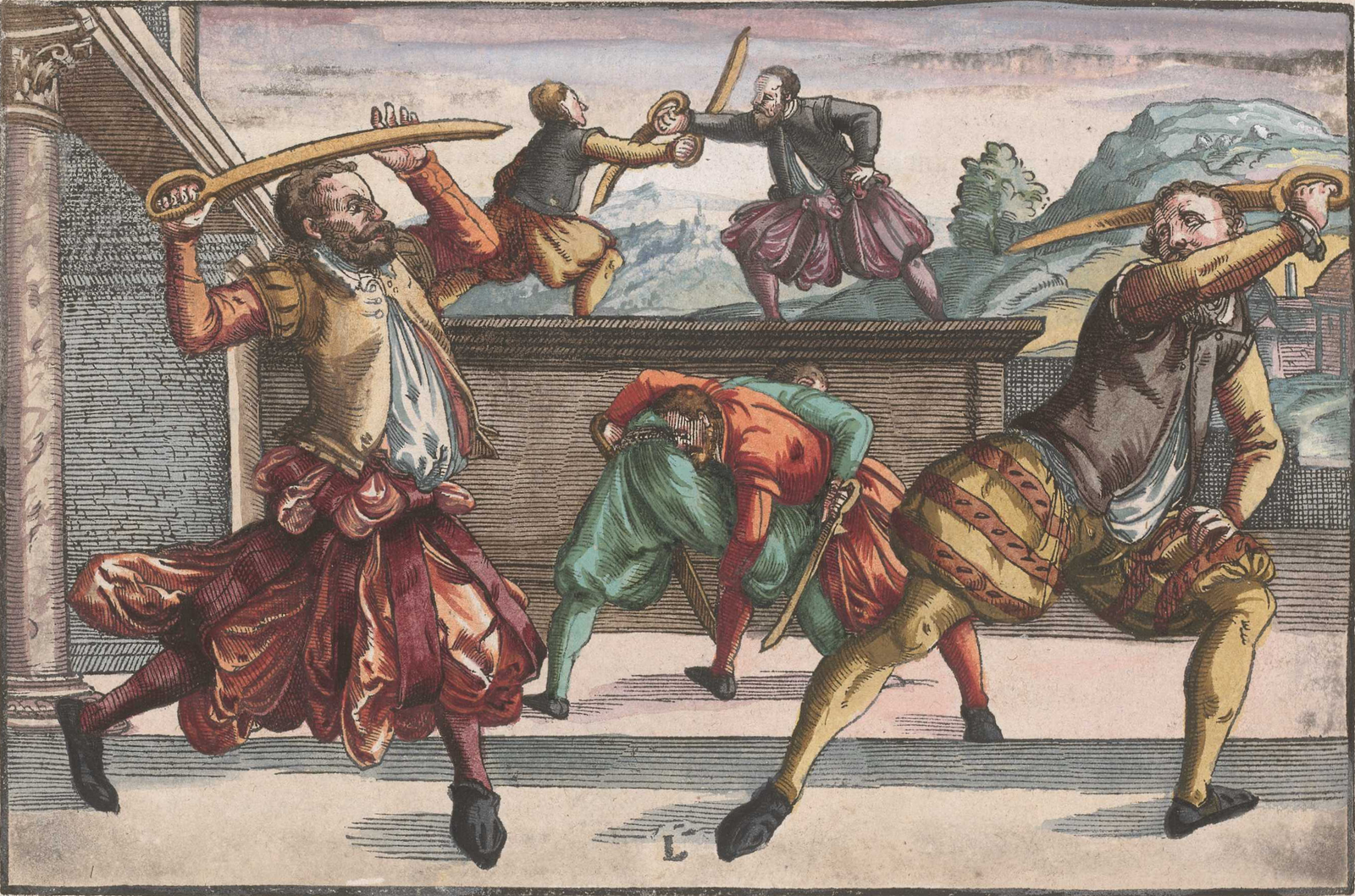
For this stance, position yourself like this: stand with the left foot forward, hold your dusack with your hilt to the right next to your head so that the front end extends toward your opponent’s face (as the large portrait on the left shows in the Figure [B] printed previously, although they are in mid-step). And the stance is nothing more [or less] than a gathered thrust from above.
DIses Leger ist dem Sturtz nicht unehnlich, und der besten Leger eins, auß welchem, durch
alle Häuw, allerley stuck füglich zum angreiffen im Vor, können gefochten werden. Zu disem Leger schick
dich also, Stand mit den Lincken füß vor, halt dein Dusacken mit deim gehültz zur Rechten, neben deim Kopff,
Also das der vorder ort dem Mann gegen seinem gesicht stand, aller ding, wie das grösser Bildt, in
hievor getruckter Figur zur Lincken an zuzeigen im tritt ist, Und ist das Leger an
ihm seber nichts anderst, dann ein gezuckter stoß von oben.
Ⅱ.22r.3
25.1linked passage
25.2
[2] The first sequence, in which it is taught how you should reach past with simultaneous cuts from the Bull, with an appended Middle Cut including a thrust and a Cross Cut afterwards
When you move into the guard of the Bull in the Onset, and your counterpart cuts at you from their right, whether from above or below: leap well out from their strike toward their left side. Cut through simultaneously with them, with an extended arm, at their face and toward the hand in which they hold their weapon (ensuring that you remain with your weapon above theirs). Cut strongly enough that your dusack shoots around above your head into the Plummet (that is into the left Bull). From there, cut a Middle Cut back through toward their face (with the outward flat facing toward their right), so that your dusack shoots around above your head into right Bull. These two cuts should move quickly and strongly one after the other. Afterwards, threaten with a thrust from there. At the halfway point [of the thrust], pull the thrust back and cut two strikes through the cross.
1570 Edition · fol. Ⅱ.23r.1
[Ⅱ.23r.1] Das erste Stuck, in disem wirt gelehret, wie du ihn mit gleichem
hauw aus dem Stier uberlangen solt mit einem angehenckten Mittelhauw,
sampt einem stoß, und einem creützhauw nach.
WAnn du im zufechten in die Hut des Stiers kommest, und dein widerpart Hauwet dir zu
von seiner Rechten, es sey von Unden oder Oben, so spring wol auß seinem streich gegen seiner Lincken
seitten, und Hauw mit ihm zugleich, doch das du mit deiner Wehr uberhalb der seinen bleibest zu seinem gesicht,
und gegen seiner hand, darinnen er sein Wehr führet, mit außgestrecktem Arm gantz durch, also starck, das dein
Dusack wider uber deinem Haupt umschiesse in den Sturtz, das ist in Lincken Stier, von dannen Hauw ein
Mittelschlag mit außwendiger Fleche gegen seiner Rechten, wider gegen seinem gesicht durch, das dein Dusack
abermal uber deinem Kopff umbschiesse in rechten Stier, dise zwen häuw sollen behend unnd starck auff einander
gehen, Demnach trawe von dannen einen stoß, auff halbem wege aber zuck den stoß wider, unnd hauwe zwen
streich durch das kreutz, nach.
Ⅱ.23r.1
25.2linked passage
25.3
[3] The second sequence, in which is taught how you should cut through their arm (in that moment in which they lift), and how you should cut simultaneously and above their weapon at their head (in that moment in which they cut back)
When you move into this guard, pay attention: as soon as they have cut, in that moment in which they lift for the strike, cut through across or from below from your right toward their hand. Afterwards, in that moment in which they cut back, cut again quickly from outside and over their right arm at their head with powerful steps outward toward their right out from their strike.
1570 Edition · fol. Ⅱ.23r.2
[Ⅱ.23r.2] Das ander stuck, in welchem gelehret würt, wie du, in dem er auffgehet,
durch sein Arm solt Hauwen, und in dem er wider herab Hauwet, du ihm
zugleich oberhalb seinem Wehr zum Kopff hauwen solt.
WAn du im zufechten in dise Hut kommest, so hab acht, Als bald er im hauwen ist, so hauwe
ihm uberzwerch, oder von unden (in dem er auffzeucht zum streich) von deiner Rechten, gegen seiner hand
durch, Demnach hauw auch behend, in dem er wider herhauwet, mit gewaltigem außtretten gegen seiner
Rechten, auß seinem streich, aussen uber seinem rechten Arm zu seinem Kopff.
Ⅱ.23r.2
25.3linked passage
25.4
[4] The third sequence, how you should counteract and cut in response from the Bull if they cut outwardly at you (that is, at your right)
If they cut at your right side when you stand in Bull, whether from above or below: step with your right foot toward their right and out to the side and toward them. Extend your dusack away from you toward their right. Let your front end hang toward the ground in this push forward and rebuff their strike with the dusack from your left toward your right. This setting off and step outward should take place together with one another. As soon as their cut touches on the outward flat of your dusack in this counterposture: withdraw your dusack back upward and away from theirs toward your left to strike. Cut outwardly above their right arm at their head, and step around toward their right simultaneously with this cut.
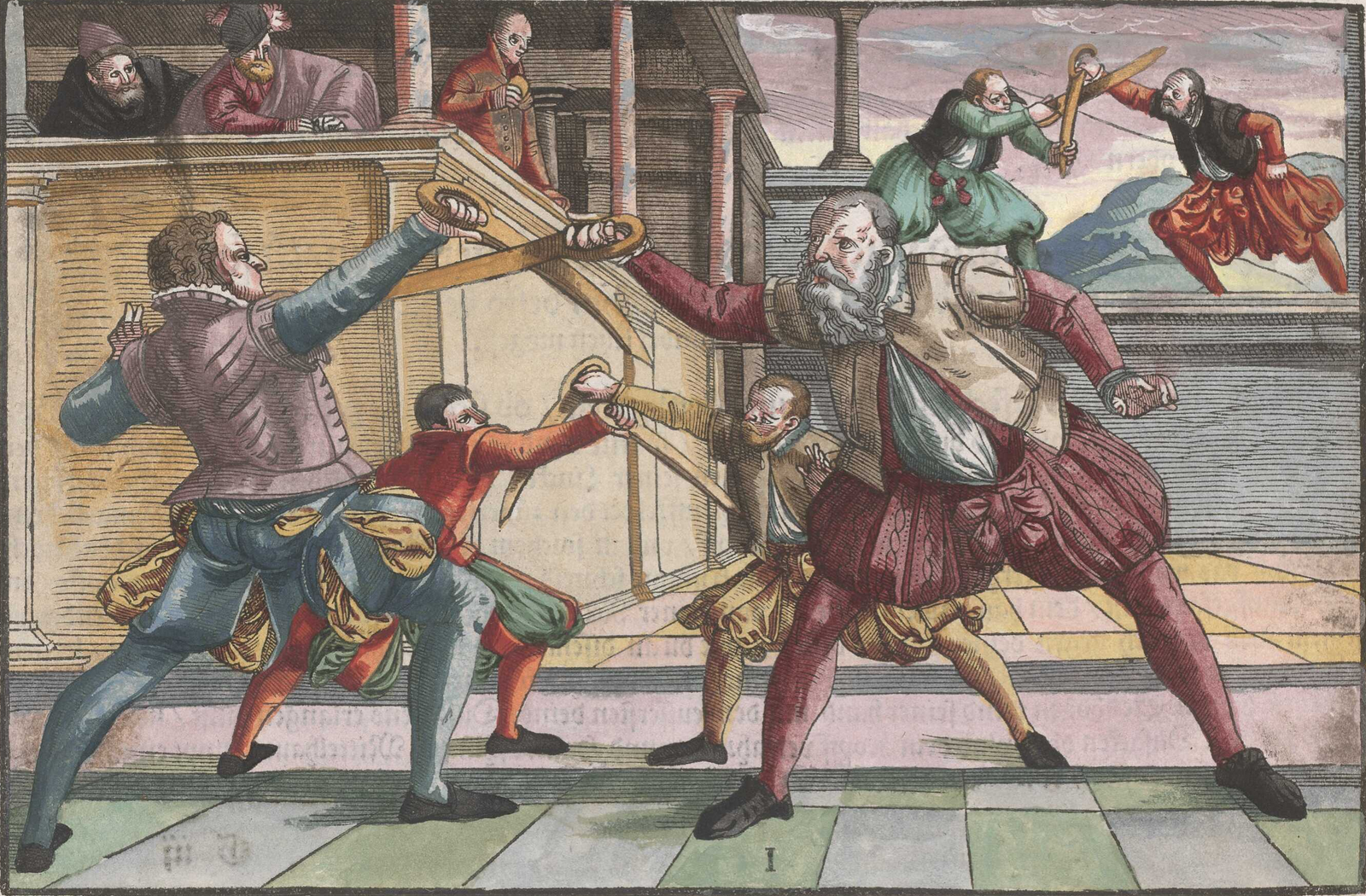
Or, if you have rebuffed their strike with the hanging dusack through the Arch, and they pull up from your counterposture to cut: step with a doubled step well out on their right side. Simultaneously with the steps outward, pull your dusack upward around your head and cut slantwise upward from your right with the curved edge, under their dusack, at their inward arm bone or flat (as can be seen in the subsequent Figure [I]). This Low Cut must take place in that moment in which they pull up to cut, so that your dusack arrives at your left shoulder. From there, cut two strikes long through the cross.
1570 Edition · fol. Ⅱ.23v.1
[Ⅱ.23v.1] Das dritte stuck, Wie du auß dem Stier, so er dir außwendig,
das ist zur Rechten zuhauwet versetzen, und nachhauwen solt.
HAuwet er dir aber zu deiner Rechten seitten, so du im Stier stehest, es sey Unden oder Oben, so tritte mit deinem
Rechten Fuß gegen seiner Rechten, zur seitten auß zu im, und streck deinen Dusacken gegen seiner Rechten von
dir, laß in solchem fortschieben dein Vorder Ort gegen der Erden hangen, unnd weise im also mit hangenden Dusacken,
seinen streich von deiner Lincken gegen deiner Rechten, ab, Diser absatz und austrit sollen miteinander geschehen.
Als bald dein haw also an die außwendige fleche deines Dusackens im Versetzen rüret, so zuck deinen Dusacken von
seinem wider ubersich gegen deiner Lincken ab, zum streich, und hauwe außwendig uber seinen Rechten arm, zum
kopff, zu solchen hauw trit auch ferner gleich mit umb gegen seiner Rechten, oder wen du ihm, also mit dem
hangenden Dusacken seinen streich durch den Bogen hast abgesetzt, unnd er von deiner Versatzung auffzeucht zu
hauwen, so trit mit einem zwyfachen trit, wol auff seine Rechte seitten, auß, und zugleich solchem außtretten, zuck
deinen Dusacken ubersich umb deinen kopff, und hauw mit krummer Schneid von deiner Rechten, Under seinem
Dusacken, Schlims ubersich zu seiner inwendigen Spindel oder Flech, wie in diser nachgesetzten Figur zusehen,
diser Underhauw muß geschehen, in dem er auffzeucht zuhauwen, das dein Dusack zu deiner Lincken Achsel komme, von dannen hauw zwen streich, durch das creütz, lang nach.
Ⅱ.23v.1
25.4linked passage
25.5
[5] The fourth sequence is a rule in which it is taught how you should safely catch all cuts in all stances, whether they come from the right or the left
This is a good rule, therefore: whenever you have cut with diligence or have cut through into one of the stances and they cut in response, swiftly and unexpectedly, you shall move out of that same stance with the point toward their face (such that your long edge is turned towards their in-flying strike in this push forward to catch [their strike]) in such a way that you stand in Longpoint at the end of the thrust.
As an example of this, when you move in the Onset into the aforementioned Bull in front of your opponent and your counterpart cuts from their right toward your left: step quickly with your right foot out toward their left (somewhat to the side). In that moment in which they cut in: thrust toward their face with arm extended. In this thrust, turn the long edge toward their incoming cut, so that you counteract their strike and thrust simultaneously. If they defend against your thrust and guide it upward: lift your hilt up toward your left. From there, cut a Low Cut through their right. Then cut quickly back straight from above through their face, with another step forward of your right foot.
1570 Edition · fol. Ⅱ.23v.2
[Ⅱ.23v.2] Das vierde stuck ist ein Regel, in welchem gelert wirt wie du
alle Häuw, sie kommen von Rechter oder Lincken, in allen Legern
sich er aufffangen solt.
DIses ist ein gute Regel, das, wo du mit fleiß, oder durch verhauwen, in der Leger eins kommen
werest, und hauwet er dir eilends und unversehen nach, so fahre auß demselbigen Leger mit dem Ort gegen
seinem gesicht, doch das in solchem fürtschieben dein Lange schneid gegen seinem herfliegenden streich den [Ⅱ.24r.1] auff zufangen gekehret sey, also, das du zu ende des stosses im Langen ort standest, dessen nim ein Exempel also,
wann du im zufechten in gemelten Stier für den man kommest, und dein widerpart hauwet dir von seiner Rechten
gegen deiner Lincken, so tritt behend mit deinem Rechten Fuß gegen seiner Lincken etwas zur seiten auß, und stich
in dem er herhauwet, mit außgestrecktem Arm gegen seinem gesicht, in solchem stechen aber wende die Lange
schneide gegen seinen herkommenden hauw, also versetzestu ihm seinem Streich unnd stichest zugleich, wehret er
dir den stich unnd führet den ubersich, so fahr auch auff mit deinem gehültz gegen deiner Lincken, von dannen
Uauw[!] ein Underhauw durch seine Rechte, und demnoch hauwe behend wider mit fernern zutritt, deines
Rechten Fuß gerad von Oben durch sein Gesicht.
Ⅱ.23v.2Ⅱ.24r.1
25.5linked passage
25.6
[6] What you should fence from the Bull toward an opponent who does not want to cut first
In the first Onset, when you become aware that they don’t want to cut or attack first with their sequences, take diligent note how they want position themselves into a guard or stance, so that you can see whether they hold their hand too high or low, or also too far outward toward one side in their fencing.
Therefore, pay attention: as soon as you observe that they hold their hand, including the weapon, too high, you fence at them in this way, namely, from the aforementioned Bull, step and cut through from your right, across from below and underneath their dusack (while they hold it too high), upward at their face and toward their right hand (in which they hold their weapon) so that that you arrive into the Wrath Guard on the left after the end of this Low Cut. From there, cut again with the long edge (as before), powerfully and strong, upwardly toward their right through their face. In conjunction with this Low Cut, you should step farther toward them with your right foot (which you have forward anyway) so that with this upward cut you arrive into the right High Guard. From there, cut a Cross Strike through their face quickly, long, and strong.
1570 Edition · fol. Ⅱ.24r.2
[Ⅱ.24r.2] Was du auß dem Stier, gegen dem, er nicht zu erst Hauwen
will, Fechten solt.
Im ersten zufechten, wann du gewar wirst das er nicht Hauwen wil, noch zu erst mit seinen
stucke angreiffen, so merck fleissig wie er sich in ein Hut oder Leger schicken wil, damit du sehen mögest
ob er sein Hand im Fechten zu hoch oder nider, oder auch zu weit gegen einer seiten auß füret, Derhalben so
hab acht, also bald du ersihest das er sein Hand mit sampt der Wehr zu hoch füret, das du ihm also unnd auff solche
weiß zufechtest, nemlich, trit und hauwe auß jetztgemeltem Stier, von deiner Rechten uberzwerch von Unden,
underhalb seinem Dusacken (dieweil er den noch in der höhe führet) ubersich zu seinem gesicht, unnd gegen
seiner Rechten Hand, in welcher er die Wehr führet durch, also das du nach ende des Underhauws zur Lincken
in die Zornhut kommest, von dannen Hauw abermals wie vor mit Langer schneid gewaltig unnd starck übersich,
gegen seiner Rechten durch sein gesicht, zu solchem Underhauw solt du mit deinem Rechten Fuß welchen du ohne
das vor hast, weiter zu ihm fürt tretten, so komstu mit disem ubersich hauwen in der rechten Oberhutten eine,
von solcher hauwe behend lang unnd sarck, ein Kreutzstreich nach durch sein gesicht.
Ⅱ.24r.2
25.6linked passage
25.7
[7] An example and sequence, how you bring someone down who holds their weapon high in fencing and how you should arrive above the [weapon] at their head or face
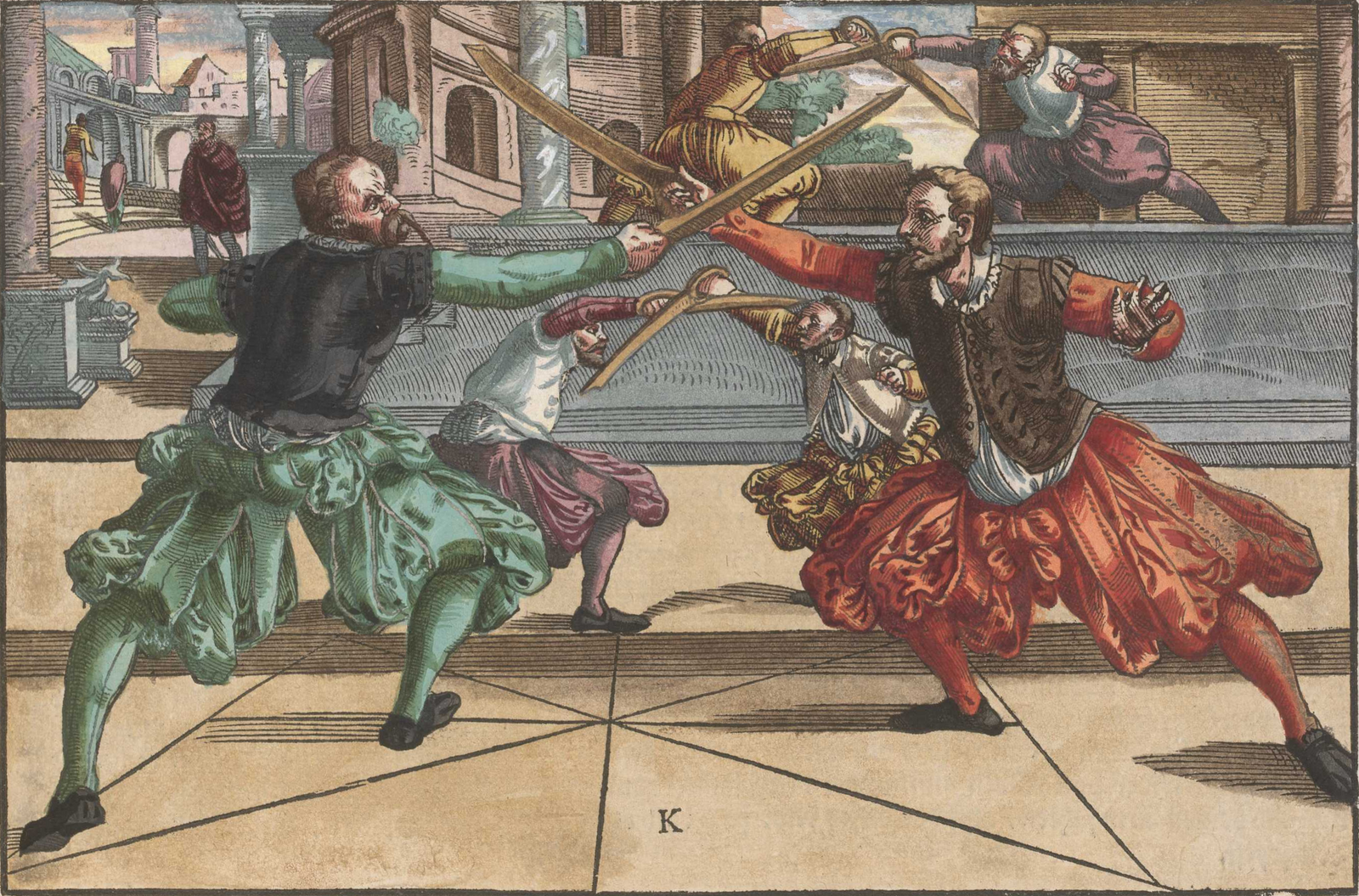
In the Onset, step toward them with your right foot and thrust underneath their dusack toward their face or chest (as the upper and smaller scene in the Figure which is designated with the letter K teaches). As soon as they drop down to counteract the thrust (since they must counteract if they otherwise don’t want to get hit in the face), pull your dusack back around your head. In that moment in which they drop down with their dusack: cut straight and across above the same through their face. Afterwards, cut the third straight from above through the upright line with another step forward of your right, so that you arrive in left Change [Guard] at the end of the cut. From there, move quickly to the counterposture outside of their right arm with the long edge upward and toward their weapon. Bind on their dusack from below and take diligent note: as soon as they lift up from your weapon and pull upward to cut, in that moment in which they pull upward, cut hard next to their hilt, from above, downward through their face.
For this cut, you should step with the right foot farther around toward them, so that you bend your upper body far forward following the cut and you stand with your feet wide apart (so that you can arrive that much earlier back at the counterposture with your dusack).
1570 Edition · fol. Ⅱ.24v.1
[Ⅱ.24v.1] Ein Exempel und stuck, wie du einen der sein Wehr im fechten
hoch füret, herab bringen, unnd oberhalb desselbigen zum Kopff
oder gesicht kommen solt.
IM zufechten tritt mit deinem rechten Fuß zu ihm, und stich ihm underhalb seinem Dusacken
gegen seinem gesicht oder Brust zu, aller ding wie dich das ober und kleiner Bild, in der Figur (welche mit dem
Buchstaben K. verzeichnet) lehret, als bald er dem stoß nach, den zuversetzen (wie er dann solchen wo er anders nicht ins
gesichte getroffen werden wil) versetzen muß, herab fellet, so zucke deinen Dusacken wider zu ruck umb den Kopff
und hauwe eben (in dem er mit seinem Dusacken herab fellet) Oberhalb desselbigen überzwerch durch sein gesicht,
demnach Hauwe zum dritten gerad von Oben durch die auffrecht Lini, mit einem fernern zutrit deines rechten,
also das du nach ende des Hauwes in Lincken Wechsel kommest, von dannen fahr behend ausserhalb seines rechten
Armes mit Langer schneid, ubersich gegen seiner Wehr zur versatzung, bind ihm also von Unden an sein Dusacken,
aldo merck fleissig, als bald er von deinem Wehr abgeht, unnd den ubersich zeicht zuhauwen, so Hauwe
in dem er noch im ubersich ziehen ist, hart neben seinem gehültz von Oben nider durch sein gesicht, zu solchem
Hauw soltu mit dem rechten Fuß also fürter umb zu ihm tretten, damit du mit deinem Obern leib dem Hauw
nach wol fürsich nider gesenckt, und mit den füssen weit von einander standest, so kanstu mit dem Dusacken dester
ehe zur versatzung wider auffkommen.
Ⅱ.24v.1
25.7linked passage
25.8
[8] How you should oppose an opponent who holds their weapon too low
If they hold their dusack low in their counterposture—namely, in the Arch—so that you can see and reach their face well above their hilt: from Bull, step and cut from your right above their hilt, across through their face and thus close to their hilt so that you touch and hit them with the abovementioned cut. In that moment in which your cut flies in through their face, simultaneously pull your hilt back upward. During this, step with your left foot behind your right toward their left and follow with the right further toward the abovementioned side. During these steps, cut the second quickly straight from above through their face.
These two cuts—namely, the Crossing [Cut] and then the High [Cut]—should always be completed with the steps just taught, quickly and fast in series. Then the sequence comes off well.
1570 Edition · fol. Ⅱ.24v.2
[Ⅱ.24v.2] Wie du dem der sein Wehr zu nider führet
begegnen solt.
FUhret er aber sein Dusacken mit seiner versatzuug[!] nemlich im Bogen niderig, also das du
ihm Oberhalb seinem gehültz sein Angesicht wol ersehen unnd erlangen kanst, so tritt und Hauwe von deiner
Rechten auß dem Stier oberhalb seinen gehültz uberzwerch durch sein gesicht, also hart an seinem ge= [Ⅱ.25r.1] hültz, auff das du im dasselbige mit gemelten hauw anrürest und treffest, In dem aber dein hauw also durch sein
gesicht herfleugt, so zuck zu gleich auch dein gehültz wider ubersich, und trit under des mit deinem Lincken Fuß hinder
deinem Rechten gegen seiner Lincken, und folge mit dem Rechten auch ferner zu im gegen gemelter seiten, hauwe also
behend den andern mit solcheo[!] tritten gerad von Oben durchs gesicht, Dise zween Häuw, nemlich der
uberzwerch, Demnach der Ober sollen sampt mit gelehrten tritten behendiglich und geschwind auff einander volbracht
werden, so gehet das Stuck wol an.
Ⅱ.24v.2Ⅱ.25r.1
25.8linked passage
25.9
[9] An example and sequence about an opponent who cuts quickly in response, how you should cut through the Weak of their dusack (to provoke), then catch their cut, and then cut through their face (with the curved edge to the right and with the long to the left)
Furthermore, if they hold or guide their dusack extended far in front of themselves and are also ready to cut quickly in response: step and cut the first from your right (from the abovementioned Bull) toward their left, this time through the Weak of their dusack.
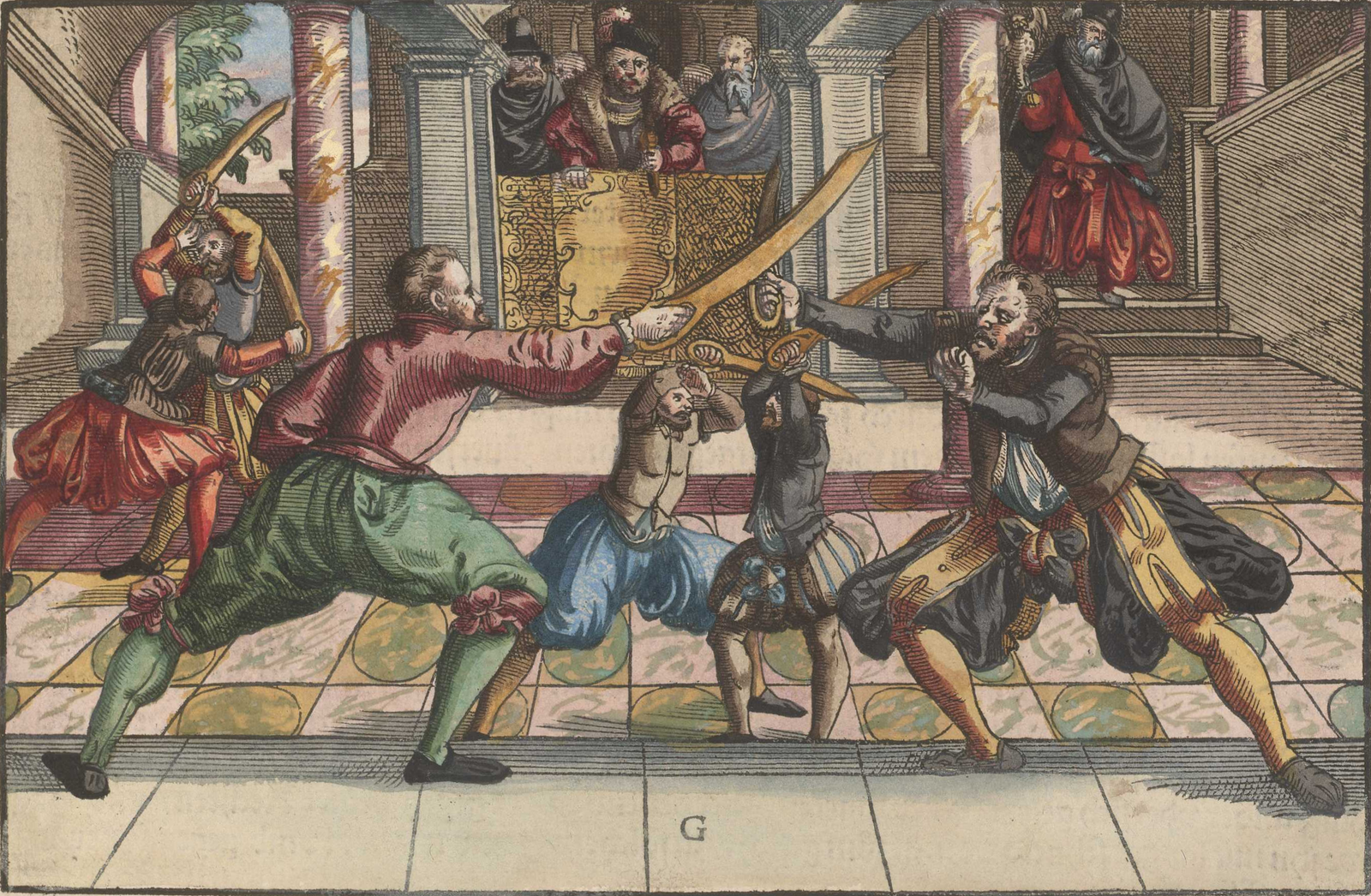
They will want to quickly cut in response to this cut, in the opinion that they can overtake you. Therefore, pull your hilt quickly upward around your head after the first strike and cut the second (also from your right), across toward their cut (to which your first cut has provoked them and shifted them upward), so that you catch them with the [second cut] while they are still flying in (as the large scene toward the right side shows in the Figure which is designated with the letter G).
As soon as their cut touches or beats on the long edge of your dusack: step around quickly with your left foot out toward their right side. Simultaneously with this step, pull your dusack back up from their weapon around your head and cut with the curved edge outside of their right arm at their head (as the smaller scene between the larger also teaches you in the abovementioned Figure [G]). They must counteract that (if they otherwise don’t want to be hit). In that moment in which they want to defend against this and counteract, they expose their face, so you should quickly cut through strongly at it with a step backward of your left foot. After this cut, move quickly back into a good counterposture.
1570 Edition · fol. Ⅱ.25r.2
[Ⅱ.25r.2] Ein Exempel und Stuck, wie du dem der bald nach hauwet,
durch die schweche seines Dusackens (in auff zu bringen) hauwen, Demnach
seinen Hauw aufffangen, und mit krummer schneid zur Rechten,
mit langer zur Lincken, durch sein gesicht hauwen solt.
WEiter helt oder führet er seinen Dusacken weit vor ihm auß gestreckt, und ist bereit auch bald
nach zu hauwen, so trit und hauwe den ersten von deiner Rechten auß gemeltem Stier, gegen seiner Lencken
abermal durch die schwech seines Dusackens, Disem Hauw wirt er bald nach hauwen wöllen, in meinung dich zu
ereylen, derhalben zucke behend nach dem ersten streich dein gehültz wider ubersich umb deinen kopff, unnd hauwe
den andern auch von deiner Rechten, doch uberzwerch gegen seinen hauw, zu wölchem du ihn dann mit deinem
ersten durchhauw angereitzt und auffbracht hast, auff das du ihm den selbigen (dieweil er noch also im herfliegen
ist) aufffangest, aller ding wie das grosser Bild in der Figur wölche mit dem Buchstaben G. verzeichnet, gegen der
Rechten hand anzeiget, Als bald sein hauw also auff die Lange schneid deines Dusackens rüret oder bocht, so trit behend
mit deinem Lincken Fuß gegen seiner Rechten seiten auß, umb, und zugleich mit solchem trit zucke deinen Dusacken
wider ab von seiner wehr umb dein haupt, und hauwe mit krummer schneide ausserhalb seinem Rechten Arm
zu seinen Kopff, wie dich dann solches die kleinern Bilder zwüschen den grossen auch in gemalter Figur lehren,
das muß er (wo er anders nit wil getroffen wern) versetzen, Aber in dem er dir solches wehren unnd versetzen wil, [Ⅱ.25v.1] Blößt er damit sein gesicht, zu welchem du als dann behendiglichen mit einem abtrit deines lincken Fußes starck
durch hauwen solt, nach solchem verhauwen fahr behend wider auff in gute versatzung.
Ⅱ.25r.2Ⅱ.25v.1
25.9linked passage
25.10
[10] An example and sequence, how you should break through the counterposture of your counterfencer from below and above with force
If your counterpart opposes you in a stance (regardless of which stance it is), position yourself in the Onset into the guard of the Bull also on the right. From there, threaten them with a powerful thrust from above toward their left. As soon as they rise to oppose your thrust, pull the same uncompleted [thrust] quickly back towards yourself and upward toward your right. Catapult strongly and powerfully from there, with the curved edge upward, toward their left through their face and counterposture.
In association with all of this, you should always step in this way: namely, in that moment in which you threaten the thrust, lift your right foot to step, and pull the threatened thrust so quickly that you set the lifted foot back down with the completion of the Low Cut, so that the step forward and the strike are completed together.
1570 Edition · fol. Ⅱ.25v.2
[Ⅱ.25v.2] Ein Exempel und stuck, wie du durch deines gegen Fechters
versatzung, von Unden unnd von Oben, mit gewalt
durchbrechen solt.
BEgegnet dir dein gegenpart in einem Leger (gilt gleich was es für ein Leger sey) so schicke
dich im zufechten in die Hüt des Stiers auch zur Rechten, von dannen trauwe ihm ein gewaltigen stoß, von
Oben gegen seiner Lincken, und als bald er aufffehret deinem stoß zubegegnen, so zucke denselbigen behend
wider an dich, unvolbracht übersich gegen deiner Rechten, unnd schlaudere von dannen mit krummer schneide,
und gewaltiger stercke ubersich gegen seiner Lincken, durch sein gesicht und versatzung, zu solchem allen soltu auff
dise weise tretten, nemlichen also in dem du den stoß trauwest, so erhebe dein rechten Fuß zu dem tritt, und zucke
den getrauweten stoß also behend, auff das du mit solchem tritt eben in volführung des Underhauwes, den erhebten
Fuß im fürtretten wider nider setzest, also das der tritt und der streich mit einander vollendet werden.
Ⅱ.25v.2
25.10linked passage
25.11
[11] Following this Low Cut, cut quickly from above through their face, powerfully and long in front of yourself, with additional steps outward toward their left. When you execute the outward rip from below, with the High Cut, swiftly one after the other, with their associated steps, the sequence moves well.
1570 Edition · fol. Ⅱ.25v.3
[Ⅱ.25v.3] Auff disen Underhauw, hauwe behend mit fernerem außtretten gegen seiner Lincken, von Oben durch sein
gesicht gewaltig und lang von dir, wann du nun also den Riß von Unden, sampt dem Oberhauw geschwindt
nach einander führest, miit ihren zugehörenden tritten, so geht das stuck wol an.
Ⅱ.25v.3
25.11linked passage
25.12
[12] If another opposes you with this sequence, counter it like this, namely: in that moment in which you are moving upward toward their thrust to catch it, and you perceive that they will withdraw and want to cut from below, step with your right foot well toward their right side and drop down with the long edge strongly from above onto their in-flying Low Cut, so that, in this drop, the front end of your dusack extends toward your opponent’s right side. Block their Low Cut like this, so that they cannot move through. From there, pull quickly back up toward your left shoulder. From there, cut again at their head, from outside and over their right arm.
If they were to break through with their upward rip: Catch their High Cut above [yourself] on the long edge (assuming that you have deflected the previous Low Cut from above without injury) and take diligent note, in that moment in which their cut beats or touches on your counterposture, your dusack should immediately be pulled toward your left shoulder (as before) and cut at their closest opening. Or in that moment in which you have received their High Cut on your counterposture, thrust at them quickly (before they recover) underneath their dusack at their face. They must defend against this and thus give you space at an upper opening.
1570 Edition · fol. Ⅱ.25v.4
[Ⅱ.25v.4] So dir aber ein anderer mit solchem stuck begegnete, so brich ihm das also, nemlich in dem du gegen seinem
stoß den auff zufangen ubersich verfahren bist, unnd aldo gewahr wirst das er dir den wider entzucket, und von
Unden hauwen will, so tritt mit deinem rechten Fuß wol gegen seiner rechten seitten, unnd falle mit Langer
schneid starck von Oben auff seinen herfliegenden Underhauw, also das in solchem daraufffallen der Vorder ort
deines Dusackens gegen des Mans rechten seiten außsteht, sperre ihm also den Underhauw, auff das er nicht
durchkommen möge, von dannen zucke behend wider ab gegen deiner Lincken Achsel, von welcher hauwe ihm
ferner außwendig uber seinem rechten Arm zum Kopff, so er dir aber mit seinem Riß ubersich durch gebrochen[Ⅱ.26r.1] wehr, so fang ihm (zu dem das du im den vorigen Underhauw von Oben, dir unschedlich abgewisen hast) auch
seinen Oberhauw ubersich auff dein Lange schneid, unnd merck fleissig, in dem sein hauw auff dein versatzung
bocht oder riert, sol gleichfals wie vor dein Dusacken gegen deiner lincken Achseln gezuckt werden, und hauw ihm
zur nechsten Blöß, oder in dem du ihm sein Oberhauw auff dein versatzung empfangen hast, so stich ihm behend
(ehe das ersich wider erholet) Underhalb seinem Dusacken zu seinem gesicht, das muß er wehren, und dir damit
raum geben zur obern Blöß.
Ⅱ.25v.4Ⅱ.26r.1
25.12linked passage
25.13
[13] An example and sequence, how you should goad an opponent upward with body language (including cuts) so that you can better injure their arm bone with the curved edge
Take note: when you are in the Onset, observe diligently whether your counterfencer wants to position themselves into the Arch. As soon as you have recognized this, step and guide a powerful High Cut from the guard of the Bull (with serious body language) toward their left. However, don’t allow the cut to hit or touch, but take diligent note. As soon as they lift to counteract your cut: pull it quickly toward your left, back around your head. During the withdrawal, rotate your grip even more than when you want to cut farther, with the curved edge forward in the hit. In that moment in which they lift to capture your cut: cut underneath their dusack from your right (from inside) at their arm and upward toward their left (as you can learn and take note of in the portrait on the right in the next Figure [I]). However, in this cut, you should not come [any] closer to them than that you can just reach their arm between their elbow and their hand with the outermost [point] of your dusack. After this cut, let your dusack move up around your head and cut a Middle Cut, including a High Cut, through their face, etc.
1570 Edition · fol. Ⅱ.26r.2
[Ⅱ.26r.2] Ein Exempel und stuck, wie du einen mit geberden, zu sampt den
Häuwen, auffbringen solt, damit du ihm desto besser mit krummer
schneide die Spindel letzen mögest.
MErck, wan du im zufechten bist, so nim fleissig war, ob sich dein gegen Fechter in den Bogen
schicken wölle, als bald du solches ersehen hast, so trit unnd führe ein gewaltigen Oberhauw, auß der
Hut des Stiers mit ernsthafften geberden gegen seiner Lincken, laß aber solchen Hauw nicht antreffen
noch rieren, sonder merck fleissig, als bald er ubersich aufffehret den zuversetzen, so verzucke deinen Hauw behendiglich
gegen deiner Lincken wider ab umb dein Kopff, und in solchem abzucken umbgreiff dein Handhab noch
mehr auff das wann du fürterhin hauwen wilt, die krumme schneid im treffen vorgang, und Hauwe also (in
dem er auffgefahren ist, dein hauw zu empfahen) von deiner Rechten underhalb seinem Dusacken, inwendig zu
seinem Arm ubersich gegen deiner Lincken durch, wie du an disem Bild in gesetzter Figur zur Rechten, lernen
unnd mercken kanst, du solt aber zu solchem hauw nicht neher zu ihm kommen, dann das du ihm bloß seinen Arm
zwischen seinem Elenbogen unnd seiner hand mit dem eussersten deines Dusackens erlangen kanst, nach solchem
hauw laß dein Dusacken oben umb dein Kopff verfahren, unnd Hauwe ihm ein Mittelhauw sampt einem Oberhauw,
durch sein gesicht, &c.
Ⅱ.26r.2
25.13linked passage
25.14
[14] A good sequence from the Dangerous Cut which can also be properly fenced from the Bull
If you find your counterpart in Arch: step and cut a powerful cut from above, strongly at their hilt. They will cut quickly and soon in response. Therefore, take note that you don’t move through with your cut, but instead, as soon as your cut beats on theirs, let your blade drop downward next to their right arm and pull your hilt simultaneously back upward. In that moment in which they pull up to strike, cut the second quickly, next to their hilt and inwardly through their face (while they are still rising into the air for their strike).
Observe at the same time that you don’t move closer with your foot than that point from which you can easily reach them with the outermost point of your [dusack].
1570 Edition · fol. Ⅱ.27r.1
[Ⅱ.27r.1] Ein gut stuck auß dem Gefehrhauw, welches auch auß dem
Stier füglich kan gefochten werden.
FIndestu dein gegenpart im Bogen, so tritt unnd Hauw ein gewaltigen Hauw von Oben
starck auff sein gehültz, disem Hauwe wirdt er behend und bald nach hauwen, Derhalben merck das du mit
deinem hauw nicht durch kommest, sondern als bald dein hauw auff dem seinem bocht, so laß dein klingen
neben seinem rechten Arm undersich ablauffen, unnd zuck zugleich dein gehültz wider ubersich, Hauwe also den
andren[!] behend in dem er auffzeucht zum streich, neben seinem gehültz (dieweil er solches zu seinem streich noch in
der höhe führet) inwendig durch sein gesicht, und schauw aber gleichwol das du mit deinem Fuß nicht neher, dann
das du ihn mit dem eussersten deines theils wol erlangen kanst.
In the Onset, take note when you find an opponent in Arch: in order to counteract, step and cut a powerful cut from the right Bull. As soon as the cut beats or touches on their counterposture, turn the front end over their dusack and inward at their face. Thrust in on top of their dusack, so that they must counteract and defend upward. Therefore, take note: in that moment in which they lift up, pull your dusack around your head and cut from your right across toward their left at their face (while they are still high with their dusack). If they counteract the second from above: remain with your dusack on theirs in the bind and turn your point on their dusack and inward toward their face again. If they also defend against this: move your point through under their right arm and thrust outwardly over their right arm at their face. If they defend against the thrust: let your dusack move around your head and cut a Middle Cut across through toward the closest opening.
MErck wan du einen im zufechten im Bogen findest, zu versetzen, so tritt und Hauwe ein gewaltigen
Hauw auß dem rechten Stier, als bald der hauw auff sein versatzung bocht oder rieret, so wende
den vorder ort oberhalb seinem Dusacken hineinwerts zum gesicht, und stich ihm also auff seinem Dusacken
hinein, das muß er ubersich versetzen unnd wehren, Derhalben merck in dem er aufffart, so zuck dein Dusacken
umb den Kopff, und hauwe von deiner Rechten uberzwerch gegen seiner Lincken (dieweil er mit seinem Dusacken
noch also in der höhe ist) zu seinem Gesicht, versetzt er dir den abermal von Oben, so bleib mit deinem Dusacken
an dem seinen im Band, unnd wende im dein ort widerumb an seinem Dusacken einwerts gegen seinem
gesicht, wehrt er dir den auch, so fahre mit deinem orte under seinem rechten Arm durch, unnd stiche im
außwendig uber seinen rechten Arm auch zu seinem gesicht, wehret er dir den stich abermals,
so lasse deinen Dusacken umb deinen Kopff fahren, und hauwe durch
Mittelhäuwe uberzwerch gegen seiner der nechsten
Blössen einer zu durch.
Ⅱ.27r.2
25.15linked passage
25.16
[16] A good sequence from the Bull with which you can break through powerfully
In the Onset, take note as soon as you can now reach your counterpart: step and cut a strong cut powerfully through their counterposture with arm extended, so that at the end of the cut, your dusack sweeps around next to your left arm with the front end behind you (when seen from the outside). From there, again cut strongly and powerfully upwards from below through their right. Cut the third from your right toward their left (whether from above or below) through their dusack, through their face.
1570 Edition · fol. Ⅱ.27v.1
[Ⅱ.27v.1] Ein gut stuck auß dem Stier, mit welchem du
gewaltig durchbrechen kanst.
MErck im zufechten, Als bald du nun deinen gegenpart erlangen kanst, so trit und Hauwe einen
starcken hauwe mit außgestrecktem Arm gewaltiglich durch seine versatzung, also, das sich dein Dusacken
nach ende des hauwes neben deiner Lincken mit dem vordern ort hinder dir auß zusehen, verschwinge,
von dannen Hauwe herwiderumb, abermals gewaltiglich unnd starck von Unden ubersich durch seine Rechte,
Den dritten hauwe von deiner Rechten gegen seiner Lincken, es sey Unden oder oberhalb seines Dusackens, durch sein Gesicht.
Ⅱ.27v.1
25.16linked passage
25.17
[17] A general rule to counter all kinds of sequences
Although I had initially planned to order and set a counter to be assigned to each sequence, it appears to me that it would be good to put this off, especially as in my other book (which I will possibly allow to be published in time and for the good of the art), I have set and described many nice sequences, including their counters. Therefore, I will merely present a general rule here, from which you can take and learn all kinds of counters. In addition, the art of fencing is such that you cannot easily know or hurriedly take note what kind of sequences they want to fence against you, to say nothing of the fact that you would have to be able to quickly know how it is countered.
Therefore, I always hold with the fencer, who knows many sequences and few counters, and also knows to carefully fence using the same in the Before and After, and allows the other to concern themselves with the counters. This fencer is so prepared with sequences that, if one of theirs is countered, they have two others at that point which are already in the works.
The general counter which I will set here is this: namely, when you have been overpowered with cuts by your counterfencer so that you must counteract them, move with a strong counterposture under their cut and hold them back so that they can’t get through with the same [cut] and so that they must pull their dusack back around from yours. While they are thus lifting from your dusack for another strike, thrust straight in front of you at them and toward their face. While doing this, turn the long edge toward that point which you see that they will cut in from again. This will counteract them.
However, if you cannot hold up their cut because, perhaps, they are too strong for you and will break through with strength, take note: in that moment in which their strike drops through toward the earth from your dusack, or moves out to the side, you should thrust straight at their face (while their dusack is still moving through), and you should complete this thrust before their weapon has completely dropped down to the ground.
If they oppose you with untrustworthy cuts, in that moment in which they guide their dusack around from one point to another: once again thrust at them straight forward from Longpoint toward their face or their chest. While doing this, pay diligent attention to the point where they want to attack from with their cut. Turn the long edge toward that same point (with the hilt upward). During this, remain with your front end equally in front of their face or chest. As soon and as often as you then observe your opportunity, let a cut fly at their closest opening.
And that is the correct summary and final opinion on all counters. Namely, as often as two cuts touch or bind together, in that moment in which they beat in the bind, you thrust forward on their dusack (regardless of whether their dusack moves away from yours).
You should consider and take note of this rule in all hits, thus you will easily counter whatever they fence at you and you will also be able to drive them and their sequences away from you.
Correspondingly, if your counterfencer does not want to cut and positions themselves in the same stances before you so that you absolutely can’t cut in at an opening without [careful] consideration, the following will also be of interest. You should therefore practice and have good knowledge of countering all of the stances and driving [your opponents] out of [the stances] (namely, if your counterfencer positions themselves in a stance, regardless of the guard, thrust straight at their face from Longpoint).
From whichever side they strike out at your thrust, cut in at that same side. There will subsequently be more instruction about this.
1570 Edition · fol. Ⅱ.27v.2
[Ⅱ.27v.2] Ein gemeine Regel, allerhand stuck zubrechen.
OB ich wol erstlich fürhatte, einem jeden stuck seinen sondern Bruch zu ordnen unnd zu
setzen, so hatt es mich doch für gut angesehen, solches alhie anzustehen lassen, besonders dieweil ich in meinem
andern Buch (welches ich mit der zeit, auch der Kunst zu gut, villeicht wirt außgehen lassen) vil schöner
stuck sampt ihren Brüchen gesetzt unnd beschriben, Will derwegen alhie allein ein general Regel, darauß du allerhand
Brüch nemen unnd lernen kanst, dargeben, Zu dem, so ist es auch mit dem Fechten also geschaffen, das du
nicht leichtlich wissen, oder in eil mercken kanst, was er für stück auff dich Fechten wölle, wil geschweigen, das du
soltest so behend wissen mögen, wie ihm das zubrechen sey, Darumb halt ichs alzeit mit dem, der vil stuck unnd wenig
Brüch kan, als dann auch dieselbige, im Vor und Noch, fürsichtiglich durch Fechten, unnd lasse den andern
umb die Brüche sorgen, er aber sey mit stucken also gefaßt, auff das, wo ihm eines gebrochen wirt, er zwei andere
an die stat, und schon im werck habe. Der gemeine Bruch aber welchen ich hie setzen wil, ist diser, nemlich
also, Wann du von deinem gegenfechter mit Häuwen ubereilet wurdest, also das du ihm versetzen must, so gehe
ihm mit stacker versatzung under seine häuwe, und halt im die auff, das er mit solchem nicht durch kommen könne,
damit er seinen Dusacken wider von dem deinen zu ruck umb zucken müsse, stiche ihm als dann dieweil er also von [Ⅱ.28r.1] deinem Dusacken auffzeucht zu einem andern streich gerad für dir hin in sein Gesicht, und wende under des
gleich wol die Lange schneide gegen dem ort, von welchem du sihest das er wider herhauwen wil, so bistu versetzt.
Wann du ihm aber seine häuwe nicht auff halten kanst, dieweil er dir villeicht zu starck ist, und mit gewalt durch
brechen wurde, so mercke in dem sein hauwe von deinem Dusacken durch, gegen der erden verfellet, oder zur seiten
auß verfahren, das du ihme (dieweil sein Dusacken noch also im durchfahren ist) auch gerade zu seinem gesicht
stechest, und solchen stich ehe dann sein Wehr volkommen zur erden verfallen ist, vollendest, Begegnet er dir aber
mit verführten häuwen, so stich ihm abermals in dem er seinen Dusacken also herumb von einen ort zum andern
führet, gerad fürsich auß dem Langen ort, gegen seinem Gesichte oder seiner Brust, und nim under des fleissig
wahr, wo er mit seinem hauw herein fallen wölle, gegen dem selbigen ort wende die Lange schneide mit dem gehültz
ubersich, und bleibe under des mit deinem vordern orth gleichwol vor seinen gesichte oder Brußt, als
bald und so offt du demnach deine gelegenheit ersihest, so lasse ein hauw der nechsten Blösse zu fliegen, unnd ist das
die rechte summa, und entliche meinung aller Brüch, Nemlich als offt zwen häuw zusammen rieren oder binden,
das du in dem sie noch im Band bochen, also an seinem Dusacken für dir hin stechest, unangesehen wo sein Dusacken
von dem deinen verfahre. Diser Regel soltu in allen treffen wol wahr nemen unnd mercken, so wirstu einem
jeden er Fechte auff dich was er wölle, leichtlich einbrechen, und ihn mit seinen stucken von dir abtreiben können.
Demnach so dir aber dein wider Fechter nicht hauwen wolte, und sich gleichwol also für dich Legert, auff
das du ihm abermals nicht also unbedacht zur Blösse hinein hauwen darffest, Derhalben wil auch von nöten sein,
das du auch alle Leger zubrechen, und wie du ihn darauß treiben sollest gut wissens habest, nemlich also,
Es Legere sich dein widerFechter in was Hut er wölle, so stich ihm gerade zu auß dem Langen
ort sein gesicht, von welcher seitten er dir als dann deinen
stoß außschlecht, eben zu der selbigen Seitten hauwe ihm
hinein, davon dann hernach offtermals
meldung beschehen wirt.
_1570_page194.jpg)
_1570_page196.jpg)
_1570_page197.jpg)
_1570_page198.jpg)
_1570_page199.jpg)
_1570_page200.jpg)
_1570_page201.jpg)
_1570_page202.jpg)
_1570_page204.jpg)
_1570_page205.jpg)
_1570_page206.jpg)