[1] About the secondary cuts, which have their origin in the four primary cuts, and how one should use them in the work
Chapter 4
Because the four primary cuts have been laid as a foundation for all other cuts, I also want to set down as much as is necessary for you about the secondary cuts (which grow out of the same), and firstly the reason for their existence and to show how they differ from the others.
Namely and firstly, you should know that the cuts explained above are not only cut straight (as taught previously) but are also cut curved. This was also mentioned in the Sword [Section], as then the hands are turned or reversed in cutting so that you don’t hit with the (front) long edge but with the (rear) short edge or with the flat. Therefore, as the cuts are cut differently in this reversal [of the hands], they are also named differently, regardless of whether they are cut from above, slantwise, across, or from below, as this will be seen in the Crooked Cut, which alone of them is also called this in dusack, because the curved edge leads in the reversal and it hits with the same. Thus, this reversal is the first and most common reason for the many names of the cuts.
1570 Edition · fol. Ⅱ.8v.2
[Ⅱ.8v.2] Von den Beyhäuwen, welche auß den vier Haubthäwen
ihren ursprung haben, und wie man sie ins werck richten solle.
Das vierdt Capitel.
DIeweil nun die vier Haubthäuwe, als ein grund aller anderer Häuw, gelegt, wil ich dir von
denselbigen heraußwachsenden Beyhäuwen, sovil ihrer von nöten, auch hieher setzen, unnd aber Erstlich
die ursach ihres herkommens, auch wie sie von den andern underschieden, anzeigen. Nemlich unnd fürs
Erste, soltu wissen, das die oberzelten Häuwe nicht nur gerad zü, wie bißher gelehrt, Sondern auch verkerth[!],
darvon hievor im Schwerdte auch meldung geschehen, gehauwen werden, als da die Handt im Hauwen umbgewendt
oder verkehrt wirdt, also das du nicht mit der vordern Langen, sondern mit der hindern Kurtzen Schneide,
oder mit der Fläche antreffest. Derhalben wie die Häuwe im verkehren anderst gehauwen, also werden sie auch
anderst genandt, unverhindert, ob sie wol auch von Oben schlims uberzwerch, oder von Unden, gehauwen werden,
Wie dann solches am Krumphauw zusehen, welcher allein im Dusäcken also genent, Dieweil im verkehren
die kramme schneide vorgehet, unnd mit derselbigen getroffen wirdt. Also ist die verkehrung die erste und meiste
ursach solcher villerley namen der Häuwe.
Ⅱ.8v.2
20.1linked passage
20.2
[2] However, some cuts are not reversed when cut and are still named differently. This is the reason and it arises from this: firstly, according to the intent of the one who cuts with it, as occurs with the Missed Cut and the Ramming Cut. Even if they are High Cuts, they are named like this because my intention with the one is to miss and with the other is to ram (if an opening were exposed to me).
Some names are linked to the external movement of one’s body language, like the Wrath or Rage Cut.
Some also receive their names from the shape, which is viewed as identical to their cutting action, like the Rose Cut. Likewise, some are named for the limbs at which they are aimed, as you will see in the Rapier [Section] in the Hand Cuts and the like.
From these reasons listed above, you can easily understand the subsequently listed cuts, and notice how far they differ from the others. The secondary cuts are fifteen in number, namely:
1570 Edition · fol. Ⅱ.9r.1
[Ⅱ.9r.1] Das aber etliche häuwe im Hauwen nicht verkehrt, unnd doch anders genennt werdt, ist dises die ursach
und kompt daher: Erstlich nach dem fürhaben des ihenigen der in Hauwet, als da geschicht mit dem fehl unnd
Bochhauw, welche ob sie wol Oberhäuw seindt, so werden sie doch also genant, dieweil mein fürnemmen
ist, mit dem einem züfehlen, mit dem andern an zu Bochen, ob mit auffgethan würde. Etliche namen aber,
verursachen sich auß bewegung des gemuts, als der Zorn und Entrüst Hauw. Auch bekommen etliche ihre
namen von der gestalte, deren sie im Hawen gleich angesehen werden, wie der Rosenhauw, Desgleichen werden
etliche genendt von den glidern, zu welchen sie Gehauwen werden, wie du solches im Rapier am Handthauwe
unnd dergleichen sehen wirst. Auß disen bißher gesetzten ursachen, kanstu nun leichtlich die hernach gesetzten Häuw
verstehen, und wie fern sie von den andern underscheiden seind vermercken. Der Beyhäuwe aber seind an der zal
Funffzehen: als nemlich.
Ⅱ.9r.1
20.2linked passage
20.3
[3] Plummet Cut is brought into motion from the High Cut and Wrath Cut
[The] Plummet Cut: this is most often used in the Onset. Thus, in the Onset, cut a High Cut from your right (including the step) back through next to your left, so that your dusack shoots or plummets around back over your head so that the front end faces toward your opponent’s face at the end of the plummet around. [This is] not dissimilar from the left Bull, except that you must thrust the point forward and longer away from you and toward your opponent’s face. It has its name from this plummet over, otherwise, it is itself merely a High Cut, except that you allow the front end to drop downward over the hand toward your right.
[Then] Indesly pull your hilt upward around the head and simultaneously lift your left foot (stepping forward with the same) in that moment in which you pull upward, and cut from your left back through next to your right, so that your front end plummets around over your head so that the front end faces toward your opponent’s face (just as previously). Then, let it drop down again toward your left, and cut from one side to the other until you can arrive at your appropriate placement.
1570 Edition · fol. Ⅱ.9r.2
[Ⅱ.9r.2] Sturtzhauw wird auß dem Ober und Zornhauw
züwegen bracht.
STurtzhauw, diser wirt den mehrertheil im züfechten gebraucht, also, Im züfechten Hauwe
ein Oberhauw mit sampt den tritt von deiner Rechten, neben deiner Lincken, zü ruck durch,
das dein Dusäcken ob deim kopff wider umbschiesse, oder ubersturtze, das der vorder orth nach
ende des umbstürtzens wider gegen des Mans gesicht stande, dem Lincken Stier nicht unehnlich,
allein das du den orth lenger von dir gegen des Mans gesicht furtschieben must, Von
diesem uberstürtzen hat er den namen, sonst ist es an ihm selber nur ein Oberhauw, als dann lasse
dein Vorder ort uber die hand gegen deiner Rechten wider undersich sincken, unnd zucke in des
dein gehültz ubersich umb den kopff, unnd erhebe zugleich, in dem du also ubersich zuckest, dein
Lincken fuß, tritt also mit demselbigen furt, und Hauwe von deiner Lincken, neben deiner Rech= [Ⅱ.9v.1] ten zu ruck durch, das dein vorder orth gleichsfals wie vor, uber dein kopff umbstürtze, damit
das vorder orth gegen des Mans gesicht stande, laß als dann andersmals gegen deiner Lincken ablauffen, unnd Hauwe von einer seitten zur andern, biß du auff dein fürgenommen platz kommest.
[The] Crooked Cut is executed like this: rotate the grip of your dusack so that the curved edge leads and hits in cutting. Then cut from above or below with the curved edge according to opportunity.
KRumphauw wirdt also gemacht, umbgreiffe dein handthab am Dusäcken wol, also das
die Krum schneid im Hauwen vorgang und treffe, Hauwe als dann von Oben, oder Unden
mit Krummer schneid nach gelegenheit.
[The] Short Cut: in the Onset, when you perceive that they want to cut from above, pay attention. In that moment in which they lift their dusack for the cut: pull your weapon toward your left shoulder during that moment. From there, cut across simultaneously with them (through with the short edge) above their arm at their face, so that your [palm] faces upward in the cut.
Thus, you take their strike from them and simultaneously hit, etc. [The] Short Cut is also carried out at the sides and short under their weapon. You were taught about this in the Sword [Section].
KUrtzhauw im zufechten, wann du gewar wirst, das er von oben Hauwen will, so hab acht
in dem er mit seim Dusäcken zum Hauw auffgehet, so zucke under des dein Wehr gegen deiner
Lincken Achsel, von dannen Hauwe mit ihm zugleich mit kurtzer schneid Uberzwerch, oberhalb
seim Arm zum gesicht durch, das dein offene hand im Hauwen ubersich stand, so nimstu
ihm sein streich, unnd triffest zugleich &c. Auch ist Kurtzhauw zun zeiten kurtz under seiner Wehr
durchfahren. Davon du im Schwerdt gelehrt bist.
Firstly, when you stand in Middle Guard on the left and from there cut your counterpart’s cut in front of you away with the long edge. Regarding this, see the Middle Guard.
ZWingerhauw wirt auff zweyerley art volbracht, Erstlich wann du in der Mittelhut zur
Lincken stehest, unnd von dannen deines gegenparts Häuw vor dir mit langer schneid wegk
Hauwest, davon besihe die Mittelhut.
Ⅱ.10r.1
20.6linked passage
20.7
[7] Secondly, it is now executed like this: namely, stand with the right foot forward, hold your dusack with arm extended in front of you in the Slice or Simple Brace. If your counterfencer cuts at you from their right and guides their cut high: let your point drop downward and simultaneously pull through with your hilt toward your left under their dusack, so that they cut in vain above your dusack. Cut quickly from the outside over their right arm (in that moment in which their dusack still falls downward toward the ground) at their head.
Ensure that you have withdrawn your head under your counterposture by bending your body, so that they cannot reach you as they pass through.
1570 Edition · fol. Ⅱ.10r.2
[Ⅱ.10r.2] Zum andern geht er nun auch auff dise weiß, nemlich, Stand aber mit dem Rechten Fuß vor,
halt dein Dusacken mit strackem Arm vor ir im schnit, oder gerader versatzung, Hauwt dein
gegen Fechter auff dich vonn seiner Rechten, und führet sein Hauw hoch, so laß dein orth undersich
sincken, unnd zuck zugleich mit deim gehultz gegen deiner Lincken, under sein Dusacken
durch, auff das er oberhalb deim Dusacken fehl Hauwe, unnd Hauwe behend außwendig uber
sein rechten Arm, (in dem er mit seim Dusacken noch undersich gegen der Erden feldt) zum
kopff, schauw das du ihm im durchgang dein Kopff mit gebucktem Leib under dein versatzung
entzuckest, das er dich nicht erlangen möge.
[The] Roaring Cut therefore has this name because it moves in one sweeping motion so quickly that it has an effect like a blustering wind. Execute it like this: observe how you [can] drive your opponent high with their counterposture. Indesly rotate your grip so that you hold your dusack curved [edge outward]. Pull your hilt with hanging dusack around your head and cut next to your right from below across with the curved edge—with a step forward of your right foot toward their right—under their dusack at the bone of the forearm or inwardly at the tendons, depending on how high they have lifted. Let your dusack shoot back in front of your face to the counterposture.
You will be taught more about this Roaring Cut in subsequent sequences, because it is used and fenced in many ways.
BRumerhaw hat daher solchen namen, Dieweil er in eim flug so geschwindt gehet, das er
gleich ein Brausenden windt von sich gibt, den treib also, Schauw wie du den Mann mit
seiner versatzung in die höhe treibest, In dessen umbgreiff dein Handthab, das du dein Dusacken
krumb habest, zuck also dein gehültz mit hangendem Dusacken umb dein Kopff, und Hauw neben
deiner Rechten von Unden, uberzwerch mit krummer schneid, mit eim außtritt deines rechten
Füsses, gegen seiner Rechten, under seim Dusacken, zu der spindel, oder inwendig zu flechsen [Ⅱ.11r.1] ihe nach dem er auff gefahren ist, doch las dein Dusacken vor deim Gesicht wider verschiessen
zur versatzung, Von disem Brummerhauw würstu hernacher in stucken mehr gelehrt werden, danner
auff mancherley art gebraucht und gefochten wirdt.
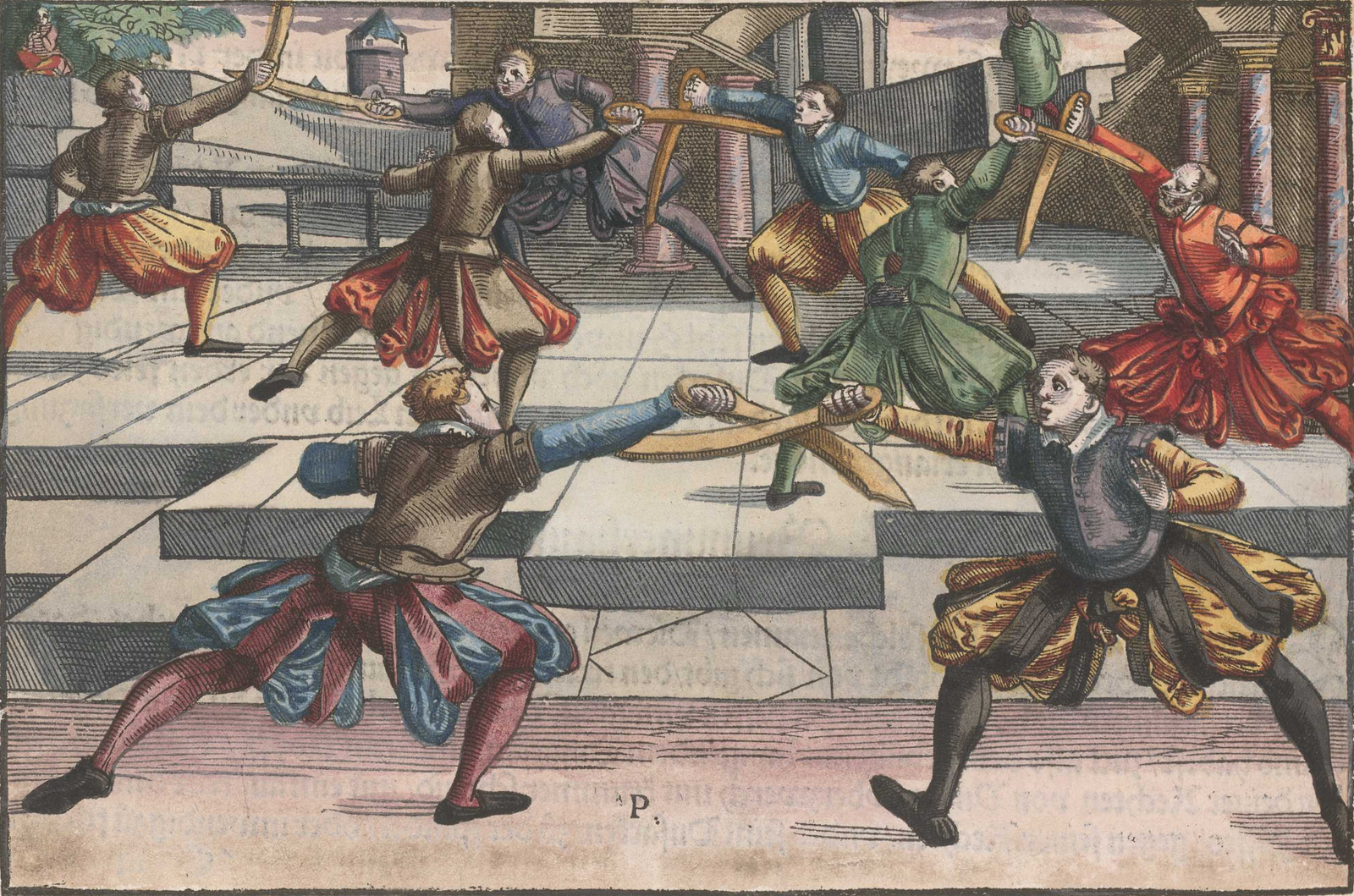
Perform the Awakening Cut like this in the Onset: cut in at them with a powerful High Cut. If they counteract the cut, take note: in that moment in which it glances off or touches on their counteraction: turn the cut into a thrust, pushing your dusack around onto theirs at their face (as the two tenants on the right side in this Figure [P] teach you).
If they rise up: cut upward through their arm with the curved edge (as you can see in the larger tenants [in Figure P]).
WEkerhauw treib also im zufechten, Hauw einen gewaltigen Oberhauw auff ihn hinein,
versetz er den Hauw, so merck in dem es glützt, oder auff sein versatzung riert, so verwende
den Haw in einen Stich, umbscheübe dein Dusacken auff dem seinen hinein, zum Gesicht, wie
dich die zwen bossen in diser Figur zur rechten Handt lehren, Fehrt er auff, so Hawe ubersich mit
krummer schneid, durch sein Arm, wie du an dem grössern bossen sehen kanst.
Rose Cut; if you find an opponent tarrying in Arch: act as if you wanted to cut from above at their head. Don’t let the cut touch, but instead move through and around from outside and under their right arm so that you move in a circle around their dusack. Let it drop down again in the air next to their right side and cut at their face. Thus, you can also move in a circle around their counteraction on the other side and cut in, wherever you find them open.
ROsenhauw, Findestu einen im Bogen zuwarten, so thu als woltestu von Oben zum Kopff
hauwen, laß den Hauw nicht rieren, sondern fahr außwendig seines Rechten Arms unden
durch, das du in ein zirckel umb sein Dusacken herumb kommest, und laß in der lufft neben
seiner Rechten wider ablauffen, und hauw ihm zum gesicht, Also magstu auff die ander seitten
auch in eim zirckel umb sein versatzung herumb fahren, unnd hinein hauwen, wo du ihn bloß
findest.
Perform the Dangerous Cut like this: when you approach your opponent in the Onset, pay attention. As soon as you trust that you can reach them, take diligent note of when they want to cut. In that moment in which they pull their dusack up to strike: cut at them from above next to their hilt at their face or chest (in that moment in which they have lifted their dusack up high).
This Dangerous Cut must be carried out with caution, otherwise it is dangerous; therefore, it is named the Dangerous Cut.
GEfehrhauw, den treib also, wann du im zufechten für den Mann kompst, so hab acht, so bald
du ihn thrauwest zu erlangen, so merck fleissig wann er Hauwen will, In dem er dann sein
Dauscken auff zuckt zum streich, so Hauw ihm neben sein gehültz (in dem er sein Dusacken nach
in der höhe hat) von oben zu dem Gesicht oder Brust, diser gfehr Hauw muß mit fürsichtigkeit
gethonsein, anders ist er gefehrlich, daher er auch Gesehrhauw genennet wirt.
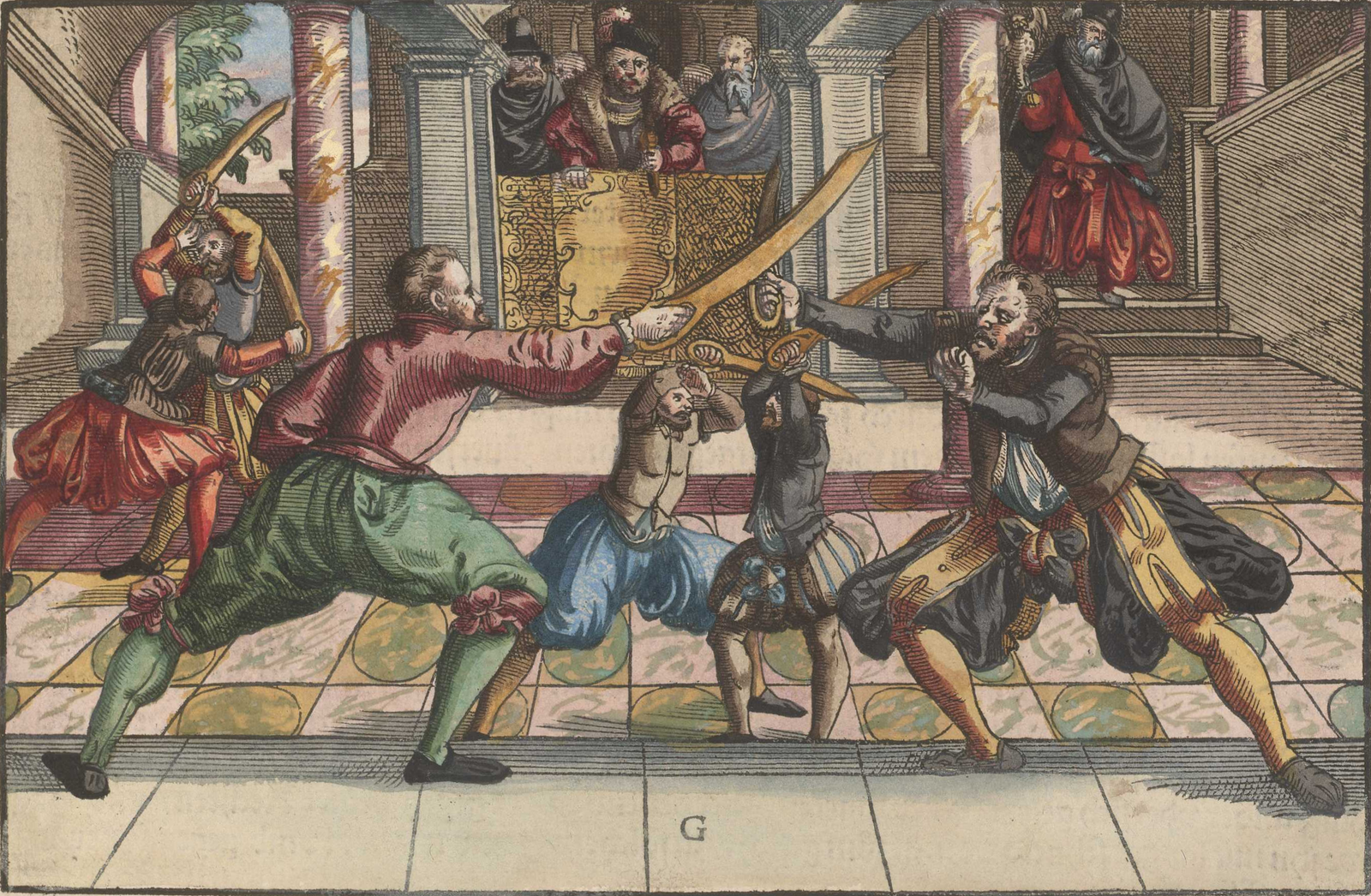
[The] Rage Cut is completed in many ways, [and] also named with two names: as the Armored Cut because it catches the High Cut in the air and holds it like a lance rest on armor; and it is named Rage because it comes so seriously and unpredictably, as if you had become unpredictably enraged [and filled] with wrath toward them. Execute it like this to oppose their cuts: if an opponent cuts at you from above, take note. In that moment in which they pull their dusack into the air to strike, pull quickly around your head Indesly and cut across a little from below and upward toward their cut, so that you catch their cut still high in the air with the long edge and with the dusacks horizontal (so that your dusack faces horizontally between you and them, as the larger portrait to the right shows in this Figure [G]).
In that moment in which the dusacks thus touch together, you can carry out many lovely sequences, etc.
ENtrüsthauw würt auch auff mancherley weiß volbracht, auch mit zweyerley namen genent,
als Rüsthauw, darumb das er di Oberhäuw aufffangt in der lufft, unnd auffhelt wie ein
gerüst, Entrüst wirt er darumb genent, das er so unversehens und ernstlich kompt, als werest
du mit zorn unversehenlich gegen ihm entrüst worden, also seinen Häuwen zübegegnen, den treib
also: Hawt einer auff dich, von Oben, So merck: In dem er seinen Dusacken in die lufft zeucht zum
streich, in dessen zuck behendt auch umb dein Kopff, und Hauw uberzwerch ein wenig vonn unden,
ubersich gegen seim Hauw, das du sein Hauw noch Oben in der lufft auff fangest, mit langer
schneid und uberzwerchem Dusacken, also das dein Dusack zwischen dir unnd ihm uberzwerch
stande, wie das grosser Bild in diser Figur zur Rechten anzeigt, In dem die Dusecken also
zusamen rüren, kanstu viel schöner stuck machen, &c.
Ⅱ.11v.2
20.12linked passage
20.13
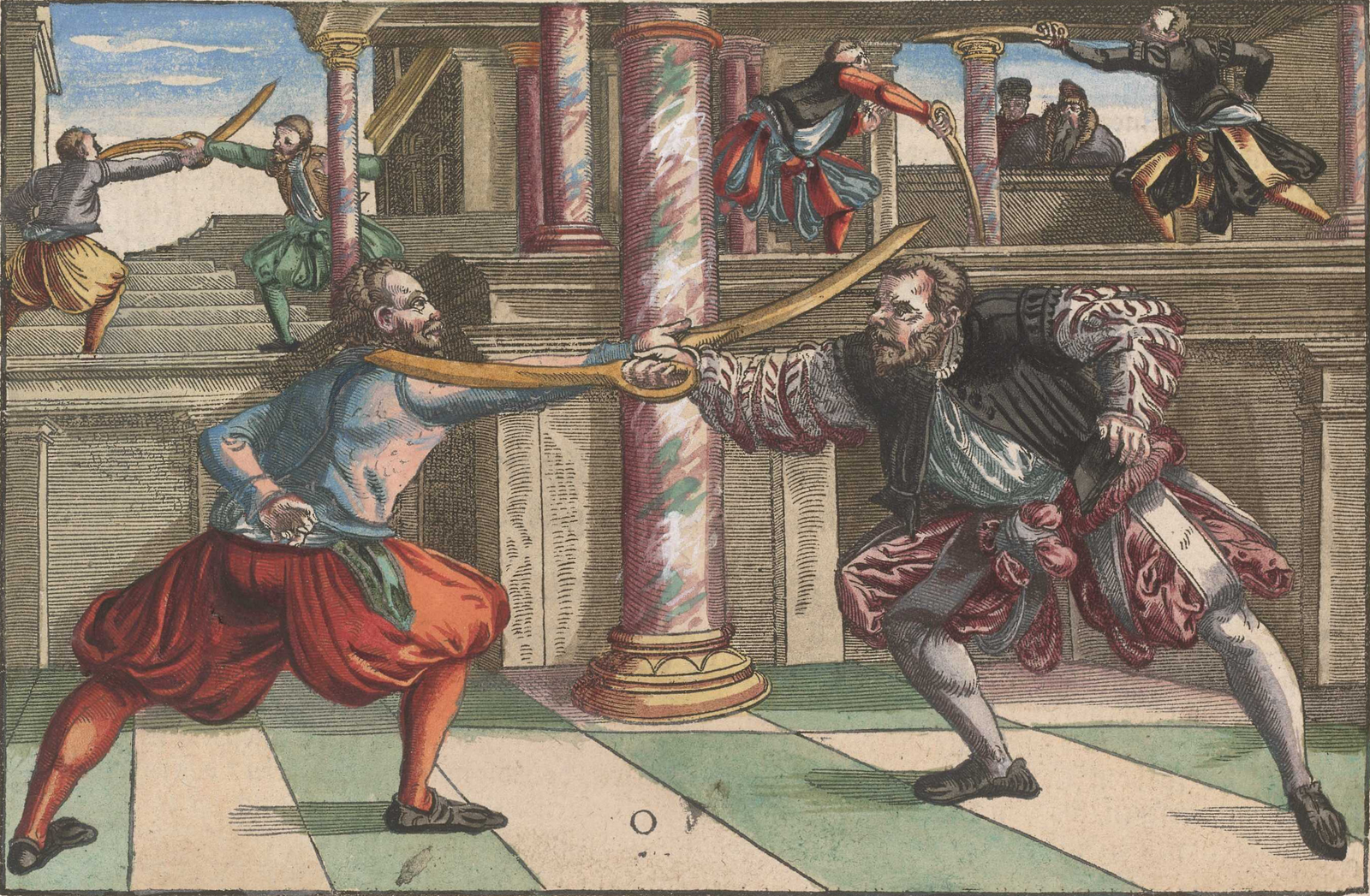
[13] Furthermore, it is also performed in this way: stand with your left foot forward and hold your dusack in Boar (as you will subsequently learn). If they cut at you from above: raise both arms to the counteraction, so that your dusack comes to lie with its back on your left arm and leap in under their strike. In that moment in which it glances off, thrust outside of their right arm at their face, step away, and cut across toward their left and through their face (as you can see in the Figure designated with the letter O, in the small tenants on the left).
1570 Edition · fol. Ⅱ.11v.3
[Ⅱ.11v.3] Ferner würt er auch auff dise weiß gemacht,
Stand mit dem lincken Füß vor, halt dein Dusacken im Eber, wie du denn hienach findest, Hawt
er von Oben, so fahr auff mit beyden Armen zu versatzung, also das dir dein Dusacken mit
dem ruck auff dein Lincken Arm zu ligen komme, und spring im under sein streich, In dem es glützt,
so stich im ausserthalb seim rechten Arm zum gesicht, tritt ab, unnd Hauw als dann gegen seiner[Ⅱ.12v.1] Lincken, uberzwerch, auch durch sein gesicht, wie du in der Figur, so mit dem Buchstaben O. verzeichnet, an den kleinen Bossen zur Lincken sehen kanst.
[The] Missed Cut: in the Onset, if you find your counterfencer in Arch or Simple Brace, step and cut outwardly at their right arm from above. In that moment in which you notice that they want to counteract: let your short edge drop strongly downward in front of their arm and simultaneously pull your hilt back upward so that your cut doesn’t hit. Instead let it run in front of their arm and miss, so that they vainly move to counteract. Step quickly outward to their left and cut at them straight through their face.
You can thus let this cut miss near any opening of those who move against the cut to counteract it.
FElhauw, Findestu im zufechten dein gegenfechter im Bogen, oder gerader verzatzung, so
tritt und hauw außwedig zu seinem Rechten arm von Oben, und in dem du merckest, das er
versetzen will, so laß die kurtz schneidt hart vor seinem Arm undersich sincken, und zuck zugleich
dein gehültz wider ubersich, das du mit dem hauw nit antreffest, sondern laß ihm also fehl vor
seinen Arm füruber lauffen, damit er um sunst verfahr zuversetzen, tritt behendt auß auff sein
Linck, und hauw ihm gerad durch sein gesicht, also magstu den Hauw neben einer jeden blöß felh[!] lauffen lassen, denen, die dem Hauw entgegen fahren, zuversetzen.
[The] Obscured Cut is carried out in many ways; however, take note of this technique: if an opponent cuts from above, catch their strike high over your head in the air on your long edge, with your dusack horizontal so that your point projects toward their left (as taught above about the Rage Cut). As soon as it beats or touches: turn the short edge inward in a flick in at their face. Immediately after the flick: turn your dusack with the hilt upward toward their left. Pull quickly back toward your right and cut with the long edge forward at their face. In addition to this cut, step well around toward their left in this strike and away from their strike.
BLendthauw, wirt auff mancherley gemacht, alhie aber merck ihn auff dise art, Hauwet einer
von Oben, so fang ihm sein streich hoch uber dein Haupt, in der lufft, mit uberzwerchem
Dusacken, auff dein lang schneid, das dein ort gegen seiner Lincken außsteht, aller ding wie
oben vom Entrüsthauw gelehrt, Als bald es bocht oder riert, so wende die kurtz schneide einwerts
in eim schnal in sein gesicht, und wende als bald nach dem schnall dein Dusacken mit dem gehültz
wider ubersich gegen deiner Lincken, zuck behend wider gegen deiner Rechten, und Hauwe
ihn mit langer schneid vornen zum gesicht, zu solchen Hauw trit wol umb gegn seiner Lincken
auff sein streich.
[The] Flicking Cut: take note when you stand in Arch in front of an opponent. If they don’t want to cut: pull upward into the Watchtower as if you wanted to cut from above; however, don’t do that. Instead, turn in the air and cut with the long edge up from below at their right arm in a flick and twist the dusack back toward your left shoulder. From there, cut a Defensive strike through their right (either above or below their arms) through their face.
Item, if an opponent stands before you in Arch and doesn’t want to work: flick at them above their dusack at their head with the short edge. Or if they hold their dusack high in a counterposture: flick under their counterposture at their face.
SChnel hauw, Merck so du im Bogen vor einem stehest, will er nit hauwen, so zuck ubersich
in die Wacht, sam du oben hauwen woltest, thüe es aber nit, sonder verwends in der lufft,
und hauw mit langer schneid von Unden auff, zu seim rechten Arm in eim schnall, und windt
den Dusacken wider zu ruck gegen deiner Lincken Achsel, von dannen hauw ein Weherstreich
durch sein Rechte, es sey underhalb oder oberhalb den Armen, durchs gesicht. Item wann einer
vor dir im Bogen stehet, unnd nicht arbeiten will, so schnelle im mit kurtzer schneid oberhalb
seim Dusacken zum Kopff, oder, So er sein Dusacken hoch in Versatzung helt, so schnell ihm under
sein versatzung zum gesicht.
[The] Twisting Cut is a cut that twists [and] is nothing other than you cut in (regardless of side) and you move back out toward that same side.
Thus, if you cut in from your high left, pull and turn the dusack downward toward your left and outward, all in one smooth motion (as if you wanted to cut a piece from their side equal to half a man) and this works on both sides.
WIndthauw, ein gewundener Hauw, ist an ihm selber nicht anderst, dann von welcher seitten
du hinein hauwest, das du gegen derselben wider herauß komest, also, wann du von
deiner Lincken Oben hinein hauwest, so zuck und wende den Dusacken gegen deiner Lincken
undersich wider herauß, unnd das alles eim flug gleich, als woltestu ein stuck, einen halben
mann gleich, auß seiner seiten hauwen, und gehet zu beiden seitten.
Perform the Ramming Cut like this: when you two stand in front of each other in a high counterposture in Arch and neither wants to cut Before the other, but instead waits for the other’s strike: drop down before them and cut straight in front of you at their dusack so that you touch their chest with your hilt so strongly that their dusack rams against their face once or twice. You thus force them to work.
And take note, as soon as they lift up: step out to their left side and cut in next to their hilt at their face, or undertake other appropriate sequences after you have thus driven them upward.
BOchhauw treib also, Wann ewer zwen voreinander in hoher Versatzung im Bogen stondt,
unnd keiner vor dem andern Hauwen will, sonder ihe einer auff des andern streich wartet, [Ⅱ.14r.1] so sencke dich vor ihm, unnd hauw gerichts für dir hin wider sein Dusacken, das du mit deim
gehültz sein Brust rierest, also starck, das im sein Dusacken wider sein gesicht brelt, ein mal oder
zwey, damit zwingstu ihn das er arbeiten muß, und merck, so bald er auffgehet, so trit auß auff
sein Lincke seitten, und hauw ihm neben seim gehültz hinein zum gesicht, oder nim andere
dir füglichere stuck für, nach dem du ihn also hast auffgetrieben.
[The] Change Cut is among the five cuts initially taught to students [and] which fundamentally does not differ (in itself) from changing through the cuts from one side to the other. However, because the alternation of the cuts and sequences is often considered in this [Dusack Section], it is unnecessary to introduce this here.
WEchselhauw wirdt auch under den fünff häuwen dein schuler anfangs gelert, welcher im
grundt, und an ihm selder, nicht anderst ist, dann durch die häuw von einer seitten zur andern
Wechseln. Dieweil aber in desem Buch von abwechßlung der Häuw, unnd stuck, offt gedacht
wirt, ist unnöttig solches hie zu eröffnen.
[The] Cross Cut is (in itself) two Wrath Cuts from both sides which are completed through the two slanted and hanging lines; thus, strike through your opponent slantwise from both sides and cross the strikes over one another in this way.
[Execute] the cut like this: stand with the right foot forward and cut the first from your right through their left and the second from your left through their right (both slantwise through their face).
Practice this cut four, five, or six times (backwards and forwards), yet so that you always remain with the right foot forward so that, when you want to step, you recover with the rear foot so that you can step forward with the right—because you should always take at least one step for both cuts (thus cut through the cross from both sides).
KReutzhauw seindt an ihm selber zwen Zornhäuw von beiden seitten, werden volbracht
durch die zwo Schlimm und Hangenden Lini, so von beiden seiten schlims durch den
mann streichen, unnd sich ubereinander schrencken, Den hauw also, Stand mit dem Rechten
fuß vor, und hauwe den ersten von deiner Rechten, durch sein Lincke, den andern von deiner
Lincken, durch seine Rechte, alle beide Schlims durch sein gesicht, das lerne ein hauw vier
fünff oder sechs, fürsich und hindersich, doch das du alwegen mit dem rechten Fuß vor bleibest, [Ⅱ.14v.1] darumb wann du tretten wilt, so erhole dich mit dem hinderen Fuß, damit du mit dem Rechten
fürtretten könnest, dann du solt auff das wenigst, allwegen zu beiden Häuwen (so von beiden
seitten durchs creütz gehauwen werden) ein tritt haben.
Ⅱ.14r.3Ⅱ.14v.1
20.20linked passage
20.21
[21] You should learn to cut this Cross Cut, including the abovementioned four cuts, with extended arms in a free-flying, powerful, and quick way. In the cuts, don’t keep your arms in the chest (as they say), that is close to yourself, because that person who fences short and keeps their arms close to themselves is easy to mislead and to touch. However, the extension must remain within bounds according to the opportunity at that time.
Therefore, I want to especially remind you, so that even if you wanted to make use of this book in no other way, then before everything else, you would want to learn to cut the cuts long, free, and well. And if you can cut the Principal Cuts well, the others will all be easy for you. Because when you fence whatever sequences you want, regardless of how good [the sequences] are, if you can’t cut these cuts well individually (in and of themselves and each according to their art) and execute the sequences correctly, you will not perform much of use, because as is often said, all fencing is based on the cuts.
1570 Edition · fol. Ⅱ.14v.2
[Ⅱ.14v.2] Disen Kreutzhauw sampt obgedachten vier Häuwen, soltu frey fligendt, gewaltig und behendt,
mit außgestreckten Armen, hauwen lernen, und in den hauwen die Arm nicht also in
busen (wie man sagt) das ist, kurtz bey dir füren, Dan der, der also kurtz Fichtet, und die Arm
nahe bey ihm führet, ist leichtlich zuverführen, unnd zu rieren, wiewol das außstrecken auch sein
maß und ziel, nach gelegenheit der zeit, haben muß. Derenhalben will ich dich in sonderheit ermanet
haben, so du dir anderst diß Buch nutz machen wilt, du wöllest vor allen dingen die Häuw
frey lang und wol lernen hauwen, und so du die Principal Häuw wol kanst, so werden dir als
dann die andern alle leicht werden. Dann du Fechtest was für stuck du immer wöllest, wie gut sie
auch seindt, wann du die Häuw an ihn selber, ein jeden nach seiner arth, insonderheit nicht wol
kanst, und die stuck recht führest, so wirst du nicht vil nützliches außrichten, dann alles Fechten,
wie offt gesagt, stehet auff den Häuwen.
Ⅱ.14v.2
20.21linked passage
20.22
[22] Finally, take note of how the cuts counter one another, thus a rule in brief: namely and for the first, the High Cut (if you guide it against your opponent’s dusack at the Strong toward their right hand) counters all other cuts which are cut at you, whether from below, slantwise, or across. In contrast, the Wrath Cut or the Crossing Middle Cut counters or takes the High Cut.
Correspondingly, also take note that two identical cuts which are cut against one another (with their steps) always move one another aside and counteract. However, the one whose cut directs the other’s farthest outward is the one who comes above the other with their weapon during the cuts. Therefore, as often as an opponent cuts at you from below [or] across (regardless of whether from the left or right), oppose them with High Cuts. If they cut at you from above, take away their High Cut with crossing or slanted Wrath Cuts. This rule is truly to be observed in all fencing and especially applied with respect to the Before and the After, the Strong and the Weak.
1570 Edition · fol. Ⅱ.14v.3
[Ⅱ.14v.3] Zum letsten, merck wie die Häuw einander brechen, kürtzlich dise Regel, nemlich, Zum ersten
so bricht der Oberhauw (so du den gegen des mans Dusacken zu der stärck gegen seiner Rechten
hand fürest) all ander Häuw, die auff dich gehauwen werden, es sey von Unden, Schlims oder
Uberzwerch, Hergegen, so bricht oder nimpt der Zornhauw, oder der uberzwerch Mittelhauwe,
den Oberhaw, Demnach, so merck auch, das alwegen zwen gleiche Häuw, die gegen einander mit
iren tritten gehauwen werden, einander abtragen und versetzen, doch richt der mit seim Hauwen
am meisten auß, der mit seim Wehr im Hauwen Oberhalb des andern kompt, Derhalben so offt
dir einer von unden Uberzwerch zu Hauwet, es sey von Lincker oder Rechter, dem begegne mit[Ⅱ.15r.1] Oberhäuwen. Hauwt er dir aber von Oben, so nim ihm die Oberhäuw mit uberzwerchen oder
Schlimmen Zornhäuwen hinweg, solcher Regel ist wol war zunemen in allem Fechten, und
sonderlich nim hierinnen, im Vor und Nach, der stercke und schweche wol wahr.
_1570_page167.jpg)
_1570_page168.jpg)
_1570_page169.jpg)
_1570_page170.jpg)
_1570_page172.jpg)
_1570_page173.jpg)
_1570_page175.jpg)
_1570_page177.jpg)
_1570_page178.jpg)
_1570_page179.jpg)
_1570_page180.jpg)