Longsword, Chapter 1: The Division of the Opponent
Translation · Rebecca L. R. Garber
1570 Edition
4.1
[1] About the opponent and the division of the same
Chapter 1
Although the division of the opponent (from which the openings and stances originate, toward which and from which one fences) actually belongs to the Middle or Handwork, and for this reason will also be discussed in the contents of that book, I want to describe it and set it out here at the beginning for a specific reason: that is, because it is initially necessary to know in fencing (and in all matters and arts) what it concerns and what the goal is; therefore, this must be discussed. Consequently, [I] wanted to raise this point of discussion at the beginning so that it would not be necessary to describe the openings when they were mentioned during the Middle or Handwork [Section], which would cause an interruption in the course of my writing.
WIewol die theilung des Mans aus welcher die Blösungen und Leger entstahn, zu und von
welcher auch gefochten würdt, eingentlich zu der Mittel oder Handtarbeit gehöret, unnd
derowegen auch im inhalt dises Buchs hievon meldung beschehen, jedoch hab ich dieselbe alhie
zum ersten nit ohne sondere ursach wöllen setzen unnd beschreiben. Den dieweil im Fechten
und in allen stucken und künsten, es am ersten von nöten ist zu wissen, was das sey darumb es zuthun,
und derwegen darvon gehandelt würdt, hat sich zum ersten wöllen gebüren, hievon bericht
zuthun, damit nit erst in dem Mittel oder Handarbeit so solcher Blösungen gedacht würt,
von nöten davon zuschreiben, und ich im lauff meines schreibens hindersich gezogen wurd.
Ⅰ.3v.1
4.1linked passage
4.2
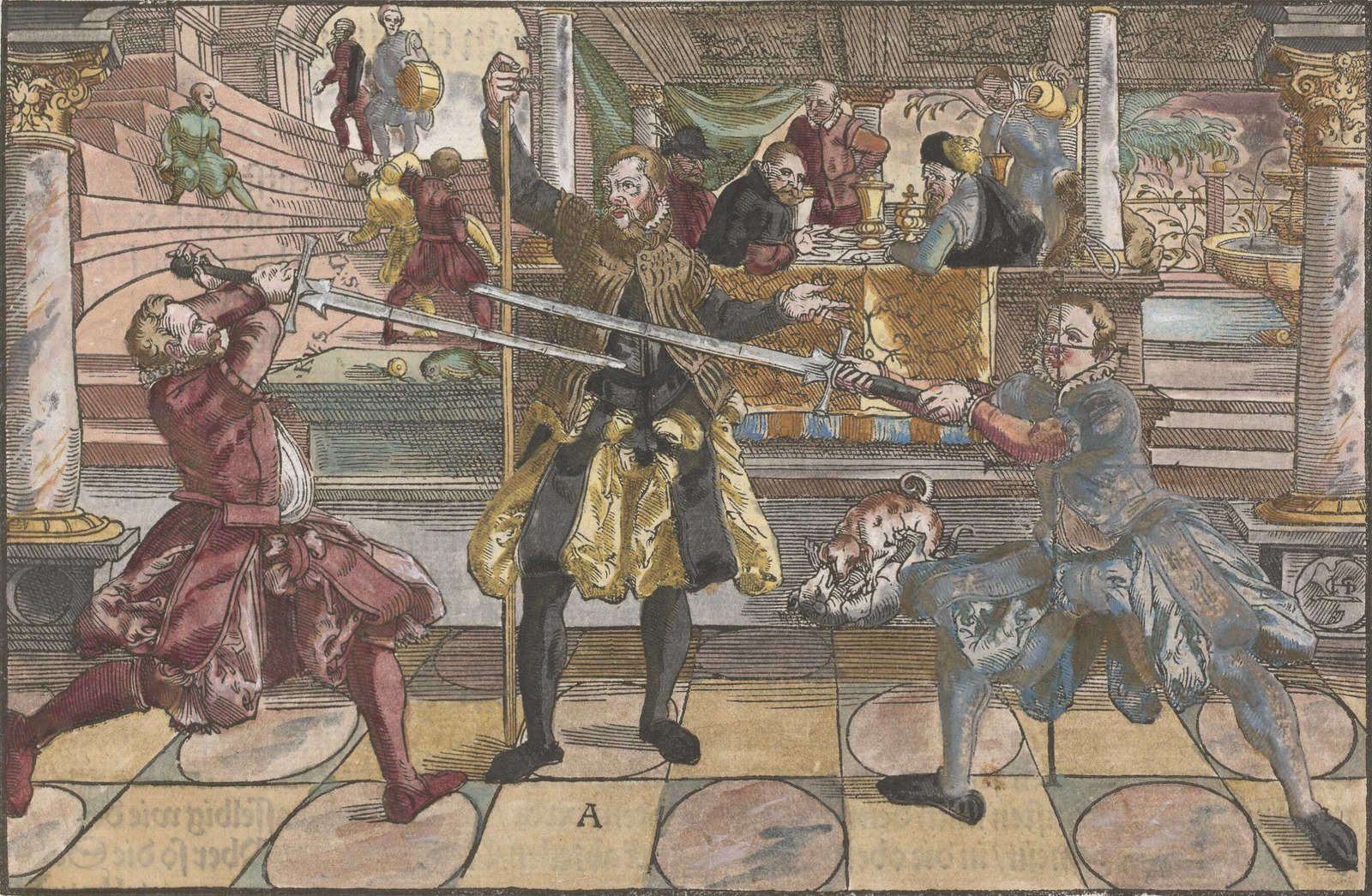
[2] The opponent is now divided into four quarters or parts: into the upper and lower, and each of these into the right and left. The what and the why of their intrinsic existence requires no more extensive description because a mere glance at a human body reveals what is the highest or lowest and the left or right part. However, the portrait on the right in the previous Figure [A] [is offered] to explain what I mean here for greater understanding.
1570 Edition · fol. Ⅰ.3v.2
[Ⅰ.3v.2] Nun wirdt aber der Man abgetheilt in vier quatier oder theil, in das Ober und das Under,
und der jedes in das Recht und Linck. Dise was unnd wie sie an ihnen selbs seind, darff nicht
weitleuffiges beschreibens, dieweil der augenschein selbs solches gibt am menschen was an ime
das oberste oder das underste, auch Recht und Lincke theil sey. Doch zu mehrerm verstand was ich
hiemit gemein, eklert das Bild zur rechten in obgesetzter Figur.
Ⅰ.3v.2
4.2linked passage
4.3
[3] And, while the aforementioned four parts of the opponent would be sufficient according to the customs of the Old German fencers (for whom thrusting was permitted as well as cutting), because we Germans of the current time often and most properly fence at the head (and especially in the Handwork with twisting) most, I will also divide it into the abovementioned four pieces (like the human being as a whole). Namely, into the upper, which relates to the hairline; the lower, which is assigned to the chin and neck; and again the right and left part, which are generally assigned to the right or left ear because the ears are located on both sides.
1570 Edition · fol. Ⅰ.3v.3
[Ⅰ.3v.3] Und ob schon dise nun erzelte vier theil des Mans gnugsam were, nach dem gebrauch der Alten
Teutschen Fechter, bey welchen das Stechen so wol als das Hauwen zugelassen, jedoch dieweil
bey uns Teutschen jetziger zeit, unnd sonderlich in der Handarbeit mit den Winden, am
meisten unnd fürnemsten nach dem Haubt gefochten wirdt, wil ich auch dasselbig wie den gantzen
menschen in gemein, in die oberenante vier stuck abteilen, Nemlich in das Ober so die Schei=[Ⅰ.4r.1] tel betrifft, vnd das Under so dem Kin und Halß zustendig, und darumb das Rechte und Lincke
theil, welche gemeinlich wegen der ohren, so beiden seitten zustendig, das Recht oder Lincke ohr
genant werden.
Ⅰ.3v.3Ⅰ.4r.1
4.3linked passage
4.4
[4] Even though this division could be thought of as somewhat childish (as there are always more who criticize than improve), the well-intentioned [reader] must keep in mind that this is really only described because all other matters which are necessary and are part of fencing arise and flow from this division as from a spring or well.
Because again (as mentioned above), fencing is nothing other than when two persons fight with the same weapons against one another and how a fencer can injure the other with quickness or defend and protect themselves carefully, my intention is also to present and explain them using certain sequences and brief summaries (as in the [sections on] other weapons). Therefore, I neither can nor should betray [my intentions] to mention this division of the person myself, so that if a counterfencer fences from one or another part, an opponent can take note and know how to secure their defenses with the correct counteraction, or, if a fencer were to expose their opening somewhat on one or the other side, then their opponent could place their strike at [the opening] correctly and with advantage (because an opponent is either hit at one of four points due to exposed openings or must position themselves into the guard or counterposture to protect the same again).
1570 Edition · fol. Ⅰ.4r.2
[Ⅰ.4r.2] Wiewol aber nicht ohne, das solche außtheilung etlichen sehr kindisch duncken wurd, wie dan
aller ding mehr tadler denn verbesserer, müssen es doch die guthertzigen darfür achten, das diß
fürnemlich und allein darumb gemeldet, das auß diser teilung alle andere notwendige und zum
Fechten gehörige stuck, als auß einem quell und brunnen entspringen und herfliessen. Denn sinte
mal das Fechten wie obgemelt nichts anders ist, dan so zwo Personen in gleichen wehren gegen
einander Kempffen, wie einer den andern mit behendigkeit verletzen, oder sich fürsichtigklich ver
teidigen und beschützen möge. Auch mein vornemen ist, wie denn in allen andern wehren, solchs
durch gewisse stuck unnd kurtze begriff anzuzeigen und erkleren, hab ich nicht können noch sollen
hindergehn, solche teilung der Person alhie zumelden, damit ob der gegenfechter auß einem oder
anderm theil zufechten sich vermercken leßt, einer mit rechtmessiger versatzung, widerumb sich
gefaßt zumachen wißte. Oder ob jener auff einer oder andern seiten sich etwa mit einer Blösse er
zeigen wurd, er sein streich auch auff ihn rechtschaffen mit vortheil anstellen könde. Dann je ein
man an deren vier orten einen, von wegen entdeckter Blösse getroffen, oder hinwider zuuerhütung
dessen, sich in die Hut oder versatzung muß legen.
Ⅰ.4r.2
4.4linked passage
4.5
[5] Therefore, that which is subsequently taught about the stances, cuts, and openings, can be gathered more easily because all of this flows out of this division of the opponent which is now sufficiently described.
1570 Edition · fol. Ⅰ.4r.3
[Ⅰ.4r.3] Derwegen was volgends von den Legern, Häuwen und Blösung gelehrt wirt, ist hie leichtlich
abzunemen, das solches alles auß diser nun gnugsam beschreibung und abtheilung des mans herfleußt.
_1570_page27.jpg)
_1570_page28.jpg)