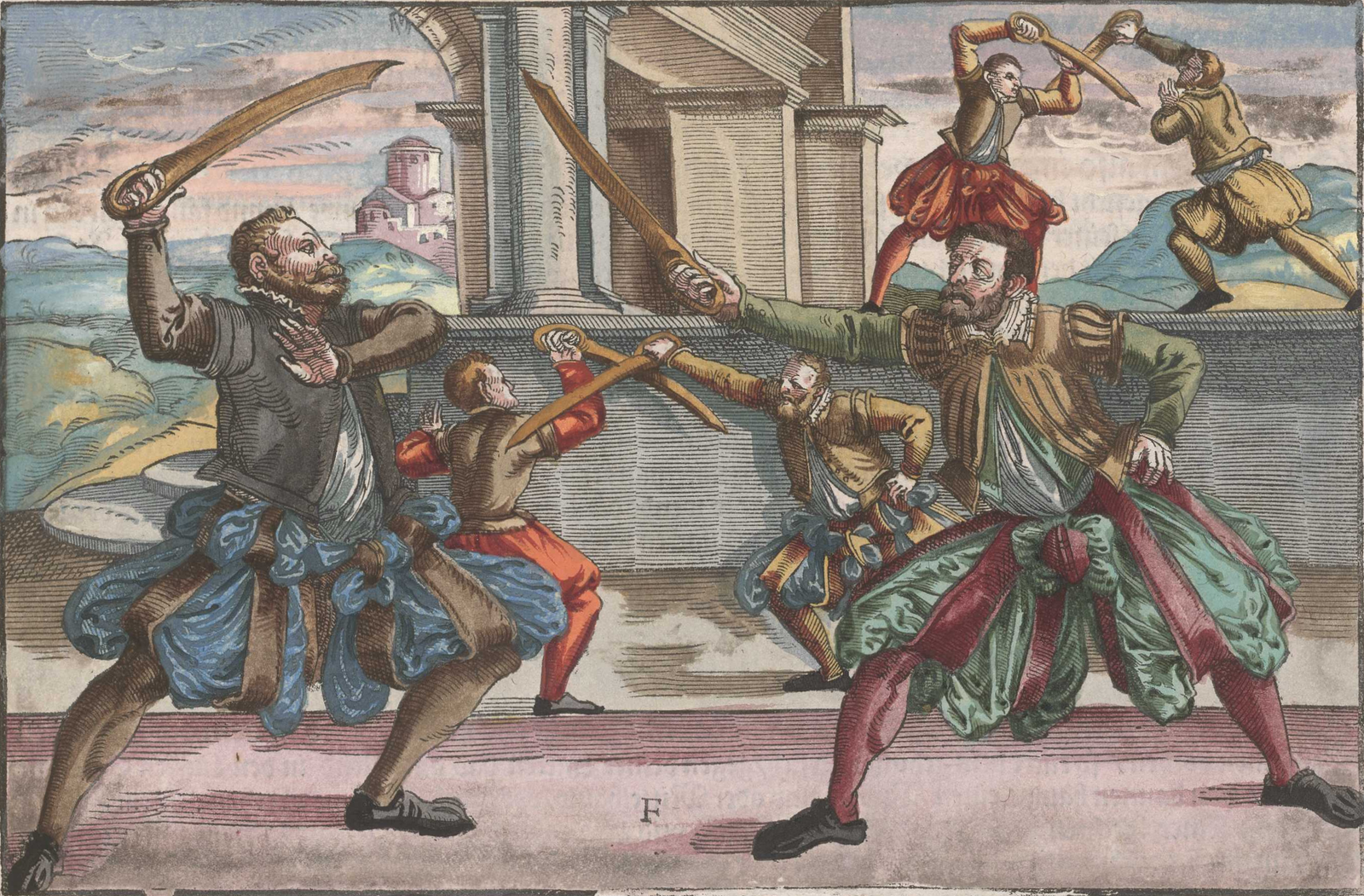
Position yourself into this Simple Brace like this: stand with your right foot forward and hold your dusack in front with an extended arm so that the long edge is toward your opponent and the front end is upward (as the large portrait on the right hand indicates in the next printed Figure [F]). I praise this stance for the best of them all because you can wait for your enemy in this stance more safely than in any other.
IN dise Versatzung schicke dich also, stand mit deinem rechten Fuß vor, und halt deinen Dusackem
mit außgestrecktem Arm vor, das die Lange schneide gegen dem Mann, und der vorder ort fürsich auff
stehe, wie das grösser Bild zur Rechten hand in hiebey[!] getruckter Figur außweisset, Dises Leger lob ich für
das beste under allen, darumb dieweil du in disem stand sicherer dann in keinem anderen, deines Feindes erwartten
kanst.
Ⅱ.32v.2
27.1linked passage
27.2
[2] An example and a sequence, how you should work from below at the opening
When you arrive into the Simple Brace in front of your opponent, take note: if they want to cut from in front at your face, turn the long edge toward their cut and catch them in the air toward their right. In addition, step with your left foot behind your right and toward them during this and follow quickly with your right foot afterwards and toward their left. As soon as their strike beats on your dusack: turn your long edge away from their dusack and draw the long edge toward your right through their muzzle. Pull quickly and Indesly back around and cut a Middle Cut with a good counterposture toward their left at their face, so that (if they were to cut a second [cut]) you would hold off or rebuff their cut with this Middle Cut. After this Middle Cut, pull quickly back around your head and flick a cut from outside at their right arm. Immediately cut Cross Strikes long in front of yourself. You should complete the Slice and the step backward simultaneously with one another. The sequence proceeds well [when this happens].
1570 Edition · fol. Ⅱ.33v.1
[Ⅱ.33v.1] Ein Exempel und stuck, wie du von Unden
zur Blöß arbeiten solt.
WAn du nun also in gerader versatzung für deinen Man kommest, aldo mercke wann er dir
vornen zum gesicht hauwen will, so wende die Lange schneide gegen seinem hauwe, unnd fange ihm den in
der lufft gegen seiner Rechten auff, zu dem so trit under des mit deinem Lincken fuß hinder deinem Rechten
zu ihm, unnd volge mit deinem rechten Fuß behend fürbaß nach gegen seiner Lincken, als bald sein streich also
auff deinem Dusacken bochet, so wende dein Lange schneide wider ab von seinem Dusacken, und ziehe ihm die Lange
schneide gegen deiner Rechten durch sein Maul, in des zuck aber behend widerumb, und hauwe ein Mittelhauw,
mit guter versatzung gegen seiner Lincken, zu seinem gesichte, also das du ihm mit solchem Mittelhauw, sein hauwe
(wo er anderst hauwen wurde) auffhaltest, oder abweisest, nach solchem Mittelhauw zucke behend widerumb
deinen Kopff, und schnell ihm außwendig zu seinem Rechten arm, als bald hauwe mit kreutzstreichen Lang
von dir, Den Schnit und den hindertrit soltu zugleich miteinander volbringen, so gehet das stuck wol ahn.
Ⅱ.33v.1
27.2linked passage
27.3
[3] Furthermore, if they cut from in front at your face: turn the long edge toward their cut as before. As soon as the dusacks beat together, pull your dusack back up again (around in front of your face) and cut outwardly at their right arm. Afterwards, cut the second quickly from in front and through their face.
1570 Edition · fol. Ⅱ.33v.2
[Ⅱ.33v.2] Ferner hauwet er dir vornen zu deinem gesichte, so wende die Lange schneide gegen seinem hauw wie vor, als
bald die Dusacken zusamen bochen, so zucke deinen Dusacken wider zu ruck ab, vor deinem gesicht umb, und hauwe
außwendig zu seinem Rechten arm, demnoch hauwe den andern wider behend vornen durch sein gesicht.
Item, counteract their High Cut with the long edge (as before). In that moment in which the dusacks beat together, yank your hilt upward toward your left so that you arrive completely in the left Bull. From there, cut a Low Cut or Middle Cut (or even cut slantwise) away from you, powerfully and long, over their right arm and toward their right, through their face. Immediately cut additional Cross Strikes long and through their face.
ITem versetze ihm seinen Oberhauw wie vor, mit Langer schneide, und in dem die Dusacken
zusamen bochen, so rucke dein gehültz ubersich, gegen deiner Lincken das du vollend in den Lincken Stier ankommest,
von dannen hauwe einen Underhauw oder Mittelhauw, oder auch Schlims oberhalb seinem Rechten
arm gegen seiner Rechten durch sein gesicht, gewaltig und Lang von dir, als bald hauwe ferner mit kreutzstreichen
Lang nach, auch durch sein gesicht.
Ⅱ.33v.3
27.4linked passage
27.5
[5] Item, counteract their strike with the long edge (as before) and in that moment in which it touches, pull your dusack back toward your right around your head. Step and thrust from outside over their right arm at their face. Pull back quickly and cut at their face from in front again.
1570 Edition · fol. Ⅱ.34r.1
[Ⅱ.34r.1] ITem versetze ihm seinen steich mit Langer schneide wie vor, unnd in dem es rieret, so zucke
deinen Dusacken wider gegen deiner Rechten zu rucke umb deinen Kopff, trit unnd stich ihm außwendig uber
seinen Rechten arm zum gesicht, zuck behend wider und hauwe ihm vornen auch zum gesicht.
Ⅱ.34r.1
27.5linked passage
27.6
[6] Item, if you stand in the oft-mentioned Simple Brace and your counterfencer cuts outwardly at you to the right: counteract their cut with the long edge. Quickly cut a Low or Middle Cut from your right toward their left through their face. Perform this cut so strongly that your dusack moves above your head in this Twisting [Cut], once on each side. You will confuse them with this moving around so that they are misled. Immediately cut a Cross Strike.
1570 Edition · fol. Ⅱ.34r.2
[Ⅱ.34r.2] Item stehestu in offtgemelter versatzung, und dein gegenfechter hauwet dir außwendig zu der Rechten, so versetze
ihm seinen hauw mit Langer schneide, und hauwe als bald ein Under oder Mittelhauw, von deiner Rechten
gegen seiner Lincken durch sein gesicht, solchen hauwe thue so starck, also das dein Dusacken in solchen Windt
zweimal oberhalb deinem Kopff umblauffe, zu jeder seiten einmal, mit welchem umblauffen du ihn irre machest,
auff das er verführt werde, und hauwe als bald kreutzstreich nach.
Ⅱ.34r.2
27.6linked passage
27.7
[7] How you should set off their cuts, hang inward, and pull upward through their face
Item, if you stand in front of your opponent in the Simple Brace and they cut outwardly toward your right: in that moment in which they cut in, step with your left foot quickly toward their right and out away from their strike and turn the long edge toward their cut (while doing this). Simultaneously (and while in the Simple Brace) raise your hilt and shove your point on their dusack over their right arm from outside into their face. Hastily hang your dusack from outside over their right arm and inwardly in front of their chest. Step farther to their right side simultaneously with this inward hang. Draw your long edge back upward toward your left through their face. Immediately cut the Cross [Cut] long in front of yourself.
1570 Edition · fol. Ⅱ.34r.3
[Ⅱ.34r.3] Wie du im seine Häuw absetzen, einhencken, und
ubersich durch sein Gesicht ziehen solt.
ITem stehestu vor deinem Mann in gerader Versatzung, und er hauwet dir außwendig gegen
deiner Rechten, in dem er herhauwet, so tritt mit deinen Lincken Fuß behend gegen seiner Rechten auß seinem
streich, unnd wende under deß die Lange schneide gegen seinem hauwe, zugleich in der Versatzung fahre
auff mit deinem gehültz, und scheibe im den Ort an sein Dusacken aussen uber seinen Rechten arm in sein gesicht,
und hencke ihm deinen Dusacken in eyl auffen uber seinen Rechten arm vor seiner Brust hinein, tritt zu gleich mit
solchem einhencken ferner auff sein Rechte seiten, zeuch im dein Lange schneide wider ubersich gegen deiner Lincken
durch sein gesicht, als dann hauw bald mit dem Kreutz wider Lang von dir.
Ⅱ.34r.3
27.7linked passage
27.8
[8] A good sequence, how you should set off from the Simple Brace, step out, and cut through their face
Or, if you stand in the abovementioned counterposture and they cut or flick at you outwardly (at your right arm): step well toward their right while they strike. Turn their cut well away from you and toward your right with your long edge as you step backward. From there, draw the long edge above their arm and back toward your left, through their face and up into the Middle Guard. From there, continue to fence (as you will subsequently be taught in the Middle Guard). If they cut at you so quickly from both sides that you are completely unable to fence with them as quickly in the first cuts, turn away some cuts with the long edge toward both sides and observe: whenever they offer an opening with their cuts, you should hastily cut in toward the same.
1570 Edition · fol. Ⅱ.34r.4
[Ⅱ.34r.4] Ein gut stuck wie du aus gerader Versatzung absetzen,
außtretten, und durch sein gesicht schneiden solt.
ODer stehestu in obgemelter Versatzung, und er hauwet oder schnelt dir außwendig zu deinem
Rechten arm, so tritt (dieweil er schlecht) wol gegen seiner Rechten, und wende ihm seinen hauw mit
deiner Langen schneiden in einem abtrit, wol ab von dir gegen deiner Rechten, von dannen zeuhe ihm die [Ⅱ.34v.1] Lange schneide oberhalb seinen arm wider gegen deiner Lincken durch sein gesicht biß in die Mittelhut, von der
selbigen ficht ferner wie du hie nach in der Mittelhut gelehrt wirst. Wo er dir aber von beiden seiten so geschwinde
zuhauwet, also das du im so behend in die erste häuwe nicht fechten darffest, so wende ihm etliche häuw mit Langer
schneide gegen beiden seiten ab, und schaw eben, wo er sich mit verhauwen Bloß gibt, das du ihm eylend daselbest
hin nach hauwest.
Ⅱ.34r.4Ⅱ.34v.1
27.8linked passage
27.9
[9] Item, if your opponent cuts a Wrath Cut from their right side toward your left, and if they guide the cut high: don’t respond to the cut with a counteraction. Instead let your front end sink downward and move through under their right arm with a wide step outward to your opponent’s right side (as you were taught previously in the Overwhelming Cut). Cut simultaneously with them from outside and over their right arm, straight to the side or opening from which they had cut. You should use this against those who cut too high and cut more at the dusack than at the body.
If an opponent doesn’t want to cut at you (because you stand in this counterposture), take note of how they guard themselves against you. If they position themselves into a stance on one side (whether above or below): thrust at their face with an extended arm with your Longpoint straight in front of you. They must defend against that. Therefore, take note from which side they strike your thrust outward or ward off your thrust. Let [your dusack] move around and cut in at precisely that same side from which they warded off or counteracted your thrust. You can perform this cut in response from above, across, or from below. Then cut quickly afterwards with Cross Cuts.
1570 Edition · fol. Ⅱ.34v.2
[Ⅱ.34v.2] Item hauwet dir dein gegenmann von seiner Rechten ein Zornhauw gegen deiner Lincken seiten, unnd führet
den Hauw hoch herein, so nimme den Hauw mit keiner Versatzung nicht an, sondern laß deinen Vordern ohrt undersich
sincken, fahre also under seinem Rechten arm durch, mit einem weiten außtrit zu deines gegenmanns Rechten
seiten wie du hievor im Zwinger gelehret bist, und Hauwe mit im zu gleich außwendig uber seinen Rechten arm, eben
zu der seiten oder Blöß, von welcher er gehauwen hat, solches soltu brauchen gegen die so do hoch und doch mehr
zum Dusacken dann zum leib hauwen. So dir aber einer nicht hauwen wolt (wann du in solcher versatzuug[!] stehest)
so mercke wie er sich gegen die Lägert, schicket er sich als dann in ein seiten Leger, es sey Unden oder Oben, so stich
ihm mit auß gestrecktem Arm mit deim Langen ort, gerad für dir hin zu seinen gesicht, das muß er wehren, Als
dann mercke von welcher seiten er dir deinen stoß außschlecht, oder nimpt, so laß umbfahren, und Hauw im eben
zu derselben seiten hinein, von welcher er dir den stoß außgenommen oder ubersetzet hat, disen Nachhauw magstu
von Oben uberzwerch oder von Unden thun, als dan hauwe ferner bald mit kreutzhäuwen hinnach.
Ⅱ.34v.2
27.9linked passage
27.10
[10] Or, if you take note that they want to counteract your thrust (including the cut): thrust straight at their face (as taught above). In that moment in which they move the thrust aside: act as if you wanted to cut at the side which they counteracted you from. Don’t let the cut hit or touch, but instead pull it back up around your head and cut at the other side. As often as you perceive that they want to counteract your cut, don’t let your cut hit but instead pull it back up to the other side. If they move to a counterposture in response: pull up again and do this until you trust that you can hit an opening.
1570 Edition · fol. Ⅱ.34v.3
[Ⅱ.34v.3] Oder so du merckest, das er dir deinen stich sampt dem hauw versetzen will, so stich ihm gerad zum gesicht,
wie oben gelehrt, in dem er dir den stoß abtregt, so thu als woltestu zu der seiten hauwen, von welcher er dir versetzet
hat, laß aber den hauw nicht antreffen, noch rieren, sonder verzuck den wider ab umb den Kopff, und hauwe
zur andern seiten, dann als offt du nun gewahr würst das er dir einen hauw versetzen will, so laß denselben nicht
antreffen, sonder zuck wider ab, zu einer andern seiten, fehret er ihm aber nach mit verzatzung, so zuck abermals
ab, und so lang biß du dir trauwest ein Blöß zutreffen.
If an opponent cuts at you to the right or left, counteract them with the long edge, and as soon as it glances off, pull back upward and cut straight from above and back at the closest opening while stepping outward.
Es Hauwe dir einer zur Rechten oder Lincken, so versetze im mit Langer schneide, unnd als
bald es glütz, so zucke wider ubersich, und hauwe gerad von Oben wider der nechsten Blöß mit außtretten zu.
Ⅱ.35r.1
27.11linked passage
27.12
[12] Item, if they bind on you or if they stand in a counterposture in front of you, take diligent note of their rising upward. As soon as they rise up to a strike: cut through across at their forearm bone.
1570 Edition · fol. Ⅱ.35r.2
[Ⅱ.35r.2] Item er binde diran, oder steheter in einer versatzung vor dir, so merck fleisssig auff sein auffgehn, dann als bald
er auffzuckt zu einem streich, so hauw ihm überzwerch gegen seiner Spindel durch.
Ⅱ.35r.2
27.12linked passage
27.13
[13] A swift, misleading sequence for fencing in this Simple Brace
Take note: when you find your counterfencer in the Simple Brace, position yourself into the abovementioned Wrath Guard or Bull. Use serious body language to guide a High Strike from your right shoulder toward their face. Don’t let it hit, but instead, in that moment in which the cut should touch above, move your dusack toward their left, around and below their dusack through the Rose and completely around in a circle, so that you arrive with your dusack upward in the air toward your left (having moved under their right arm). Let it quickly drop down twice in the air—once toward their left, the second toward their right. Cut a Middle Cut through from your right and in front toward their face.
You should step forward twice for all of these moves. The one at the first Wrath Cut, with which you shouldn’t hit but instead miss and move around. The other during the two drops downward (and including the Middle Cut). In that moment in which you bring your dusack into the air to drop down, you should simultaneously lift your right foot, and thus execute the two drops downward so quickly that you only bring your foot down when you hit with the Middle Cut.
1570 Edition · fol. Ⅱ.35r.3
[Ⅱ.35r.3] Ein geschwind verführ stuck, auff dise gerade
versatzung zufechten.
MErck, wann du deinen gegenfechter in gerader versatzung findest, so schicke dich im zufechten
in obgemelte Zornhut oder Stier, und füre mit ernsthafftigen geberden ein hohen streich, von deiner Rechten
Achsel gegen seinem gesicht, laß aber nicht antreffen, sonder in dem der hauw oben rieren soll, so fahr
mit deinem Dusacken gegen seiner Lincken umb sein Dusacken, Unden durch die Rosen in ein Zirckel, gantz herumb,
also das du mit deinem Dusacken, under seinem rechten Arm wider herfür gegen deiner Lincken, ubersich
in die lufft kommet, aldo laß behend in der lufft zweimal ablauffen, einmal gegen seiner Lincken, das andermal gegen
seiner Rechten, und Hauw ein Mittelhauw von deiner Rechten vornen gegen seinem gesicht durch, zu solch em
allen soltu zwen fürtrit haben, den einen zu dem ersten Zornhauw, mit welchem du nicht treffen solt, sonder fehl
neben herumb faren, den andern zu den beiden ablauffen sampt dem Mittelhauw, dann in dem du dein Dusacken
in die lufft bringst zum ablauffen, soltu zugleich dein rechten Fuß auffheben, unnd also die zwei ablauffen so behende
treiben, auff das du eben im wider nider sitzen deines Fußes, mit dem Mittelhauw antreffest.
Ⅱ.35r.3
27.13linked passage
27.14
[14] This is a free-flying and fast sequence and moves well if you have previously learned to execute it well. As soon as the Crossing Cut has hit, cut again across from below at their right arm with a good counteraction. In that moment in which you hit with this cut, take note as to whether they are high or low with their arms. If they are high: turn your point under their arm with a thrust at the chest or hip. If they are low: turn the point over their arm at their face with your palm upward (so that your long edge faces upward in this thrust).
Whichever of these two thrusts appears most proper to you (palm up or down), follow the same thrust quickly and powerfully with these cuts in response: namely, [follow] the High thrust with a Low Cut through their right. [Follow] the Low thrust with a High Cut through their left.
1570 Edition · fol. Ⅱ.35r.4
[Ⅱ.35r.4] Dises ist ein frei fliegend und geschwind stuck, und das wol angehet, so du es zuvor wol lehrest machen, als
bald der uberzwech hauw antroffen hat, so hauw widerumb uberzwerch von Unden, zu seinem rechten Arm mit
guter versatzung, in den du mit solchem hauw antriffst, so merck ob er mit seinen Armen hoch oder nider sey, ist er
hoch, so wende dein orth under sein Arm mit eim stoß zur Brust oder Hufft, ist er aber nider, so wende ihm den or[Ⅱ.35v.1] uber dein hand, oberhalb seinem Arm zum gesicht, das dein Lange schneid in solchem stoß übersich stande, welcher
under disen zweyen stossen einer, dir am füglichsten fürfellet, es sey under uder[!] ober der Hand, so volge demselbigen
stoß, gewaltig und behend mit disen häuwen nach, Nemlich dem Oberstich, mit einem Underbauw durch
sein Rechte, dem understoß mit eim Oberhauw durch sein Lincke.
Ⅱ.35r.4Ⅱ.35v.1
27.14linked passage
27.15
[15] Item, if you find an opponent in a Simple Brace: cut quickly from your right and across toward their hilt with a step forward. In that moment in which the weapons touch together, step and twist your hilt through below and use this to move outward over their right hand. Rip downward toward yourself, drawing the dusacks through their face.
You will find more information about how you should counter this Simple Brace in the Middle Guard.
1570 Edition · fol. Ⅱ.35v.2
[Ⅱ.35v.2] Item findestu einen in gerader versatzung, so
hauwe von deiner Rechten behend mit einem zutrit überzwerch gegen seinem gehültz, in dem die Wehr zusamen rieren,
so trit und winde mit deim gehültz unden durch, und fahre damit auffen über sein rechte Hand, reiß die undersich
zu dir, zeich im den Dusacken durch sein gesicht. Wie du aber dise gerade versatzung ferner brechen solt, findestu in
der Mittelhut.
Ⅱ.35v.2
27.15linked passage
27.16
[16] Finally, when you stand in this Simple Brace, take note (as also mentioned previously): if an opponent cuts at you to the right or to the left, turn the long edge toward their cut and push the point forward at their face (in addition to this counterposture). You thus force them so that they must rise to counteract, and this provides you with space at their openings. If they don’t cut: attack with any other sequences that you feel are properly the best (as you will find sufficiently here).
1570 Edition · fol. Ⅱ.35v.3
[Ⅱ.35v.3] Letstlich aber wann du in solcher gerader versatzung stehest, so mercke wie hievor auch gemeldet, Es hauw dir demnach
einer zur Rechten oder zur Lincken, so wende die Lang schneid gegen seinem hauwe, und zugleich mit solcher
versatzung, schiebe ihm den ort für die hin zu seinem gesicht, damit zwingest du ihn, das er aufffahren
muß zuversetzen, und raumet dir also zu den Blössen, hauwet er aber nicht, so greiff in
an mit allerley stucken, die dich am besten duncken füglich sein, wie
du deren hierinnen gnugsam findest.
_1570_page215.jpg)
_1570_page217.jpg)
_1570_page218.jpg)
_1570_page219.jpg)
_1570_page220.jpg)
_1570_page221.jpg)