Since I have explained what fencing concerns—namely, how a fencer can injure the other in one part of their body (for example), or conversely, how to defend themselves in a knightly manner—therefore, the division of the human body was briefly explained. Thus, it is also necessary to show why and through what means the same are completed on another person. And even though the title or heading of this part clearly indicates this (namely, that nothing besides the sword will be mentioned here), yet it is proper to say something now about the division of the sword that is useful and appropriate for this art, because this does not occur in a single way but instead here with the short edge and there with the long edge, here with the Strong and there with the Weak.
NAch dem nun erklert, warumb es im Fechten zuthun, nemlich wie einer den andern etwa
an einem theil seines leibs, Ritterlichen abbrechen oder hinwider seinen selbs verteidingen
möge. Darauff auch die theil des menschen kürtzlich erklert, so ist weiter anzuzeigen von nöten,
warumb und durch was mittel dasselb gegen einander zuvolbringen, und wiewol dasselb der Tittel
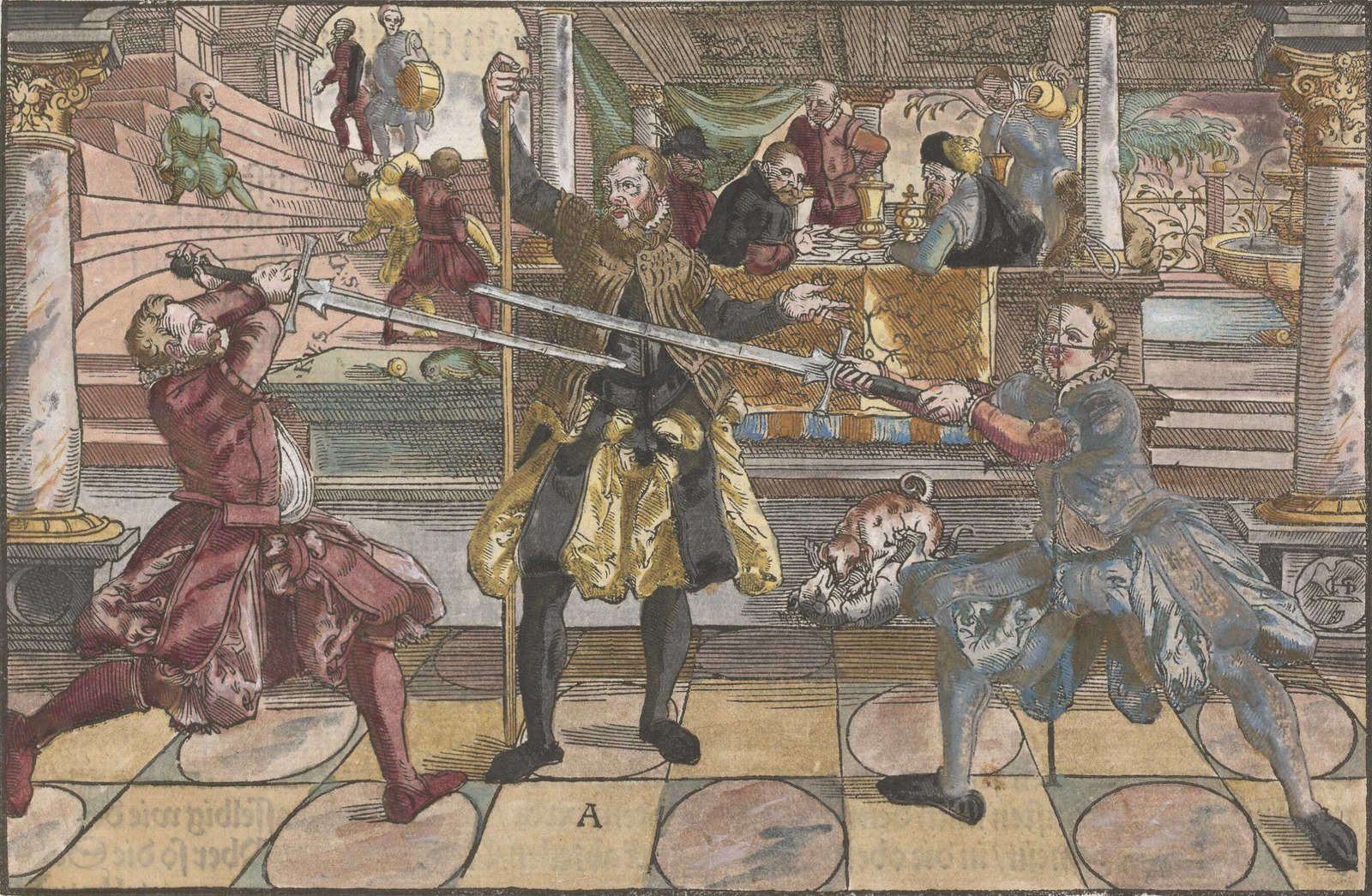
oder uberschrifft dises teils vor sich selbst deutlich außweist, das als nemlich hierinne von nichts
anders dann dem Schwerdt allein meldung geschehen sol, Dieweil aber dasselb nicht auff einigerley
art und weise allein geschicht, sonder bald mit der Kurtzen, bald mit der Langen schneiden,
bald mit der sterck, bald mit der schwech, wil sich gebüren nechstvolgendt von des Schwerdts
gebreuchlichen und zu diser kunst gehörigen außtheilung auch etwas zusagen.
Ⅰ.4v.1
5.1linked passage
5.2
[2] As regards the parts of the sword, relating to its shape and figure—its pommel, point, crossguard or hilt, grip or wrapping, and blade—it is unnecessary to use many words for what each of them is.
1570 Edition · fol. Ⅰ.4v.2
[Ⅰ.4v.2] Des Schwerdtes teil, was seine form un figur antrifft, sein Knopff, Ort, Creutz oder Gefeß,
Hefft oder Bindt und die Klinge, davon ohne not, was ein jedes, viler wort zugebrauchen.
Ⅰ.4v.2
5.2linked passage
5.3
[3] The blade has two different divisions, the first of them is the Strong and the Weak, the other is the short and long edges, which are the front and the rear.
1570 Edition · fol. Ⅰ.4v.3
[Ⅰ.4v.3] Die Kling hat widerumb zwo underschiedliche theilungen, derer erste ist in die Stercke und
Schweche, die ander in die Kurtze und Lange schneide, das ist vorder und hinder.
Ⅰ.4v.3
5.3linked passage
5.4
[4] The Strong of the sword is the part starting from the crossguard or grip up to the middle of the blade. The Weak is starting from the middle up to the point or end of the same. The distinction of techniques into long and short arises from this.
1570 Edition · fol. Ⅰ.4v.4
[Ⅰ.4v.4] Die Sterck des Schwerdts nennet man den theil vom Kreutz oder hefft, biß mitten in die
klinge, die Schweche von der mitten biß and das ort oder endt derselben, dardurch die verenderung
der stucke in Lange und Kurtze herwachsen.
Ⅰ.4v.4
5.4linked passage
5.5
[5] The long edge is the complete edge facing outward from the fingers straight toward your counterpart. The short or half edge is the [edge] toward the thumb or between the thumb and index or first finger, facing toward the fencer themselves (stated by way of comparison); in other words, the back of the sword, as is clear from the previous Figure [A].
1570 Edition · fol. Ⅰ.4v.5
[Ⅰ.4v.5] Die Langeschneid ist die volle Widerschneid von den fingern hinaus, gerad gegen deinem widerpart,
die Kurtze oder halbe schneide heist die so gegen dem daumen oder zwischen dem daumen
und zeiger, oder ersten finger gegen den Fechter selbst gekeret, als ob es umb gleichnus willen mit[Ⅰ.5r.1] andern wehren, also zu reden, der rucken am Schwerdt were, wie auß hie vorgesetzter Figur
zusehen.
Ⅰ.4v.5Ⅰ.5r.1
5.5linked passage
5.6
[6] The correct, complete division of the sword (which is quite useful in fencing) originates from the abovementioned divisions: namely, that the sword is commonly also divided and distinguished into four parts (as is clear in the Figure [A] printed previously).
1570 Edition · fol. Ⅰ.5r.2
[Ⅰ.5r.2] Auß oberzelten theilungen des Schwerdts entspringen die rechte gantze theilung, welche im
Fechten sehr nutzlich, nemlich das das Schwerdt abermals unnd ferner in gemein in vier theil
getheilet und underscheiden, wie in hievor getruckter Figur zusehen.
Ⅰ.5r.2
5.6linked passage
5.7
[7] The first is called the wrapping or grip, and includes the pommel and crossguard, and is useful for running in, wrestling, grappling, throwing, or other work.
1570 Edition · fol. Ⅰ.5r.3
[Ⅰ.5r.3] Der erst wirt genant, das Bindt oder Hefft begreifft in sich Knopff und Kreutz, zum einlauffen,
Ringen, Greiffen, Werffen und anderer arbeit dienstlich.
Ⅰ.5r.3
5.7linked passage
5.8
[8] The second, the Strong (as mentioned above) is useful to slice, twist, press and other [techniques] that are fenced from the Strong.
1570 Edition · fol. Ⅰ.5r.4
[Ⅰ.5r.4] Der ander die Sterck wie oberzelet, zum Schneiden, Winden, Trucken, und anderm was
aus der sterck gefochten nützlich.
Ⅰ.5r.4
5.8linked passage
5.9
[9] The third part is the Middle (taken equally from the Strong and Weak around the halfway point) and is suitable for changeable work and can always be used according to opportunity.
1570 Edition · fol. Ⅰ.5r.5
[Ⅰ.5r.5] Der dritte theil ist das Mittel, wirt auß der sterck und schwech umb den halben theil zugleich
genomen, und der wandelbaren arbeit, welche nach eines jeden gelegenheit alweg mag gebraucht
werden, zugeeignet.
Ⅰ.5r.5
5.9linked passage
5.10
[10] The fourth is the Weak, for the change through, flick, catapult, and whatever belongs to fencing from length [out of distance], as you will subsequently have many and sufficient examples and sequences.
1570 Edition · fol. Ⅰ.5r.6
[Ⅰ.5r.6] Der vierde ist die Schweche zum durchwechseln, Schnellen, Schlaudern, und was dergleichen
aus der Lenge gefochten gehörig, wie du denn solches alles folgends vil und gnugsam
Exempel und stuck haben würst.
_1570_page29.jpg)
_1570_page30.jpg)