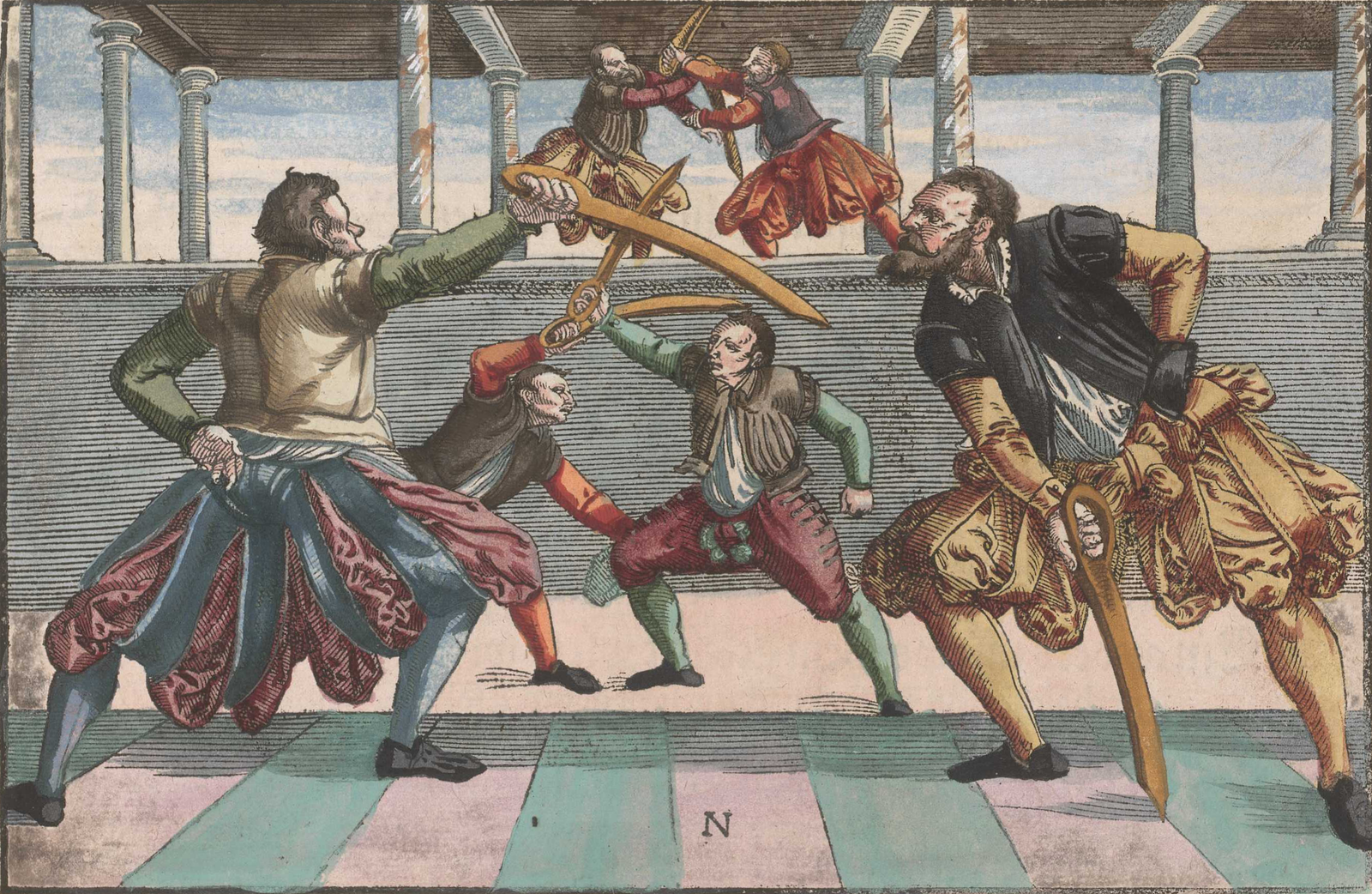
Position yourself into this guard, which is the counterposture from below (as the portrait on the left indicates in the Figure [N] printed previously).
IN dise Hut, welches ist die versatzung von Unden, schicke dich, wie das Bild zur Lincken
in diser hiebey getruckter Figur außweiset.
Ⅱ.36v.1
28.1linked passage
28.2
[2] How you should entice their strike onto your Arch and cut in response
Take note: when you thus arrive in Arch in front of your opponent, pay attention: as soon as they cut from their right toward your left at your head, turn your hanging dusack toward their strike with the long edge upward. During this and simultaneously with this counteraction, step toward them with your left foot behind your right and out away from their strike. Let their cut sweep downward on your long edge and off next to your left. Step with your right foot farther to their left and cut through their face from in front.
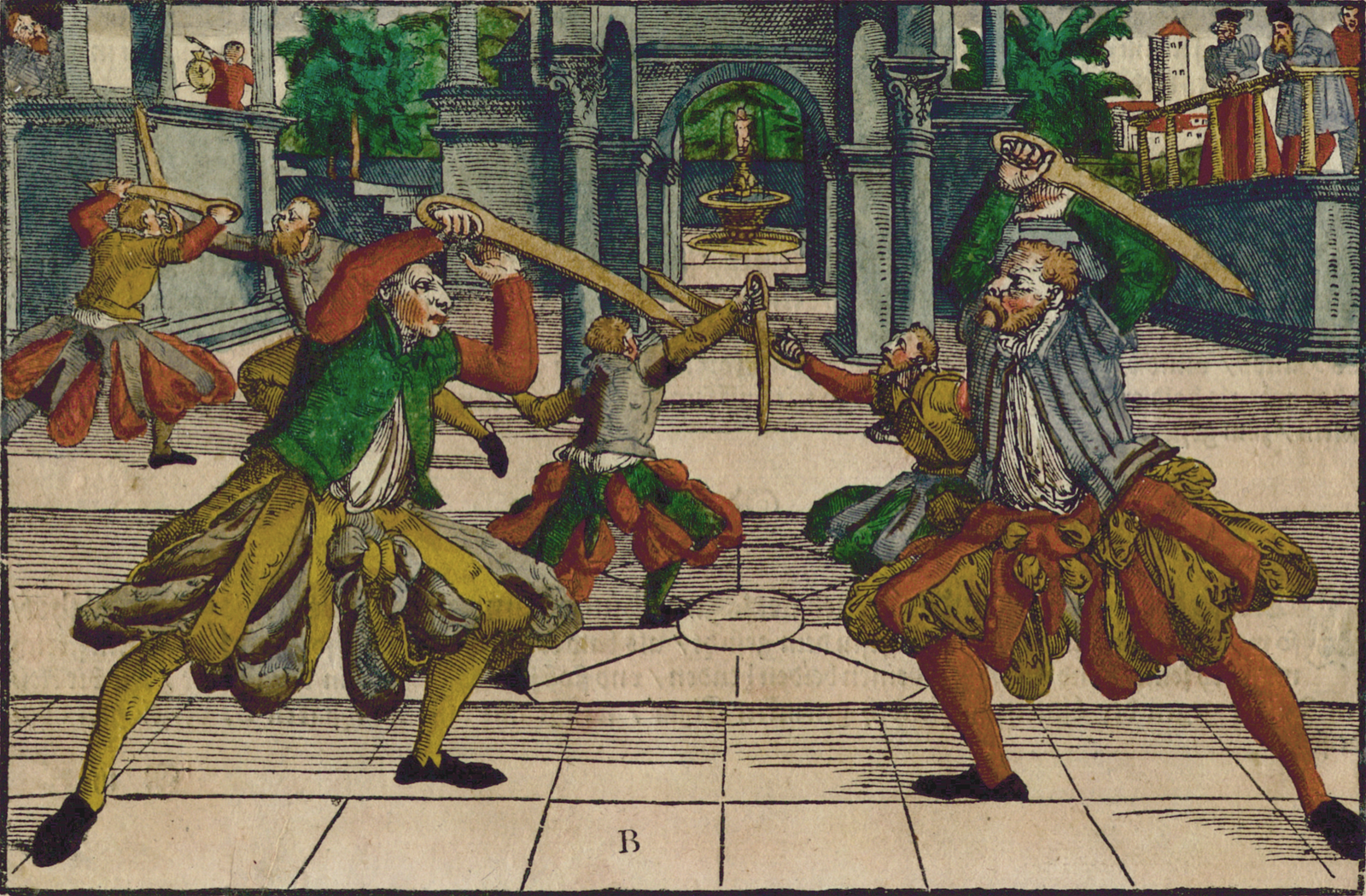
Or: if you have counteracted their cut upward toward your left using your Arch (as taught above), in that moment in which it glances off or beats, pull your dusack toward your left shoulder. Immediately cut from the left shoulder toward their right slant-wise through their face or arm. Furthermore, cut with Middle and Cross Cuts away from you. (Regarding this counterposture, view the small scene between the large portraits in Figure B.)
1570 Edition · fol. Ⅱ.36v.2
[Ⅱ.36v.2] Wie du ihm seine häuw auff deinen Bogen
abreitzen und nachhauwen solt.
MErck wann du also im Bogen für den Man kommest, so hab acht, als bald er von seiner
Rechten gegen deiner Lincken zum Kopff hauwet, so wende also mit hangendem Dusacken die Lang schneid
ubersich gegen seinem streich, under des unnd zugleich mit solchem versetzen, trit mit deinem Lincken Fuß
hinder deinen Rechten auß seinem streich zu ihm, und laß also seinen hauw auff deiner Langen schneiden neben
deiner Lincken undersich abrauschen, trit mit dem rechten Fuß ferner zu seiner Lincken, und hauwe im vornen
durch sein gesicht. Oder so du im sein hauw mit deinen Bogen ubersich gegen deiner Lincken versetzest hast,
wie oben gelehrt, so zucke deinen Dusacken in dem es noch glützt oder bocht gegen deiner Lincken Achsel, als bald
hauw von der Lincken Achsel gegen seiner Rechten Schlims durch sein gesicht oder Arm, ferner hauwe mit Mittel
und kreutz häuwen von dir. Von diser Versatzung besihe die kleinen Bilder zwüschen den grossen in der Figur B.
Ⅱ.36v.2
28.2linked passage
28.3
[3] Another, with which it is taught how you should cut at their face above or below their dusack, depending on whether they have moved too high or low in the counteraction
Take note: when you thus stand in front of your opponent in Arch and they cut powerfully through your counterposture, pay attention to how they rise back into their counterposture—whether they move too high or low. If they are too low in this rising upward (so that you can see their face above their dusack), Cut a Middle Cut quickly across at their face and above their dusack, before they have correctly lifted through into their counterposture. Immediately pull back around your head and cut a Cross Strike in front of you. If they lift too high after they have cut, cut immediately below their dusack across at their face in that moment in which they are still lifting.
1570 Edition · fol. Ⅱ.36v.3
[Ⅱ.36v.3] Ein anders mit welchem gelehrt wirt, wie du ihm unden oder
oberhalb seinem Dusacken zum gesicht hauwen solt, ihe nach dem er
im versetzen zu hoch oder nider auffgefahren ist.
MErck wann du also vor deinem Man im Bogen stehest, und er hauwet dir gewaltig durch
deine versatzung, so hab achtung wie er wider aufffehret zur versatzung, ob er zu hoch oder nider kommet, und
er im aufffahren zu hoch, also das du ihm sein gesicht oberhalb seinem Dusacken ersehen kanst, so hauw ihm [Ⅱ.37r.1] behend ein Mittelhauw uberzwerch zu seinem gesicht, oberhalb seinem Dusacken, ehe dann er recht auffkommet zur
versatzung durch, als bald zuck wider umb dein Kopff, unnd hauw ein kreutzstreich von dir, fehret er aber zu hoch
auff, nach den er gehauwen hat, so hauwe im bald im dem er noch im aufffahren ist, underhalb seinem Dusacken
uberzwerch zu seinem gesicht nach.
Ⅱ.36v.3Ⅱ.37r.1
28.3linked passage
28.4
[4] Rule: how you should let them miss and cut in response
In the Onset, position yourself into Arch and observe that you are not too close to them. As soon as you take note that they want to cut, don’t catch their strike but instead let them cut and miss. That is, in that moment in which they cut in, pull your dusack upward toward you, and yield with your front foot toward the back so that they don’t hit. In that moment in which their dusack drops toward the ground, cut quickly in response with a step forward. After you have observed that they can be hit, you can execute this responding cut from above, slantwise, across, or from below. You should also quickly follow this responding cut with Cross Cuts, unless you observe an opportunity for other sequences.
1570 Edition · fol. Ⅱ.37r.2
[Ⅱ.37r.2] Regel wie du in verfehlen lassen und nachhauwen solt.
IM zufechten schicke dich in Bogen, und schauwe das du ihm nicht zu nahe seyest, als bald
du merckest das er hauwen wil, so fang ihm sein streich nicht auff, sonder laß ihn fehl hauwen, also in dem er
herhauwet, so zuck dein Dusacken ubersich an dich, unnd weich mit deinem vorderen Fuß zu dem hindern,
damit er nit antreffe, in dem aber sein Dusacken gegen der erden fellet, so Hauwe mit einem zutrit behendt hinach,
solchem Nachhauw magstu auch von Oben oder Schlims uberzwerch von Unden thun, nach dem du sihest das
er zutreffen sey, auch soltu auff solchen Nachhauw behend mit kreutzhäuwen nachvolgen, es sey dann das du gelegenheit
ersihest zu andern stucken.
Ⅱ.37r.2
28.4linked passage
28.5
[5] How you should cut at the forearm bone, in that moment in which they want to rise upward to cut
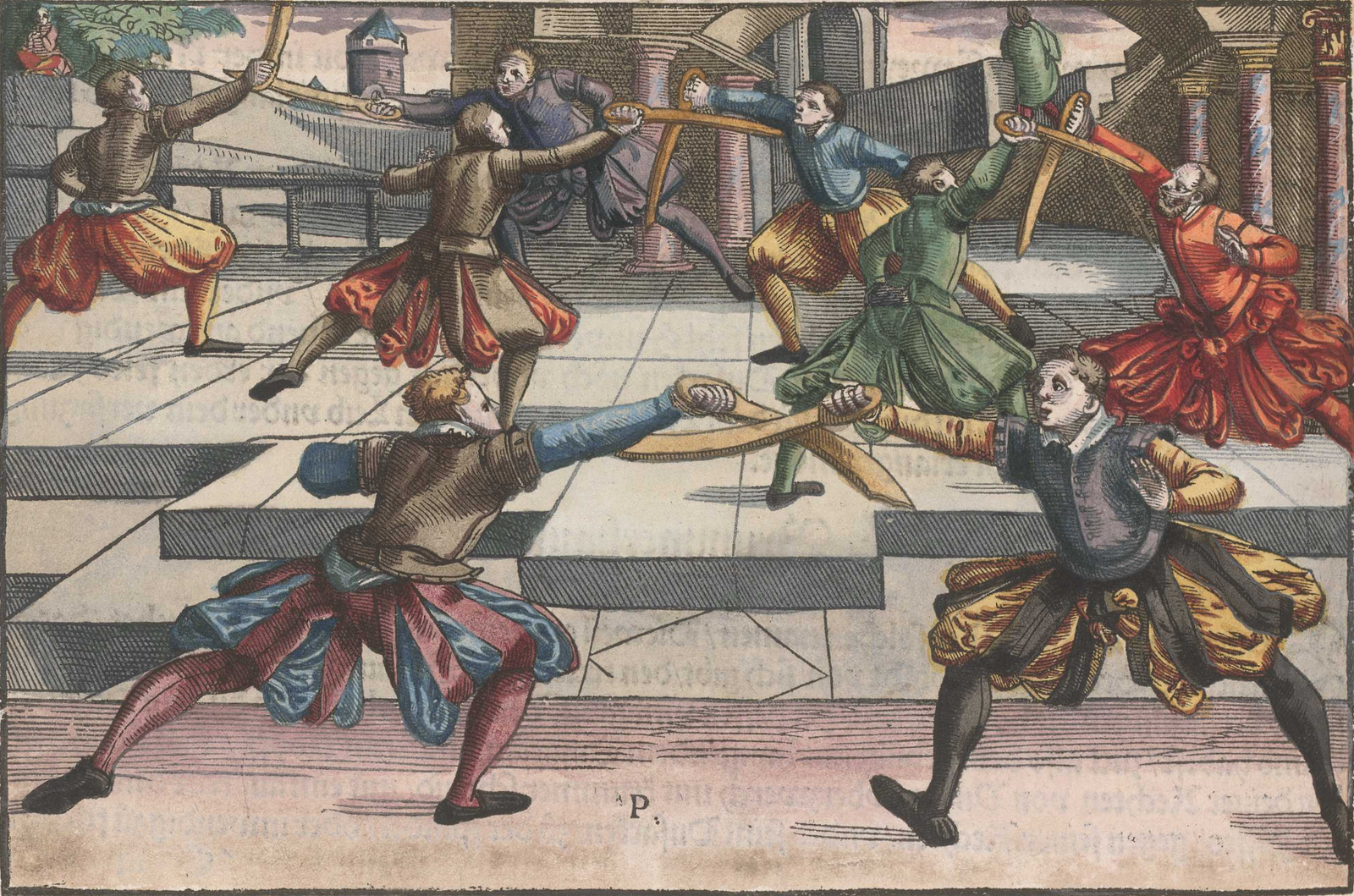
If you find your counterpart in Arch, position yourself also [in Arch] and pay attention: as soon as they rise upward to hit: in that moment in which they lift, cut a Middle Cut through and inwardly toward their forearm bone (as you can see the same in the Figure printed previously, designated with P, in the small scene to the left side). You can also fence from outside and over their arm with Twisting Cuts, in that moment in which they rise upward.
1570 Edition · fol. Ⅱ.37r.3
[Ⅱ.37r.3] Wie du einem in dem er zum streich auffziehen wil, zur Spindel hauwen solt.
FIndestu dein gegenpart im Bogen, so schicke dich auch also, unnd hab acht, so bald er auffzuckt
zuschlagen, so Hauw ihme in dem er auffzeucht, mit einem Mittelhauw inwendig gegen seiner Spindel
durch, wie du solches in hievor getruckter Figur, so mit dem P. verzeichnet an den kleinen Bildern zur Lincken
hand sehen kanst, auch kanstu ihm also in dem er auffzeucht, mit Windthäuwen außwendig uber seinen
Arm Fechten.
Ⅱ.37r.3
28.5linked passage
28.6
[6] Or take note in that moment in which they rise upward: step out toward their left and let your dusack move well around in your hand. Cut next to or under their hilt inwardly at their face in that moment in which they rise upward.
1570 Edition · fol. Ⅱ.37v.1
[Ⅱ.37v.1] Oder merck in dem er auffgehet, so trit gegen seiner Lincken auß, unnd laß deinen Dusacken in der Handt
wol umbfahren, hauwe ihm also in dem er auffzeucht, neben oder under seinen gehültz inwendig zum gesicht.
If they don’t want to cut from the Arch, perform the sequence from the High Cut at them like this: cut a swift High Cut toward their face through the Weak of their dusack. You provoke them to hit with this cut. As soon as they rise upward to cut, cut their in-coming strike away from you using a Middle Cut toward their hand. Then quickly [cut] the third in response.
WIll er aber nicht hauwen auß dem Bogen, so treib die stuck auß dem Oberhauw auff ihn
also, Hauwe einen geschwinden Oberhauw gegen seinem gesicht durch die schweche seines Dusackens, mit
selchem hauw Reitzest du in zuschlagen, so bald er auffgehet zuhauwen, so hauwe im seinen herkommenen
streich durch ein Mittelhauw gegen seiner Handt, von dir wegk, als dann den dritten behend nach.
Ⅱ.37v.2
28.7linked passage
28.8
[8] Take note: if you stand in Arch along with your counterpart, pull your dusack toward your left shoulder. From there, move the outward flat next to their hilt and upward toward their face. You frighten them with this so that they move upward. In this sweep upward, let it move around your head, and cut the second through from your left and across toward their right arm.
1570 Edition · fol. Ⅱ.37v.3
[Ⅱ.37v.3] Merck stehestu sampt deinem widerpart im Bogen, so zuck dein Dusacken gegen deiner Lincken achseln, von dannen
fahr mit der außwendigen Flech neben seinem gehültz übersich gegen seinem gesicht, damit erschreckestu ihn,
das er übersich fehret, laß also in solchem ubersich rauschen umb den kopff fahren, und Hauwe den andern von deiner
Lincken uberzwerch gegen seinen Rechten Arm durch.
Ⅱ.37v.3
28.8linked passage
28.9
[9] Item, when you arrive in Arch in the Onset, pull your dusack out of Arch into the Middle Guard toward your left. From there, move the outward flat from outside of their right arm and upward toward their face and toward your right shoulder. Complete this in a strong fluid movement, so that your dusack additionally snaps upward around your head and threaten them with the inward flat to flick out at their right ear. As soon as they swipe at this Flicking Strike, immediately pull back upward and around your head and cut across through from your right with the curved edge, toward their face or arms. This is a very good sequence. When you do it correctly, it will not fail you.
1570 Edition · fol. Ⅱ.37v.4
[Ⅱ.37v.4] Item so du im zufechten in Bogen kommest, so zucke deinen
Dusacken auß dem Bogen in die Mittelhut, gegen deiner Lincken, von dannen fahre mit außwendiger Fleche
ausserhalb seines rechten Arms ubersich gegen seinem gesicht und gegen deiner rechten Achsel, unnd solches vollende
in einem starcken schwung, also das dein Dusacken ferner oberhalb deinem Kopff umb schnappe, und trauwe
im mit inwendiger Fleche auffen zu seinem rechten Ohr zuschnellen, so bald er disem schnall nach wüscht, als
balde zucke wider ubersich umb deinen Kopff, und Hauwe mit krummer schneide uberzwerch von deiner rechten gegen
seinen gesicht, oder Armen durch, dises ist ein fehr gut stuck so du das recht machet, wird es dir nicht fehlen.
Take note: when you stand before an opponent in Arch, if they don’t want to cut, pull upward into Watchtower. Use body language to pretend that you want to cut from above; however, don’t do that. Instead reverse (while in the air) and flick with the long edge from below at their right arm. Twist the dusack back toward your left shoulder. From there, cut back and around through their right shoulder (either below or above their arm) and through their face. Cut Cross Cuts or a straight [diagonal] Driving Cut long in front of yourself.
MErck so du im Bogen vor einen stehest, wil er nit hauwen, so zuck ubersich in die Wacht,
stell dich mit geberden als woltestu Oben hauwen, thu es aber nit, sonder verwende noch in der lufft, unnd
hauwe mit langer schneide von Unden in einem schnall zu seinem rechten Arm, unnd wind den Dusacken [Ⅱ.38r.1] wider zuruck gegen deiner Lincken Achsel, von dannen hauwe herwiderumb durch sein rechte Achsel, es sey under
oder oberhalb des Arms durch sein gesicht, asl dann hauw kreutzhäuw, oder gerade Treibhäuw Lang von dir.
Ⅱ.37v.5Ⅱ.38r.1
28.10linked passage
28.11
[11] Item: if they cut from above, counteract upward toward your left. In that moment in which they pull their dusack up from their executed cut: cut quickly through, during this, from your left toward their right, either above or below their dusack, depending on whether they lift quickly or slowly. Thus, you arrive with your dusack next to your right side at the end of the cut. From there, cut through across quickly and strongly, from below with the long edge, so that your dusack arrives back at the left shoulder. From there, cut in straight and long from above.
1570 Edition · fol. Ⅱ.38r.2
[Ⅱ.38r.2] Item hauwer er aber von Oben, so versetz ubersich gegen deiner Lincken und in dem er seinen Dusacken von
seinen gethonen hauw wider auffzeucht, so Hauwe dieweil behend von deiner Lincken, gegen seiner Rechten durch,
es sey unden oder oberhalb seinen Dusacken, ihe noch dem er behend oder langsam auffgefahren ist, so kompstu
nach ende des hauwes mit deinen Dusacken neben dein Rechte seiten, von dannen hauw behend wider uberzwerch
von unden auff mit Langer schneide starck durch, also das dein Dusacken wider auff die Lincke achsel komme,
von dannen hauw gerichts und lang von Oben hinein nach.
Ⅱ.38r.2
28.11linked passage
28.12
[12] When an opponent cuts at you from above: take note Indesly as they rise and pull your weapon to your left shoulder again. Cut across with the long edge from your left simultaneously with them [their cut]. Step well out toward their right with this cut. You thus hit them and take away their cut using the Cross.
1570 Edition · fol. Ⅱ.38r.3
[Ⅱ.38r.3] Wann einer auff dich von Oben hauwet, so merck in des er auffzeucht, so zuck dein Wehr auch auff dein Lincke
achseln, Hauw also mit Langer schneid von deiner Lincken uberzwerch, gleich mit ihm hinein, zu solchem hauw
trit wol gegen seiner Rechten auß, so triffestu ihn, und nimbst ihm seinen hauw hinweg durchs kreutz.
Cut your first Middle Cut from your right (above their hilt and through their face). The second: from your left, also strongly through (under their right arm). The third: from your right again toward their left (at their face). When you cut these correctly, one among the three will hit.
HAuw dein ersten Mittelhauw von deiner Rechten, oberhalb seinem gefeß durch sein gesicht,
Den andern von deiner Lincken under seinem Rechten arm auch starck durch, Den dritten widerumb von
deiner Rechten gegen seiner Lincken zum gesicht, so du die recht hauwest, so wirt under disen dreyen einer treffen.
Ⅱ.38r.4
28.13linked passage
28.14
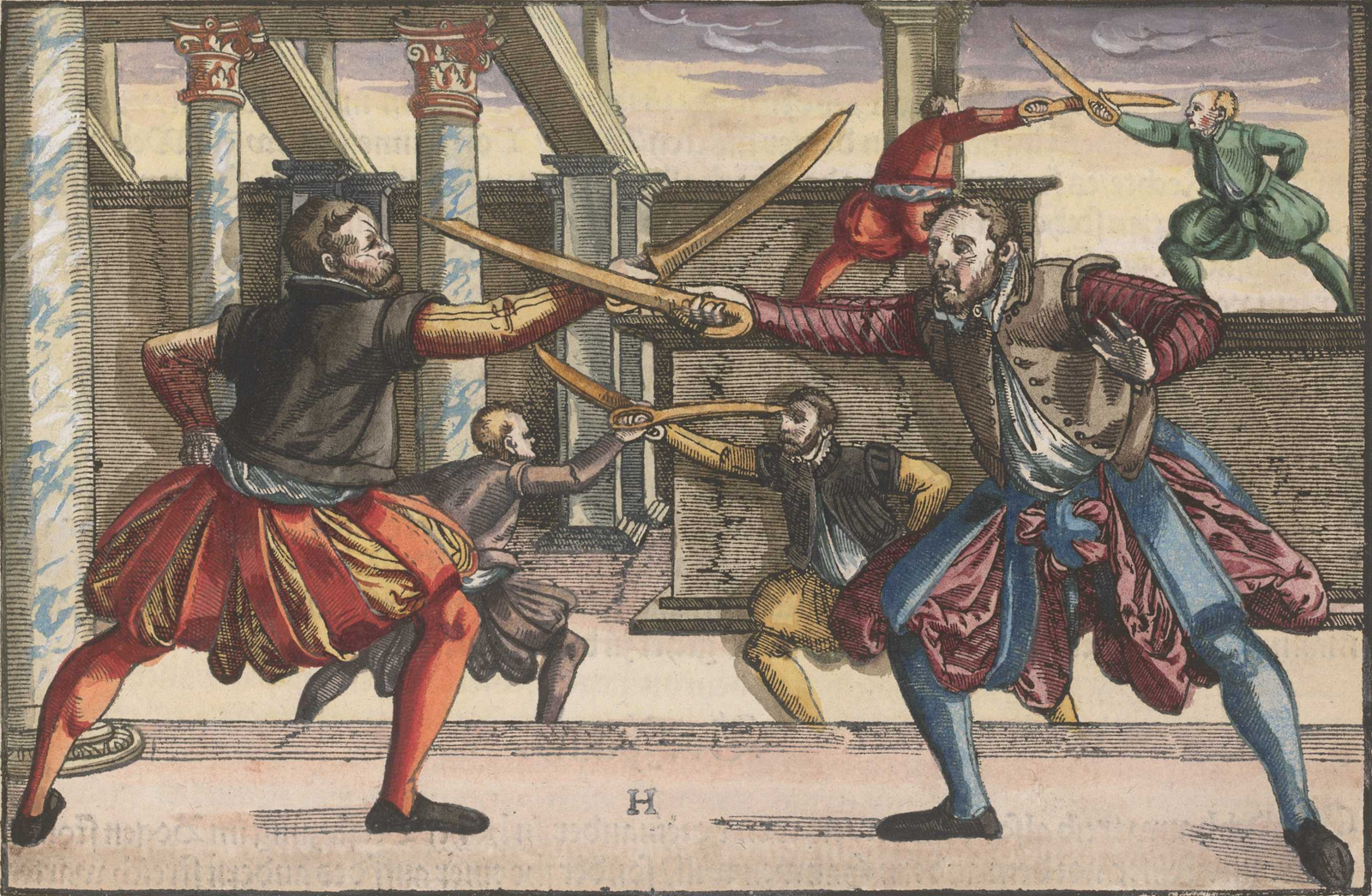
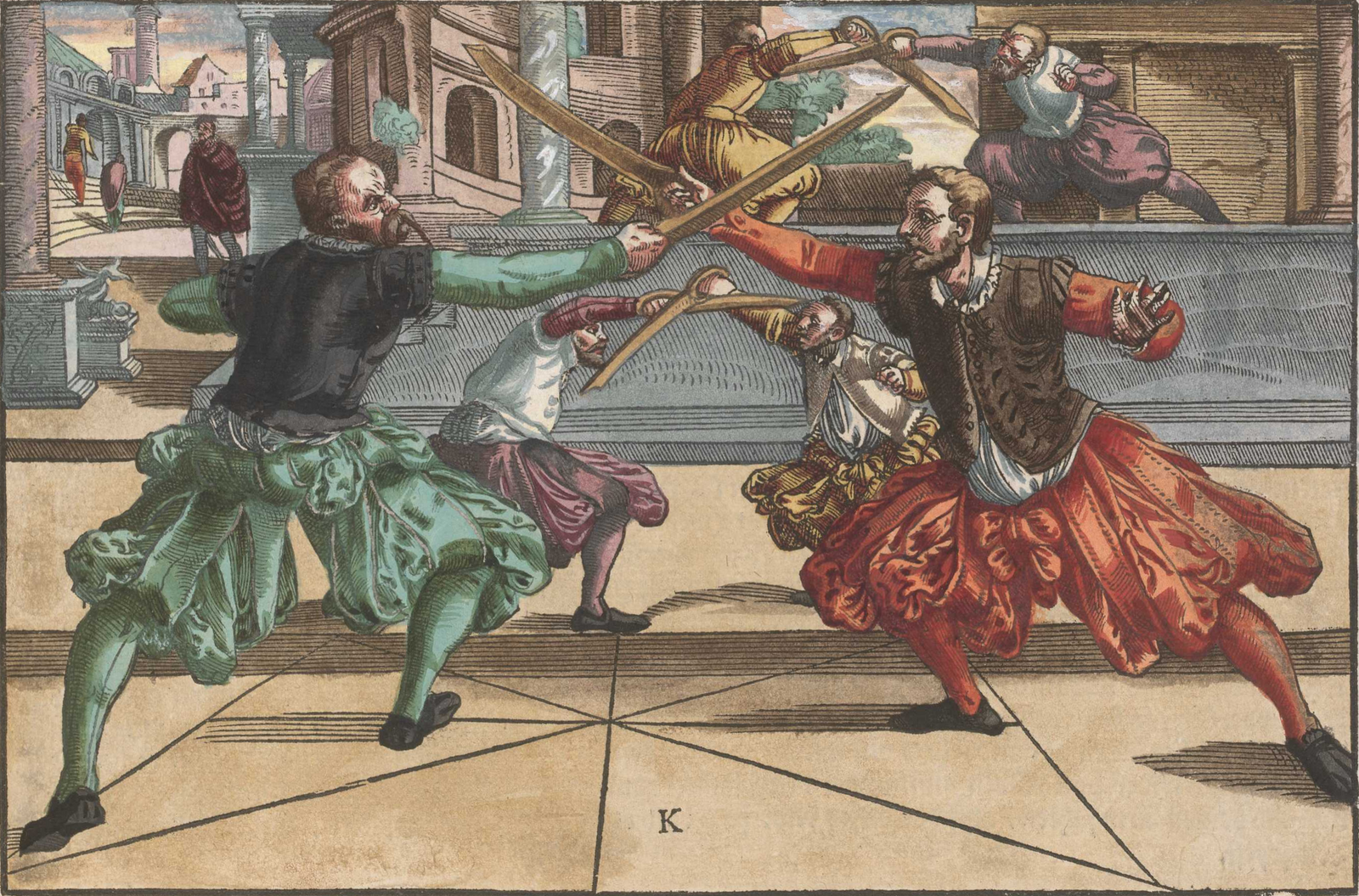
[14] Take note when you arrive in front of an opponent in the Onset and they don’t immediately strike, but instead wait for your strike: observe until you can provoke them long and greatly with your body language (until they lift and hit). During this, take diligent note: as soon as they lift and hit in, pull your dusack around your head to strike as well. Strike simultaneously in with them, such that you receive their strike on the strong of your dusack. Simultaneously and in that moment in which your dusack beats on theirs, you also hit them on their head with the outward half edge (as you can see in the two smaller portraits From there, let [it] snap quickly back around and thrust with inverted hand under their dusack in front of their chest (as, indeed, the smaller scene on the [upper] right Afterwards, cut through the cross, long and away from yourself. In the second part, you will find that which can subsequently be fenced from these two counterpostures.
1570 Edition · fol. Ⅱ.38r.5
[Ⅱ.38r.5] Merck so du im zufechten für den Mann kommest, er aber schlecht nicht gleich, sonder wartet auch auff
deine streich, so schauwe das du ihn mit geberden also lang und vil anreitzest, biß das er auffgeht und schlecht, under
deß merck fleissig, als bald er auffgeht unnd herschlecht, so zucke deinen Dusacken auch umb deinen Kopff zum
streich, unnd schlage mit ihm zugleich auff solche weiß hinein, also das du sein streich auff die sterck deines Dusackens
empfangest, unnd das du auch zugleich in dem sein Dusacken auff den deinen bocht, ihne mit der eussersten
halben schneiden auff seinen Kopff treffest, wie du solches an den zweyen kleinern Bildern in der Figur mit
dem H. zwischen den grössern sehen kanst, von dannen laß behende wider umb schnappen, und stich ihn mit verkerter
hand under seinem Dusacken vor sein Brust, aller ding, wie dich solches auch die kleinern Bilder zur Rechten[Ⅱ.38v.1] in der Figur so mit dem Buchstaben K. verzeichnet lehren, demnach hauwe durch das kreutz lang von dir. Was
aber nun folget auß disen beiden versatzungen zufechten, findestu in dem andern theil.
Ⅱ.38r.5Ⅱ.38v.1
28.14linked passage
28.15
[15] How you should change through, pursue, slice, and fence from the binds
Namely like this, if you (including your counterpart) stand in Arch: bind onto them in the middle of their dusack—this applies regardless of whether that occurs using the Arch or Simple Brace. Remain with the bind on their dusack and provoke them with your front end above or below their dusack, depending on how you have bound on, for as long [as it takes] until they rise upward to cut. Immediately after they pull away or around from your dusack: cut through next to their hilt, at their face or toward their arm while they are guiding their hand to cut in (and are thus still up high), with a step backward. It should be observed that in all binds (regardless of which cut was used to cause it), you can quickly rush to an opening by twisting on their dusack, as you can gather from the following rhymes which I have set here from my didactic poem. I will explain it somewhat to you (before I then describe the other stances) and it follows like this:
1570 Edition · fol. Ⅱ.38v.2
[Ⅱ.38v.2] Wie du auß dem Banden durchwechseln, nachreissen,
schneiden und fechten solt.
NEmlich, also, stehstu sampt deinem gegenpart im Bogen, so binde im an die mitte seines Dusackens,
gült gleich ob das mit dem Bogen oder gerader versatzung geschehe, bleib also mit dem Band an
seinem Dusacken, und reitze in mit deinem vorndern ort ober oder underhalb seinem Dusacken je nach dem du
angebunden hast, so lang biß er auffgeht zu hauwen, als bald er demnach ab oder von deinem Dusacken umbzuckt,
so Hauwe ihm diewil er sein Hand zum herhauwen (noch also in der höhe füret) neben seinem gehültz zu seinem gesicht,
oder gegen seinem Arm durch mit einen abtrit, also ist wol war zunemmen das du in allen Banden, sie geschehen
durch was hauw sie wöllen, mit den Winden an seinem Dusacken ein Blöß ereylen kanst, wie du solches auff
folgenden reimen die ich auß meinem Zedel hieher gesetzt, vernemen kanst, wölche ich dir (ehe dann ich die andern
Leger vollen beschreibe) etwas erkleren, und stehet under anderm also.
Ⅱ.38v.2
28.15linked passage
28.16
[16] Then, as often as your cut touches in binds, The point is guided to the opening by turning. And you feel correctly to remain in all, Likewise, to slice off and counterslice. You pull the cuts away straight and smoothly, If you move through quickly, you will correctly find them. If you change through quickly, moving with steps, You will injure their chest and face greatly.
The first technique to be understood here is this: namely, as often as you bind with your dusack onto theirs (whether from above or below), you should turn your point inward toward their body in that moment in which your weapon touches theirs. Likewise, as often as two cuts hit one another, always turn the point quickly inward on their dusack (as mentioned), and likewise in that moment in which the dusacks touch together or bind. That should or can be completed in all cuts. You should apprehend that you cut in upward and bind on against a High Cut, and bind from above against the Crossing or Low Cut. Now, as often as two cuts touch one another in this way, turn your point inward (while remaining on their dusack) and thrust in at their body. If they rush at your opening during this, twist back toward their dusack and turn them away from yourself with a counter slice.
1570 Edition · fol. Ⅱ.38v.3
[Ⅱ.38v.3] Dann so offt dein hauw inn Banden riert, Im wenden der ort zur Blöß wirt gfiert. Und füllest recht ihn allen bleiben, Deßgleichen ab und gegenschneiden. Die häuw verziehest gerad und schlecht, Durch farest behend so findest ihn Recht. Wechselst bald durch mit tritten fehr, Brust und angesicht lest ihm fehr.
[Ⅱ.39r.1] Das erste stuck so hierinnen begriffen, ist dises, nemlich als offt du mit dein Dusacken auff den seinen bindest,
es geschehe von unden oder von oben, so soltu eben in dem dein wehr auff die seine rieret, deinen Ort einwerts gegen
seinen Leib wenden, deßgleichen auch als offt zwen häuw gegen einander antreffen, alwegen den Ort wie gemelt
abermals behend an seinen Dusacken einwehrts wenden, und das eben in dem die Dusacken zusamen rieren oder
Binden, das sol oder kan in allen Häuwen volbracht werden, doch soltu wahr nemmen das du gegen dem Oberhauw
überherhauwest und andbindest, und gegen dem uberzwerchen oder underhauw von oben darauff Bindest, als
offt nun also zwen häuwe auff solche weiß zusammen rieren, so kehre dein ort noch also an seinem Dusacken blibend
einwerts und stich im zum Leib, eylet er under deß der Blöß zu, so wind wider gegen seinem Dusacken unnd weise
ihm den mit einem gegenschnitt von dir.
Ⅱ.38v.3Ⅱ.39r.1
28.16linked passage
28.17
[17] To understand the second technique in the aforementioned rhyme: it teaches you how you should correctly pull the cuts away from the bind to the body, and from the body to the bind (that is, to the dusack). Namely, as often as the weapons hit together in the bind or you have received their cut with a counterposture, that you slice from the same bind with your dusack toward their body with a pulled slice, and then from the body back swiftly on their dusack with a counterslice, so that you pull the weapon to the body [and] from their body back to the weapon using the slice (as was taught previously in the Simple Brace).
1570 Edition · fol. Ⅱ.39r.2
[Ⅱ.39r.2] Das ander stuck, so in gemelten reimen begriffen, lehret dich wie du die häuw vom Band zum Leib, vom Leib zum
Band, das ist zum Dusacken Recht verziehen solt, Nemlich, als offt die wehren im Band zusamen treffen oder du im
seine häuw mit versatzung empfangen hast, das du von dem selbigen Band mit deinem Dusacken in einem gezogenen
schnitt gegen seinem Leib schneidest, und als dann vom Leib mit widerschneiden bald wider an seinem Dusacken
seygest, also das du die wehr zum Leib vom Leib wider zur wehr, davon in gerader versatzung, hievor auch gegelert[!],
durch den schnitt verziehest.
Ⅱ.39r.2
28.17linked passage
28.18
[18] The third technique, about which is taught here, is the change through. This change through, even though it is also otherwise used for fencing outside of the binds, is very serviceable and clever to also to fence from the binds. This is because, as often as two cuts hit one another, you can, in that moment in which the weapons touch together or bind, move through properly under their [weapon] and step out to the other side, and fence at their weapon and their body with all kinds of sequences.
1570 Edition · fol. Ⅱ.39r.3
[Ⅱ.39r.3] Das dritte stuck aber davon hie gelehret wirtist das durchwechseln, welches durchwechseln ob es wol auch sunst
ausserhalb den Banden gefochten wirt, so ist es doch fehr dienstlich und künstlich solche auch auß den Banden zu
fechten, dan als offt zwen häuw gegen einander antreffen, so kanstu in dem die wehre zusamen rieren oder Binden,
füglich mit außtretten under dem seinem durchfahren unnd auff der andern seiten gegen ihm mit allerhand stuck zur wehr und dem Leib fechten.
Ⅱ.39r.3
28.18linked passage
28.19
[19] The fourth is how you should suddenly withdraw [your] cuts and counterposture. Namely: when your counterfencer cuts in at you, you should let it drop in front [of you] as a miss in that moment just prior to when their cut should hit, and then cut quickly in response. I have previously spoken about this before. Or, if you guide a powerful cut in toward their opening, and as soon as they move to counteract the same, you pull back and guide the same to another opening.
1570 Edition · fol. Ⅱ.39r.4
[Ⅱ.39r.4] Das vierdt, ist wie du im die häuw und versatzung entzucken, als nemlich wan dein gegenfechter auff dich herhauwet
das du im in dem sein hauw eben treffen sol, in verfehlen lassest, und ime als dann behendiglich nach hauwen solt,
Davon ich auch hievor gemelt, oder fürest einen gewaltigen hauw gegen seiner Blösse eine, und als bald er mit versatzung
dargegen auffehret wider abzuckest, und den selbigen einer andern Blösse zu fürest.
Ⅱ.39r.4
28.19linked passage
28.20
[20] Finally, you should also diligently learn to correctly step and to feel, which is the best among these techniques for fencing with speed, because the word fülen is understood here [to mean] that you learn to recognize the correct and proper time for each technique.
1570 Edition · fol. Ⅱ.39r.5
[Ⅱ.39r.5] Zum letsten so soltu auch recht tretten und mit fleiß fülen lernen, welches dir under disen stucken allen das beste
in eyl zu fechten sein werde, dann mit dem wort fülen, wirt hie auch verstanden das du die rechte und gelegene zeit
eines jeden stucks erkennen lernest.
Ⅱ.39r.5
28.20linked passage
28.21
[21] Since the aforementioned techniques are treated now and then in the stances, it is unnecessary to discuss them comprehensively here, and I will then only briefly discuss the most necessary
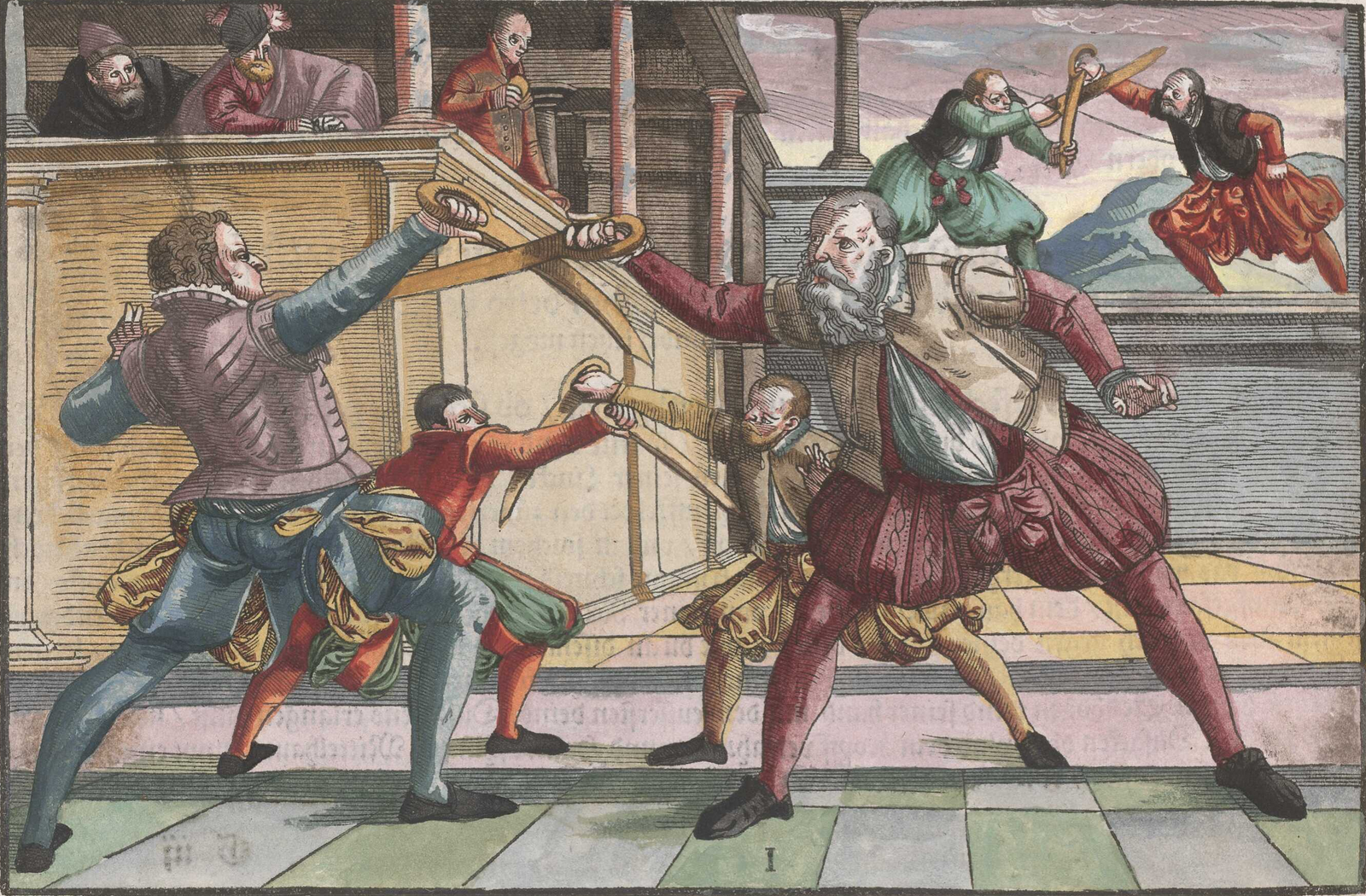
And firstly, you have heard previously in the two guards (namely the Bull and Wrath) how you should turn the point inwardly to the body; therefore, in relation to the cuts that are pulled away, take note of this example: if you find an opponent in Arch, bind on them with your Arch at the front-most part of their dusack. In that moment in which it touches, guide your front end outward around theirs and in to their body. Draw the long edge upward between their body and dusack and through their face (Figure I). Even if you move too far forward with your draw upward into the air and expose yourself, you can still hold them back and recover with downward slices or counterslices.
1570 Edition · fol. Ⅱ.39v.1
[Ⅱ.39v.1] Diewil aber von gemelten stucken fast hin und wider in Legern gehandelt
wirt, ist uunöttig[!] weitleiffig hie davon zumelden, wil allein das notwendigest
auff das kürtzest anzeigen.
UNd für das erste wie du den ort einwerts zum Leib wenden solt, hast bißher in beiden Hutten,
nemlich Stier und zorn gehört, derhalben so vil die verzogene Häuw anlanget, merck dise exempel, Findestu
einen im Bogen so binde ihm auch mit deinem Bogen an, am vordersten theil seines Dusackens, in dem
es aber rieret so füre deinen forder ort aussen umb den seinen hinein zum Leib, und ziehe im die Lang schneid zwüschen
seinen Leib und Dusacken ubersich durch sein gesicht, F. I. und ob du dich wol mit deinen ubersich ziehen in der lufft verfahrest
und Blössest, so kanstu dich doch mit undersich oder gegenschneiden wider fristen und erholen.
Ⅱ.39v.1
28.21linked passage
28.22
[22] Item, bind your Arch on theirs at the Strong. In that moment in which the weapons touch together, step forward and turn your hilt over their dusack in toward their chest. Shove your dusack hastily downward. Draw your long edge behind their dusack through their face.
1570 Edition · fol. Ⅱ.39v.2
[Ⅱ.39v.2] Item binde im
mit deinem Bogen an den seinen inn die sterck, und in dem die Wehren auch zusamen rüren, so wende mit einem zu
trit dein gehiltz über seinen Dusacken hinein gegen seiner Brust, und trucke im sein Dusacken in eil undersich, und
zeihe im dein Lange schneid hinder seinem Dusacken durch sein gesicht.
Ⅱ.39v.2
28.22linked passage
28.23
[23] Item, if you bind them close to their hilt: as soon as your bind touches (if they otherwise maintain their counterposture), cut from outside and above their right arm, inwardly through their face. If they hold their counterposture high and you have bound them with an equal Arch at the middle of their dusack: turn your short edge under their dusack, inward toward their left (and remain with the bind on their dusack during this). Turn the short edge quickly back toward their right so that the short edge arrives on their head or through their face. However, pull the hilt quickly back upward toward you and cut long in response (as the smaller scene in the Figure designated with K teach you). This sequence appears to be impossible, as presented; however, when you perform it at its correct timing—which is quickly, in the first meeting of the bind—you will truly have completed it before they perceive it.
1570 Edition · fol. Ⅱ.39v.3
[Ⅱ.39v.3] Item bindestu im an nahet bey seinen gehültz,
so hauw (als bald dein Band rieret, so er anders seine versatzung widerhelt) von auffen Oberhalb seinem Rechten
arm innwendig durch sein gesicht, helt er aber seine versatzung hoch wann du im mit gleichem Bogen an die mitte
seines Dusackens gebunden hast, so wende dein kurtze schneide under seinem Dusacken einwerts gegen seiner Lincken,
und bleib under des gleich wol mit den Band an seinem Dusacken, wende aber mit der kurtzen schneide behend
wider gegen seiner Rechten, so kumpt im die kurtz schneid auff den kopff, oder durch sein gesicht, aller ding wie
dich die kleineren Bilder in der Figur mit dem K. verzeichnet lehren, zuck behend das gehiltz wider ubersich gegen dir,
und Hauw Lang nach, dises stuck scheinet am fürgeben unmüglich sein, aber wann du solches zu seiner zeit machest,
und das behend im ersten antreffen des Bandts, so wirstu es ehe dann ers gewar wirt volbracht haben.
Ⅱ.39v.3
28.23linked passage
28.24
[24] Item, if an opponent binds you with their Arch on yours and is high in their counterposture: turn your short edge under their dusack again, inwardly toward their left so that you offer a front opening. When they hurry from above to this opening, slice from your right at their arm with a step outward, in that moment in which they move with their strike (as the larger tenants in the Figure designated with K teach you). From this slice, move your point quickly toward their face.
1570 Edition · fol. Ⅱ.39v.4
[Ⅱ.39v.4] Item bindet
dir einer mit deinem Bogen an den deinen und ist hoch mit seiner versatzung, so wende im abermal dein Kurtze
schneide under seinem Dusacken einwerts gegen seiner Lincken, damit gibstu dich vornen Bloß, welcher blöß, so er
dir deren von oben zueilet, schneide im von deiner Rechten in dem er mit seinem streich herfehret mit eim außtrit auff
seine arm, wie dich solches die grösseren Bossen in den Figur so mit dem K. verzeichnet lehren, auß solchem schnit
fahr behend mit den Ort gegen seinem gesicht.
Ⅱ.39v.4
28.24linked passage
28.25
[25] Item, bind on their Arch with Simple Brace (that is, with the High Cut). In that moment in which that cut touches, turn the long edge either downward or upward (remaining on their dusack in the bind) and either toward or through their face (as you can see in the small tenants on the right side in the Figure designated with P). This will drive them upwards; therefore, cut across through their arms while they rise.
You can learn how you should slice off and counterslice at several places in this text. Namely: when an opponent cuts at you from above: cut across counter to it. In that moment in which your cut touches theirs, step quickly out to the side and toward their left during this. Draw the long edge away from their dusack toward your right through their face. If they rush to your opening during this: slice quickly back around toward their weapon. If they chase your dusack: move quickly through from below, as occurs in the change through.
1570 Edition · fol. Ⅱ.39v.5
[Ⅱ.39v.5] Item binde ihm auff seinen Bogen mit gerader versatzung das ist[Ⅱ.40v.1] mit dem Oberhauw, unnd in dem solcher hauw rieret, so wende die Lang schneid mit dem Band noch auff seinen
Dusacken bleibend einweders undersich oder ubersich gegen oder durch sein gesicht, wie du an den kleinen Bossen
in der Figur mit dem P. verzeichnet, zur rechten Hand sehen kanst, damit treibestu ihn übersich, darumb hauwe
im dieweil er aufffehrt, uberzwerch durch sein Arme, wie du aber ab, und gegenschneiden solt, hastu hierinen an
etlichen orten zufinden, nemlich also, Wann einer von Oben auff dich herhauwet, so Hauwe uberzwerch dargegen,
und in dem dein Hauw an den seinen rieret, so trit under des behend zur seiten auß, gegen seiner Lincken, und
zeihe ihm die Lange schneide von seinem Dusacken ab gegen deiner Rechten durch sein gesicht, eilet er aber under
des deiner Blösse zu, so schneide bald widerumb gegen seiner Wehr, fehret er aber deinem Dusacken nach, so fahre
behend unden durch wie im durchwechseln folget.
Ⅱ.39v.5Ⅱ.40v.1
28.25linked passage
28.26
[26] Regarding the change through, take note of this rule: if an opponent cuts from their right at you: cut also from your right toward their [cut]. In that moment in which the cuts should just hit together, move through under their dusack toward the other side with a wide outward step. Throw your blade from outside over their right arm at their head, etc.
Or, if they don’t want to cut, cut again toward an opening with serious body language and take diligent note. As soon as they lift their dusack to receive your cut: don’t let it hit, but instead, in that moment in which it should just touch, move through under their dusack and drop your point from outside over their right arm at their face. If they defend against this and rebuff the thrust away from them: draw the long edge inside their right arm and upward through their face. Cut quickly from your right back opposite to that. If it were to become necessary for you to drop down to counteract during this, you should not let anything prevent you from doing so.
1570 Edition · fol. Ⅱ.40v.2
[Ⅱ.40v.2] Vom durchwechsel aber merck dise Regel also, hauwet einer von seiner Rechten auff dich, so Hauwe auch von
deiner Rechten gegen dem seinen, und in dem die häuw eben zusamen treffen sollen, so fahr under seinem Dusacken
durch, gegen der andern seiten, mit einem weiten außtrit, unnd wirff ihm deine klingen außwendig seines
rechten Arms zum Kopff, etc. Oder wo er nicht hauwen wil, so Hauwe abermals mit ernsthafften geberden ime gegen
einer Blöß zu, und merck fleissig als bald er mit seinem Dusacken herfehret, deinen Hauw zu empfangen, so
laß nicht antreffen, sonder in dem es eben jetz rieren sol, so fahr under seinem Dusacken durch, unnd sencke im deinen
ort aussen uber seinen rechten Arm zum gesicht, wehret er dir solches und weiset den stoß von ihm ab, so ziehe
ihm die Lang schneid inwendig seines rechten Arms ubersich durch sein gesicht, und Hauwe behend von deiner
Rechten wider dargegen, wo dir aber und des notwendig zuversetzen fürfallen wurden, soltu dich daran nichts
hindern lassen.
Ⅱ.40v.2
28.26linked passage
28.27
[27] Item, if your counterpart stands before you in the Slice, cut from your right toward their left. In that moment in which it should just hit, step well to their right side and simultaneously move through below with your dusack. Thrust from outside of their right arm at their face again. If they defend against that and rise upward: move outside and around their arm with the point, to move back underneath the same and at their right chest. If they defend against that again and move downward: move the point around from outside of their right arm again and thrust again from above and from outside over the same arm at their face. You should always move your point around their arm in this way (so that you are now below, and soon above their dusack with your point facing their body).
1570 Edition · fol. Ⅱ.40v.3
[Ⅱ.40v.3] Item steht dein gegenpart vor dir im schnit, so hauwe von deiner Rechten gegen seiner Lincken,
und in dem es jetz eben antreffen soll, so trit wol auff seine Rechte seiten, unnd fahr gleich mit deinem Dusacken
unden durch, und stich im außwendig seines rechten Arms abermals zu seinem gesicht, weret er das, unnd
feret ubersich, so fahre aussen umb seinen Arm, wider mit dem ort underhalb desselbigen an sein rechte Brust,
wehret er solches abermal unnd fehret undersich, so führe den ort widerumb von aussen umb seinen rechttn[!] Arm,
und stich ihm wider von Oben aussen uber demselbigen zum gesicht, auff solche weiß soltu alwegen mit deinem
Ort umb deinen Arm fahren, auff das du jetz underhalb bald Oberhalb seinem Dusacken, mit deinem ort an seinem
Leib seyest.
Ⅱ.40v.3
28.27linked passage
28.28
[28] Learn pursuit with every fencing partner, Whether they are soft or hard in the binds, If you pursue and follow with slices, Observe their arm, be quick with steps.
You have heard enough previously as to what pursuit is and that it is a special skill; therefore, I will only give you a short instruction into how you should use the Strong and the Weak in pursuit, likewise how you should fence hard and soft against it.
1570 Edition · fol. Ⅱ.41r.1
[Ⅱ.41r.1] Nachreisen lern mit jede.n[!] gefert, Er sey banden weich oder hert, Reisestu nach und folgst mit schnitten, Seins Arms nim war biß behend mit tritten.
Was das nachreisen, und das es ein sonderlich kunstuck sey, hastu bißher gnugsam gehört, derhalben wil ich
dir alhie allein anzeigen, wie du im nachreisen dich der stärck unnd schwech, deßgleichen hert unnd weich gebrauchen
und dargegen Fechten solt, ein kurtze anleitung geben.
Ⅱ.41r.1
28.28linked passage
28.29
[29] And take note: when they are hard on your dusack in their resistance in the bind, move or change through quickly underneath, or let [your dusack] move back and snap around. (You have been taught this at length previously.) If they are not hard against you, but instead soft on your dusack in the bind: shove them away from you with one movement. You shouldn’t fall too far forward with this movement, so that you can be quick with a slice or with cuts at the opening (before they escape them again). If you have bound them on the Strong of their dusack (however that were to happen) and they strike around from there: follow them with a slice toward their arm and the opening. Observe that you don’t anticipate and move in front of their arm (if they were to move through).
You should understand all of this from both sides. You will find here and there in the sequences [instruction on] how you should pursue from the Weak with slices or pulls. These [offer] sufficient examples for understanding.
1570 Edition · fol. Ⅱ.41r.2
[Ⅱ.41r.2] Und merck wann er in den Banden mit dem widerhalten hart an deinem Dusacken ist, so fahr oder wechsel
behend unden durch oder lasse wider ab zu ruck umb schnappen, davon du bißher nach lenge gelehrt bist, Helt er aber
nit hart wider, sonder ist weich mit dem Band an deinem Dusacken, so trucke ihm denn in einem ruck von dir,
doch soltu mit solchem außtrucken nicht zu weit verfallen, auff das du ihm behendiglich mit dem Schnit oder mit
hauwen an der Blösse (ehe dann er dir die wider entziehe) seyest. So du im aber an die stercke seines Dusackens
angebunden hast, wie das zugangen wehre, so folge im (wo er dir von dannen umbschlecht) mit dem schnit gegen
seinem Arm unnd der Blöß zu, und schauw das du dich dem Arm nach nit (wo er dir durchgehn wurde) verfahrest,
solches alles verstand von beiden seiten, wie du aber von der schwech mit schnitten oder zügen nachreisen
solt, findestu in stucken hin und wider, die solches verstendigen gnugsame exempel.
_1570_page223.jpg)
_1570_page224.jpg)
_1570_page225.jpg)
_1570_page226.jpg)
_1570_page227.jpg)
_1570_page228.jpg)
_1570_page229.jpg)
_1570_page231.jpg)
_1570_page232.jpg)