[1] Follow the second part of the Sword Fencing in which it will be taught how to use the guards and cuts together with their associated work as taught in the first part and should also be brought into use
I will tell you much more about the Cuts and school-related things, but I will explain the rhymes that were made with hidden words by the ancients so that the art did not become too common. And about the guards, binding, shooting off, remaining, winding, chasing after, running through, and those which are subsequently described in the Indes.
Munich Manuscript · fol. 14r.2
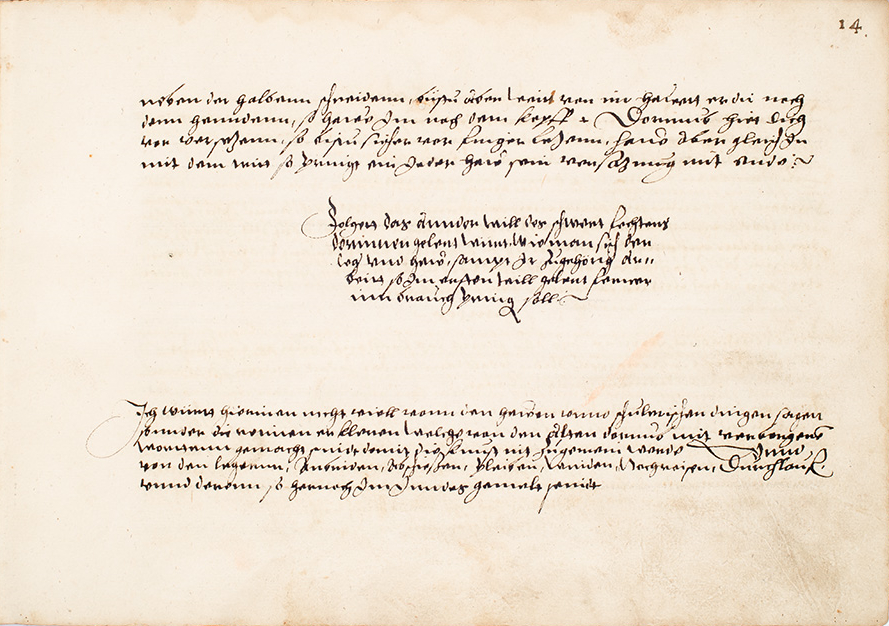
[14r.2] Folgett das annder will des schwert fechtens
dorinnen gelert wirtt, Wie man sich den
leger vnd hew, sampt Ir zugehörig arbeitt
so Im ersten will gelert ferner
inn brauch pringen soll ⁋
Ich württ hierinen nicht viell vonn den hewen vnnd schulerischen dingen sagen
sonnder die reimen erkleren welche von den Alten darumb mit verborgenen
worttenn gemacht seindt domit die kunst nit zugemein werde Vnnd,
von den legernn, Anbinden, Abschießen, Pleiben, Winden, Nachreisen, Durchlaufen,
vnnd denenn so hernach Im Inndes gemelt seindt
14r.2
3.1linked passage
3.2
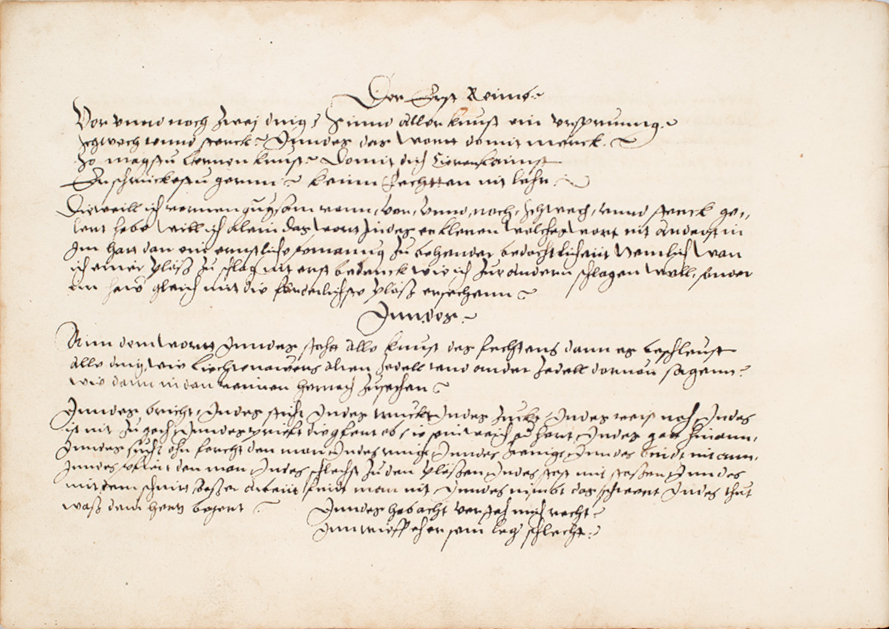
[2] The First Rhyme
17
Before and After these two things, are an Origin to all of the art
18
Weak and Strong, with it note the word Indes
19
so you may learn the art, and with it you will know honor.
20
If you scare easily, don’t learn to fence.
Since I have taught sufficiently about the Before and After, the Weak and Strong, I will solely explain the word Indes, which word has no other in it than an earnest meaning to be kept and considered. For when I strike to an opening, without first considering how I should strike the next, but rather see a cut along with it to the most conducive opening.
Vor vnnd noch zwej ding 3 Sinnd aller kunst ein vrsprunng ⁋
Schwech vnnd sterck ⁋ Inndes das wortt domit merck ⁋
So magstu Lernen kunst ⁋ Domit dich Ewren kannst
Erschrückestu gernn ⁋ keinn Fechtten nit lehr ⁋
Dieweill ich vornen gnugsam vonn, vor, vnnd, noch, Schwech, vnnd sterck gelert
habe will ich alein das wortt Indes erkleren welches wort nit anderst in
Im hatt dan ein ernstliche vermanug zu behender bedachtlicheüt Nemlich wan
ich einer Plöß zu schlag nit erst bedenck wie ich zur andern schlagen woll, sonder
ein haw gleich mit die furderlichste Plöß ersechenn ⁋
14v.1
3.2linked passage
3.3
[3] Indes
In the word Indes stands all the art of fencing, then it decides all things as Liechtenauer's old Zedel and other Zedel say of it. As can be seen hereafter in the rhymes.
Ann dem wort Inndes stehtt alle kunst des fechtens dann es beschleust
alle ding wie Liechtenawers alten Zedell vnd ander Zedell daruon sagenn ⁋
wie dann in den reimen hernach zusechen ⁋
14v.2
3.3linked passage
3.4
[4] Indes counters, Indes stabs, Indes pushes, Indes pulls, Indes travels after, Indes is not too high, Indes tests out the danger, if he is hard or soft, Indes goes in, Indes seeks the opponent without fear, Indes wrestles, Indes constraints, Indes does not bind on, Indes deceives the opponent, Indes strikes to the openings, Indes thrusts with thrusting, Indes with the slice a better work one will not find, Indes takes the sword, Indes does what your heart desires.
Munich Manuscript · fol. 14v.3
[14v.3] Inndes bricht, Indes sticht Indes truckt Indes zuckt, Indes reist noh, Indes ist nit zu gach, Inndes pricht die gfert ob sie sein weich oder hert, Indes gett hinann, Inndes sucht ohn fercht den man, Indes ringt, Inndes zwingt, Inndes bindt nit ann, Inndes verfirtt den man, Indes schlechst zu den Plößen, Indes stest mit stoßen, Inndes mit dem schnitt, beßer arbeüt feidt man nit, Inndes nimbt das schwert Indes thut waß dem hertz begert ⁋
14v.3
3.4linked passage
3.5
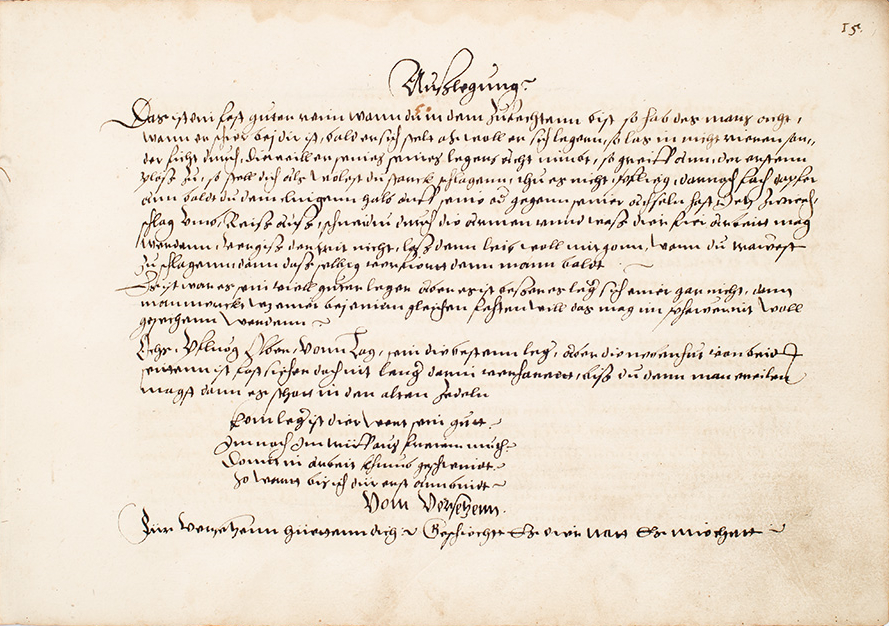
[5] Indes pay attention understand me correctly Hit him before he is in a guard
Interpretation
This is a fairly good rhyme when you are in the Zufechten, thus pay attention to when he is nearly close to you, and will position himself in a guard, don’t allow him to rest, but rather fight through to the first opening while he is taking up his guard, then act as if you would strike strongly, but don’t do it, fly away after and boldly attack once your blade is nearly halfway on his or you have it at his shoulders, now Thwart Strike around, wrench out and slice through the arms and whatever other work my become you, don’t forget the stepping, let your body go well, when you threaten to cut, then the same will deceive the opponent.
Munich Manuscript · fol. 14v.4
[14v.4] Inndes heb acht vor steh mich recht ⁋ Inn trieff eher sein leger schlecht ⁋
Das ist ein fest guter reim wann du in dem zufechtenn bist so hab des mans acht,
wann er schier bej dir ist, bald er sich stelt ohr woll er sich legern, so las in nicht rieren sonder
ficht durch, dieweill er seines seines[!] legers acht nimbt, so greiff ann, der erstenn
Plöß zu, so stell dich als wolest du starck schlagenn, thu es nicht, verflieg, darnach fach dopfer
ann baldt du dein clingenn halb auff seine oder gegenn seiner achseln hast, Jetz zwirch,
schlag vmb, Reiß auß, schneidtu durch die armen vnnd waß dier fier arbeitt mag
werdenn, vergiß der trit nicht, laß denn leib woll mit gonn, wann du trawest
zu schlagenn, dann daß selbig verfiertt denn mann baldt ⁋
14v.415r.1
3.5linked passage
3.6
[6] Thus it is true there are many good guards, but it is better to not lay in a guard at all because you can notice how one wants to fence from the same, that in the striking it may not be seen.
Munich Manuscript · fol. 15r.2
[15r.2] Es ist war es sein viell guter leger aber es ist beßer es leger sich einer gar nicht, denn
man merck wz einer bej einem gleichen fehten will das mag im verhewen nit woll
gesechenn werdenn ⁋
15r.2
3.6linked passage
3.7
[7] Ox, Plow, Fool, from the Roof, are the best guards, but the Side Guard from both sides is most safe but do not try to long with it. If you are to overtake one, then it is shadowed by the old Zedel.
Munich Manuscript · fol. 15r.3
[15r.3] Ochs, Pfluog Olber, vonn Tag, sein die bestenn leger, aber die nebenhut von beiden
seitten ist fast sicher doch nit langer darin verhareltt, biß du denn man ereilen
magst denn es sthott in den alten zedeln
15r.3
3.7linked passage
3.8
[8] No guard is worth it to you In the After you hit him from free courage With it you come quickly to the work So wait until I first bind you.
Munich Manuscript · fol. 15r.4
[15r.4] Kein leger ist dier wert sein gutt ⁋ Im nach im trüff aus freiem muth ⁋ Domit in arbeit khumb geschwindt ⁋ So wartt bis ich dür erst annbindt ⁋
15r.4
3.8linked passage
3.9
[9] Of the Parrying
71
Guard yourself from displacing, if it occurs it hurts you
In the whole of the Zedel there is no rhyme that is more true than this; For those who like to Parry, will be gladly defeated, a proper fencer does not parry. However from this it is taught in the first part.
Für versetzenn hüettenn dich ⁋ Geschiechtt Eß dier nott Es miechett ⁋
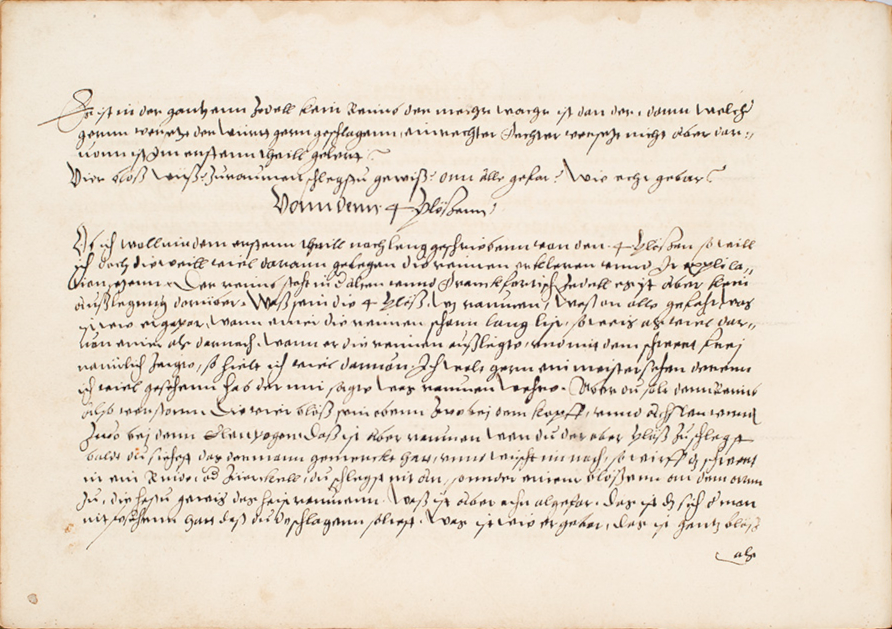
[15v.1] Es ist in der gantzenn zedell kein Reimb der mechr wachr ist dan der, dann welcher
gernn versetz der wurtt gern geschlagenn, ein rechter Fechter versezt nicht aber daruonn
ist Im erstenn theill gelert ⁋
15r.515v.1
3.9linked passage
3.10
[10]
36
Know the four openings, aim your strikes confidently,
37
without any danger, however he acts.
Of the 4 Openings
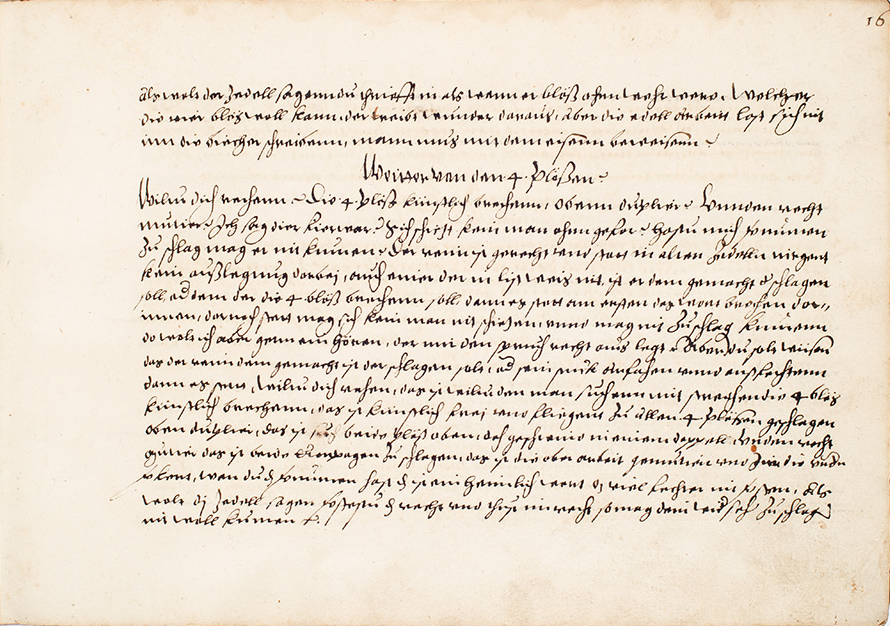
Although I have written in the first part extensively about the 4 openings, I want to explain the contents and make them explicit. The rhyme stands in the old Zedel and the Frankfurt Zedel but there is no interpretation about what are the 4 openings, what is "taking aim", what is "to drive on against everyone", what is "how he bears". When one reads the rhymes already for so long, then one knows much about it afterwards, when he interprets the rhymes, and is showed freely with a sword, I thought a lot about it, I would like to see a master who can tell me the truth about aiming. But you should then understand the rhyme. The four openings are two above by the head and shoulders, and two by the elbows. But aiming* is when you strike to the upper openings and soon you see that the man has noticed, and does not slip after, then throw your sword in a Loop, or circle, you don’t lay on though, but rather to an opening on the arm, which you certainly have, that is called aiming. But what is; without any danger, that is when the opponent has not seen that you should strike, what is; however he acts, that is to all openings, then would the Zedel say, you hit him when his defense becomes open, he who knows well the four openings, can make wonder out of them, but the noble work can not be written in the books, one must prove it with iron.
Munich Manuscript · fol. 15v.2
[15v.2] Vier bloß wüß ⁋ zuraumen schlegstu gewiß ⁋ onn alle gefar ⁋ Wie echr gebar ⁋
Vonn denn 4 Plößenn,
Ob ich woll inn dem erstenn theill nach leng geschriebenn von den 4 Plößen so will
ich doch dieweill viel darann gelegen die reimen erkleren vnnd Ir explication
sezenn, Der reimb steht in der alten vnnd Franckfortischen Zedell es ist aber kein
Außlegung darüber, Waß sein die 4 Plöß, wz raumen, waß on alle gefehr, was
ist wie eigepar, wann einer die reimen schonn lang list, so weis als viel daruon
einer als darnach, Wann er die reimen außlegte, vnd mit dem schwert frej
natürlich zeigte, so hielt ich viel daruon, Ich wolt gern ein meister sehen denenn
ich viel gesehenn hab der inn sagte was raumen wehre, Aber du solt denn Reimb
also verstonn, Die vier blöß sein ebenn zwe bej dem kopff, vnnd achslen werden
zwo bej denn Elenpogen, Daß ist aber raumen wen du der ober Plöß zuschlegst
baldt du siehest das der mann gemerckt hatt, vnnd wischt inn nach, so wirff dz schwert
in ein Rinde, oder züerckell, du schlegst nit an, sonnder einem blößenn an dem arm
zu, die hestu gewis des heist reumenn. Waß ist aber ahn algefar. Das ist dz sich der man
nit versehenn hatt daß du de schlagenn soltest. Was ist wie ergeber, das ist gantz blöß [16r.1] als wolt der zedell sagenn du thriefft in als wann er blöß ohnn wehr were, Welcher
die vier blös woll kann, der treibt wunder daraus, aber die edell arbeitt lest sich nit
inn die biecher schreibenn, mann mus mit dem eisenn beweisenn ⁋
15v.216r.1
3.10linked passage
3.11
[11] More about the four openings
38
Will you rely on yourself, to break the four openings with skill,
39
double above, transmute below correctly,
40
I say to you truthfully, no one can defend himself without danger.
41
Have you understood me, he may not even be able to strike.
The rhyme is fair and nowhere in the old Zedel are any interpretations of it, also one knows not of it in the list. Is he the one who it is done to, or is he the one who should strike, or is he the one who shall break the four openings, the word Break is written first, then after that, no one can defend, and may not even be able to strike, but I would like to hear one, who lays out the saying correctly, so you should know that the rhyme is made for the one who should strike or start his Stuck and fight it out. Then it reads: “Will you rely on yourself”, this means, you will search out the opponent with striking, “the four openings artfully break,” that is striking artfully and freely flying to all four openings, “Doubling above” that is search both openings above it goes quickly in a double, “transmute below correctly” that is striking at both elbows, that is to transmute the upper work and reverse it to the lower, when you have heard it, it is a stealthy word that many fencers do not understand, as if the Zedel would say, understand it correctly, do it correctly, so your resistance to strike may not come willingly.
Wiltu dich rechenn ⁋ Die 4 plöß künstlich brechenn, Obenn duplier ⁋ Vnnden recht mutier ⁋ Ich sag dier fierwar ⁋ Sich schitzt kein man ohnn gefar ⁋ hastu mich vernumen zu schlag mag er nit kumen ⁋
Der reim ist gerecht vnd stett in alten Zedelln nirgent
kein außlegung darbej, auch einer der in list weis nit, ist er dem gemacht der schlagen
soll, oder dem der die 4 blöß brechenn soll, dann es stett am ersten des wort brechen darinnen,
darnach stett mag sich kein man nit schiezen, vnnd mag nit zuschlagen kumenn
do wolt ich aber gern ein hören, der mit den spruch recht aus legt, Aber du solt wüsen
das der reim dem gemacht ist der schlagen solt, oder sein stuck anfahen vnnd ausfechtenn
dann es stett, Wiltu dich rehen, das ist wiltu den man suchenn mit streichen die 4 blös
künstlich brechenn, das ist künstlich frej vnd fliegent zu allen 4 Plössen geschlagen
oben duplier, das ist such beide Plöß oben, deh geschwind in einem doppell, vnden recht
Mutier das ist beide Elenpogen zu schlegen, das ist die ober arbeit gemutier vnd Inn die vndern
verkert, wan du dz vernumen hast dz ist ein heimlich wert dz viel fechter nit versten, Als
wolt dj Zedell sagen verstesu dz recht vnd thust im recht so mag dein widersehen zu schlagen
nit woll kumen ⁋
16r.2
3.11linked passage
3.12
[12]
42
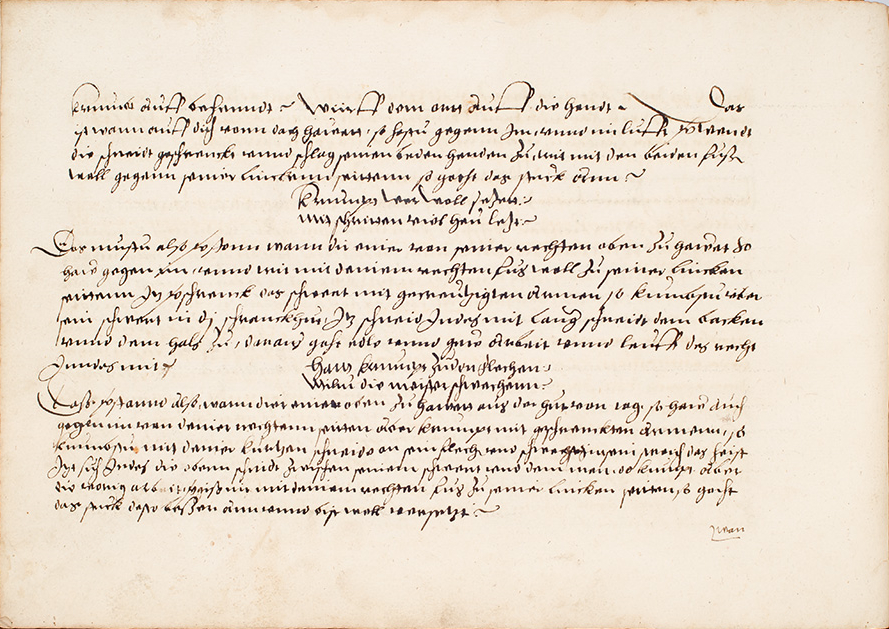
Crooked Cut quickly, throw the point at the hands
That is when someone cuts at you from the Roof Guard, thus you have gone against him and in the air turned the edge crosswise and struck at both his hands, step with both feet well to his left side, this is how the Stuck starts.
Munich Manuscript · fol. 16v.1
[16v.1] krumbt auff behenndt ⁋ Würff dem ortt auff die hendt,
Das
ist wann auff dich vonn dach hawett, so hastu gegenn Im, vnnd im lufft verwendt
die schneidt geschrenckt vnnd schlag seinen beden henden zu, trit mit den beiden fußen
woll gegenn seiner linckenn seittenn so geeht das stuk ann ⁋
16v.1
3.12linked passage
3.13
[13]
43
Who cuts Crooked well With stepping many cuts are hindered
This you must understand when one cuts at you from his upper right, then cut against him and step with your right foot well to his left side, now turn the sword crosswise with arms crossed thus you come over his sword in the Barrier Guard, now slice Indes to his jaw and neck with the long edge, hence it has noble and good works and goes with the correct Indes.
Munich Manuscript · fol. 16v.2
[16v.2] Krumpt wer woll sezett ⁋ Mit schritten viel heu lezt ⁋
Das mustu also verstenn wann dir einer von seiner rechten oben zuhawet So
haw gegen im, vnnd mit mit[!] deinem rechten fus woll zu seiner lincken
seittenn Itz verschrenck das schwert mit gecreutzigten armen so kumbstu über
sein schwert in dj schranckhut, Itz schneid Indes mit langer schneidt dem backen
vnnd dem hals zu, daraus goht edle vnnd hew arbeit vnnd leuff des recht
Inndes mit ⁋
16v.2
3.13linked passage
3.14
[14]
44
Cut Crooked to the flats You will weaken the Masters
Understand this when one cuts from above at you from the Guard of the Roof, thus also cut against him from your right side but with crossed arms, thus you come with your short edge onto his flat and weaken his strike, now cut Indes the upper slice between his sword and the man, thus you come however to the previous work, and do not forget to step with the right foot to his left side, thus the higher the Stuck goes the better it is and you are parrying well.
Munich Manuscript · fol. 16v.3
[16v.3] Haw krumpt zu den Flechen ⁋ Wiltu die meister schwechenn ⁋
Daß verstannd also, wann dier einer oben zu hawett aus der hut von tag so haw auch
gegen im von deiner rechtenn seitten aber krumpt mit geschrenckten armenn, so
kumbstu mit deiner kurtzen schneide an sein flechen vnd schwech stoz in sein streich das heist
Itzt suh Indes die obenn schnidt zwischen seinem schwert vnd dem man, do kumpt aber
die wonig arbeit, vergiß nit mit deinem rechten fus zu seiner lincken seitten so gocht
das stuck desto beßer ann vnnd bist woll versetzt ⁋
16v.3
3.14linked passage
3.15
[15]
45
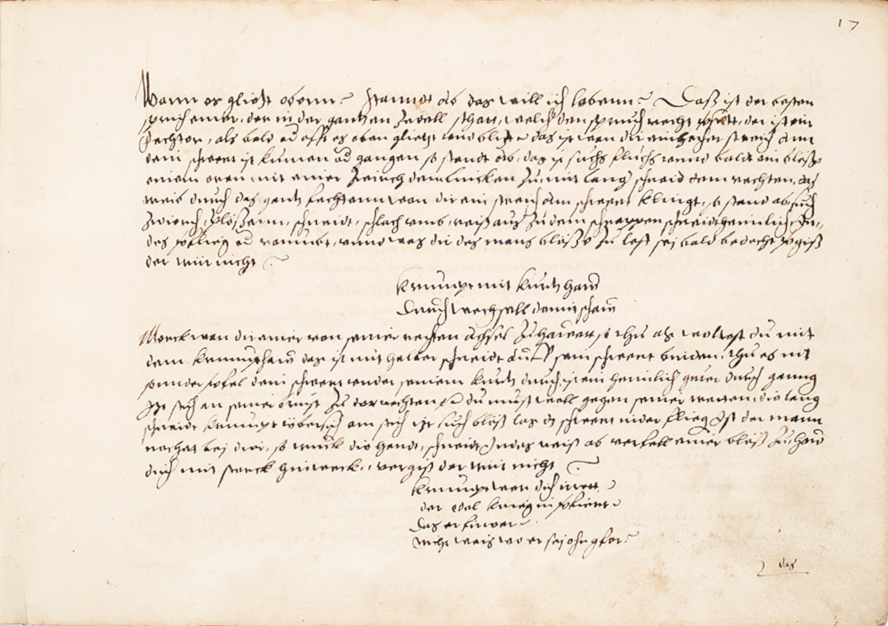
When it clashes above, move away, this will I praise
This is the best saying in the whole Zedel, for he who understands it correctly, is a fencer, as soon as or as often as it clashes or flashes above, that is, when you see the strike is coming or has come on your sword, so move off, that is searching wrathfully, and once he is open, strike a Thwart to the left ear, correctly with the long edge, that is what drives all of fencing, when someone strikes on to your sword blade, that you move off, search for openings with the Thwarter, Slice, Strike around, wrench out into the snapping, slice secretly, Indes fly away or fail, and what openings he gives you should be considered, do not forget to step.
Munich Manuscript · fol. 17r.1
[17r.1] Wann es gliezt obenn ⁋ Stanndt ab das will ich lobenn ⁋
Daß ist der besten
streich einer, der in der gantzen Zedell sthatt, welcher den spruch recht versiett, der ist ein
Fechter, als bald oder offt es oben glietzt vnd blizt ⁋ das ist wen dir ein hocher streich ann
dein schwert ist kumen oder gangen so standt ab, das ist suchs fluchs vnnd baldt ein blöße
einem oren mit einer zwirch dem Lincken zu, mit langer schneid dem rechten, das
treib durch das gantz fechtenn won dir ein streich am schwert klingt, so stand ab, such
zwierch, Plößenn, schneidt, schlach vmb, reiß aus zu dem schnappen schneidt heimlich, Indes
verflieg oder raumbt, vnnd was dir des mans blöße zu lest sej bald bedecht vergiß
der trüt nicht ⁋
17r.1
3.15linked passage
3.16
[16]
46
Cut Crooked with Short Cut Show with it the Changing through
Note when someone cuts at you from his right shoulder, so do as if you would bind onto his sword with the Short Cut, that is with the half edge, but do not do it, rather cast your sword short and through in under his, it is a good and secret going through, now thrust to his right breast, so you must go well to his right, the long edge comes upwards with the thrust, now search for an opening, allowing the sword to fly low, if the opponent is close to you, then push his hands, slice Indes, wrench away, if someone fails at your opening, then cut that strongly away, do not forget to step.
Munich Manuscript · fol. 17r.2
[17r.2] Krumpt mit kurtz haw Durch wechsell domit schaw
Merck wan dir einer von seiner rechten achsel zuhawett so thu als woltest du mit
dem krumphaw das ist mit halber schneidt auff sein schwert binden, thu es nit
sonnder verfel dein schwert vnder seinem kurtz durch ist ein heimlich guter durch ganng
Izt stich an seiner brust zu der rechten ⁋ du must woll gegen seiner tretten, die lang
schneidt krumpt übersich am stich izt such blöß las dz schwert nider fliegen Ist der mann
nochet bej dier, so truck die handt, schneidt Indes reis ab verfell einer blöß zu, haw
dich mit sterck hinweck, vergiß der trüt nicht ⁋
17r.2
3.16linked passage
3.17
[17]
47
Cut Crooked to he who wanders into you The Noble war will deceive him
48
That he in truth Will not know where to go without danger
That stuck is nearly like the previous, then when you cut in at him from above or below, and he will do a Crooked Cut to your strike, but fails halfway to you above your sword, then position your sword under his with a thrust to his breast, step well to his right side, now seek to work from the previous stuck, that both stuck give nearly the same understanding.
Munich Manuscript · fol. 17r.3
[17r.3] Krumpt wer dich irrett ⁋ der edel krieg in verfiert ⁋ das er firwer ⁋ nicht weis wo er sej ohn gfer ⁋
[17v.1] Das stuck ist fest wie das vorig, dann wann du einem vnden oder oben zu hewest
vnnd er dier denn streich mit einem krumpthaw Irret, felt dier oben vff dein
schwert halb, so stell dein schwert aber vnder seinem durch mit einem stich oder brust zu
trit woll gegen seiner rechten seitten, Itz such arbeit aus dem vorigen stuck die bede
stuck hebenn fest einen verstenndt ⁋
17r.317v.1
3.17linked passage
3.18
[18]
49
Thwart takes What comes from the Roof Guard
That is an epitome from a saying, then where the Thwart does not defend, so it would happen from half fencing, what comes from the Roof, that takes them freely away, but there is more to it than that, as it is written hereafter in the ancient Zedel.
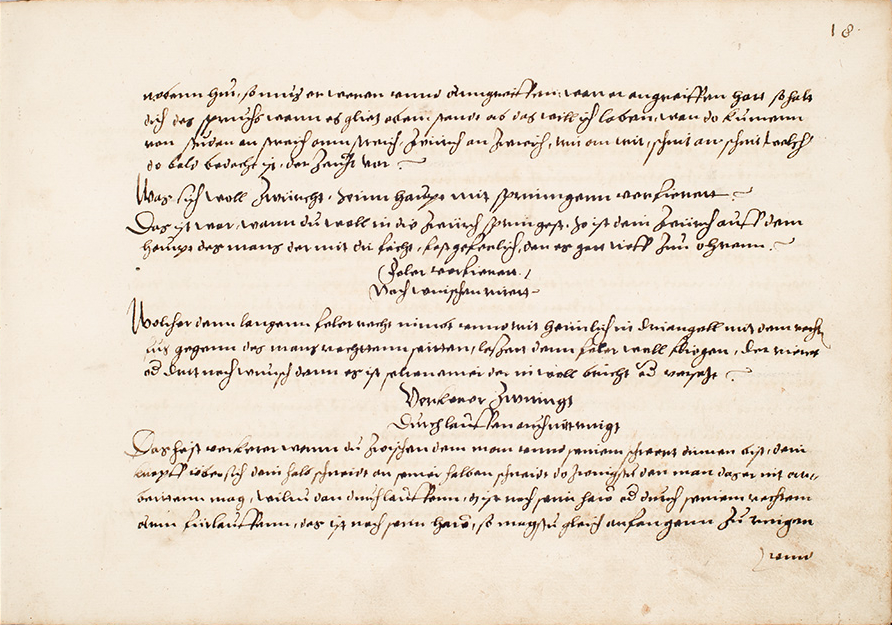
Das ist ein aus bundt vonn einem spruch, dann wo die Zwürch nit were, so war es
vmb halb fechten geschechen was von tach kumbt, das nimbt sie frej hinweg Es hert
aber mechr dar zu, dann es stett inn den alten Zedlen hernach ⁋
17v.2
3.18linked passage
3.19
[19]
50
Thwart with the Strong Note your work with it
That is when you have bravely Thwarted, then at once search above with the Strong or Reverser, now slice, Indes push, Indes nearly in the ancient Slice or Remaining
Indes takes the sword, Indes does what your heart desires.
Munich Manuscript · fol. 17v.3
[17v.3] Zwürch mit der sterck ⁋ dein arbeit domit merck ⁋
Das ist wan du dapffer zwirchett hast so such baldt oben mit dem schranck oder verkeren
ützt schneidestu Inndes druckest Inndes fest in denn altenn schritt oder bleübenn ⁋
Inndes nimbt das schwertt ⁋ Inndes macht was dein hertz begert ⁋
17v.3
3.19linked passage
3.20
[20]
51
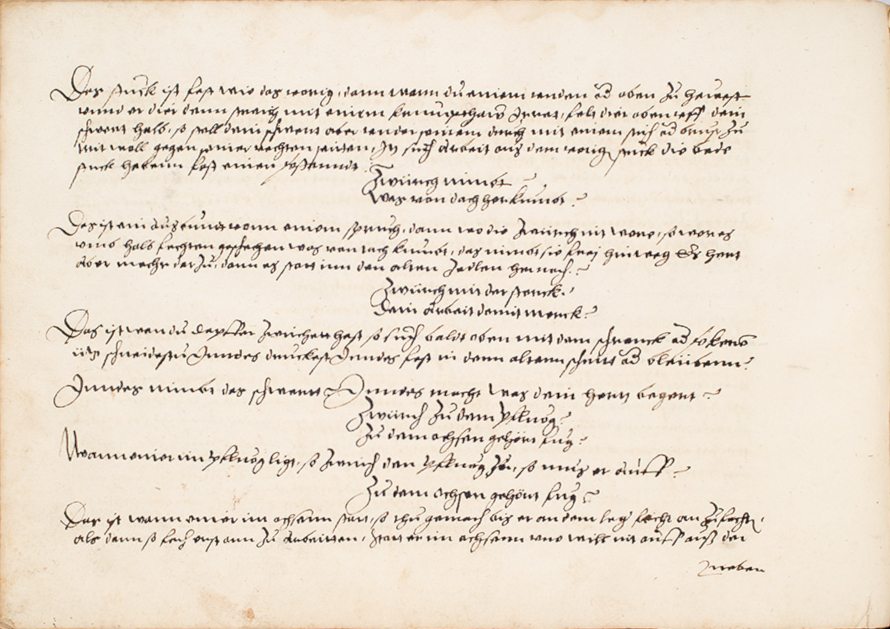
Thwart to the Plow To the Ox hard together
When someone is positioned in the Plow, then Thwart at his Plow, so he must Get Up!
Munich Manuscript · fol. 17v.4
[17v.4] Zwürch zu dem Pfluog ⁋ Zu dem ochsen gehört fug ⁋
Wann einer im Pfluog ligt, so zwirch den Pfluog zu, so mus er auff ⁋
17v.4
3.20linked passage
3.21
[21] To the Ox hard together
When someone stands in the Ox, so do it [Thwart] until he must start fencing from the guard, and when he first starts to work he stays in the Ox and does not want to get out of the Side Guard, thus he must defend and attack, when he has attacked, then hold yourself to the saying, “When it clashes above, move away, That I will Praise” When coming from below strike to strike, Thwart to Thwart, step to step, slice to slice, that moves forth.
Das ist wann einer im ochsenn stett, so thu gemach bis er an dem leger ficht an zufechten,
als dann so fach erst ann zu arbeitten, Statt er im ochsenn vnd will nit auff auß der [18r.1] nebenn hut, so mus er weren vnnd anngreiffen, wan er angreiffen hatt so halt
dich des spruchs wenn es gliez oben, standt ab das will ich loben, wan do kumenn
von studen an streich ann streich[!], Zwürch an zwierh, trit an trit, schnit an schnit, welcher
do bald bedacht ist, der Zeucht vor ⁋
17v.518r.1
3.21linked passage
3.22
[22]
52
What you will Thwart well, his mind is easily deceived by jumping
That is when you spring well in the Thwarter, so is your Thwart Strike to the head of the man who fights with you, nearly dangerous, for it goes deep to the Ox.
Munich Manuscript · fol. 18r.2
[18r.2] Was sich woll zwürcht, Seinn haupt mit sprinngenn verfierett ⁋
Das ist war, wann du woll in die zwürch springest, So ist dein Zwürch auff dem
haupt des mans der mit dir ficht, fest geferlich, dan es gett tieff zuu ohrenn ⁋
18r.2
3.22linked passage
3.23
[23]
53
The Failer deceives And hits how you desire
Which then the long Failer takes correctly and steps secretly in the triangle with the right foot to the opponent’s right side, allow the failure to fly well, to hit or fail according to your wishes, because it is seldom that someone will break it or parry it.
Welcher denn langenn feler recht nimbt vnnd trit heimlich in driangell mit dem rechten
fus gegenn des mans rechttenn seitten, leßen denn feler woll fliegen, der rieret
oder drit nach wunsch denn es ist sehen einer der in woll bricht oder versezt ⁋
18r.3
3.23linked passage
3.24
[24]
54
Reverser constrains Running through so you may wrestle
That is called Reversing when your sword is between his sword and his body, your pommel is upwards, your short edge is on his short edge, thus you constrain the opponent so that he may not work, if you will then run through, that is, after his cut or through his right arm running forth, that is after his cut, thus you may simultaneously begin to wrestle and grab at the elbow and thereafter the man is winning, then you must take to wrestling for you then you can’t always allow yourself to wrestle and fence, like it is written in the books, because much more often happens, and therefore you must be aware of it.
Munich Manuscript · fol. 18r.4
[18r.4] Verkerer zwinngt Durchlauffen auch mit ringt
Das heist verkerer wann du zwischen dem man vnnd seinem schwert drinen bist, dein
knopff über sich dein halb schneidt an seiner halben schneidt do zwingstu den man das er nit arbeittenn
mag, wiltu dan durchlauffenn, dz ist nach seim haw oder durch seinem rechtem
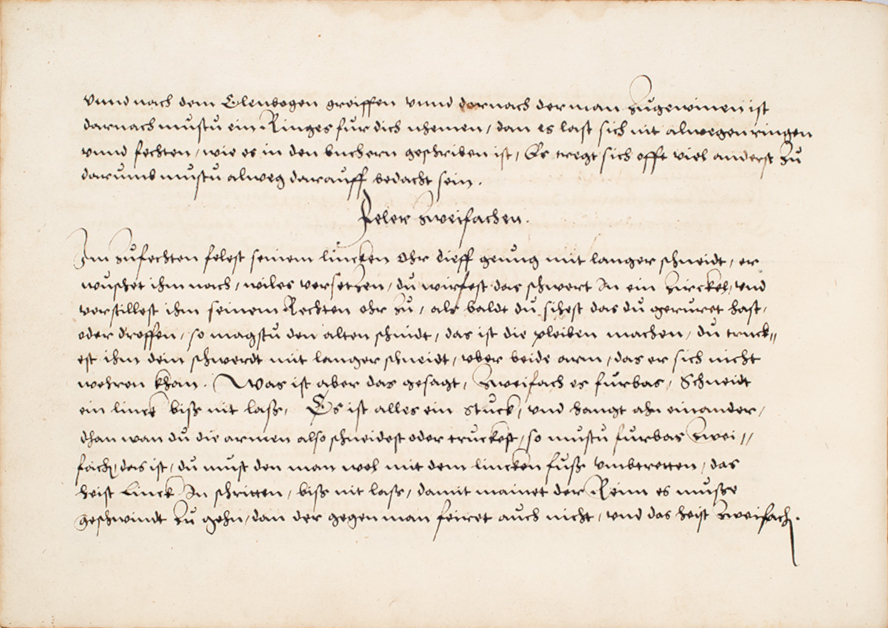
arm fürlauffenn, das ist nach seim haw, so magstu gleich anfangenn zu ringen [18v.1] vnnd nach dem Elenbogen greiffen vnnd dornach der man zugewinen ist
darnach mustu ein Ringes fur dich nhemen, dan es last sich nit alwegen ringen
vnnd fechten, wie es in den buchern geschriben ist, Es tregt sich offt viel anderst zu
darumb mustu alweg darauff bedacht sein.
18r.418v.1
3.24linked passage
3.25
[25] Failer Twice
In Zufechten, fail in deep enough at his left ear with the long edge, if he slips after, and will parry, so cast your sword in a circle and present it at his right ear, as soon as you see that you have touched swords, or hit, then you may use the ancient Slice, that is doing the (handwork) Remaining, you push your sword over both his arms with the long edge so that he cannot defend it. However, what is the saying: “Double Failer, Step left until not allowed”. It is all in a stuck, and relies on one another, that when you slice or push to the arms, then you must continue it twice, that is, you must step around well to the opponent with the left foot. That is called Stepping in Left, until not allowed, with it the rhyme means that you must go quickly, so that the opponent doesn’t also veer away, and this is called Doubling.
Im zufechten felest seinem lincken Ohr dieff genug mit langer schneidt, er
wuschet ihm nach, wiles versetzen, du wirfest das schwert In ein Zirckel, vnd
vorstillest ihm seinem Rechten ohr zu, als baldt du sihest das du geruret hast,
oder dropfen, so magstu den alten schnidt, das ist die pleiben machen, du truckest
ihm dein schwerdt mit langer schneidt, vber beide arm, das er sich nicht
wehren khan. Was ist aber das gesagt, zweifach es furbas, Schneidt
ein linck biß nit laß, Es ist alles ein stuck, vnd hangt ahn einander,
dhan wan du dir armen also schneidest oder truckest, so mustu fürbar zweifachen,
das ist, du must den man wol mit dem lincken fuß vmbtretten, das
heist Linck In schritten, biß nit laß, damit mainet der Reim es muße
geschwindt zu gehn, dan der gegen man feüret auch nicht, vnd das heist zweifachen.
18v.2
3.25linked passage
3.26
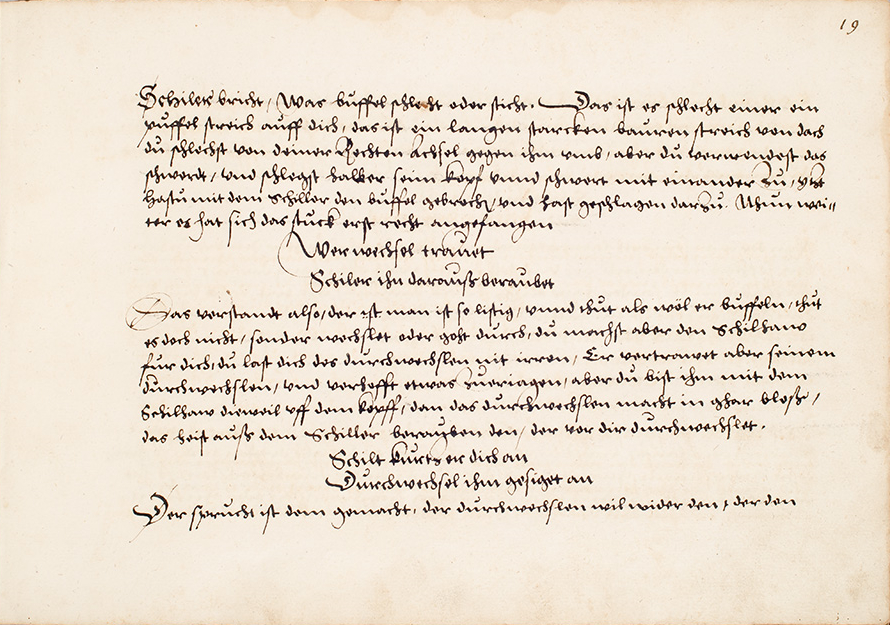
[26]
58
Squinter breaks what the Buffel strikes or thrusts
This is when someone strikes a Buffel Strike at you, it is a long and hard peasant’s strike from the Roof Guard, you then strike around from your right shoulder against him, however you turn your sword and strike in part together to his head and sword, now you have broken the Buffel with the Squinter, and hit with it. Now further, the stuck has just begun.
Munich Manuscript · fol. 19r.1
[19r.1] Schiler bricht, Was buffel schlecht oder sticht.
Das ist es schlecht einer ein
puffel streich auff dich, das ist ein langen starcken bauren streich von dach
du schlechst von deiner Rechten Achsel gegen ihm vmb, aber du verwendest das
schwerdt, vnd schlegst halber seim kopf vnnd schwert mit einander zu, ytzt
hastu mit dem Schiller den buffel gebrochen, vnd fast geschlagen darzu. Nhun weiter
es hat sich das stuck erst recht angefangen
19r.1
3.26linked passage
3.27
[27]
59
Who threatens the change through The Squinter robs him of it
So understand that one who is so lively and makes as if he would Buffel, but doesn’t do it, and rather changes or goes through, that you don’t let yourself change through in error, but he trusts his changing through, and hopes to gain something, however you have in the meantime hit him with the Squinter to the head because his changing through made him completely open, that is known as The robbing from the Squinter, from those who change through before you.
Munich Manuscript · fol. 19r.2
[19r.2] Wer wechset trauet Schiler ihn darauß beraubet
Das verstandt also, der ist man ist so listig, vnnd thut als wöl er buffeln, thut
es doch nicht, sonder wechslet oder goht durch, du machst aber den Schilhaw
fur dich, du last dich des durchwechslen nit irren, Er vertrawet aber seinem
durchwechslen, vnd verhofft etwas zueringen, aber du bist ihm mit dem
Schilhaw dieweil vff dem kopff, dan das durchwechslen macht in ghar bloß,
das heist auß dem Schiller berauben den, der vor dir durchwechslet.
19r.2
3.27linked passage
3.28
[28]
60
Squint when he is short against you Changing through defeats him
The saying is made for he who wants to change through against one who will use the Squinter Cut, that is, if he extends his arms short away from himself, so he may not well reach you, then you may easily change through, thus you come to him with stepping and thrust to his right side, that is called overcoming, it is much talked about, you come to him, and bring him out of his work and take him.
Munich Manuscript · fol. 19r.3
[19r.3] Schilt kurtz er dich an Durchwechsel ihm gesiget an
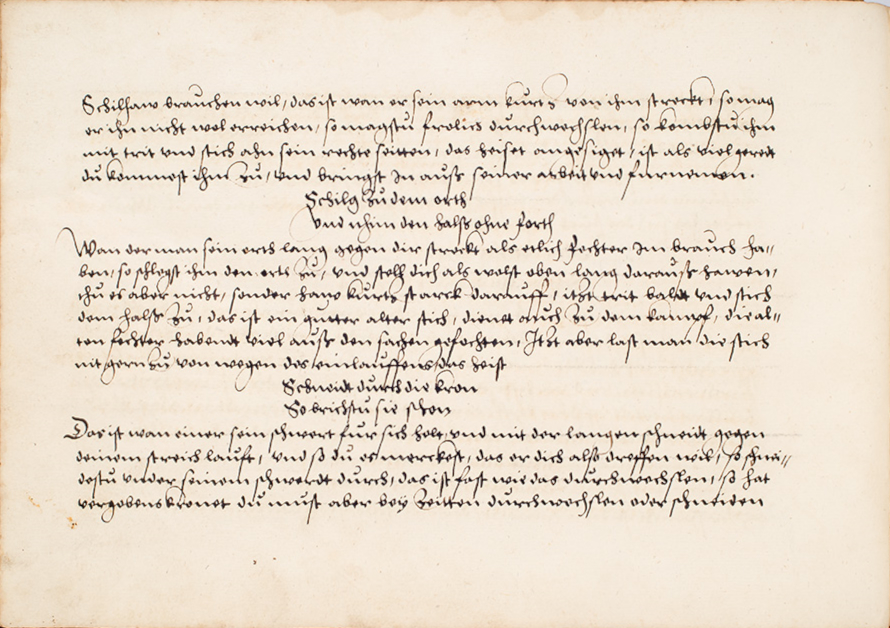
Der sprucht ist dem gemacht, der durchwechslen wil wider den, der den [19v.1] Schilhaw brauchen wil, das ist wan er sein arm kurtz von ihm streckt, so mag
er ihn nicht wol erreichen, so magstu frolich durchwechslen, so kombstu ihm
mit trit vnd stich ahn sein rechte seitten, das heiset angesiget, ist als viel geredt
du kommest ihm zu, vnd bringst In auß seiner arbeit vnd furnemen.
19r.319v.1
3.28linked passage
3.29
[29]
61
Squint to the point And take the neck without fear
When an opponent extends his point long out towards you, which quite a few fencers have in use, so put your point at him, and position yourself as if you would cut from there, long and from above at him. but don’t do that, instead cut short and strongly thereafter, now step at once and thrust him to the neck, this is a good old thrust which also serves you well in battle, the ancient fencers have fenced much using these things, but nowadays the thrust is not favored, because of the running in, that is.
Munich Manuscript · fol. 19v.2
[19v.2] Schilg zu dem orth Vnd nhim den halß ohne forth
Wan der man sein orth lang gegen dir streckt als etlich Fechter Im brauch haben,
so schlegst ihm den orth zu, vnd stell dich als wolst oben lang darauß hawen,
thu es aber nicht, sonder haw kurtz starck darauff, itzt trit baldt vnd stich
dem halß zu, das ist ein gutter alter stich, dienet auch zu dem kampf, die alten
fechter habendt viel auß den sachen gefochten, Itzt aber last man die stich
nit gern zu von wegen des einlauffens das heist
19v.2
3.29linked passage
3.30
[30]
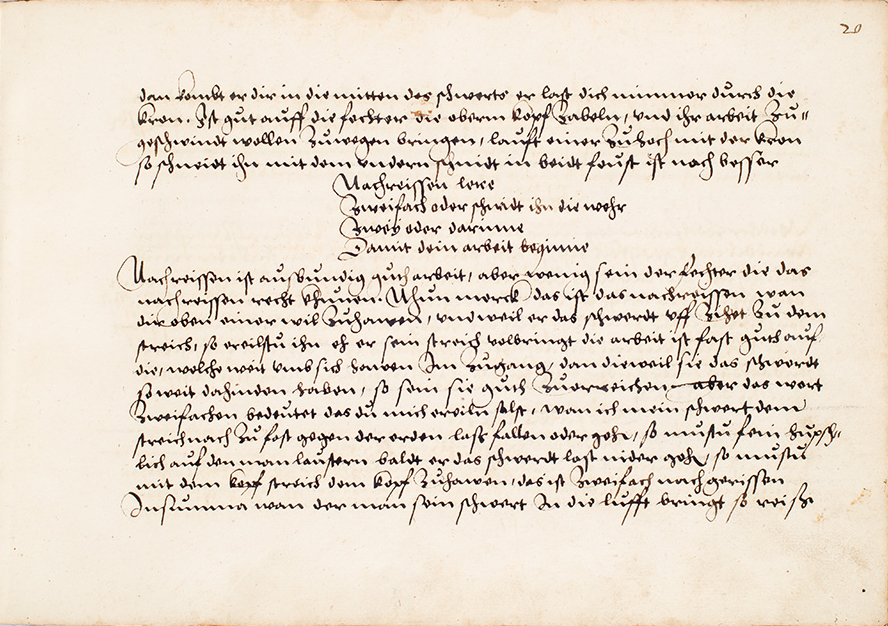
66
Slice through the Crown Thus you will certainly break them
This is when the opponent holds his sword out before you, and runs against your strike with his long edge, and thus you should note, when he will strike you, then you slice through under his sword, this is almost like changing through, thus he has crowned in vain, but you must in good time change through or slice, for then he comes to you amidst the sword, he never allows you through the crown.
It is good for the fencers who want to use their heads and their work will quickly be brought about, if he runs too high with the Crown, then slice him with the lower slice to both fists, is still better.
Munich Manuscript · fol. 19v.3
[19v.3] Schneidt durch die kron So brichstu sie schon
Das ist wan einer sein schwert fur sich holt, vnd mit der langen schneidt gegen
deinem streich lauft, vnd so du es merckest, das er dich also dreffen wil, so schneidestu
vnder seinem schwerdt durch, das ist fast wie das durchwechslen, so hat
vergebens kronet du must aber bey Zeitten durchwechslen oder schneiden [20r.1] dan kombt er dir in die mitten des schwerts er last dich nimmer durch die
kron. Ist gut auff die Fechter die oberm kopf Zabeln, vnd ihr arbeit zugeschwindt
wollen zuwegen bringen, lauft einer zuhoch mit der kron
so schneidt ihn mit dem vndern schnidt in beidt feust ist nach besser
19v.320r.1
3.30linked passage
3.31
[31]
75
Learn to Double the Chasing After, Slice to his weapon
76
Twice, or in it, With it your work begins
Chasing after is an exceptionally good work, however very few are the fencers who do it correctly. Now note that this is the chasing after, when one will cut in at you from above, and as he draws up his sword to strike, so rush to him before he brings his strike, the work is all good against those who cut around too wide in the onset, then because they have their sword so far away, thus they are easier to reach, but the word Doubled means that you shall overtake me, when I have allowed my sword to fall or go nearly to the ground after the strike, so you must be cautious against the man who gladly allows his sword to fall nearly to the ground, then you must cut in at his head with the Head Strike, that is Doubling after shrewdly. In summation: when the opponent brings his sword in the air, then Chase after when he goes too far behind himself, Indes cut in the onset, then commit yourself to the chasing after, because the saying is made so well for the traveling after.
Munich Manuscript · fol. 20r.2
[20r.2] Nachreissen lere Zweifach oder schneidt ihn die wehr Zwey oder darinne Damit dein arbeit beginne
Nachreissen ist ausbundig guth arbeit, aber wenig sein der Fechter die das
nachreissen recht khunen. Nhun merck das ist das nachreissen wan
die oben einer wil zuhawen, vnd weil er das schwerdt vff zihet zu dem
streich, so ereilstu ihn eh er sein streich volbringt die arbeit ist fast guth auf
die, welche weit vmb sich hawen Im zugang, dan dieweil sie das schwerdt
so weit dahinden haben, so sein sie guth zuerreichen, aber das wort
zweifachen bedeutet das du mich ereiln solst, wan ich mein schwert dem
streich nach zu fast gegen der erden laß fallen oder gehen, so mustu fein hupschlich
auf den man laustern baldt er das schwerdt last nider gehen, so mustu
mit dem kopf streich dem kopf zuhawen, das ist zweifach nachgerissen
In summa wan der man sein schwert In die lufft bringt so reiß [20v.1] So reiß nach wan ers zu weit hinder sich lest fallen In des haw ahn dem
zugang, so befleiß dich des nachreissens, dan der spruch ist den nachreissen
zu lieb gemacht.
20r.220v.1
3.31linked passage
3.32
[32]
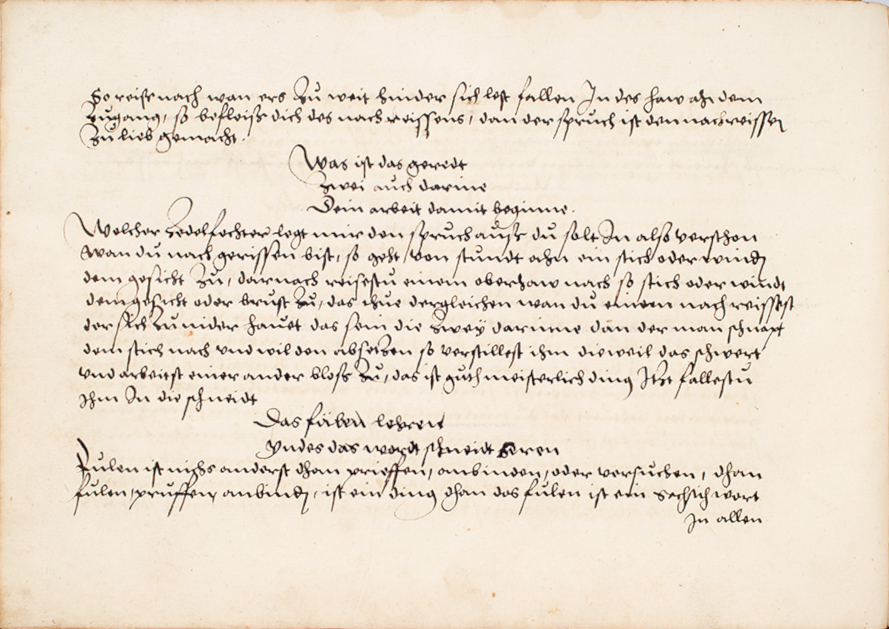
What is the Saying
76
Two also within With it Your work begins
So that you shall also understand the Zedelfechter who laid out the saying for me, when you are chasing after, then go henceforth with a thrust or a winding to the face, thereafter travel into a High Cut then thrust or wind to the face or chest, do the same when you chase after one who has thrust too low and cuts, those are the “two within,” then the opponent will snap after the thrust and then wants to displace, so in the meantime you stifle his sword and just work to another opening, that is a good and masterful thing, now fall on him with the cut.
Munich Manuscript · fol. 20v.2
[20v.2] Was ist das geredt Zwei auch darine Dein arbeit damit beginne.
Welcher Zedelfechter legt mir den spruch auß du solt In also versthon
wan du nach gerissen bist, so geht von stundt ahn ein stich oder winden
dem gesicht zu, darnach reisestu einem oberhaw nach so stich oder windt
dem gesicht oder brust zu, das thue dergleichen wan du einem nachreissest
der sich zu nider hauet das sein die zwey darinne dan der man schnapt
dem stich nach vnd wil den absetzen so verstillest ihm dieweil das schwert
vnd arbeitst einer ander bloß zu, das ist guth meisterlich ding Itzt fallestu
Ihm In die schneidt
20v.2
3.32linked passage
3.33
[33]
78
Learn the feeling, Indes is a word that cuts severely
Feeling is nothing more than testing, binding on, or searching, so that feeling, testing and binding on is a thing, then the feeling is a simple word in all fencing, test whether the opponent fights hard or soft, if he cuts or pushes hard after, then pull your sword fine and softly, thus you will certainly find an opening, because the hard fencers reveal it themselves. But why is there a saying right after this “Indes the word cuts severely”, therefore, one is a gentle and fast swordsman who cuts around at once so you are there with the slices, thus it is broken.
Munich Manuscript · fol. 20v.3
[20v.3] Das fülen lehren Yndes das wordt schneidt Seren
Fulen ist nichs anderst dhan prieffen, anbinden, oder versuchen, dhan
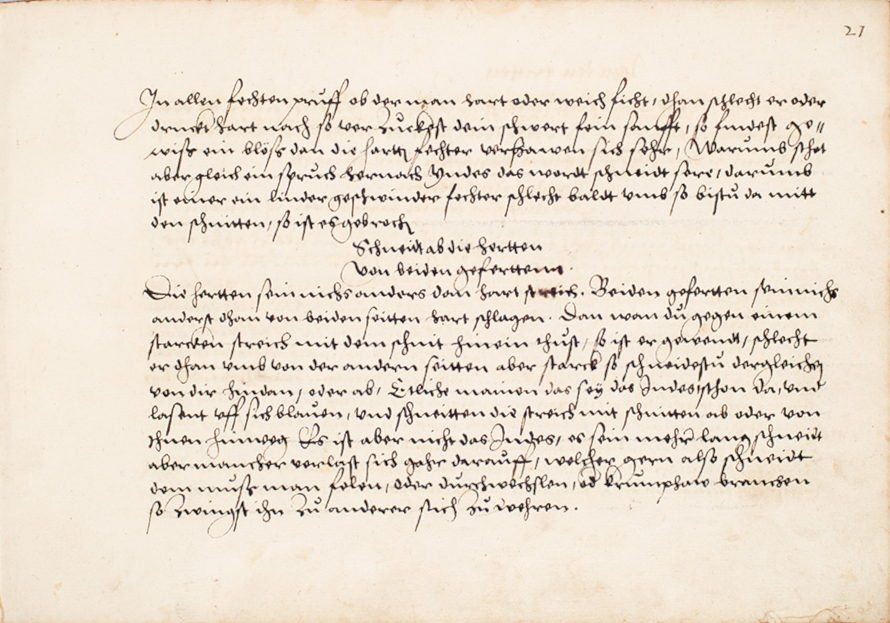
fulen, pruffen, anbinden, ist ein ding dhan das fulen ist ein sechsich wort [21r.1] In allen fechten pruff ob der man hart oder weich ficht, dhan schlecht er oder
druckt hart nach so verzuckest dein schwert fein sanfft, so findest gewiß
ein blöß dan die hartten fechter verhawen sich sehr, Warumb sthet
aber gleich ein spruch hernach yndes das wordt schneidt sere, darumb
ist einer ein linder geschwinder fechter schlecht baldt vmb so bistu da mitt
den schnitten, so ist es gebrochen
20v.321r.1
3.33linked passage
3.34
[34]
93
Slice off the hard ones From both attacks
The hard ones are nothing other than Hard strikes, both attacks are nothing other than hard strikes from both sides. So when you go in against a strong strike with the slice, and if he is skillful and strikes around to the other side however strong, then slice his strike down or away from you, some people think that this is already the Indes, and allow themselves to beat, and cut away the strike with slicing, however this is not the Indes, it is more like long edge, but some people rely on it, so if you like to cut, you must use failing, or changing through or Crooked cutting, thus you force him to defend against other thrusts.
Munich Manuscript · fol. 21r.2
[21r.2] Schneidt ab die hertten Von beiden geferttenn.
Die hertten sein nichs anders dan hart streich. Beiden gefertten sein nichs
anderst dhan von beiden seitten hart schlagen. Dan wan du gegen einem
starcken streich mit dem schnit hinein thust, so ist er gewendt, schlecht
er dhan vmb von der andern seitten aber starck so schneidestu dergleichen
von dir hindan, oder ab, Etliche mainen das sey das Indes, schon da, vnd
lasent vff sich blauen, vnd schneitten die streich mit schnitten ab oder von
Ihnen hinweg Es ist aber nicht das Jndes, es sein mehrer lang schneidt
aber mancher verlast sich gahr darauff, welcher gern also schneidt
dem muß man felen, oder durchwechslen, oder krumphaw brauchen
so zwingst ihn zu anderer sich zu wehren.
21r.2
3.34linked passage
3.35
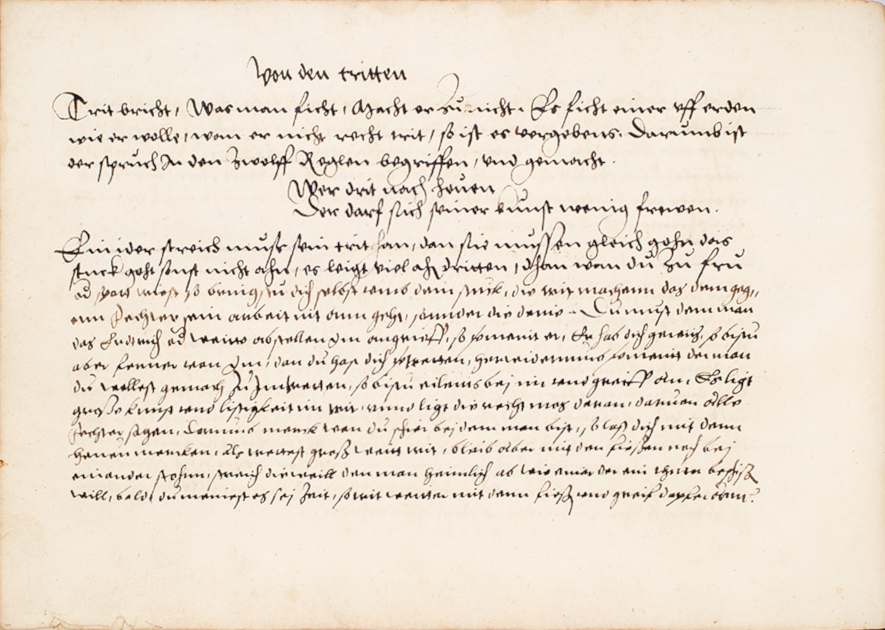
[35] From the Stepping
Stepping breaks, what one fights, he who does not do it, it fights one to the ground as he wills it, if he does not do it correctly, he is unsuccessful, therefore the saying in the twelve rules is made and understood:
Whoever steps after cutting Shall have little joy in his Art.
Every cut must have its step, they must go together, otherwise the stuck will not work, for much relies on stepping, then if you step too soon or too late, thus you (will be responsible for your own loss). The stepping makes it so that the opponent’s work cannot go on, but that yours’ can, you must attack the opponent in a stance or wide position, so he thinks he has you for sure but that you are further from him than you have presented yourself, if on the other hand the opponent thinks you want to step in at him, then do not hurry to the attack. There is great art and cunning in the stepping, and the right measure lies in it. About it, all fencers say, so notice when you are close to the man, then let yourself note with the cutting as if you were treading with great, wide steps, but remain with your feet near to each other, meanwhile, strike off the man secretly like one who wants to steal a step, once you think it is time, then step further with your feet and boldly attack.
Trit bricht, Was man ficht, Macht er zu nicht, Es ficht einer vff erden
wie er wolle, wan er nicht recht trit, so ist es vergebens. Darumb ist
der spruch In den zwolff Reglen begriffen, vnd gemacht.
Wer drit nach heuen Der darf sich seiner kunst wenig frewen.
Ein ider streich muß sein trit han, dan sie mussen gleich gohn das
stuck geht sonst nicht ahn, es leigt viel ahn dritten, dhan wan du zu fru
oder spatt triest so bringstu dich selbst vmb dein stuck, die trit machenn das dem gegenn
Fechter sein arbeit nit ann gehen, sonnder die deine, Du must dem man
das Endtrich oder weitte abstellen Im angrieff, so vermeint er, Er hab dich gewüs, so bistu
aber ferner von Im, dan du hast dich vertretten, herwiderumb vermeint der man
du wollest gemach zu Imtretten, so bistu eilents bej im vnd greiff an, Es ligt
große kunst vnd listigkeit im trit, vnd ligt die reihen mos daran, daruon alle
Fechter sagen, Darumb merck wen du schier bej dem man bist, so laß dich mit denn
heuen mercken, als trettest groß weitt mit, bleib aber mit den fießen nach bej
einander stohnn, streich dieweill den man heimlich ab wie einer der ein thurn beschißen
will, baldt du meinest es sej zeit, so trit weitter mit denn fießen vnd greif dapfer ann ⁋