[1] Fencing in Dussack and the use of all types of single hand weapons
First of all, there are the guards, of which there are six, which are not made to be waited in, as mentioned above in part, but rather for the sake of division, so that one knows how to distinguish one from the other, when one fights from Steer, he should or must use the usual cut and Stuck that are assigned to the Steer, if one wants to fence with someone, he shall take care of which or by which part he fights against him, so that he may know with which cut or Stuck he should attack him most effectively, so that he may deprive him of the Before, because the fencers who carelessly strike their blows and Stucke are soon hit and usually have to go away with damage.
Munich Manuscript · fol. 22r
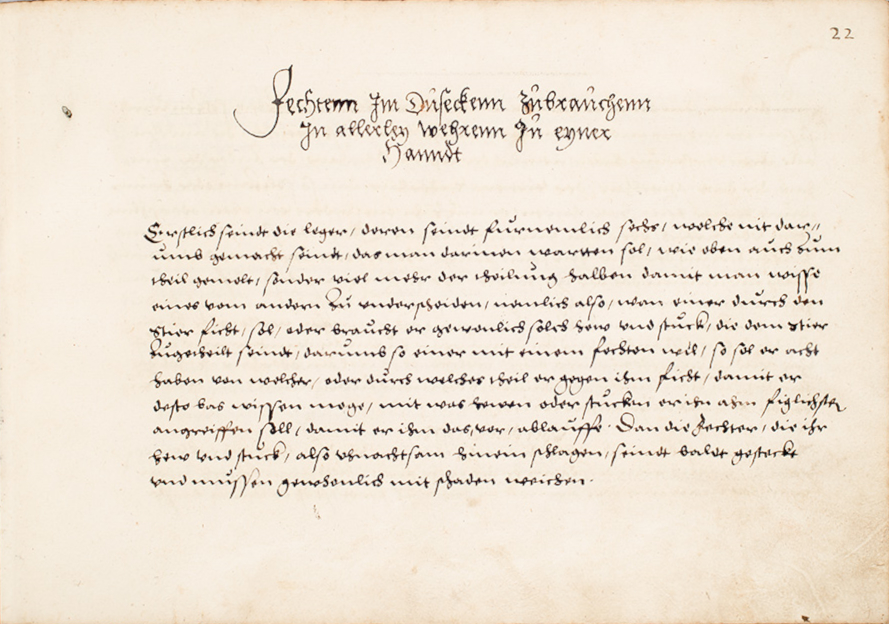
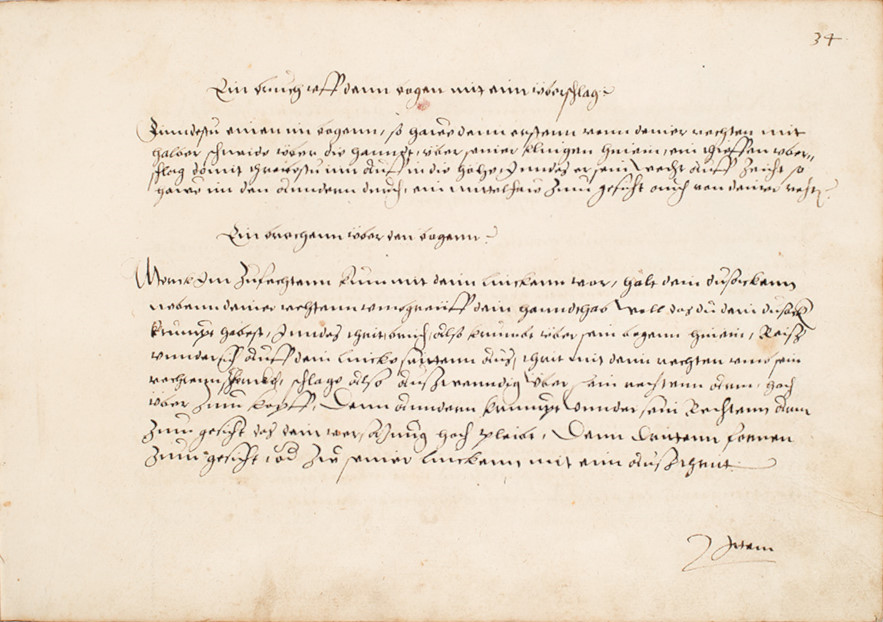
[22r] Fechtenn Im Duseckenn zubrauchenn In allerley wehrenn zu eyner hanndt
Erstlich seindt die leger, deren seindt furnemlich sechs, welche nit darumb gemacht seindt, das man darinnen wartten sol, wie oben auch zum theil gemolt, sonder viel mehr der theilung halben damit man wisse eines vom andern zu vnderscheiden, nemlich also, wan einer durch den Stier ficht, sol, oder braucht er gewonlich solch hew vnd stuck, die dem Stier zugetheilt seindt, darumb so einer mit einem fechten wil, so sol er acht haben von welcher, oder durch welches theil er gegen ihm ficht, damit er desto bas wissen moge, mit was hewen oder stucken er ihn ahm figlichsten angreiffen soll, damit er ihm das, vor, ablauffe. Dan die Fechter, die ihr hew vnd stuck, also vhnachtsam hinein schlagen, seindt baldt gesteckt vnd mussen gewohenlich mit schaden weichen.
22r
4.1linked passage
4.2
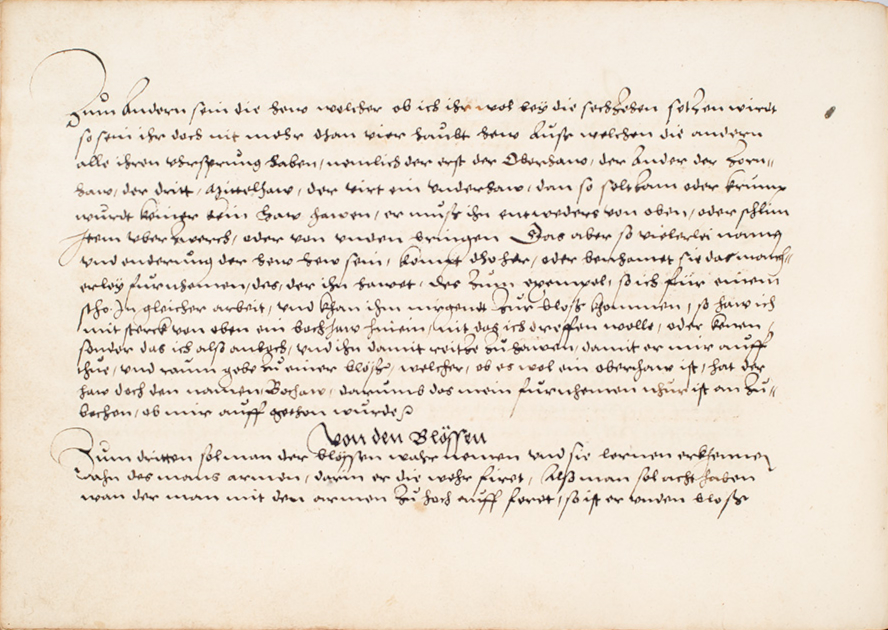
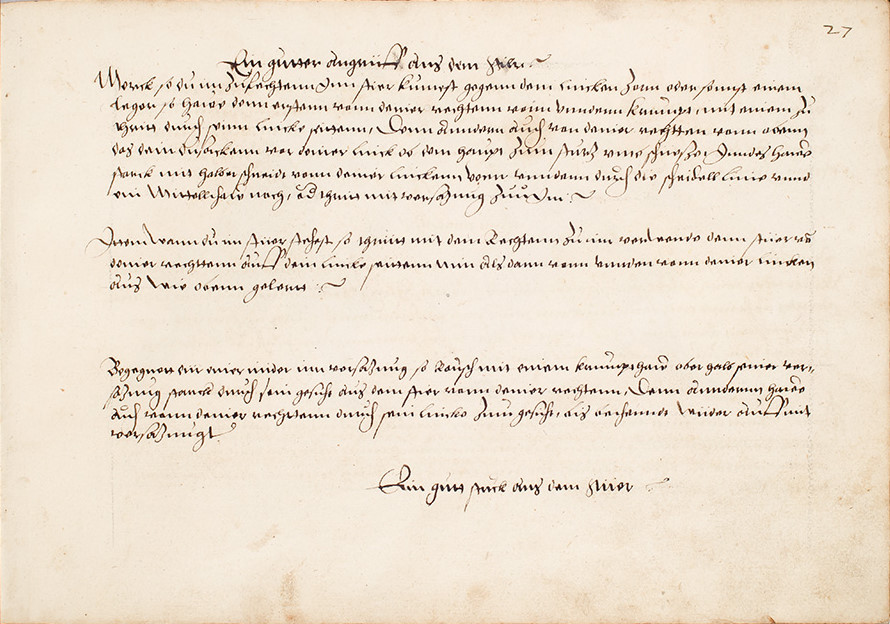
[2] Next there are the cuts, which, although I will tell you there are sixteen, you will not have more than 4 Main Cuts, from which the others have their origins, namely the first, the High Cut, the second the Wrath Cut, the third is the Middle Cut, and fourth is a Low Cut. Yet none will ever cut or deliver any so rare or crooked, but that he must bring from above or diagonally, athwart or from below. And the many names and variations of the cuts come from the diverse intentions of the one who delivers them. Of this I'll give an example, when I stand before someone in the same work, and cannot at all come to his openings, then I strike in strongly to him from above with a Knocking Cut, not so that I would hit, but so that I would attack him and provoke him to cut so that he would then open up for me, and give me room for the opening, and although it is a High Cut, the cut is still called the Knocking Cut, because my intent is only to knock onto him to see whether he will open up for me.
Munich Manuscript · fol. 22v.1
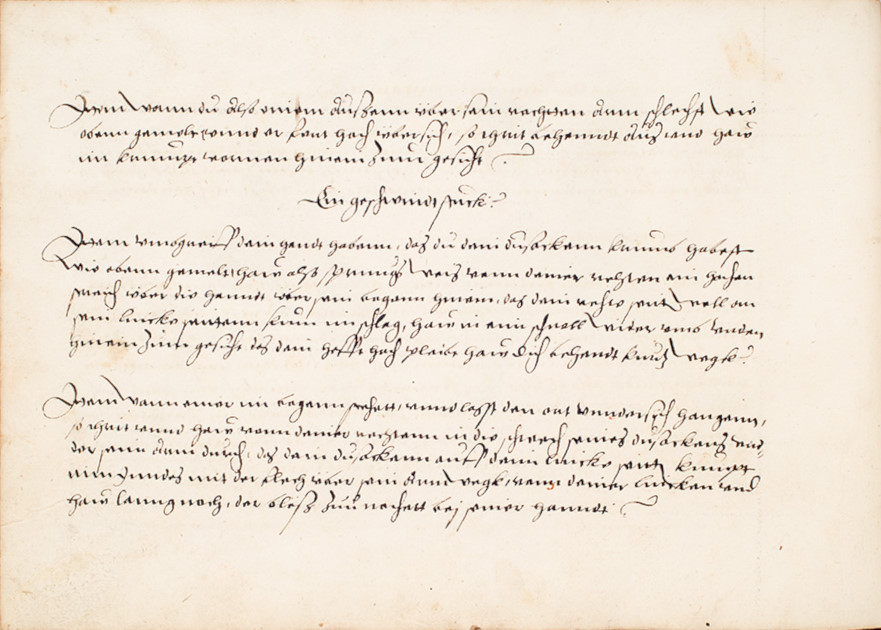
[22v.1] Zum andern sein die hew welcher ob ich ihr wol bey die sechzehen setzen wirdt so sein ihr doch nit mehr dhan vier haubt hew Auß welchen die andern alle ihren vhrsprung haben, nemlich der erst der Oberhaw, der Ander der Zornhaw, der dritt, Mittelhaw, der virt ein vnderhaw, dan so seltzam oder krump wurdt keiner kein haw hawen, er muß ihn entweders von oben, oder schlim Item vberzwerch, oder von vnden bringen Das aber so vielerlei namen, vnd enderung der hew hew[!] sein, komptt dho her, oder benhamet sie das mancherley furnhemen, des, der ihn hawet, des zum exempel, so ich für einem sthe. In gleicher arbeit, vnd khan ihm nirgendt zur bloß khommen, so haw ich mit sterck von oben ein bochhaw hinein, nit das ich dreffen wolle, oder kenen, sonder das ich also anboch, vnd ihn damit reitze zu hawen, damit er mir auff thue, vnd raum gebe zu einer blöß, welcher, ob es wol ein oberhaw ist, hat der haw doch den namen, Bochaw, darumb das mein furnhemen nhur ist an zubochen, ob mir auff gethon wurde ⁋
22v.1
4.2linked passage
4.3
[3] From the Openings
Thirdly, you should take note of the openings and learn to recognize them by the man's arms with which he leads the weapon. So you should note if he stands too high with the arm, then he is open below.
Zum dritten sol man der blössen wahr nemen vnd sie lernen erkhennen ahn des mans armen, darin er die wehr firet, Also man sol acht haben wan der man mit den armen zu hoch auff feret, so ist er vnden bloßen
22v.2
4.3linked passage
4.4
[4] If he falls in too deep, then he is just open above, likewise, if he goes too far to the sides.
Further as to the four parts of the man, the Before and After, the Weak and the Strong, item: the Rounding and the Circle Cut, slicing and the like and all kinds of hand works have been explained at length previously in the Sword, which one should also use here.
Munich Manuscript · fol. 23r.1
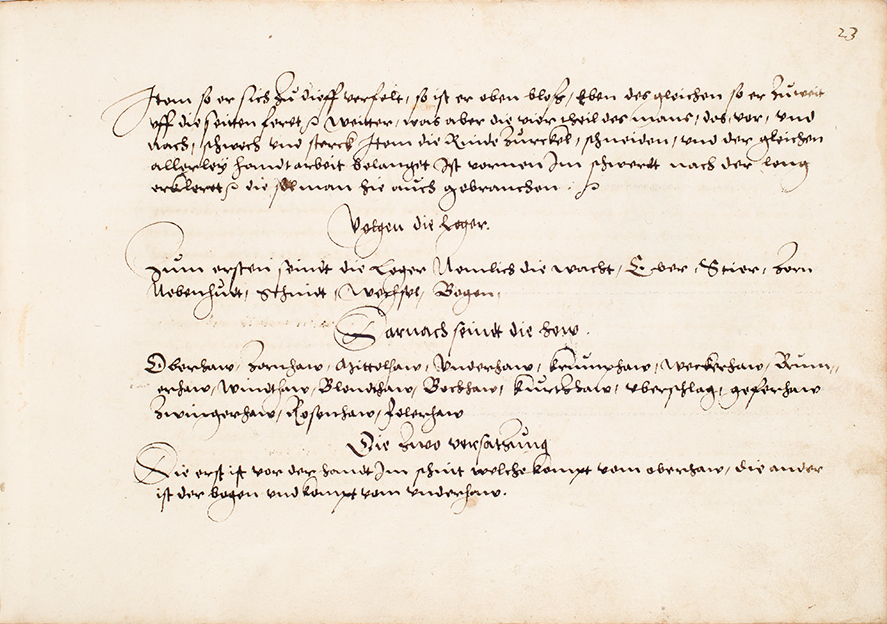
[23r.1] Item so er sich zu dieff verfelt, so ist er oben bloß, Eben des gleichen so er zuweit vff die seitten feret ⁋ Weitter, was aber die vier theil des mans, des, vor, vnd nach, schwech vnd sterck Item die Rinde zurckel, schneiden, vnd der gleichen allerley handtarbeit belanget Ist vornen Im schwerdt nach der leng erklertt ⁋ die sol man hie auch gebrauchen. ⁋
23r.1
4.4linked passage
4.5
[5] Follow the guards
First of all there are the guards, namely, the Watch, Boar, Steer, Wrath, Side Guard, Slice, Changer and Bow.
Die erst ist vor der handt Im schnit welche kompt vom oberhaw, die ander ist der bogen vnd kompt vom vnderhaw.
23r.4
4.7linked passage
4.8
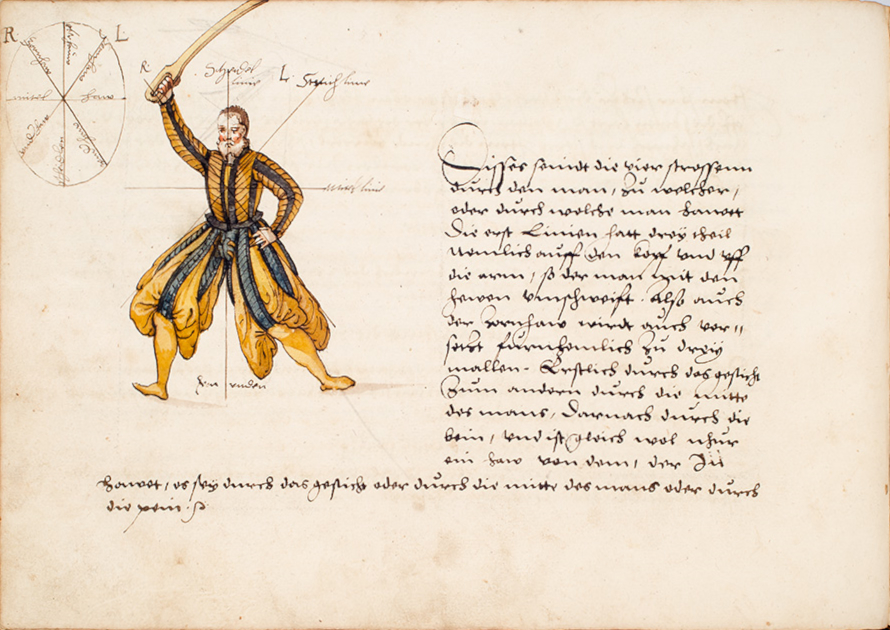
[8] These are the four routes through the opponent, to which or through which one cuts, the first line has three parts namely to the head, to the arm so that the opponent sweeps around with the cuts. Then also the Wrath Cut will be displaced mainly three ways, firstly through the face the next through the middle of the opponent, thereafter through the legs and it is still only one cut from he who cuts it, whether it is through the face, or through the middle of the opponent, or through the legs.
Munich Manuscript · fol. 23v
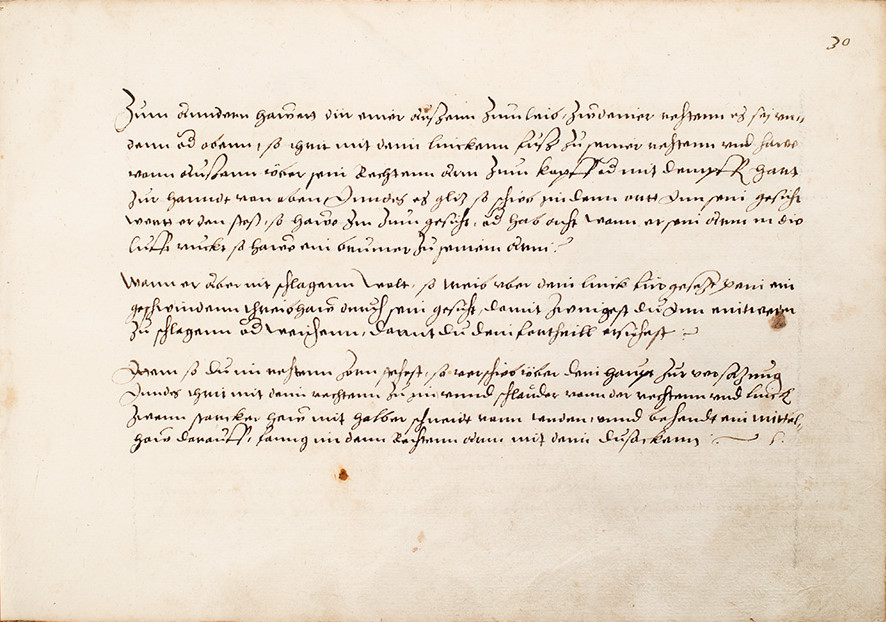
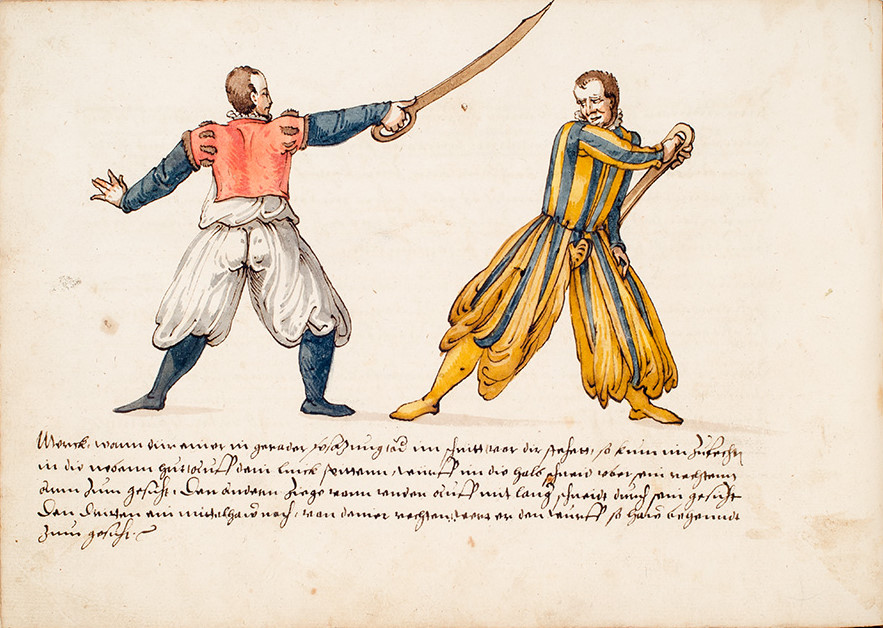
[23v] Disses seindt die vier stressenn durch den man, zu welcher, oder durch welche man hawet die erst Linien hatt drey theil Nemlich auff den kopf vnd vff die arm, so der man mit den hewen vmschweift. Also auch der zornhaw wirdt auch versetzt furnhemlich zu drey mallen. Erstlich durch das gesicht Zum andern durch die mitte des mans, darnach durch die bein, vnd ist gleich wol nhur ein haw von dem, der Inhawet, es sey durch das gesicht oder durch die mitte des mans oder durch die pein. ⁋
23v
4.8linked passage
4.9
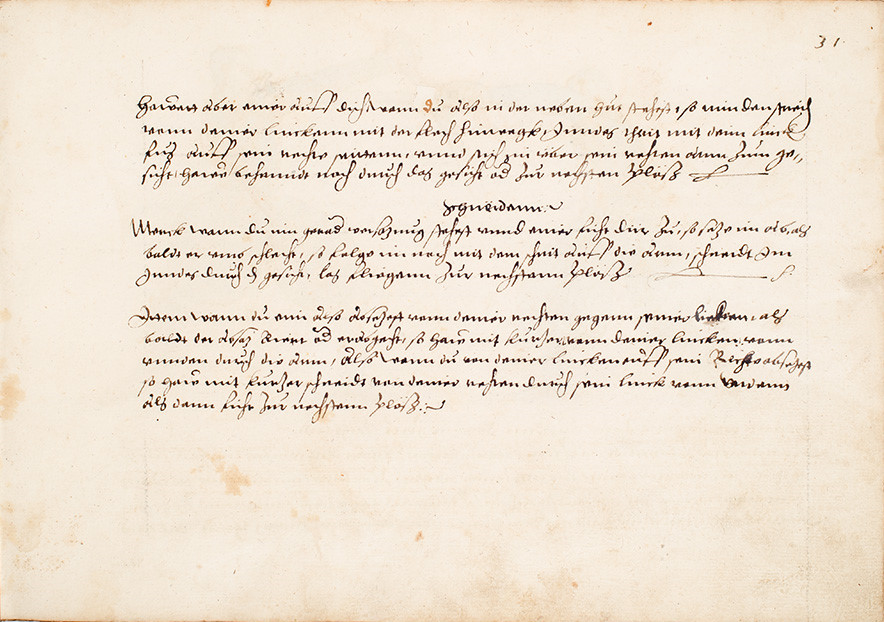
[9] In summation, whatever goes from above, that is cut to the head or arms or feet, so it is called a High Cut. Then those from the shoulder that are cut diagonally to the opponent, be it to the face or body, high or low so it is called a Wrath Cut. You may also do the cut using the crooked or straight edge, for which reason the names of the cuts are diverse, as well as the limbs to which they are cut, they take their names, how it follows hereafter in Rapier, and still the cut remains basically a Wrath Cut or Middle Cut. And so it is created with all.
Munich Manuscript · fol. 24r.1
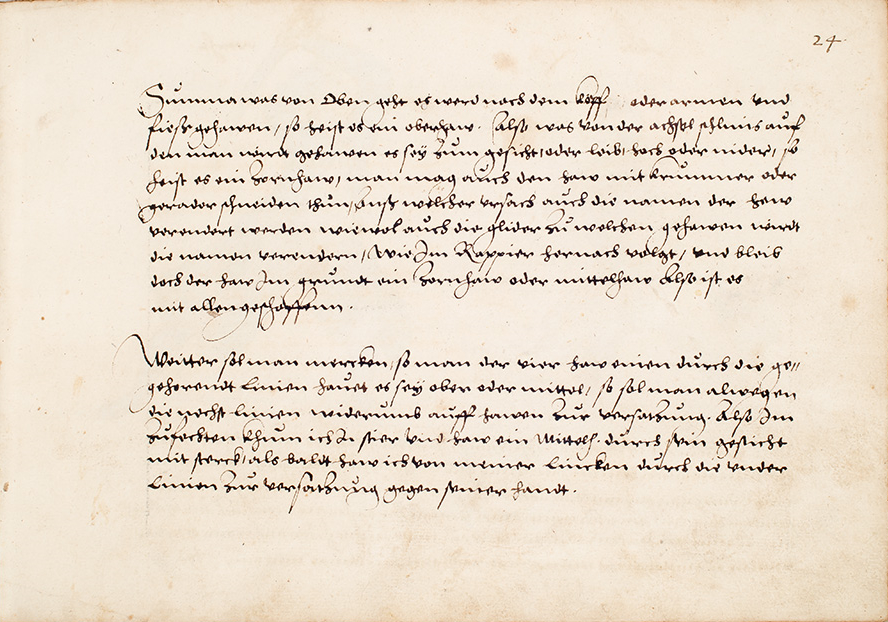
[24r.1] Summa was von Oben geht es werd nach dem köpf oder armen vnd fieß gehawen, so heist es ein oberhaw. Also was von der achsel schlims auf den man wirdt gehawen es sey zum gesicht, oder leib, hoch oder nider, so heist es ein Zornhaw, man mag auch den haw mit krummer oder gerader schneiden thun, Auß welcher vrsach auch die namen der hew verendert werden wiewol auch die glider zu welchen gehawen wirdt die namen verendern, wie Im Rappier hernach volgt, vnd bleib doch der haw Im grundt ein Zornhaw oder mittelhaw Also ist es mit allen geschaffenn.
24r.1
4.9linked passage
4.10
[10] Further you shall note that when you cut one of the four cuts through the relevant line, whether above or middle, then you shall always strike back up the next line to displace.
Munich Manuscript · fol. 24r.2
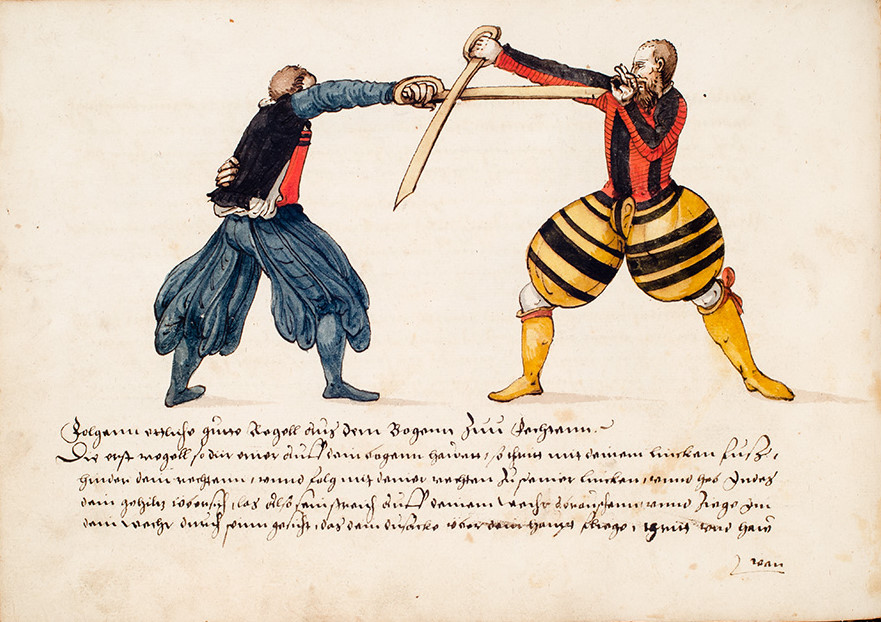
[24r.2] Weitter sol man mercken, so man der vier haw einen durch die gegehorendt Linien hawet es sey oben oder mittel, so sol man alwegen die nechst linien widerumb auff hawen zur versatzung.
24r.2
4.10linked passage
4.11
[11] Thus in the Zufechten if I come in the Steer and strongly strike a Middle Cut in through his face, I at once cut from my left up through the lower line to parry against his hand.
Munich Manuscript · fol. 24r.3
[24r.3] Also Im zufechten khum ich In stier vnd haw ein Mittelhaw durch sein gesicht mit sterck, als baldt haw ich von meiner Lincken durch die vnder Linien zur versatzung gegen seiner handt.
24r.3
4.11linked passage
4.12
[12] Boar Watch
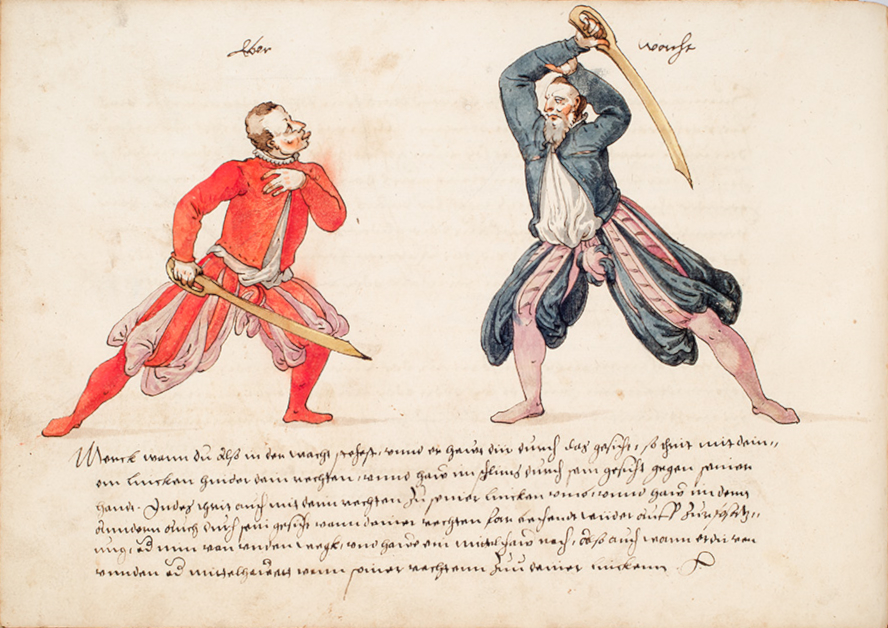
Take note when you stand in the Watch Guard, and he cuts through at your face, then step with your left foot behind your right and cut him diagonally through his face and against his hand. Also, Indes step around to his left with your right foot, and cut the next also through his face from your right, quickly drive out to the displacement, or take away his cut from below and cut afterwards with a Middle Cut, also when he cuts at you from under or through the middle, from his right to your left.
Merck wann du also in den wacht stehest, vnnd er hawt dür durch das gesicht, so thrit mit deinem Lincken hinder dem rechten, vnnd haw im schlims durch sein gesicht gegen seiner handt. Indes thrit auch mit deim rechten zu seiner lincken vmb, vnd haw im denn anndern auch durch sein gesicht vonn deiner rechten far behendt wüder auff zur versatzung, oder nim von vnden wegk, vnd hawe ein mittelhaw nach, also auch wann er dir von vnnden oder mittelhawett vonn seiner rechtenn zuu deiner linckenn. ⁋
24v
4.12linked passage
4.13
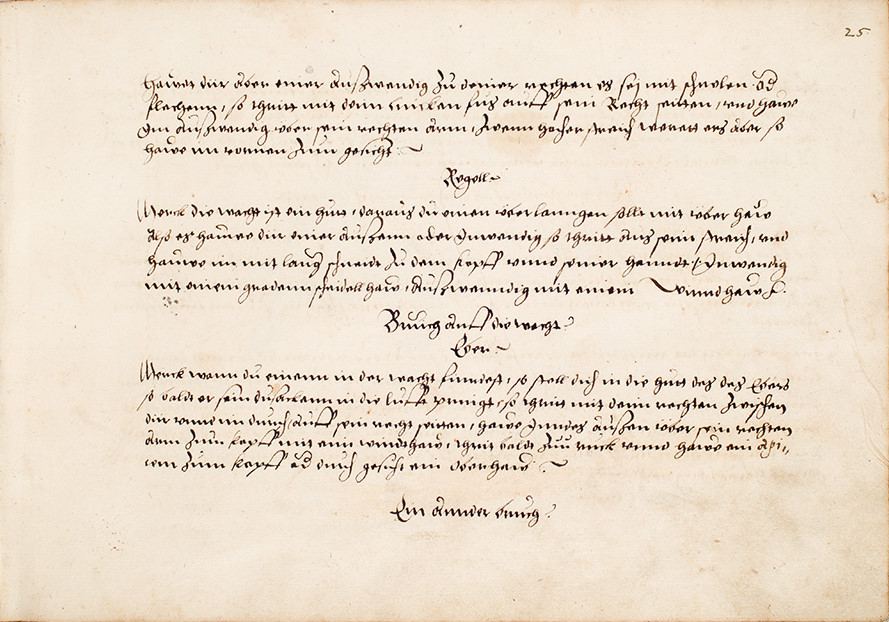
[13] If he cuts at you from outside to your right, whether the flicker or with the flat, then step with your left foot in to his right side and cut him two High Strikes from outside over his right arm, if he winds this however, then cut him forward to the face.
Munich Manuscript · fol. 25r.1
[25r.1] Hawet dür aber einer außwendig zu deiner rechten es sej mit schnelen oder flechenn, so thritt mit dein lincken fus auff sein Recht seitten, vnd hawe Im außwendig über sein rechten arm, zwenn hocher streich werett ers aber so hawe im vornen zum gesicht ⁋
25r.1
4.13linked passage
4.14
[14] Rule
Take note that the Watch is a good one, from it you should extend over him with long cuts, so that if someone cuts at you from outside or inside, then step out from his strike and cut him with the long edge to his head and his hand. Inside with a straight Scalp Cut, outside with a Winding Cut.
Merck die wacht ist ein hutt, daraus du einen überlanngen sollt mit über hew also es hauwe dür einer außenn oder Inwendig so thritt aus seim streich, vnd hauwe im mit langer schneidt zu dem kopff vnnd seiner hanndt ⁋ Inwendig mit einem gnedenn scheidell haw, Außwenndig mit einem Winndhaw ⁋
25r.2
4.14linked passage
4.15
[15] Counter to the Watch
Boar
Take note when you find him in the Watch Guard, then position yourself in the Guard of the Boar, as soon as he brings his Dussack into the air, then step with your right foot between you and him through to his right side, cut Indes outside and over his right arm to his head with a Winding Cut, then quickly step back and cut a High Cut to his head or through the face.
Merck wann du einenn in der wacht finndest, so stell dich in die hutt des des[!] Ebers so baldt er sein dusackenn in die lufft pringt, so thritt mit dem rechten zwischen dür vnnd im durch, auff sein recht seitten, hawe Jnndes außen über sein rechten arm zum kopff mit ein windthaw, thrit baldt zuu ruck vnnd hawe ein apicem zum kopff oder durch gesicht ein Oberhauw ⁋
25r.3
4.15linked passage
4.16
[16] Another Counter
If you stand in the Guard of the Boar, then step and cut from your right through his face but fall with your Dussack down into the left Changer Guard, Indes cut strongly from your lower left, upwards diagonally to his wrist, if he cuts simultaneously then all the more he hurts himself, then third from your right through his face.
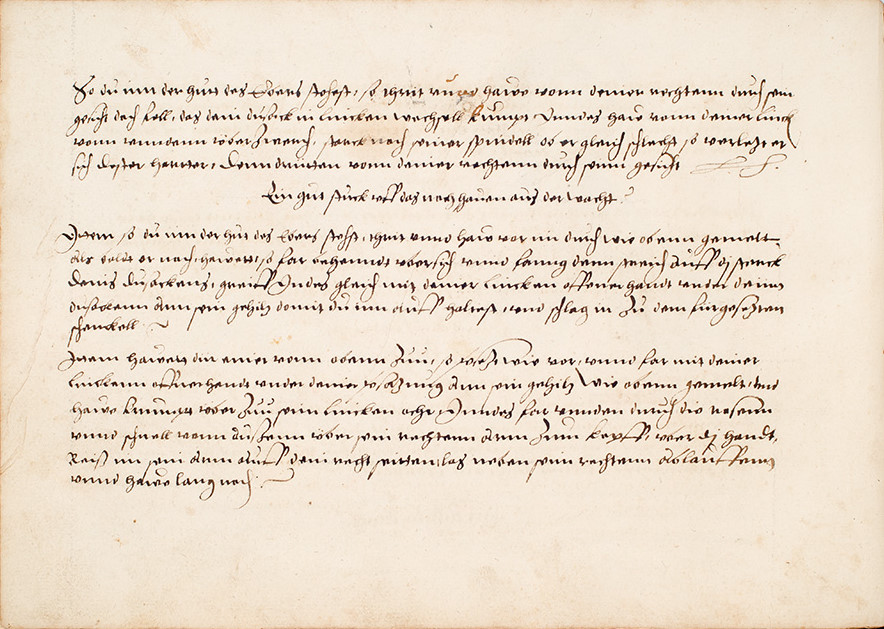
[25v.1] So du inn der hutt des Ebers stehest, so thrit vnnd hawe vonn deiner rechtenn durch sein gesicht doch fell, das dein dusack in lincken wechsell kumpt, Inndes haw vonn deiner lincken vonn vnndenn überzwerch, starck nach seiner spindell ob er gleich schlecht so verlezt er sich dester hartter, denn drütten vonn deiner rechtenn durch seinn gesicht ⁋ ⁋
25r.425v.1
4.16linked passage
4.17
[17] A good Stuck to the After Cuts from the Watch
Item: If you stand in the Guard of the Boar, step and cut him through like it is reported above, as soon as he cuts after, then quickly drive above and capture the strike on the Strong of your Dussack, Indes grasp simultaneously with your open left hand under your Dussack onto his hilt with it you hold him off and then cut him to his forward set leg.
Munich Manuscript · fol. 25v.2
[25v.2] Ein gut stuck vff das nachhauen aus der wacht ⁋
Ittem so du inn der hut des Ebers stehst, thrit vnnd haw vor im durch wie obenn gemelt, Als baldt er nach, hawett, so far behenndt vbersich vnnd fanng denn streich auff dj sterck deins dusackens, greiff Indes gleich mit deiner Lincken offener handt vnder deinn dusackenn ann sein gehilz domit du inn auff haltest, vnd schlag in zu dem fürgesezten schenckell ⁋
25v.2
4.17linked passage
4.18
[18] Item: If someone cuts you from above, then displace like before and drive underneath your displacement with your open left hand onto his hilt as described above, cut Crooked over to his left ear, instantly drive down through the nose and flick from the outside over his right arm to the head, allowing it to run off by his right, then with an over hand, wrench his arm to your right side and cut long after.
Munich Manuscript · fol. 25v.3
[25v.3] Ittem hawett dür einer vonn obenn zuu, so versezt wie vor, vnnd far mit deiner Linckenn offner handt vnder deiner versazung ann sein gehilz wie obenn gemelt, vnd hawe krumpt über zuu sein Lincken ohr, Inndes far vnnden durch die nasenn vnnd schnell vonn außenn über sein rechtenn arm zum kopff, vber dj handt, Reiß im sein arm auff dein recht seitten, las neben seim rechtenn ablauffenn vnnd hawe lang noch ⁋
25v.3
4.18linked passage
4.19
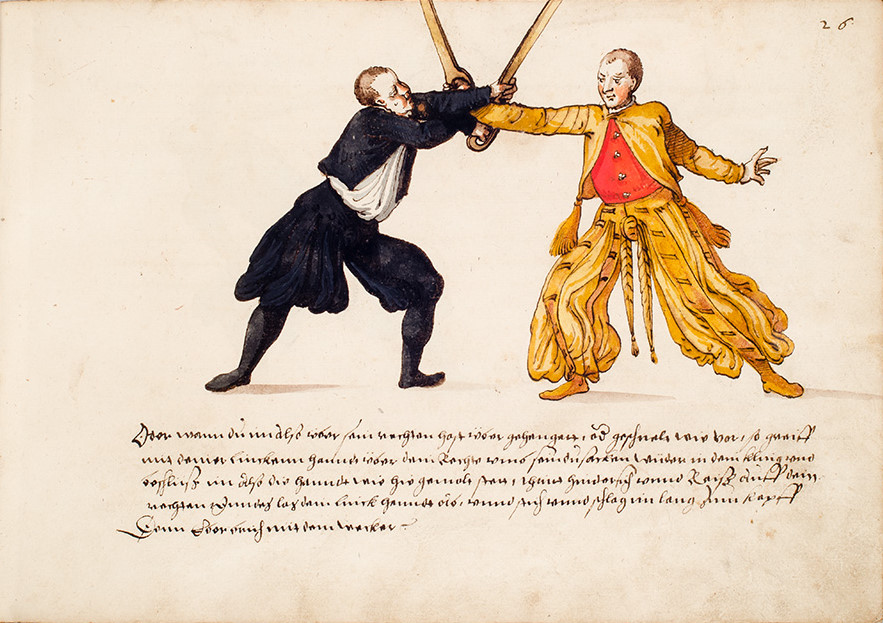
[19] Or when you have hung over or flicked over his right like before, then grasp with your left hand over your right around his Dussack again onto your blade and [...] wrench to your right, instantly release your left, thrust and cut him long to the head.
Munich Manuscript · fol. 26r.1
[26r.1] Oder wann du im also über sein rechten hast über gehengett, oder geschnelt wie vor, so greiff
mit deiner Linckenn hanndt über dein Rechte vmb sein dusacken wüder in dem kling, vnd
beschlüß im also die hanndt wie hie gemolt stett, thritt hindersich vnnd Reiß auff dein
rechten, Inndes las dein Linck hanndt ab, vnnd stich vnnd schlag im lang zum kopff
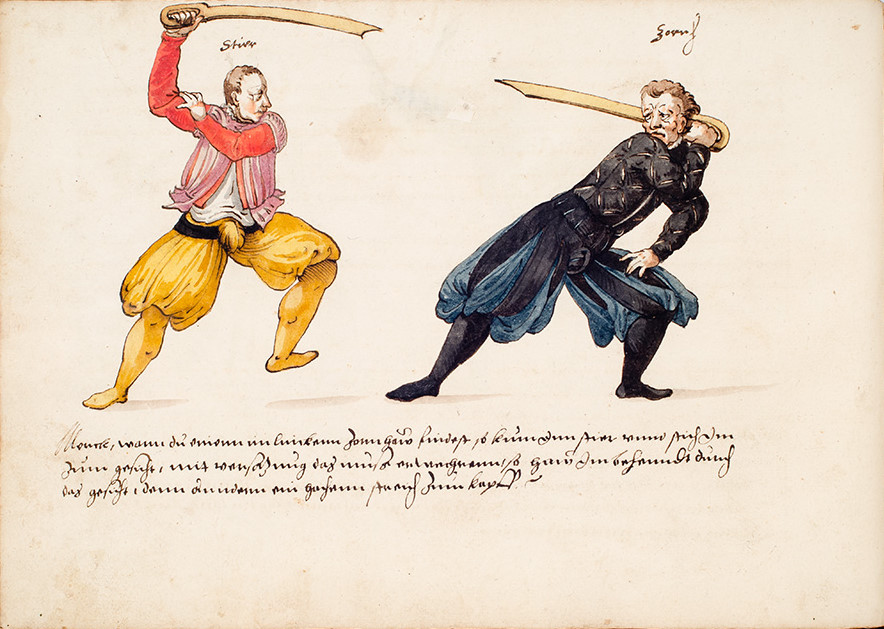
Note: When you find someone in left Wrath Guard, then come into Steer and thrust him to the face, so that he must defend himself with parrying, then cut him quickly through the face, the other is a High Strike to the head.
Merck, wann du einenn im linckenn zornhaw findest so kum Inn stier vnnd stich Im zum gesicht, mit versazung das muß er wechrenn, so haw Im behenndt durch das gesicht, denn anndern ein hochenn streich zum kopff ⁋
26v
4.21linked passage
4.22
[22] A good attack from the Steer
Take note in the Zufechten when you come in the Steer against the left Wrath or some other guard, then cut the first from your right from below Crooked through his left side with a step forward, the second also from your right from above, so that your Dussack shoots around before your left above your head into the Plunge, instantly cut strongly with your long edge from your left from below through the Scalp Line and a Middle Cut after, or step to him with parrying.
Merck so du im zufechtenn Inn stier kumest gegenn dem Lincken Zorn oder sonnst einem leger so hawe denn erstenn vonn deiner rechtenn vonn vnndenn krumpt, mit einem zu thritt durch seinn Lincke seittenn, Denn anndern auch von deiner rechtten vonn obenn das dein dusackenn vor deiner Linck ob dem haupt zum sturz vmb schüeße, Inndes hawe starck mit halber schneidt vonn deiner Linckenn vonn vnndenn durch die scheidell Linie vnnd ein Mittellchaw nach, oder thritt mit versazung zuu Im ⁋
27r.1
4.22linked passage
4.23
[23] Item: When you stand in the Steer, then step in at him with your right foot, turn the steer from your left to your right, take out those from below from your left, how it is taught above.
Munich Manuscript · fol. 27r.2
[27r.2] Ittem wann du im stüer stehest so thrütt mit dem Rechtenn zu im verwende denn stüer us deiner rechttenn auff dein Lincke seittenn nim als dann vonn vnnden vonn deiner Lincken aus wie obenn gelertt ⁋
27r.2
4.23linked passage
4.24
[24] If you encounter him low in parrying, then rush in from the steer from your right with a Crooked Cut over his displacement strongly through his face, the next cut in from your right through his left to the face, be quick again to the parrying.
Munich Manuscript · fol. 27r.3
[27r.3] Begegnett dür einer nüder inn versazung so Rausch mit einem krumpthaw ober halb seiner versazung starck durch sein gesicht aus dem stier vonn deiner rechtenn, Denn anndernn hawe auh vonn deiner rechttenn durch sein Lincke zum gesicht, bis bechenndt wüder auff mit versazungt ⁋
27r.3
4.24linked passage
4.25
[25] A good Stuck from the Steer
If someone approaches you in the Slice, then step and cut through from your right Crooked and from below to his right arm, so that you can reach his knuckles with the tip of the short edge (crooked tip), the next strongly take him away with the flat above his right arm from your left, so that your weapon again flies over your head, with this, thrust over his right arm to the face, if he wards this, then hit him in the face with a swift blow.
[27v.1] Begegnett dür einer inn dem schnütt, so thrüt vnnd hawe vonn deiner rechten krumpt, vnnder seinem rechtenn arm durch, das du im seinn knichel rierest mit dem krumenn Ort ⁋ denn anndern nim starck mit der flech oberhalb seinem rechtenn arm vonn deiner Linckenn wegk, das deinn wehr wüder vmb flieg vber denn haupt, mit dem stich vber seinn rechten arm zum gesicht, Wertt Er daß so hawe Im geschwinndt zum gesicht ⁋
27r.427v.1
4.25linked passage
4.26
[26] Another
In the approach cut him with long edge strongly through his face, so that your Dussack shoots across over your head to the displacement by your right, step Indes quickly with your left around to his right and cut Crooked over his right arm to his head, if he wards this then cut forward to his face, or cut over to his head with crooked from the left.
Im zuuganng haw im mit Lannger schneidt starck durch sein gesicht, daß dein dusacke wüder über deinn haupt schüeße über zwerch zur versazung vonn deiner rechtenn, thritt Inndes behenndt mit deim Linckenn vmb sein rechtenn, vnnd haw Im krumpt vber sein rechtenn arm zum kopff, Wertt ers so hawe im vornenn zum gesicht, oder hawe Im krumpt über zum Linnckenn auff denn kopff ⁋
27v.2
4.26linked passage
4.27
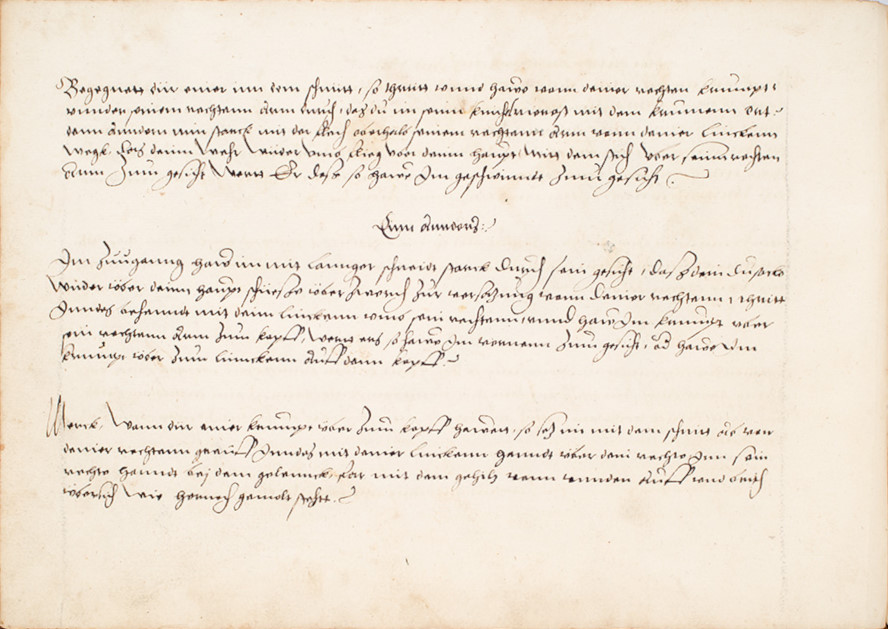
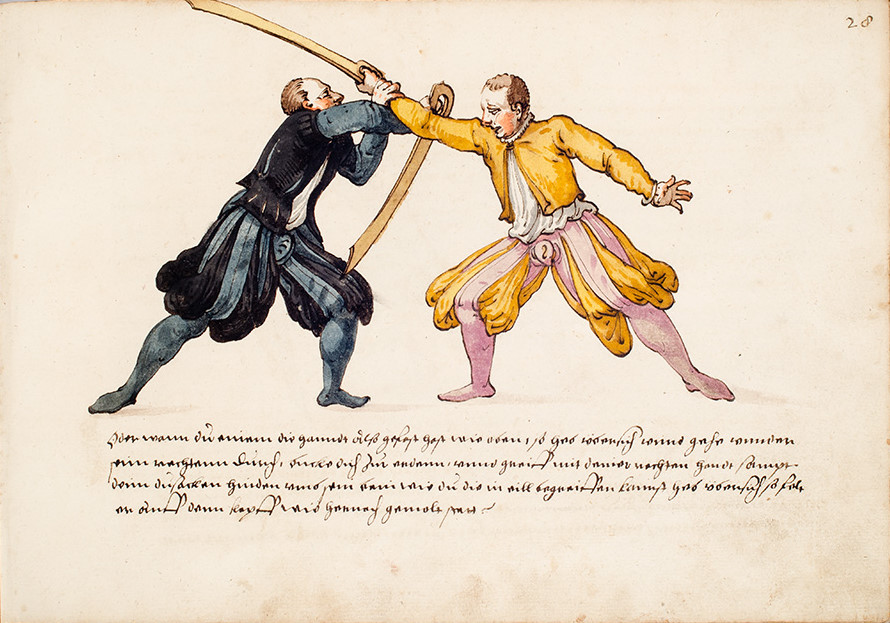
[27] Note: When he cuts Crooked over to your head, then set him off with the slice from your right, Indes grab with your left hand over your right to his right hand by the wrist, drive up with the hilt from under and break above you as depicted hereafter.
Munich Manuscript · fol. 27v.3
[27v.3] Merck, Wann dür einer krumpt über zum kopff hawett, so sez im mit dem schnitt ab von deiner rechtenn greüff Inndes mit deiner Linckenn hanndt über dein rechte, Inn sein rechte hanndt bej dem gelennck, far mit dem gehilz vonn vnnden auff vnd brich übersich wie hernach gemolt stehtt ⁋
27v.3
4.27linked passage
4.28
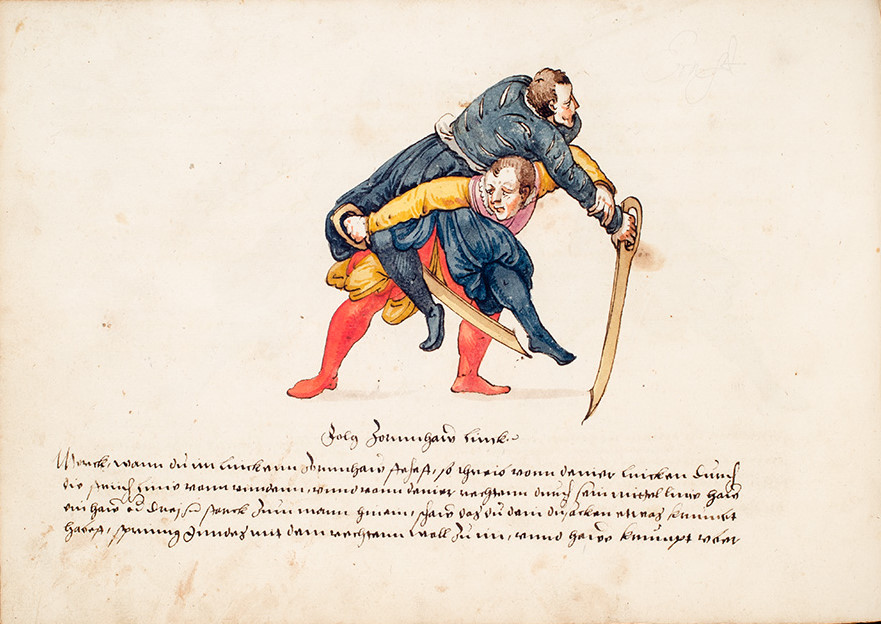
[28] Or when you have caught him by the hand how it is shown above, heave upwards and go through under his right, bend yourself over and grasp with your right hand together with your Dussack behind his leg, and as quick as you can grab him, heave upwards, thus he falls on his head how it is depicted hereafter.
Munich Manuscript · fol. 28r
[28r] Oder wann die einem die hanndt also gefast hast wie oben, so heb übersich vnnd gehe vnnden sein rechtenn durch, bucke dich zur erdenn, vnnd greiff mit deiner rechten handt sampt denn dusacken hinden vmb sein bein wie du die in eill begreiffen kannst heb übersich so felt er auff denn kopff wie hernach gemolt stett ⁋
28r
4.28linked passage
4.29
[29] Follow left Wrath Guard
Note when you are positioned in the left Wrath Guard, then drive up through the strike line from your lower left, and then cut from your right through his middle line, with one to three strikes strongly in at the opponent, see that you have your Dussack somewhat crooked, spring Indes with the right foot well to him, and cut Crooked overhand, and over his displacement to the head, quickly snap Indes back around Crooked below to his arm or face, cut away with a strong Middle Cut, or cut from outside to the right.
Merck, wann du im Linckenn Zornnhaw stehest, so threib vonn deiner Lincken durch die strüch Linie vonn vnndenn, vnnd vonn deiner rechtenn durch sein mittel Linie haw ein haw oder drej ⁋ starck zum mann hinein, schaw das du dein dusacken etwas krumbt habest, sprinng Inndes mit dem rechtenn woll zu im, vnnd hawe krumpt vber [29r.1] vber[!] deinn hanndt, über sein versazung zum kopff, schnap Inndes behenndt wider vmb krumpt vnndenn zum arm oder gesicht, hawe ein starckenn Mittelhaw wegk, oder haw außwenndig zum Rechtenn ⁋
28v29r.1
4.29linked passage
4.30
[30] Item: Drive strongly over your right thigh through to the opponent's face, Indes step with the left foot to him, and take him away from your left so that your weapon shoots around your head, stab him to the right and then cut at once to his left.
Munich Manuscript · fol. 29r.2
[29r.2] Ittem threib über dein rechtenn schennckell dem mann starck durch sein gesicht Indes thritt mit dem Linckenn fus zuu Im, vnnd nim wegk vonn deiner Linckenn das deinn wechr wüder vmb dein haupt schieße, vnnd stich Im zum rechtenn, als baldt haw wüder zuu seiner Linnckenn ⁋
29r.2
4.30linked passage
4.31
[31] Item: If he cuts to your opening, then cut with a Winding Cut over his right arm simultaneously with him, follow then to the next opening.
Munich Manuscript · fol. 29r.3
[29r.3] Ittem hawett dür einer zur Plöß so hawe mit einem Winndhaw über seinen rechtenn arm gleich mit Im hinein, folg als dann zur nechstenn Ploß ⁋
29r.3
4.31linked passage
4.32
[32] Follow the Correct Wrath Cuts
A good Stuck with 6 cuts.
Note: If you are positioned in the right Wrath Guard, then step and cut your first from below through his left, the second also from below through his right, with both of these use the crooked edge. The third from above through his left, the fourth from above through his right, so that your Dussack shoots back again above your head into the Plunge, the fifth is a Middle Cut through his left and the sixth is a High Cut (Scalp).
Merck so du im Rechtenn Zornhaw stehest so thritt vnnd hawe denn erstenn von vnden durch seinn Linnck, denn anndern auch vonn vnndenn durch sein recht alle beidt [29v.1] krumpt gefaßett. Denn drüttenn vonn obenn durch sein Linnck, Denn vierttenn auch vonn obenn durch seinn recht, das dein dusackenn wüder über dein haupt schiesen zum sturz, denn fünfftenn ein mitelhaw, durch seinn Linck den sechstenn ein oberhaw
29r.429v.1
4.32linked passage
4.33
[33] The Wrath together with the Steer are two primarily Earnest Guards to attack from, and have no differences other than the Wrath threatens the cut and the Steer threatens the thrust.
Munich Manuscript · fol. 29v.2
[29v.2] Der Zornnhaw sampt dem stier, sinndt zwej fürnemet Ernnstlicher leger, zum anngreifenn, vnnd habenn kein vnnderscheüdt dann das der zornn denn haw, der stier denn stich drawett ⁋
29v.2
4.33linked passage
4.34
[34] Note firstly when you are positioned in Wrath or Steer on your right, that you ward off what he attacks or cuts, if he cuts at your left side, whether from below or above, then step and cut away his incoming strike close by his hand and cut quickly to his opening or come again thereafter into displacement outside of his right.
Munich Manuscript · fol. 29v.3
[29v.3] Erstlich merck so du im zornn, oder Stier stehest auff deiner rechten zw warttenn des mans Anngreüffenn oder hawenn, hawett Er dür dan deiner Linnckenn zu es sej vnndenn oder obenn zum leib, so thritt vnnd haw im seinn herkummenden streich nach bei seiner hanndt vonn obenn wegck vnnd hawe behenndt der Plöß zu, oder nach, kum baldt wüder In versazung außwenndig seines Rechttenn ⁋
29v.3
4.34linked passage
4.35
[35] Next, if he cuts at your right from outside to your body, whether it is from below or above, then step with your left foot to his right and cut from outside over his right arm to his head or with a Suppressing Cut from above hard to his hand, as soon as it clashes then shove the point in at his face, if he wards this thrust, then cut him to the face or pay attention to when he pulls his arm back into the air, then cut a Roarer to his arm.
Munich Manuscript · fol. 30r.1
[30r.1] Zum anndern hawett dür einer außenn zum leib, zw deiner rehtenn es sej vndenn oder obenn, so thrit mit deim linckenn fuß zu seiner rehtenn vnd hewe vonn außenn über sein Rechtenn arm zum kopff oder mit dempffen hart zur hanndt von oben, Inndes es gliz so schieb im denn ortt Inn sein gesicht wertt er den stost, so hawe Im zum gesicht, oder hab acht wann er sein arm in die lufft ruckt so hawe ein brumer zu seinem arm ⁋
30r.1
4.35linked passage
4.36
[36] However, when he will not cut, then drive over his forward set leg with a fast Driving Cut through his face and with it, you compel him to cut or move, so that you can see your advantage.
Munich Manuscript · fol. 30r.2
[30r.2] Wann er aber nit schlagenn wolt, so treib vber dein linck fürgesezt pein ein geschwindenn threibhaw durch sein gesicht, domit zwingest du Inn eintweder zu schlagenn oder weichenn, damit du dein fortheill ersichest ⁋
30r.2
4.36linked passage
4.37
[37] Item: If you are positioned in right Wrath, then shift (your Dussack) over your head to displace, Indes step in at him with your right and hurl two forceful cuts with the half edge from below and then quickly thereafter a Middle Cut, catch his right arm then with your Dussack.
Munich Manuscript · fol. 30r.3
[30r.3] Ittem so du im rehtenn Zorn stehest, so verschieb über dein haupt zur versazung Inndes thrit mit deim rechtenn zu im, vnnd schlauder vonn der rechtenn vnd lincken zwenn starcken hew mit halber schneidt vonn vnden, vnnd behendt ein mittelhaw darauff, fanng im denn Rechtenn arm mit deim dusackenn ⁋
30r.3
4.37linked passage
4.38
[38] Note In the Zufechten, when he is positioned before you in straight parrying or in Slice, then come in the Side Guard on the left, then first throw the half edge* over his right arm to the face. Then next pull through to his face from below with the long edge, the third is a Middle Cut after from your right, if he wards then throw the cut quickly to the face.
Munich Manuscript · fol. 30v
[30v] Merck, wann dür einer in gerader versazung, oder im schnitt, vor dir stehett, so kum im zufechten in die nebenn hut, auff dein Linck seittenn, würff im die halb schneid vber sein rechtenn arm zum gesicht, Den andern ziege vonn vnden auff mit langer schneidt durch sein gesicht den dritten ein mittelhaw nach, von deiner rechten, wert er den wurff so haw behenndt zum gesicht. ⁋
30v
4.38linked passage
4.39
[39] If he cuts at you when you are in the Side Guard, then take away his strike with your flat from your left, Indes step with your left foot to his right side and thrust over his right arm to his face, then cut quickly after through his face or to the next opening.
Munich Manuscript · fol. 31r.1
[31r.1] hawett aber einer auff dich, wenn du also in der neben hut stehest, so nim den streich vonn deiner linckenn mit der flech hinwegk, Inndes thrit mit deim Lincken fus Auff sein rechte seittenn, vnnd stich im über sein rehten arm zum gesicht, hawe behenndt nach durch das gesicht oder zur nechsten Plöß ⁋
31r.1
4.39linked passage
4.40
[40] Slicing
Note when you are positioned in the straight parrying and he fights to you, then set him off, once he recovers, then follow after him with the Slice onto his arm, and cut him Indes through the face, then let fly to the next opening.
Merck wann du inn gerader versazung stehest vnnd einer ficht dür zu, so seze im ab, als baldt er vmb schlecht, so folge im nach mit dem schnit auff die arm, schneidt Im Inndes durch dz gesicht, las fliegenn zur nechstenn Plöß ⁋
31r.2
4.40linked passage
4.41
[41] Item: When you displace him from your right to his left, as soon as the parry happens or when he has set off, then cut with the short edge from the lower left to his arm, conversely, when you parry from your left to his right then cut with the short edge from your lower right through to his left and then fight to the next opening.
Munich Manuscript · fol. 31r.3
[31r.3] Ittem wann du eim also absezest vonn deiner rechten gegenn seiner linkenn, als baldt der absez Binnt oder er abgeht, so haw mit kurzer vonn deiner lincken vonn vnnden durch die arm, also wenn du von deiner lincken auff sein Rechte absezest so haw mit kurzer schneidt von deiner rehten durch sein linck vonn vndenn als dann ficht zur nechstenn Plöß ⁋
31r.3
4.41linked passage
4.42
[42] Follow several good rules in fighting from the Bow
The first rule: when someone cuts onto your Bow, then step with your left foot behind your right and follow with your right to his left and instantly lift your hilt upwards, so let his stroke shoot off of your weapon and pull the weapon through his face, so that your Dussack flies over your head; step and cut from your left outside and over his right arm. From this rule many agile tricks are increased with deception.
Munich Manuscript · fol. 31v
[31v] Folgenn ettliche gutte Regell aus dem Bogenn zuu Fechtenn ⁋
Die erst regell so dür einer auff dein bogenn hawett, so thritt mit deinem Lincken fuß, hinder dein rechtenn, vnnd folg mit deiner rechten zu seiner Lincken, vnnd heb Indes dein gehiltz übersich, las also sein streich auff deinem wechr abrauschen, vnnd ziege Im dein wechr durch seinn gesicht, das dein dusacke über dein haupt fliege, thrit vnd haw [32r.1] vonn deiner linckenn, vber sein rehten arm außzwendig, aus dieser regell sindt viel behender list zunemmen mit verfierenn ⁋
31v32r.1
4.42linked passage
4.43
[43] The second rule is as follows, when someone cuts at you from above, drive up with the Bow against his strike, then turn his blow away to your left side, thus lift your body well after with your Dussack to your left side, Indes step quickly back to him and cut outside over his right arm, pull the hilt quickly back upwards to you and cut him through his face.
Munich Manuscript · fol. 32r.2
[32r.2] Die annder regell ist also wann dür einer zu hawett vonn obenn, so far mit dem bogenn übersich gegenn seinem streich, wennde im also denn schlag auff dein lincke seittenn ab, gieb gleich mit den leib woll dem dusackenn nach auff dein linck seitten, Inndes thrit behendt wüder zu im, vnnd haw außwendig über sein rehten arm, zuck das gehilz behendt wüder übersich zu dür, vnnd hawe im durh daß gesicht ⁋
32r.2
4.43linked passage
4.44
[44] The third rule is this, if someone cuts at you, then see that he is not too close to you, so that you trust you can avoid his strikes, then pull your weapon upwards to you and yield your forward foot to the rear out from his cut, and thus take his stroke without any parrying, as soon as his stroke has failed toward the ground, then follow after to his opening with a long step toward him, thus many can be reached.
Munich Manuscript · fol. 32r.3
[32r.3] Die drütt regell ist dise, so dür einer zu hawett so merck ob er dür nit zu nache sej dz du im thrauest aus dem schlag zu weichenn, so zuck dein wehr übersich zu dür, vnnd weüch mit dem fordenn fus zu dem hindern auß seim haw, vnnd nim also sein streich mit keiner versazung ann, als baldt sein streich verfelt gegenn der erdenn, so folg im der blöß noch, mit einem langen zu thrit, also ist mancher erlangt wordenn ⁋
32r.3
4.44linked passage
4.45
[45] The fourth rule, note whenever someone strikes on the Weak of your Dussack, then drive up and cut a Roar Cut from your right to his arm.
Munich Manuscript · fol. 32v.1
[32v.1] Die viert Regel, Merck als offt dir einer vff die schwech deines dusecken schlecht so fhar auff vnd haw ein brummerhaw von deiner rechten zum arm
32v.1
4.45linked passage
4.46
[46] Item: If he cuts at you on your Strong, then turn the point upwards against his Dussack and thus turn away his Weak to your right side and cut a Roarer from your left from outside to his arm, or do the flicking. These are four especially good rules that are well to note when fighting in the Bow.
Munich Manuscript · fol. 32v.2
[32v.2] Item hawet dir einer vff die sterck, so wendt die spitz vbersich gegen seinem Dusacken, vnd wende ihm also sein streich ab, vff dein rechte seitten, vnd haw ihm ein brummer von deiner lincken, von aussen zu seinem arm, oder mach die schnellen, das sein vier furnemer gutter regel, die wol zumercken seindt Im bogen zu fechten,
32v.2
4.46linked passage
4.47
[47] Counter to the Bow
Firstly note when someone approaches you in the Bow, then position yourself in the Change on your left, with your right foot forward step and thrust up from below under his parrying to his face or chest, as soon as you find that your point is set towards him, then instantly drive your hilt up before your head and keep your point towards his body, so that he will ward off or strike this, so take heed as soon as he goes up to strike, then step to his left and strike in beside his parry to his face. This technique often works how it has been shown previously in the Bow.
Erstlich merck, wan dir einer Im bogen begegnet so schicke dich In wechsel, zu deiner Lincken den Rechten fuß vor, thrit vnd stich von vnden auff, vnder seiner versatzung zum gesicht oder brust, als baldt du Enthpfindest das dein orth angesetzt ist, so fahr Indes behendt auff mit deinem gehiltz fur das haubt, vnd bleib mit dem orth vff seinem leib, das wirdt er wehren oder schlagen, so hab acht, als baldt er auff geht zum streich, so thrit vff sein Lincke, vnd schlag ihm neben seiner versatzung hinein zum gesicht, disses stuck ist offt angangen, nemlich wie die figur anzeiget, hie fornen Im bogen ⁋
32v.3
4.47linked passage
4.48
[48] Item: If you are a strong man, then come into the Change as before, wrench away his forward Bow up from below with the half edge, cut quickly after to his face.
Munich Manuscript · fol. 33r.1
[33r.1] Item bistu ein starck man, so khum In wechsel wie vor, wisse Im sein furgesetzten bogen mit halber schneidt von vnden vbersich weck, hawe behendt nach zum gesticht.
33r.1
4.48linked passage
4.49
[49] Note when someone wants to wrench your Bow upwards as previously taught, then turn the wrenching away down to your left side with your hilt, instantly cut quickly at the same time as him in to his face with a back-step out from his stroke.
Munich Manuscript · fol. 33r.2
[33r.2] Merck wan dir einer den bogen wil vbersich außreïssen, wie nechst gelernt, so wende ihm den riß ab, auff dein Lincke seitten, mit deinem gehiltz vndersich, hawe Indes behendt mit Ihm gleich hinein zum gesicht mit einem abdritt, auß seinem streich
33r.2
4.49linked passage
4.50
[50] Note however, when he thrusts in to your face under your parrying as has been taught above, then turn away the thrust, thus you open your face, as soon as he cuts to the opening, then drive under his stroke close by his hand between both your hands and thrust your hilt in his face, how it is depicted hereafter.
Munich Manuscript · fol. 33r.3
[33r.3] Merck so dir einer aber zum gesicht sticht vnder deiner versazung hinein wie oben gelertt, so wende den stoß ab, damit blosestu dein gesicht, als baldt er der blöß zu hawet, so vnderfar Im sein streich, nahe bey seiner handt zwischen deine bede hendt, vnd stos ihm das gehiltz In das gesicht wie hernach gemallt sthet. ⁋
33r.3
4.50linked passage
4.51
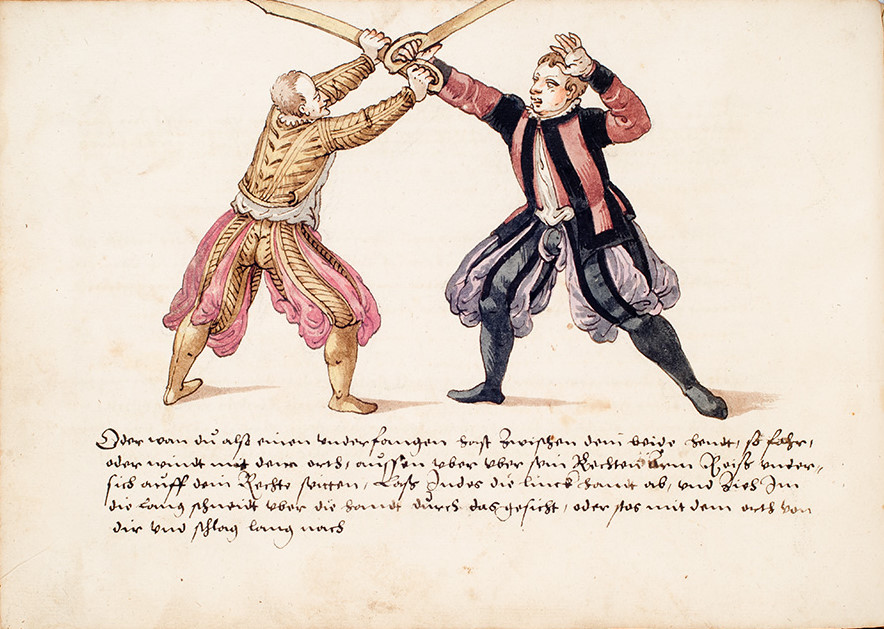
[51] Or when you have captured him from below and between both your hands, then drive or wind with the point outside and over his right arm, wrench downwards to your right side, instantly release with your left hand, pull the long edge over hand through his face, or thrust him with the point away from you and cut long after.
Munich Manuscript · fol. 33v
[33v] Oder wan du also einen vnderfangen hast zwischen dein beide hendt, so fahr, oder windt mit dem orth, aussen vber vber[!] sein Rechten arm Reiß vndersich auff dein Rechte seitten, Laß Indes die lincke handt ab, vnd zieh Im die Lang schneidt vber die handt durch das gesicht, oder stos mit dem orth von dir vnd schlag lang nach
33v
4.51linked passage
4.52
[52] A counter to the Bow with a High Strike
If you find someone in the Bow, then first cut in with a deep High Strike from your right with the half edge over his blade and hands, so that you drive him up high, as soon as he pulls up into watch then cut a Middle Cut through to the face also from your right.
Munich Manuscript · fol. 34r.1
[34r.1] Ein bruch vff denn bogen mit eim überschlag ⁋
Findestu einen im bogenn, so hawe denn erstenn vonn deiner rechten mit halber schneide über die hanndt, über seiner klingen hinein, ein thieffen vberschlag domit threibestu inn auff in die höhe, Inndes er sein wechr auff zeicht so hawe im den anndern durch, ein mittelhaw zum gesicht auch von deiner rehten ⁋
34r.1
4.52linked passage
4.53
[53] Breaking in over the Bow
Note: In the Onset come with your left foot forward, hold your Dussack beside your right, reverse your grip so that you have your Dussack crooked, Indes step, then break in Crooked over his Bow, wrench out downwards to your left, step with your right foot around his right thigh, cut from outside over his right arm high up to the head, the next; cut Crooked under his right arm to his face so that your parrying remains high, the third; forward to the face, or to his left with a step out.
Merck Im zufechtenn kum mit deim Linckenn vor, halt dein dusackenn nebenn deiner rechtenn vmbgreüff dein hanndt hab woll das du dein dusacken krumpt habest, Inndes thrit, brüch, also krumbt über sein bogenn hinein, Reiß vnndersich auff dein Lincke seittenn aus, thrit mit deim rechten vmb sein rechtenn schenkel, schlage also außwenndig über sein rechtenn arm, hoch über zum kopff, denn anndern krump vnnder sein Rechtenn arm zum gesicht das dein versazung hoch pleibt, Denn drittenn fornen zum gesicht, oder zw seiner Linckenn mit eim außthritt ⁋
34r.2
4.53linked passage
4.54
[54] Item: When you strike someone outside over his right arm as has been said above, and he goes high upwards, then step out quickly and cut in Crooked to his face.
Munich Manuscript · fol. 34v.1
[34v.1] Ittem wann du also einem außenn über sein rechtten arm schlechst wie obenm gemelt, vnnd er fert hoch übersich, so thrit behenndt aus vnd haw im krumpt vornen hinein zum gesicht ⁋
34v.1
4.54linked passage
4.55
[55] A Swift Stuck
Item: Reverse your grip so that you have your Dussack crooked how it is reported above, cut then in a springing manner from your right with a High Cut overhand in over his Bow so that in this strike, your right side comes well to his left side, then cut in a flick back around below in to his face so that your haft remains high, quickly cut away short.
Ittem vmbgreiff dein handt habenn, das du dein dusackenn krumb habest wie obenn gemelt, haw also sprungs weis vonn deiner rechten ein hochen streich über die hanndt über sein bogenn hinein das dein rechte seitten woll an sein lincke seittenn kum im schlag, haw in eim schnell wider vmb vnden hinein zum gesicht das dein hefft hoch pleibt haw dich behendt kurtz wegk. ⁋
34v.2
4.55linked passage
4.56
[56] Item: When someone stands in the Bow and allows the point to sink downwards, then step and cut from your right on the Weak of his Dussack from under his arm, so that your Dussack comes out to your left side, instantly take (his Dussack) away with the flat over his arm from your left and cut long after to the opening near by his hand.
Munich Manuscript · fol. 34v.3
[34v.3] Ittem wann einer im bogenn stehett, vnnd lasst den ort vnndersich hangenn, so thrit vnnd haw vonn deiner rechtenn in die schwech seines dusackens widder sein arm durch, das dein dusackenn auff deim Lincke seitten kumpt nim Inndes mit der flech über sein arm wegk, vonn deiner lincken vnd haw lanng nach, der blöß zuu nachett bej seiner hanndt ⁋
34v.3
4.56linked passage
4.57
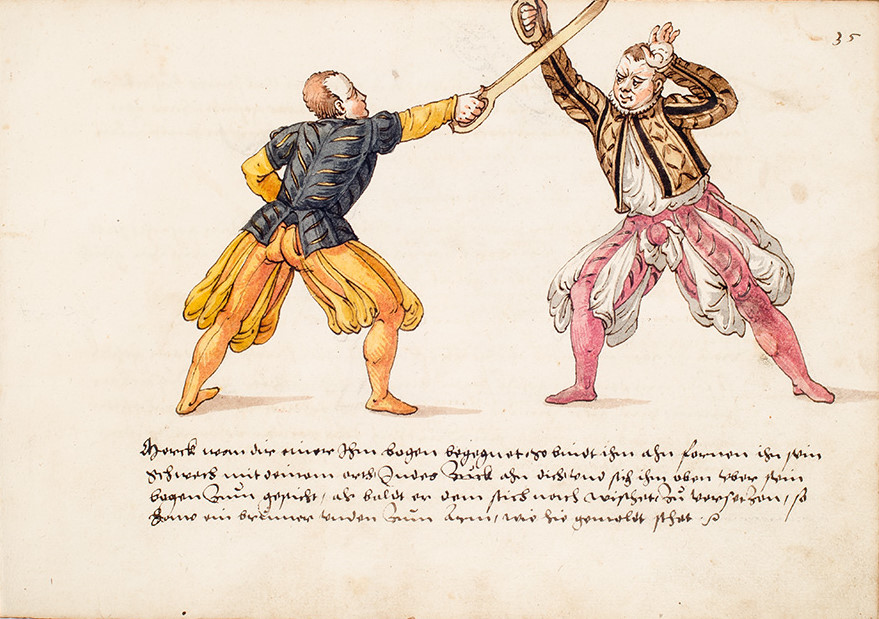
[57] Note: When he approaches you in Bow then bind forward on his Weak with your point, Indes pull back to you and thrust him high to the face over his Bow, as soon as he goes to parry your thrust, then cut a Roar Cut down to his arm, how you see depicted here.
Munich Manuscript · fol. 35r
[35r] Merck wan dir einer Ihm bogen begegnet, So bindt ihm ahn fornen ihn sein Schwech mit deinem orth Indes Zuck ahn dich, vnd stich ihm oben vber sein bogen zum gesicht, als baldt er dem stich nach wischet, zu versetzen, so haw ein brumer vnden zum arm, wie hie gemaldt sthet. ⁋
35r
4.57linked passage
4.58
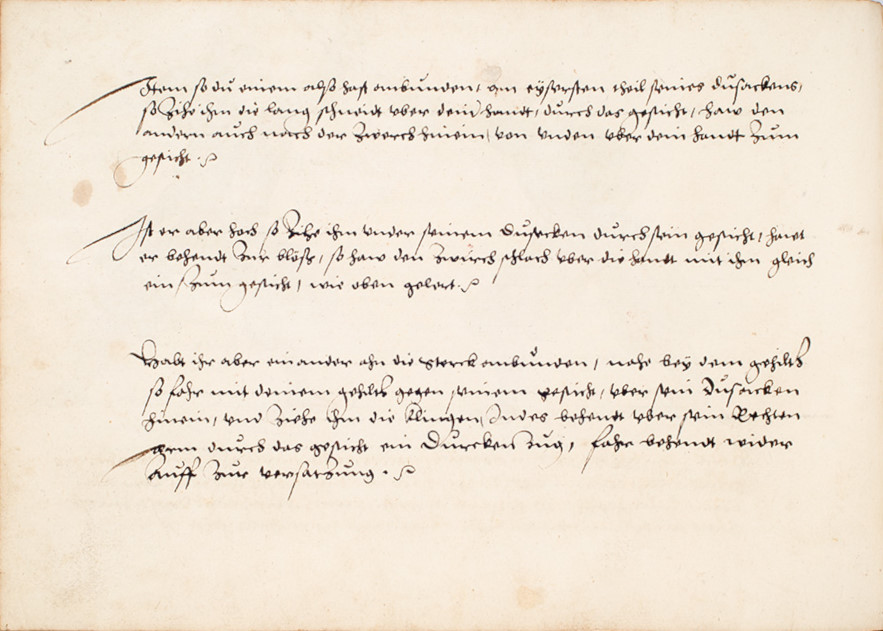
[58] Item: If you have bound on to the first part of his Dussack, then pull the long edge through his face overhand, then cut in after with another [Thwart] horizontal from below to his face.
Munich Manuscript · fol. 35v.1
[35v.1] Item so du einem also hast anbunden, an eysersten theil seines dusackens, so zihe ihm die lang schneidt vber deiner handt, durch das gesicht, haw den andern auch nach der Zwerch hinein, von vnder vber dein handt zum gesicht. ⁋
35v.1
4.58linked passage
4.59
[59] However, if he is high, then draw through his face from below, if he cuts quickly to your opening, then cut the Thwart overhand simultaneously with him to his face, how it is taught above.
Munich Manuscript · fol. 35v.2
[35v.2] Ist er aber hoch so zihe ihm vnder seinem Dusecken durch sein gesicht, hawt er behendt zur blöß, so haw den zwurch schlach vber die handt mit ihm gleich ein, zum gesicht, wie oben gelert. ⁋
35v.2
4.59linked passage
4.60
[60] However, if you have bound with someone on the Strong, near by his hilt, then drive in over his Dussack, with your hilt to his face, and Indes draw the blade over his right arm through the face with a Turkish Cut drive quickly out again to the parrying.
Munich Manuscript · fol. 35v.3
[35v.3] Habt ihr aber ein ander ahn die Sterck anbunden, nahe bey dem gehiltz so fahr mit deinem gehiltz gegen seinem gesicht, vber sein Dusacken hinein, vnd ziehe ihm die klingen, Indes behendt vber sein Rechten arm durch das gesicht ein Durcken zug, fahr behendt wider auff zur versatzung. ⁋
35v.3
4.60linked passage
4.61
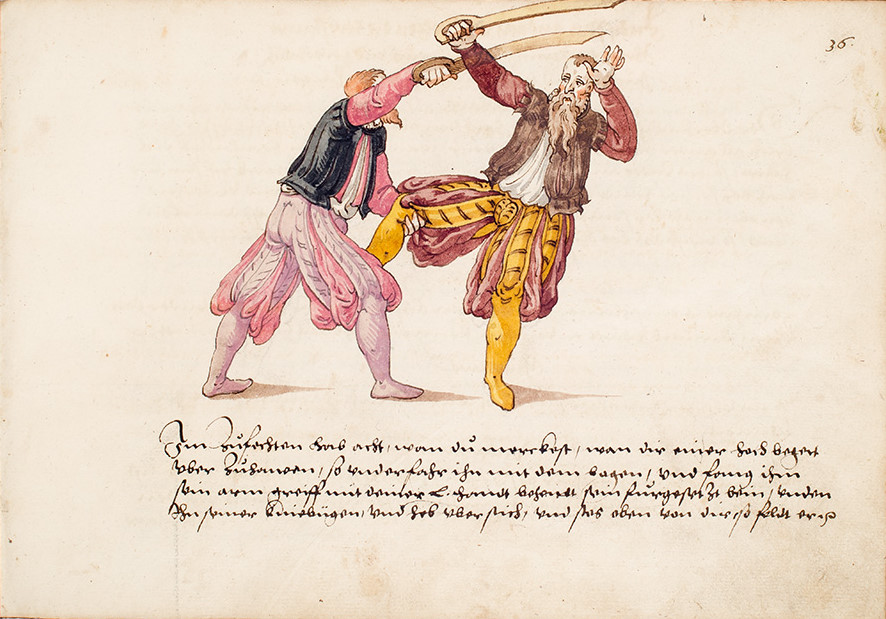
[61] In Zufechten pay attention and when you note that one desires to cut in high over at you, so then drive under it with the Bow and capture his arm then grab with your left hand quickly to the crook of his knee on his forward most leg, and heave upwards then push up away from you, thus he falls.
Munich Manuscript · fol. 36r
[36r] Im Zufechten hab acht, wan du merckest, wan dir einer hoch begert vber zuhawen, so vnderfahr ihn mit dem bogen, vnd fang ihm sein arm greiff mit deiner Lincken handt behendt sein furgesetzt bein, vnden Ihn seiner kniebügen, vnd heb vber sich, vnd stos oben von dir, so feldt er ⁋